
The legal importance of the Ford Bronco Sport and Maverick recall sequence begins with the remedy, not the defect label. In April 2024, Ford recalled certain Bronco Sport and Maverick vehicles for a loss-of-drive-power risk tied to 12-volt battery internal weld and cast-on-strap failures, and the stated repair was a software recalibration rather than replacement of the battery itself.[1] Nine months later, the same problem area returned in a more concrete form: a January 2025 battery replacement recall. That movement from software management to physical component replacement is the fact pattern that gives the later litigation its shape.
A software remedy can be perfectly lawful when it addresses the safety risk the manufacturer has identified. It becomes more legally exposed when later events suggest the software may have managed symptoms while the disputed component remained in service. That is the hinge in this Ford Bronco Sport and Maverick recall analysis: the April 2024 recall is not being viewed in isolation, and neither is the January 2025 battery replacement. Plaintiffs now have a sequence they can argue from.
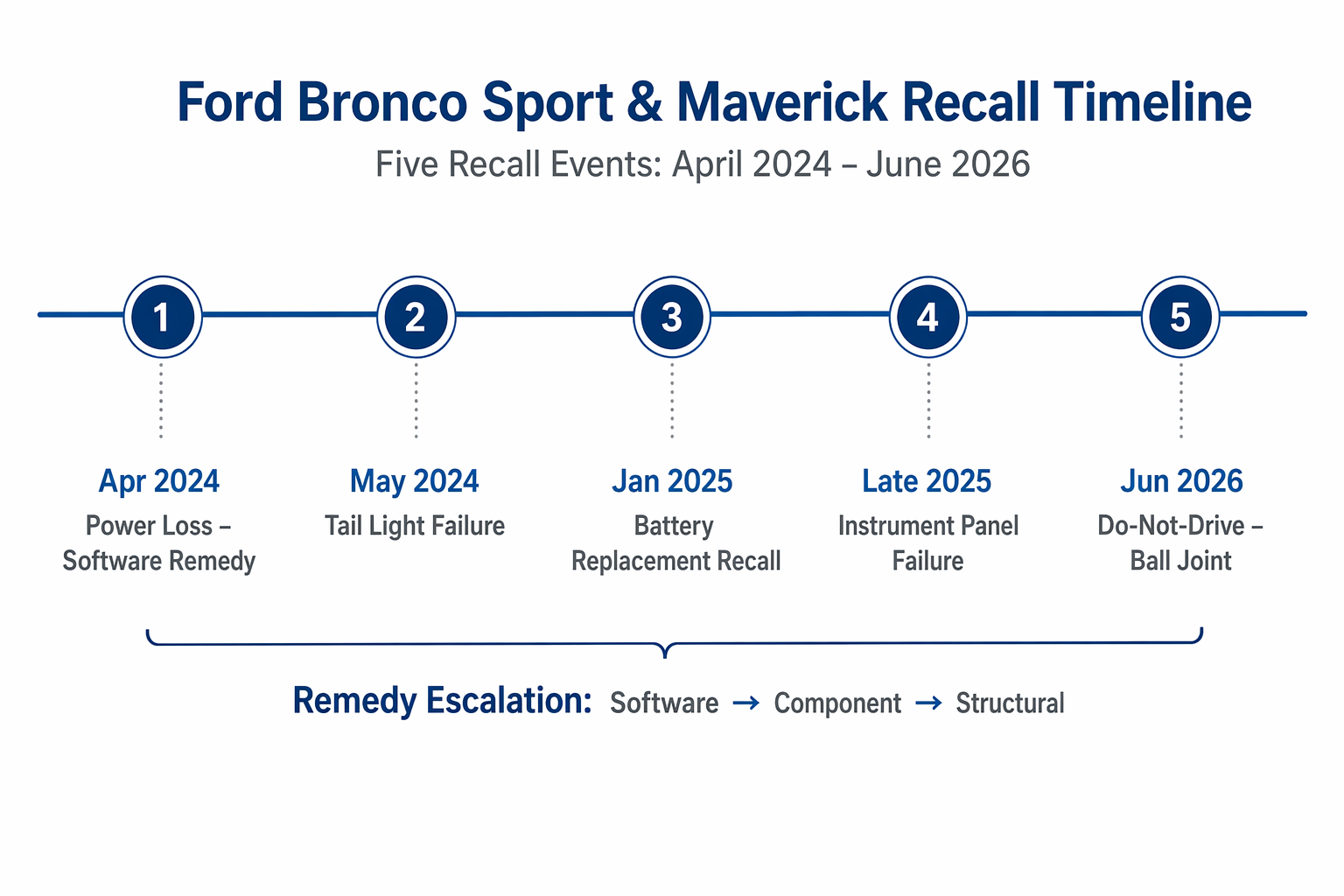
The Recall Cascade That Changed the Posture
The April 2024 action, identified by Ford as recall 24S24, covered a potential loss of motive power caused by internal 12-volt battery failures. Ford’s public recall materials described the remedy as a body control module and powertrain control module calibration update intended to improve detection and warning behavior if the battery state deteriorated.[1] Consumer Reports separately described the affected population as including 2021–2024 Bronco Sport and 2022–2023 Maverick vehicles, reinforcing that this was not a narrow, one-model anomaly.[2]
The legal problem with that first remedy is not merely that it was software. The problem is that the alleged failure mode was physical: internal weld or cast-on-strap problems inside the 12-volt battery. A calibration update may reduce the danger of an unexpected stall, change warnings, or alter vehicle behavior, but it does not itself replace a battery alleged to contain a manufacturing defect. That distinction is exactly where recall compliance and warranty litigation begin to diverge.
The sequence then widened. In May 2024, Ford issued a tail-light-related recall for certain Bronco Sport and Maverick vehicles, identified as NHTSA recall 24V684. That action belongs in the chronology because it adds to the owner-facing safety history for overlapping vehicle lines, but it should not be collapsed into the battery theory. A lighting defect, without more, does not prove an electrical power-loss defect. Its legal relevance is cumulative governance pressure, not proof of a common root cause.
The January 2025 recall, identified as 25V019, is more central. It supplied the physical replacement step missing from the April 2024 repair path. For plaintiffs, that later battery replacement can be pleaded as practical evidence that the earlier remedy was incomplete. For Ford, it can be framed as a subsequent safety action responding to updated information. Both arguments are available; neither should be treated as adjudicated fact.
| Timing | Safety Action | Legal Significance |
|---|---|---|
| April 2024 | Recall 24S24: power-loss risk tied to 12V battery internal weld/cast-on-strap failures; software recalibration remedy | Creates the first remedy-adequacy issue because the fix did not physically replace the disputed battery component |
| May 2024 | Recall 24V684: tail light failure | Adds to the overlapping safety-action history but should not be treated as proof of the battery defect |
| January 2025 | Recall 25V019: battery replacement | Gives plaintiffs a stronger chronology for arguing that software-only remediation was insufficient |
| Late 2025 | Instrument panel failure recall described in available source materials | Extends the safety-action pattern into driver-information systems, with details requiring further source verification |
| June 2026 | Recall 26S36 / 26V340: Do-Not-Drive suspension ball-joint risk | Raises the severity of the cascade while remaining analytically distinct from the battery cases |
Late 2025 added an instrument panel failure recall to the reported sequence. That development matters because failures affecting driver information can produce safety and warranty consequences even when they are not mechanically connected to the battery issue. The available source record does not support treating the instrument panel action as part of the same root defect, so the safer legal reading is narrower: another recall in the same model ecosystem, relevant to pattern and oversight, not necessarily causation.
The June 2026 development is more severe. Ford issued a Do-Not-Drive recall identified as 26S36 / 26V340, concerning suspension ball-joint separation risk in affected Bronco Sport and Maverick vehicles. Reporting described it as the most urgent safety action in this sequence, and because it arrived only weeks before the current Q3 2026 posture, remedy logistics and owner-notification details may still be developing.[3]
The Consent Order Is Context, Not the Battery Case
The November 2024 NHTSA consent order deserves attention, but for a precise reason. NHTSA announced a $165 million civil penalty against Ford over delayed rearview-camera recalls, describing it as the second-largest civil penalty in the agency’s history.[4] That penalty was not imposed because of the Bronco Sport and Maverick battery, lighting, instrument panel, or ball-joint recalls. Treating it as if it were would blur the record.
It is still not irrelevant. The consent order required independent third-party oversight, VIN-level component traceability, and a three-year lookback at prior recalls.[4] Those obligations change the governance setting in which later recall adequacy disputes are evaluated. A plaintiff does not need the consent order to prove a defective battery, but the order makes recall timing, traceability, and escalation practices harder to dismiss as purely internal housekeeping.
That is the careful middle ground. The order is not evidence that Ford violated the law in the Bronco Sport and Maverick recalls. It is evidence that NHTSA had already imposed enhanced compliance obligations on Ford in the same broad period, after finding delayed recall compliance in a different defect context. For product liability lawyers and in-house counsel, that distinction matters because governance facts often migrate between regulatory and civil files without becoming the same claim.
Where the Class Actions Draw Their Strength
The Benson and Ortega class actions are the point at which recall chronology becomes pleaded legal theory. According to secondary summaries, Benson v. Ford Motor Co. and Camel Group Battery was filed in the Eastern District of Pennsylvania in February 2025, and Ortega v. Ford Motor Co. and Camel Group Battery was filed in the Northern District of Illinois in May 2025.[5][6] The summaries report that both suits challenge the adequacy of Ford’s recall response and allege that the remedy failed to address the root manufacturing defect in Camel-supplied batteries.[5][6]
Those allegations remain allegations. The available account relies on ClassAction.org and CarComplaints.com summaries rather than verified PACER complaints, so docket-level details should be checked before anyone treats the pleadings as final litigation records. Still, the reported theory is coherent: if the defect is alleged to arise from the internal battery construction, then a software recalibration can be attacked as a temporary management tool rather than a complete repair.
The suits reportedly assert claims including Magnuson-Moss Warranty Act violations, state consumer fraud, breach of warranty, unjust enrichment, and negligence.[5][6] The first three are the core of the class-action exposure. Negligence and unjust enrichment may matter, but the recall history is most naturally converted into classwide arguments through representations, warranty obligations, and the adequacy of the repair process.
Magnuson-Moss Turns on the Warranty Consequence of the Remedy
The Magnuson-Moss theory is not simply that a recall occurred. Recalls happen without necessarily creating federal warranty liability. The stronger claim is that owners allegedly received a vehicle with a covered defect, were offered a remedy that did not cure the underlying condition, and then faced continued impairment, diminished value, or repeat service consequences. The January 2025 battery replacement is therefore important because it gives plaintiffs an answer to the obvious defense question: if the April 2024 software remedy was adequate, why did the later physical battery replacement become necessary?
Consumer Fraud Requires More Than a Bad Repair
State consumer fraud claims need a different kind of proof. A defective component and an imperfect recall may not be enough. Plaintiffs generally need to connect the recall sequence to allegedly deceptive omissions, misrepresentations, or unfair practices under the relevant state statutes. That is where timing becomes valuable: the April 2024 recall, the November 2024 compliance backdrop, and the January 2025 replacement action can be used to argue what Ford knew, when it knew it, and whether owner-facing communications kept pace with the practical defect theory.
Warranty Claims Bridge the Defect and the Repair File
Breach of express and implied warranty claims sit closer to the service lane. They ask whether the vehicles conformed to Ford’s promises and ordinary expectations, and whether Ford’s repair response restored that conformity. The battery sequence helps plaintiffs because it is concrete: an allegedly defective battery construction, an initial non-replacement remedy, and then a later replacement recall. Ford will have its own arguments about evolving technical understanding, recall compliance, and the difference between safety-risk mitigation and warranty breach. But the pleaded bridge is not speculative; it runs through the repair chronology.
Lemon Law Exposure Is Real but Less Uniform
State lemon law exposure is harder to generalize. It may be significant for individual owners who experienced repeated repair attempts, substantial impairment, or extended out-of-service time. But those claims turn heavily on state law, purchase timing, mileage, repair history, and notice. The recall cascade can supply context, especially if an owner’s repair file tracks the same battery or electrical symptoms. It does not automatically create a uniform lemon law outcome across every recalled vehicle.
Federal Enforcement Pressure Works Differently
Federal regulatory exposure under the National Traffic and Motor Vehicle Safety Act is not the same as civil warranty exposure. NHTSA’s concern is whether the manufacturer timely identifies safety defects, files appropriate recall reports, provides adequate remedies, communicates properly with owners and dealers, and complies with oversight obligations. The November 2024 consent order shows that, at least in the rearview-camera context, NHTSA was willing to impose a major penalty and structural compliance requirements on Ford.[4]
For the Bronco Sport and Maverick sequence, the regulatory questions would be narrower and fact-dependent: when Ford identified the battery failure risk; why the April 2024 remedy was selected; what changed before the January 2025 replacement action; how affected VINs and components were traced; and whether owner communications matched the safety risk as understood at each point. The consent order’s lookback and oversight provisions make those questions more consequential, even though they arose from a separate rearview-camera matter.
That is also why the June 2026 Do-Not-Drive recall matters without being folded into the battery case. A Do-Not-Drive instruction is a high-severity remedy posture. It may indicate prompt escalation once the ball-joint risk was identified, or it may invite scrutiny into how long the condition was known and what interim instructions were given. The current public record does not answer those questions. It does show that, by mid-2026, Ford’s Bronco Sport and Maverick recall history had become broader than a single disputed battery repair.
What Can Be Concluded Now
The strongest present conclusion is about compounded exposure, not proven liability. Ford faces a recall history that different legal actors can use in different ways. Regulators can focus on timeliness, traceability, reporting, and remedy adequacy. Class-action plaintiffs can focus on the battery sequence and argue that the April 2024 software remedy did not cure the alleged root defect. Warranty claimants can point to repair history and continued vehicle impairment. Individual owners may pursue lemon law theories where their state-law facts support them.
The facts should not be overstated. The tail-light, instrument-panel, battery, and ball-joint recalls should not be treated as one proven systemic defect. The NHTSA consent order should not be described as punishment for the Bronco Sport and Maverick recalls. The Benson and Ortega complaints should not be treated as established findings, especially while the available account rests on secondary summaries rather than verified docket filings.
But the recall cascade has changed the practical litigation posture. A single software remedy can be defended as targeted risk mitigation. A software remedy followed by a component replacement, followed by class actions alleging root-defect non-repair, in the shadow of a consent order requiring enhanced recall oversight, is harder to keep in a narrow compliance box. Ford’s exposure is compounded because the same sequence can now be used differently by regulators, class-action plaintiffs, warranty claimants, and individual owners.
References
- Safety Recall 24S24, Ford
- Ford recalls Bronco Sport, Maverick SUVs and pickups because they could lose power, Consumer Reports
- Ford recalls Bronco Sport, Maverick vehicles over ball joint issue, The Detroit News
- NHTSA announces consent order with Ford, including $165 million civil penalty, National Highway Traffic Safety Administration, November 2024
- Ford Bronco Sport, Maverick Battery Class Action Lawsuit, ClassAction.org, February 2025
- Ford Bronco Sport and Maverick Battery Lawsuit, CarComplaints.com, May 2025
Comments
Join the discussion with an anonymous comment.