
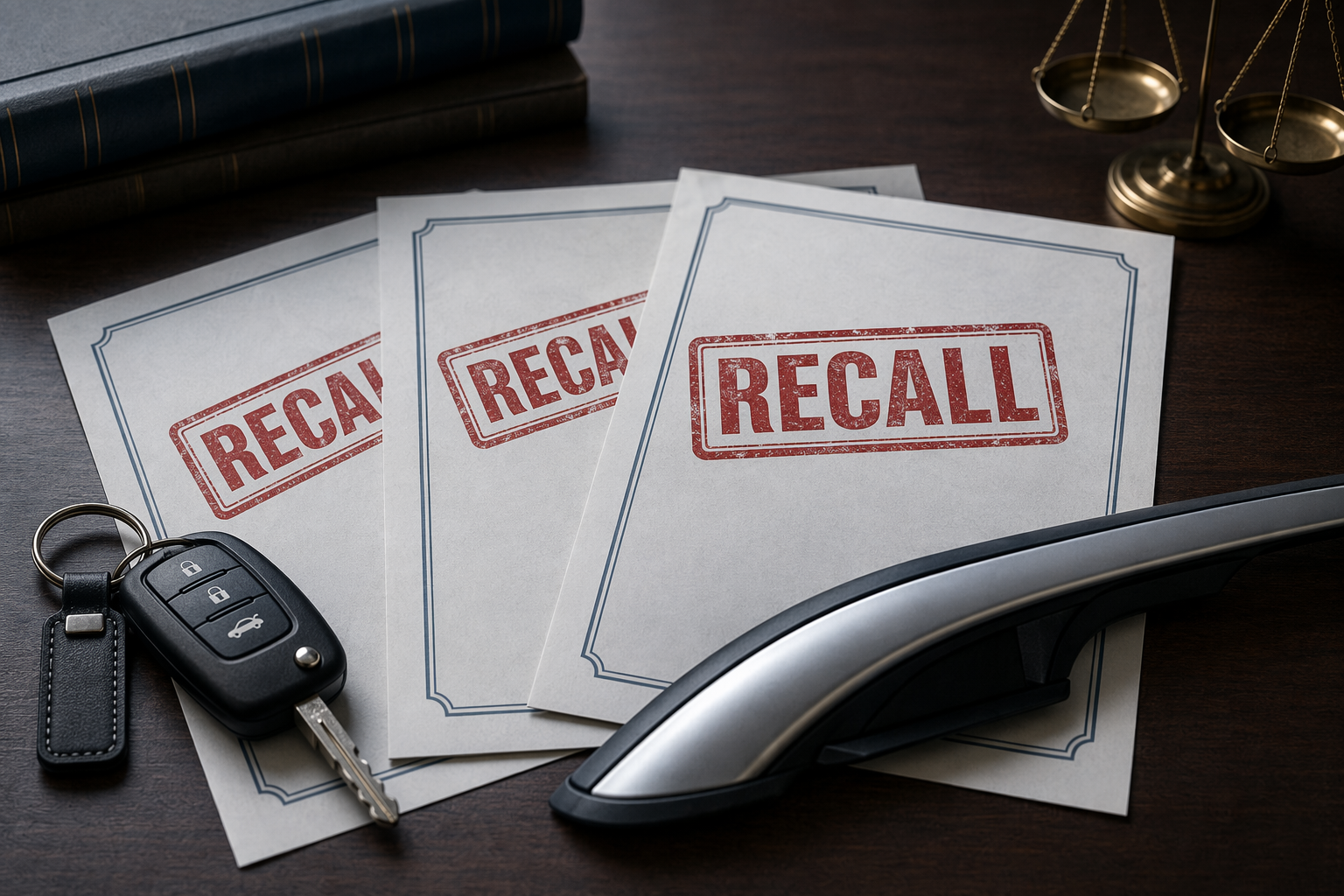
Ford's latest Explorer roof rail cover recall is not legally interesting because a trim part can come loose. It is interesting because Ford is recalling the same population again after a prior glue-based remedy did not reliably hold. For attorneys evaluating legal options after the Ford Explorer roof rail cover recall, the file now starts with a failed official repair, not merely an alleged defect.
The July 17, 2026 recall, NHTSA 26V448 and Ford 26S54, covers 288,314 model-year 2016-2019 Ford Explorer vehicles. Reporting based on the recall materials puts the estimated defect rate at 1%, with owner notification letters expected in August 2026 and remedy letters expected in September 2026.[1] Those numbers matter, but the sequence matters more: Ford first used a warranty-extension program, then a formal safety recall, and now a third campaign aimed at vehicles already repaired under the earlier programs.
Ford's earlier remedy used epoxy adhesive. The 2026 recall changes the repair to a mechanical push-pin approach, reportedly using eight push pins per vehicle. Ford also acknowledged that the adhesive remedy was technician-sensitive: damaged retention clips could be left in place, or adhesive quantities could be applied incorrectly.[2] That detail is not cosmetic. In a warranty or consumer-protection file, a remedy that depends heavily on field execution invites questions about whether the manufacturer offered a meaningful cure or merely shifted failure risk to dealership implementation.
The Timeline Is the Legal Spine
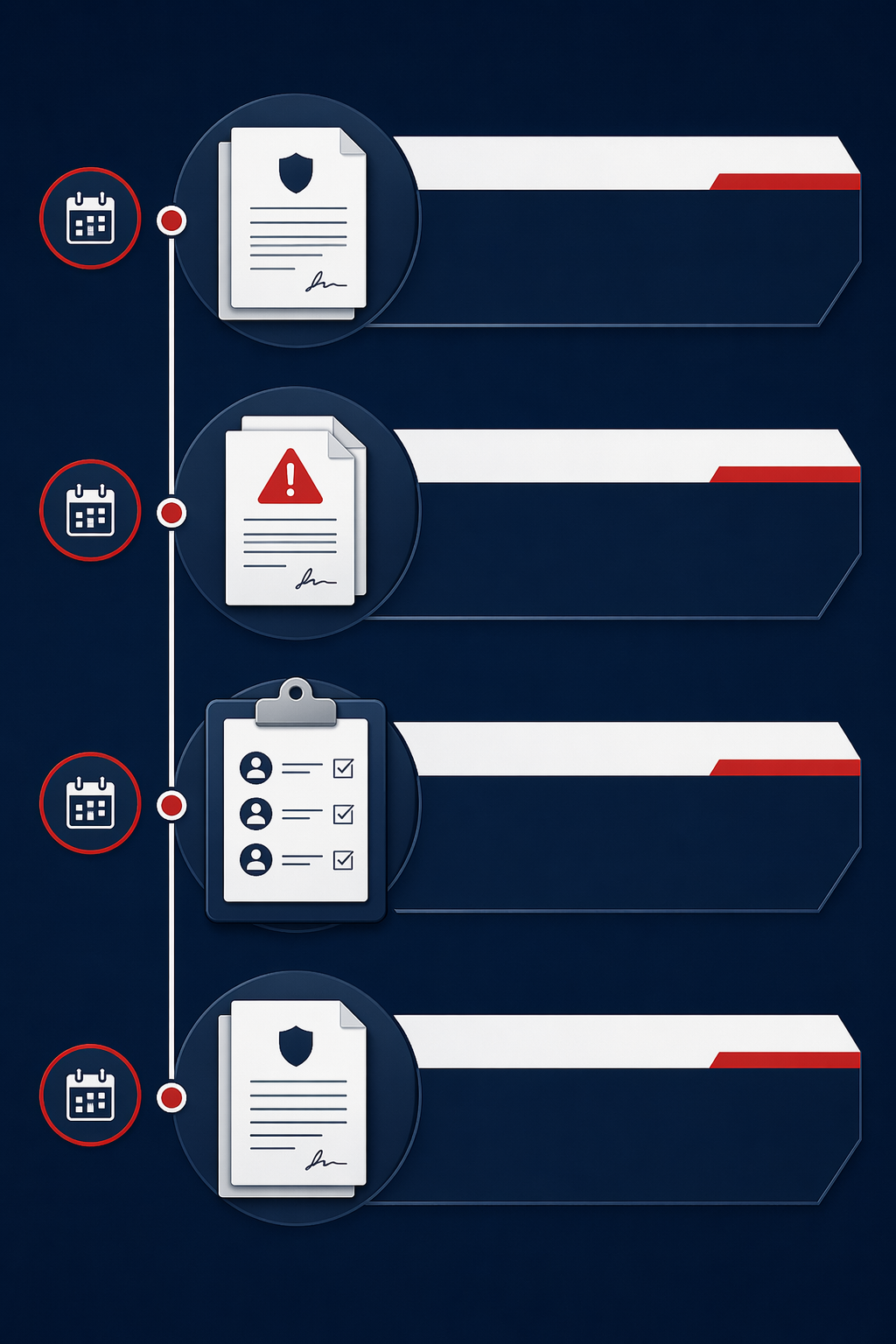
A clean chronology does more work here than adjectives. The roof rail cover issue moved through three materially different stages: a 2020 Customer Satisfaction Program, a 2021 safety recall, and a 2026 recall after owner reports pushed the defect back into regulatory view.
| Date | Action | Legal Significance |
|---|---|---|
| 2020 | Ford issued 20N11, a Customer Satisfaction Program and voluntary warranty extension. | The first repair opportunity may become part of the repair-attempt record, depending on state law and the owner's documents. |
| May 2021 | NHTSA ODI activity led to recall 21V316 / Ford 21S22, covering 661,000 Explorer SUVs. | The issue moved from service accommodation to formal safety recall territory.[3] |
| March 2026 | ODI received 46 Vehicle Owner Questionnaires about vehicles previously repaired. | The post-remedy complaint record helped reopen scrutiny of a supposedly resolved campaign.[4] |
| July 17, 2026 | NHTSA 26V448 / Ford 26S54 covered 288,314 vehicles previously repaired under earlier programs. | The new remedy changed from epoxy adhesive to mechanical fastening.[1][2] |
The 2021 recall was already substantial. Consumer Reports described Ford's recall of Explorer SUVs over roof rail concerns, and contemporaneous coverage put the campaign at 661,000 vehicles.[3] But the 2026 file is different in kind. It concerns vehicles that had already passed through an earlier remedy channel and still generated enough owner questionnaires for ODI to revisit the matter.
BizzyCar's account of the July 2026 recall ties Ford's Field Review Committee approval to ODI's review of 46 Vehicle Owner Questionnaires, and reports that Ford acknowledged one alleged accident involving a roof rail cover detachment on a vehicle that had received the epoxy repair.[4] A single alleged accident is not a statistical showing. It is, however, a litigation-relevant fact when paired with a failed recall remedy and a changed repair design.
Why the Failed Epoxy Fix Changes the Warranty Analysis
The roof rail cover label can make the dispute look small. The remedial history makes it larger. A manufacturer that offers a recall repair represents, at minimum, that the repair will address the safety defect identified in the campaign. When the same vehicles are recalled again because that remedy failed in field conditions, the warranty analysis no longer turns only on whether the original part was defective. It turns on whether the promised repair was adequate, properly performed, and durable enough to satisfy the obligation that brought the owner back to the dealership.
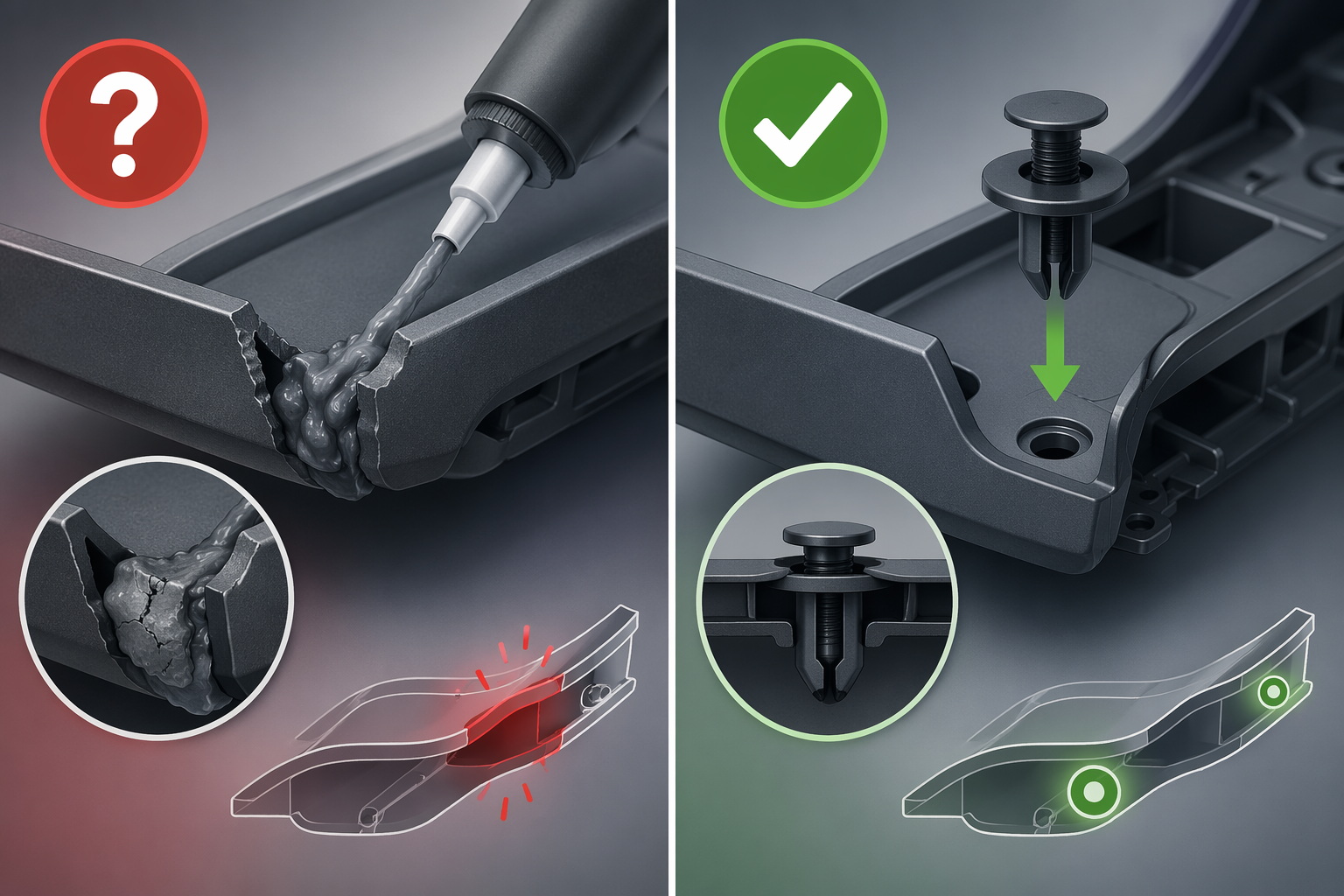
The technician-sensitive nature of the epoxy repair also complicates Ford's likely defenses. If a dealership failed to replace damaged retention clips or used the wrong adhesive amount, Ford may frame the case as poor service execution rather than a design-level remedy failure. Plaintiffs will answer that a safety recall remedy must work in the real service network Ford chose to use. The move to eight mechanical push pins gives that argument a concrete comparison point: Ford did not merely repeat the adhesive instruction; it changed the way the trim is retained.[2]
For intake purposes, the distinction is practical. Attorneys need the repair order, not just the recall notice. The useful record will show when 20N11 or 21S22 work was performed, what parts and materials were used, whether clips were noted as damaged or replaced, whether the owner later complained of looseness, noise, detachment, or inspection failure, and whether the vehicle now falls inside the 26S54 population.
Lemon Law Claims: Possible, but Not Automatic
The third recall will tempt some consumer-facing commentary into broad buyback language. That is where attorneys should slow down. Existing lemon law commentary recognizes that recall repair attempts can count toward the reasonable-number-of-repair-attempts analysis, but state-specific screening remains essential.[5][6] A failed Ford recall repair may help an owner; it does not erase delivery-date limits, mileage caps, notice requirements, or limitation periods.
The first screening question is whether the vehicle is still within the state's lemon law coverage window. Many state lemon laws are built around early ownership periods, often measured from delivery and sometimes also tied to mileage. The research materials support the general warning that state limitation periods are commonly short, often in the one-to-two-year range from delivery, but they do not support a state-by-state eligibility conclusion for any particular Explorer owner. A 2016-2019 vehicle presented in 2026 may face a timing problem unless the jurisdiction has a longer limitations theory, a tolling argument, a continuing warranty hook, or a separate statutory route.
The second question is whether the repair history satisfies the applicable threshold. Some states use presumptions tied to repeated unsuccessful repairs; others include out-of-service days or serious safety defects with fewer attempts. A roof rail cover that can detach while driving has a safety dimension, but counsel still needs to match the file to the statute rather than assume that a recall label supplies the missing elements.
A plaintiff-side file becomes stronger when the owner complied with Ford's earlier remedy and then experienced the same condition again. It becomes weaker when the only fact is that the VIN appears in the recall population and no failed repair, symptom, or post-repair inspection problem is documented. The law may count recall work as a repair attempt; proof still has to show an attempt on that vehicle.
What a Lemon Law Intake Should Capture
- Purchase or lease date, delivery state, current registration state, and mileage at each relevant repair.
- Whether the vehicle received 20N11 work, 21S22 work, or both, with repair orders rather than owner memory alone.
- The post-repair condition: loosened cover, detached cover, dealer inspection finding, noise complaint, or repeat service visit.
- Any days out of service and whether the owner received a loaner, rental, or delayed appointment.
- State-specific pre-suit notice, manufacturer arbitration, and limitations requirements.
The legal value of the third recall is strongest as evidence that the prior remedy did not reliably cure the condition. It is not, by itself, a substitute for the statutory elements of a lemon law claim.
Magnuson-Moss May Be the Cleaner Warranty Path
For many 2016-2019 Explorer owners, the Magnuson-Moss Warranty Act may deserve at least as much attention as state lemon law. The theory is not that every recall creates a federal warranty claim. The more focused theory is that Ford offered warranty or recall repairs for a covered condition, the owner submitted the vehicle for that repair, and the repair did not cure the defect.
That framing matters for older vehicles. Lemon law windows may have closed for many model-year 2016-2019 owners. Magnuson-Moss claims are generally analyzed through written and implied warranty obligations, with a four-year limitations period commonly discussed in warranty practice. The precise accrual date and available tolling theories still require state-law analysis because Magnuson-Moss borrows heavily from underlying state warranty law.
The 20N11 warranty extension is especially relevant here because it preceded the formal 2021 recall. Counsel should ask whether Ford's extension created or modified an enforceable written warranty obligation for the roof rail cover repair, whether the owner obtained service within that program, and whether the later failure can be pleaded as breach of that repair undertaking. The answer may vary by jurisdiction and by the actual documents Ford supplied to the owner.
Magnuson-Moss also may fit owners who cannot show enough repeat repair visits for lemon law presumptions but can show a failed promised cure. A single defective recall repair will not always support damages worth litigating individually. But when the same defect has a documented campaign history and the manufacturer later adopts a different remedy, the breach theory is no longer speculative in the way it would be if based only on isolated dissatisfaction after service.
Product Liability Turns on Harm, Not Irritation
A detached roof rail cover can create road hazard and injury-risk allegations, but product liability analysis should not be inflated to cover every owner in the recall population. The better product-liability file involves an actual detachment, near miss, property damage, crash allegation, bodily injury, or a documented safety event tied to the part separating after prior repair.
The reported alleged accident involving an epoxy-repaired vehicle is important because it connects the legal issue to remedy failure, not just original design.[4] Still, one alleged accident does not establish frequency. It is a warning flag for case screening and discovery, not a shortcut around causation, defect, damages, or expert proof.
Attorneys already tracking recall-driven product-liability exposure may find useful parallels in the site's analysis of Ford 2016-2019 recall risk and its coverage of Hyundai Kona recall product liability. Those comparisons are useful only to the extent they keep the same discipline: identify the defect, the remedial history, the injury mechanism, and the proof gap.
Diminished Value Is Plausible, but Proof-Heavy
A three-campaign history on the same roof rail cover defect gives diminished-value claims a plausible factual foundation. The argument is straightforward: a buyer or appraiser may discount a vehicle with a known repeat safety recall and a prior failed adhesive repair, particularly if the vehicle has not yet received the push-pin remedy or has a documented post-repair symptom.
The proof problem is equally straightforward. Diminished value needs more than the existence of a recall. Counsel would need a defensible valuation method, comparable sales or appraisal evidence, and a way to separate roof-rail-related loss from ordinary depreciation in older 2016-2019 vehicles. The claim may be more attractive as part of a broader warranty or consumer-protection case than as a standalone individual action.
The Class Action Posture Is Open, Not Obvious
As of July 2026, searches reflected no class action specifically targeting the Ford Explorer roof rail cover defect.[7] That absence is worth noting. It may indicate an early-mover opportunity for counsel prepared to plead a tight warranty, consumer-protection, or diminished-value theory. It may also indicate that earlier screening has exposed problems: older model years, varied repair histories, limited individual damages, arbitration issues, state-law variation, or difficulty showing a common post-repair failure mechanism.
The class theory with the best chance of coherence would likely focus on owners whose vehicles received the epoxy remedy and were later included in the 2026 recall. That narrower group aligns the common question with the alleged failed remedy. A broader class of all 2016-2019 Explorer owners may have more trouble because some vehicles may never have received the earlier repair, never manifested symptoms, or may already have been sold without measurable loss.
Counsel considering a class case should resist treating the 288,314-vehicle recall scope as a damages model. Recall population is not equivalent to injured class membership. The useful class questions are narrower: who received the adhesive remedy, what Ford knew about technician sensitivity, whether repair instructions were adequate, whether the mechanical push-pin campaign implicitly admits the prior cure was insufficient, and whether common proof can show economic loss.
For broader Ford recall-litigation context, the site's prior work on Ford Bronco Sport and Maverick legal liability and the Ford Expedition seat belt recall shows how quickly recall facts can become litigation facts when remedy design, regulatory oversight, and owner records intersect.
The ODI Questionnaires Matter More Than Owner Anger
Owner frustration is unsurprising after repeat recall work. In pleadings and demand letters, however, frustration rarely carries the file. The more durable fact is that ODI received 46 Vehicle Owner Questionnaires about vehicles previously repaired, and the issue progressed to a new Ford Field Review Committee-approved recall.[4] That is a regulatory signal that the prior campaign did not close the safety question.
Those questionnaires also give counsel a discovery roadmap. They point toward field performance, dealership repair variability, Ford's monitoring of post-repair complaints, and the timing of Ford's decision to abandon adhesive as the operative remedy. In a warranty case, that record may support breach and notice. In a consumer-protection case, it may support knowledge and materiality. In a product-liability case, it may support notice of risk, though it still will not prove causation for any particular incident.
A Practical Screening Framework for Attorneys
The strongest cases will not be the loudest complaints. They will be the files with dated documents tying the vehicle to the earlier remedy and showing that the condition persisted, recurred, or required another campaign. Before investing in litigation, counsel should separate four questions that consumer-facing recall coverage often blends together.
| Question | Why It Matters | Likely Theory |
|---|---|---|
| Was the vehicle repaired under 20N11 or 21S22? | A failed official remedy is stronger than mere recall eligibility. | Lemon law, Magnuson-Moss, consumer protection |
| Did the owner experience a post-repair symptom or detachment? | Manifestation supports causation, damages, and repair-attempt arguments. | Warranty, product liability, diminished value |
| Is the claim timely under the governing state law? | Older model years may fall outside lemon law windows even if warranty theories remain arguable. | Lemon law, Magnuson-Moss |
| Can loss be measured? | Economic claims need more than a recall notice. | Diminished value, class action |
| Is there injury, property damage, or a safety incident? | Product liability requires harm and causation proof beyond defect history. | Product liability |
The recall documents should be matched against the client's actual paper trail: purchase contract, warranty booklet, recall notices, dealership invoices, text messages with service advisors, photographs, inspection reports, insurance records, and any NHTSA complaint. If the owner no longer has the vehicle, counsel will also need sale, trade-in, or appraisal records before treating diminished value as more than a pleading label.
The screening should also identify which party bears the practical consequence of delay. If owner letters were scheduled for August 2026 and remedy letters for September 2026, a client calling before the push-pin remedy is available may have a different posture than a client whose vehicle has already received the new repair.[1] Because the recall timeline is current as of July 19, 2026, counsel should verify the latest NHTSA and Ford communications before relying on the scheduled notice dates.
What the Third Recall Does, and Does Not, Prove
The third recall gives owners something meaningful: an official record that the earlier adhesive repair did not reliably resolve the roof rail cover detachment risk for the covered population. It gives attorneys a timeline, a changed remedy, a regulatory reexamination, and a set of documents to request. Those are real litigation assets.
It does not give every owner the same claim. A viable lemon law case depends on jurisdiction, timing, mileage, repair attempts, and statutory procedure. A Magnuson-Moss case depends on the warranty undertaking, breach, causation, damages, and state-law limitations issues. Product liability needs harm and proof that the defect caused it. Diminished value needs a valuation record. A class action needs common proof that can survive the differences among owners who bought different model years, received different repairs, and experienced different outcomes.
This analysis is for legal-information purposes only and is not legal advice. State-specific review is required before advising any Ford Explorer owner to pursue claims arising from the roof rail cover recalls.
References
- Ford Issues SUV Recall. See Models Affected, Motor1.
- Ford Recalls 288,314 Explorer SUVs After Glued Roof Rail Fix Failed, SpeedMe.
- Ford Explorer Recalled Due to Roof Rail Concerns, Consumer Reports.
- July 2026 Ford Recall for Roof Rail Covers That Can Detach While Driving, Affecting 288,314 Vehicles, BizzyCar.
- Can A Recall Help Or Hurt Your Lemon Law Claim?, McMillan Law Group.
- Vehicle Owners' Recall Rights: What You Should Know, Lemon Law Firm.
- Ford Motor Company Lawsuit News, ClassAction.org.
Comments
Join the discussion with an anonymous comment.