
For a foreign player, coach, or national federation trying to close the books on the 2026 World Cup, the useful question is not whether the IRS “takes 30%” of foreign World Cup winnings. The useful question is which part of the income is treated as U.S.-source, which withholding rule reaches it, and whether the paperwork that could reduce the withholding was completed before the relevant payment or performance.
The IRS Taxpayer Advocate’s June 2026 Tax Playbook is the right starting point because it treats nonresident athlete withholding as a procedure problem, not a headline number: identify the income, identify the withholding regime, determine whether a Central Withholding Agreement or treaty claim applies, and document the position before the withholding agent releases funds. [1]
Spain’s championship win, which concluded the tournament on July 19, 2026, and the reported $50 million prize attached to it make the stakes visible. [2] But the same framework applies to smaller team bonuses, match fees, appearance fees, and endorsement income connected to performances in U.S. host cities. A large prize merely makes the cost of a missed filing deadline easier to see.

The 30% Rule Is a Withholding Default, Not a Final Tax Bill
For nonresident alien athletes, U.S.-source fixed or determinable annual or periodical income can be subject to 30% gross withholding under IRC §§ 871 and 1441–1442. In a World Cup setting, the withholding agent may be looking at prize money, appearance income, endorsement compensation, or other payments tied to U.S. performances. [1]
That 30% figure is deliberately blunt. It is imposed on gross U.S.-source income unless a lower rate, exemption, or alternative withholding method is established. It does not, by itself, answer whether the athlete ultimately owes that amount after deductions, treaty relief, allocation among host countries, state taxes, or a later income tax return.
This distinction matters because tournament money is rarely a single clean payment for a single U.S. event. The 2026 tournament was hosted across the United States, Canada, and Mexico. A player may have trained in one country, played group matches in another, appeared in U.S. knockout rounds, and received a federation bonus after the final. The federal withholding file has to explain what portion of the payment is U.S.-source and why.
| Issue | Practical question |
|---|---|
| Federal default withholding | Is the payment U.S.-source income of a nonresident alien athlete subject to 30% gross withholding? |
| Central Withholding Agreement | Was Form 13930 filed at least 45 days before the first U.S. performance? |
| Treaty claim | Does Article 17 or another treaty provision reduce or eliminate withholding, and was Form 8233 handled before payment? |
| Tri-host allocation | What share of prize money is allocated to the United States, Canada, and Mexico under the 2026 agreement? |
| State tax | Which host states claim a share under duty-days or similar apportionment rules? |
Central Withholding Agreements Are the Main Planning Tool
A Central Withholding Agreement is often the most practical way to move from gross withholding to a more accurate tax result. Instead of withholding 30% from gross U.S.-source income, a CWA allows withholding to be computed on estimated net income at graduated rates. The agreement is designed for nonresident athletes and entertainers with U.S. performances, and the IRS Taxpayer Advocate identifies Form 13930 as the procedural entry point. [1]
The timing is unforgiving. Form 13930 must be filed at least 45 days before the first U.S. performance. [1] In a tournament environment, that deadline may arrive while the public conversation is still about roster selection, match travel, or group-stage logistics. For the finance team, however, the tax file is already becoming either salvageable or expensive.
The point of a CWA is not to create a special athlete loophole. It allows the withholding agent to account for expected income and allowable expenses in a controlled agreement, rather than using the default gross withholding rule and leaving the athlete to recover any over-withholding later. That matters when a player’s U.S. income is paired with travel, agent costs, federation allocations, or other deductible expenses that gross withholding ignores.
Missing the CWA window does not necessarily mean the final tax will be 30%. It does mean the withholding agent may have no approved basis to reduce withholding at the payment stage. The athlete may be pushed into refund procedures or a year-end filing position after cash has already been withheld. That is a very different problem from owing the tax as a final liability.
For advisors, the CWA file should be treated as a project file, not a form dropped into a portal at the end. It should preserve the performance calendar, expected U.S. income, expense support, payment chain, withholding agent contacts, and any treaty or allocation assumptions that affect the computation. The most common failure point is not usually misunderstanding the 30% number; it is discovering too late that nobody owned the deadline.
Treaty Claims Can Help, but Article 17 Is Not a Shortcut
Tax treaties can reduce or eliminate U.S. withholding for some foreign athletes, but athlete income is commonly addressed by Article 17, the athletes and entertainers article. Sprintax’s 2026 treaty discussion identifies Article 17 mechanics and notes that certain treaty countries provide de minimis exemptions in the $10,000 to $20,000 range. [3]
The de minimis point is easy to overstate. It may matter for a player with a modest U.S.-source appearance fee or limited endorsement income. It is unlikely to carry the main load for a high-value World Cup prize allocation. Treaty eligibility also depends on the athlete’s residence, the treaty text, the type of income, and the amount attributable to U.S. performances.
Procedurally, the withholding agent needs a valid treaty claim before reducing withholding. Form 8233 is the key form for claiming exemption from withholding on certain compensation for independent personal services and dependent personal services by nonresident alien individuals. [3] If the form is not obtained and processed before payment, the treaty argument may survive as a refund or return position, but the cash may already have moved to the IRS.
A treaty claim should be kept separate from a CWA analysis. A CWA adjusts withholding based on estimated net income and an agreement with the IRS. A treaty claim asserts that a treaty provision reduces or eliminates U.S. tax on the covered income. In a clean file, the advisor can explain which mechanism is doing which work.
The 2026 Tri-Host Allocation Agreement Changes the Source Question
The most 2026-specific issue is the allocation of World Cup prize money among the three host countries. Bilzin Sumberg’s discussion of the June 2026 IRS-CRA-SAT agreement describes a tri-host allocation method intended to apportion prize money by a matches-played ratio across the United States, Canada, and Mexico and reduce the risk of double taxation. [4]
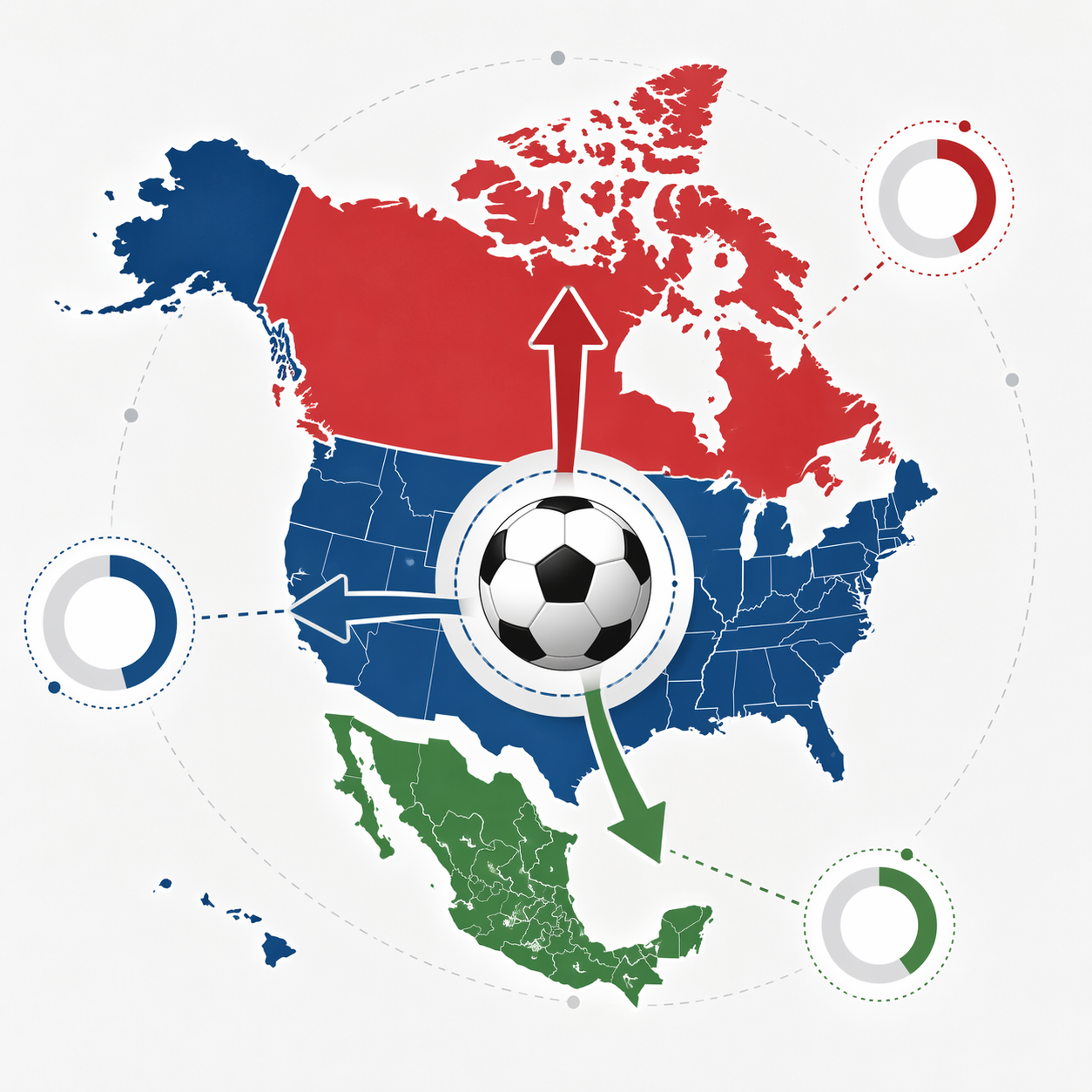
That agreement matters because default U.S. withholding analysis begins with U.S.-source income. In an ordinary single-country event, the source question may be difficult but at least geographically contained. In 2026, a single prize can relate to matches played across three tax jurisdictions. A rule that allocates prize money by match location gives withholding agents a common starting point for determining what portion is U.S.-source.
The agreement should not be read as if it eliminates withholding work. It helps answer the country allocation question; it does not automatically complete the CWA file, validate a treaty claim, or resolve state income tax treatment. If Spain’s $50 million championship prize is allocated across host countries, the relevant U.S. federal question is the U.S. share of that prize, not the full public headline amount. [2][4]
Implementation is the unsettled part. The agreement was announced only weeks before the tournament ended. [4] Withholding agents may still be translating the allocation method into payment instructions, federation reporting, athlete-level statements, and documentation that can survive later review. The legal design may be coherent while the operating procedures remain uneven.
A defensible allocation file should show the match schedule, the player’s participation or roster status where relevant, the country allocation formula used for the prize category, and the relationship between that allocation and the amount actually paid. If the payment is made by a federation rather than directly by a tournament organizer, the file should also show how the federation converted tournament-level prize money into athlete-level compensation.
State Jock Taxes Sit on Top of the Federal Analysis
Federal withholding is only one layer. State jock taxes may apply in every host state where an athlete performs. SW Accounting’s 2026 guide describes state apportionment by host city and duty-days logic across the tournament’s 16 host cities in three countries. [5]
The practical question at the state level is usually not whether the player is famous enough to be taxed. It is how much income a state can attribute to in-state work. Duty-days formulas generally compare days spent performing services in the taxing state with total duty days for the season or event period. In a World Cup file, those days may include match days, training days, media obligations, and other required team activities, depending on the state’s rules.
Rates make the exposure uneven. California’s top rate is 13.3%, New York’s is 10.9%, and New Jersey’s is 10.75%, while Texas and Florida impose no state income tax. [5] A player whose U.S. matches and team activities concentrated in high-rate states faces a different state overlay than a player whose U.S. schedule was concentrated in Texas or Florida.
The state treatment of national team prize money should not be treated as settled across the board. The research materials identify state-level uncertainty over whether certain national team prize money could qualify for a §501(c)(3)-related exemption theory. [5] That is an argument to document carefully, not a conclusion to assume.
Endorsements and Appearance Fees Need Their Own Source Analysis
Prize money gets the attention, but it is not the only income category that can create U.S. tax exposure. Appearance fees, sponsor activations, image-rights compensation, and endorsement income connected to U.S. performances may require separate sourcing and withholding analysis. The payment label is not controlling if the underlying compensation is tied to services performed in the United States.
This is where casual tournament summaries become dangerous. A federation bonus paid after the final, a sponsor fee triggered by a U.S. media event, and a prize allocation under the tri-host agreement can travel through different contracts and withholding agents. One may be addressed in a CWA, another may require Form 8233, and another may be allocated under the host-country agreement before any treaty question is reached.
The file should therefore be organized by income stream. For each payment, identify the payer, recipient, contract or governing rule, performance location, withholding agent, claimed reduction mechanism, and state exposure. A single spreadsheet that merely applies 30% to a public prize amount is not a tax analysis.
What a Defensible Withholding File Should Contain
For a foreign World Cup athlete or federation, the withholding file should be built around timing and source support. The documents that matter most are the documents that let the withholding agent justify a reduced payment before money changes hands.
- Income schedule: prize money, appearance fees, bonuses, endorsements, and any other compensation tied to tournament activity.
- Source allocation: match locations, service days, host-country allocation under the 2026 tri-host agreement, and state-by-state duty-days support.
- CWA documentation: Form 13930, filing date, first U.S. performance date, estimated income, expenses, and IRS communications.
- Treaty documentation: residence support, treaty article relied upon, Form 8233, withholding agent review, and any de minimis calculation.
- Payment chain: payer, withholding agent, recipient, federation allocation policy, and athlete-level reporting.
- State overlay: host states, applicable apportionment method, state rates, and any unresolved exemption position.
The order matters. A CWA filed after the 45-day window has a different value than one filed on time. [1] A treaty claim delivered after payment does not put the withholding agent in the same position as a properly reviewed Form 8233 before payment. [3] A tri-host allocation applied after gross U.S. withholding may still help explain a refund claim, but it is less useful than an allocation built into the payment process.
Where the 2026 Risk Remains
The largest 2026 uncertainty is operational. The tri-host allocation agreement is meant to prevent overlapping country claims on the same prize money, but withholding agents still have to apply it to real payment systems, athlete-level allocations, and documentation packages. [4] A sensible file will not simply cite the agreement; it will show how the agreement changed the U.S.-source amount used for withholding.
The second uncertainty is state treatment. Federal sourcing and treaty mechanics do not automatically bind every state on every issue. High-rate host states have their own apportionment rules and filing expectations, and the possible state-level treatment of national team prize money remains in flux. [5]
The third risk is administrative ownership. In cross-border tournaments, the athlete’s personal advisor, national federation, tournament payer, sponsor, and withholding agent may each assume someone else has handled the U.S. forms. The tax result often turns less on the sophistication of the legal theory than on whether the correct party had the correct document before the payment deadline.
For foreign World Cup winnings, the disciplined answer is this: 30% withholding is the federal default starting position for U.S.-source income of nonresident athletes, not the final word. Meaningful reductions depend on timely CWA filings, valid treaty documentation, host-country allocation, and state-by-state exposure analysis. Specific athlete, federation, endorsement, and payment structures require professional tax counsel before withholding positions are implemented.
References
- IRS Taxpayer Advocate's Tax Playbook, IRS Taxpayer Advocate, June 2026.
- July 6, 2026 analysis of Spain's $50M World Cup prize, CPA Practice Advisor, July 6, 2026.
- Article 17 treaty-country reference and Form 8233 mechanics, Sprintax.
- Tri-host allocation agreement with Canada and Mexico, Bilzin Sumberg, June 2026.
- 2026 World Cup athlete tax guide on state jock tax formulas and duty-days apportionment, SW Accounting.
Comments
Join the discussion with an anonymous comment.