
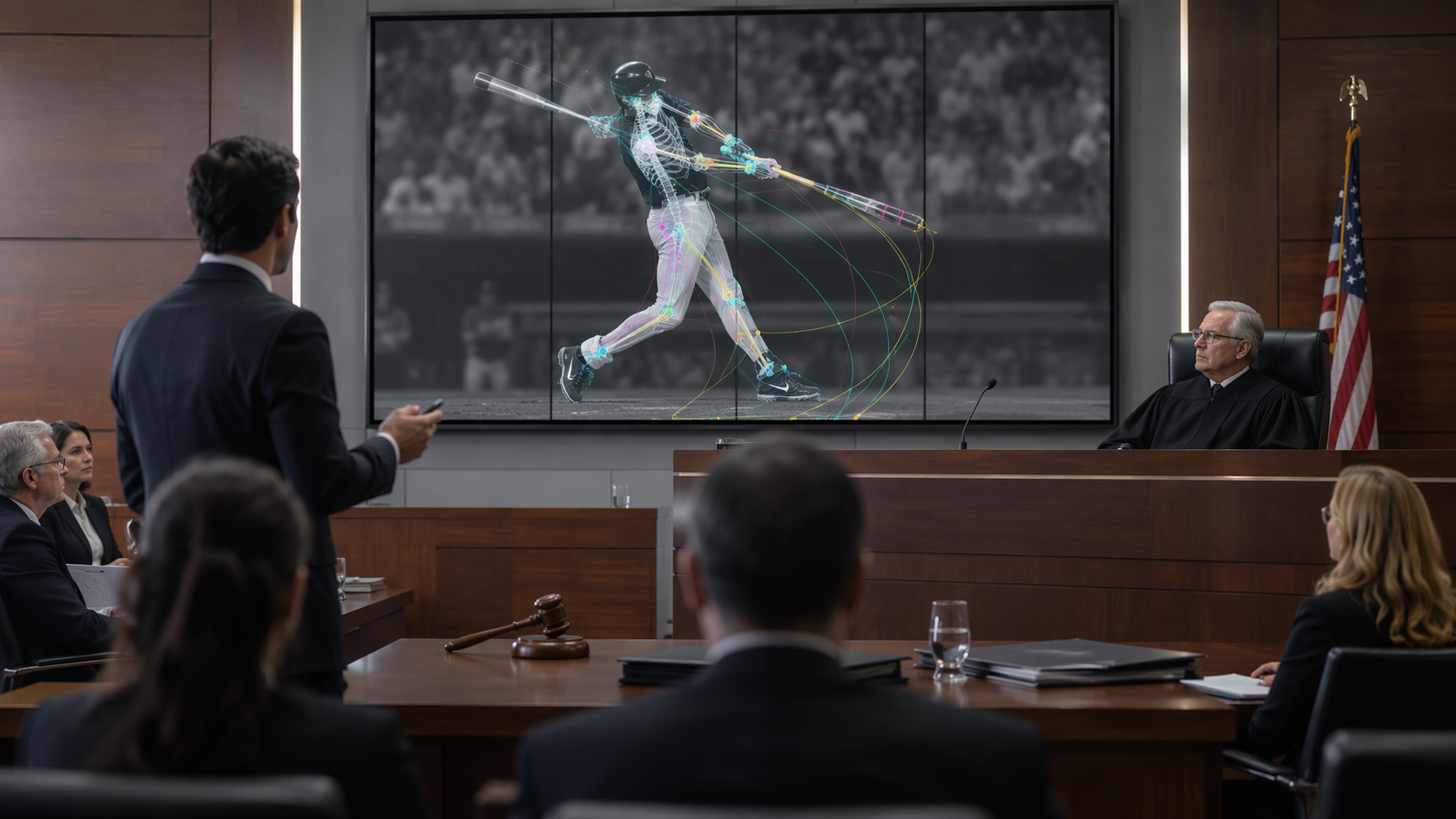
A party offering AI bat tracking swing analysis technology in court is not just offering a better-looking sports exhibit. If the output identifies body landmarks, estimates joint angles, reconstructs a swing path, or predicts movement from ordinary video, the evidentiary question becomes whether the court is looking at a measurement, an inference, or both.
That distinction is exactly where Proposed Federal Rule of Evidence 707 matters. As of July 21, 2026, the rule should still be treated as a proposed federal rule, not an enacted rule of evidence already binding in federal court. The available rulemaking materials describe it as published for public comment in August 2025 and scheduled for a final Advisory Committee vote on May 7, 2026; they do not establish that the rule has completed the full federal rulemaking process and taken effect. Practitioners should therefore check the current U.S. Courts rules docket before relying on the text as governing law, but the proposal already signals what judges, experts, and motion practice are likely to ask from machine-generated evidence. [1][2]
The Rule’s Central Move: From Output to Reliability
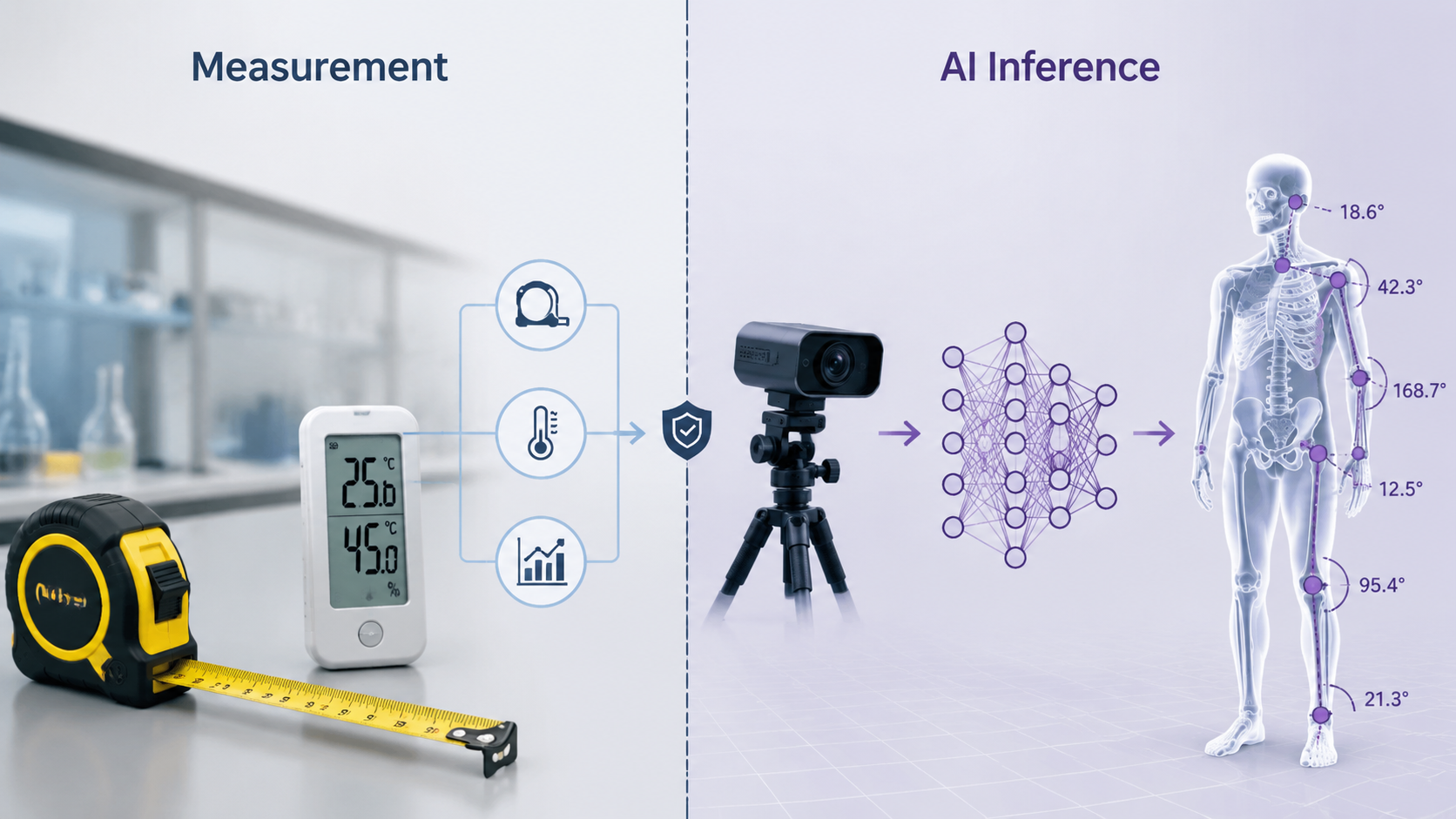
Proposed FRE 707 is aimed at machine-generated evidence that depends on a process drawing inferences or making predictions, especially when the evidence is offered without a live expert to shoulder the reliability burden. The proposal does not try to turn every thermometer, scale, radar gun, or laboratory instrument into an expert witness. Its concern is the machine output that looks like a fact but was produced through inferential processing the jury cannot see. [1][2]
For motion analysis, that boundary matters more than the label on the exhibit. A timestamped video clip may be ordinary demonstrative or recording evidence. A wearable-device log may be treated as sensor-generated scientific evidence. An AI-enhanced video may be a reconstruction of what the machine believes the image should show. A markerless motion-capture output that places a digital skeleton over a hitter and reports bat-plane angle, pelvis rotation, or shoulder kinematics is a processed inference from pixels.
The Committee materials also point courts toward questions familiar from Daubert: whether the process has been tested, whether it has a known or knowable error rate, whether it has been peer reviewed, whether standards govern its operation, whether the training data are sufficiently representative, and whether the system has been validated in circumstances sufficiently similar to the case at hand. [1][2]
Why Markerless Motion Capture Fits the Hard Category
Markerless motion capture is impressive precisely because it removes much of the artificial setup that can make reflective-marker testing feel distant from real movement. The system can work from video, detect body landmarks, estimate segment positions, and produce kinematic outputs without putting markers on the athlete. In a baseball setting, that can mean tracking the athlete’s movement, bat swing path, and ball flight in a unified output, as Theia3D’s April 2026 release was reported to do. [3]
But the same feature that makes markerless capture attractive in a lab or training facility also makes it difficult in court. The court is not merely being asked to admit a camera recording. It is being asked to admit an interpretation of that recording: which pixels correspond to which anatomical landmarks, how those landmarks move through time, and what angles or trajectories follow from that model.
That does not make the evidence inadmissible. It does mean counsel should not accept the phrase “computer vision” as a substitute for a foundation. The foundation has to connect the system’s validation record to the use being made in the case. A validation study of controlled sports biomechanics may be valuable; it is not automatically a validation study of a low-light surveillance clip, a partially obstructed industrial accident, or a disputed criminal identification.
What Theia3D’s Validation Record Helps Show
Theia3D is the most useful example here because it is not a vaporware system asking courts to trust an unexplained visual output. The materials describe more than 50 peer-reviewed validation studies, testing on more than 300 athletes and more than 2,000 swings, and median bat-plane angle differences under 3 degrees when compared with marker-based systems. [3][4][5][6]
Those are the kinds of facts a court can work with. They give counsel something to ask about besides the vendor’s sales deck: what was compared, under what conditions, with what error, and against what reference method. Marker-based motion capture is not courtroom magic either, but it is a meaningful comparator in biomechanics because it gives the court a way to evaluate whether the markerless system is approximating an accepted measurement process.
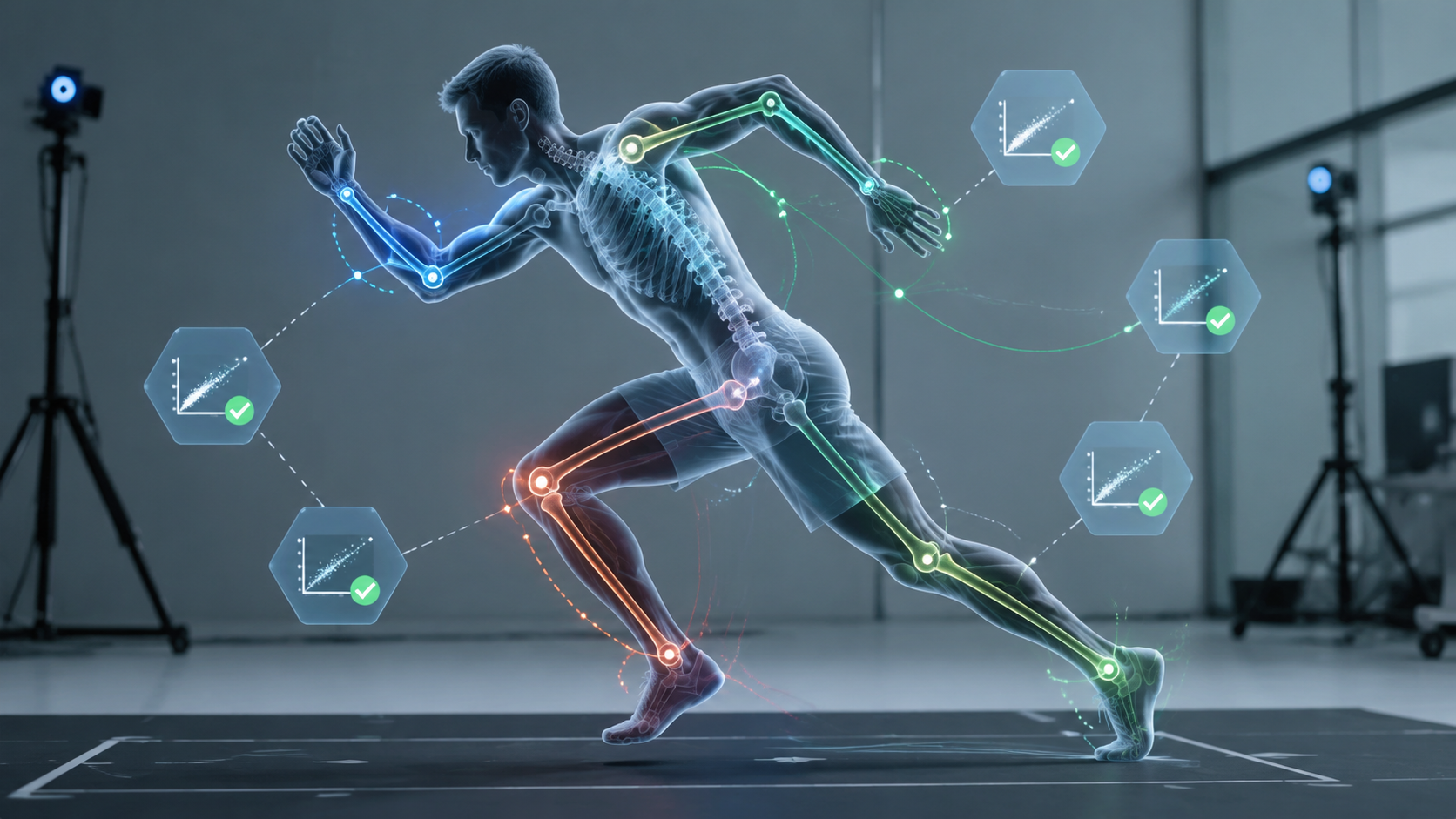
The reported validation record also includes work in baseball-specific environments. The materials identify testing by Driveline Baseball and the Point Loma Nazarene University x San Diego Padres Biomechanics Lab at Petco Park, and a November 2025 Journal of Sports Sciences study reporting a mean per-joint position error of 52.0 ± 12.3 mm during high-speed baseball pitching. [3][4][5][6]
Those details are stronger than a generic claim that “AI works.” They still need translation into the case record. The relevant question is not whether the system has ever performed well. It is whether the system was validated for the movement, camera geometry, body type, speed, occlusion, clothing, lighting, and output variable being offered to the jury.
| Foundation Issue | What Counsel Should Ask For |
|---|---|
| Peer review | The specific validation studies supporting the output being offered, not just studies involving the same brand or a nearby use case. |
| Comparator | Evidence explaining whether the system was compared against marker-based motion capture, manual coding, expert annotation, or another reference method. |
| Error rate | Error rates for the relevant variable, such as bat-plane angle, joint center position, segment orientation, or timing. |
| Representative data | Information about whether training and validation data included movements, bodies, speeds, camera views, and environmental conditions similar to the case. |
| Reproducibility | The processing settings, software version, input files, and workflow needed to reproduce the output. |
| Pipeline documentation | A step-by-step account of how raw video became the final chart, skeleton overlay, reconstruction, or opinion. |
The Deposition Problem Is the Processing Chain
In motion-analysis litigation, the weakest foundation often appears between the camera and the final exhibit. The lawyer can see the video. The jury can see the skeleton overlay. The expert may be able to explain the biomechanical significance of hip rotation or bat path. But if no one can explain how the model identified landmarks, how missing data were handled, which frames were discarded, whether the system smoothed the path, or whether a human operator adjusted the output, the exhibit starts to look less like measurement and more like an unexamined conclusion.
Proposed FRE 707’s emphasis on representative training data and validation in similar circumstances is therefore not a technical footnote. It is the path into cross-examination. If the disputed case involves a worker falling in a cluttered warehouse, validation from elite baseball swings in a controlled lab may prove that the model is sophisticated, but not necessarily that it is reliable for that accident reconstruction. If the disputed case involves a baseball swing under conditions close to those tested, the same validation record becomes more probative.
The practical demand is narrow and concrete: produce the raw input, the processed output, the versioned software information, the operator steps, the validation studies tied to the specific output, and the expert who can defend the chain from input to inference. Without that chain, the polished chart may be more persuasive than it is examinable.
Puloka Shows the Cost of Proprietary Enhancement
Washington v. Puloka is not a markerless motion-capture case, and it arose under Washington’s Frye framework rather than Proposed FRE 707. It is still the cautionary analogue because the disputed evidence was AI-enhanced video, and the court excluded it after focusing on proprietary machine-learning methods that had not been sufficiently peer reviewed by the forensic video-analysis community and were not reproducible. [7]
The lesson is not that AI video evidence fails. The lesson is that a court may refuse to treat an enhanced image or derived visual output as reliable when the relevant professional community cannot inspect, test, reproduce, or meaningfully validate the method. In Puloka, the problem was not simply that the tool was proprietary; proprietary tools appear in litigation all the time. The problem was that the proponent could not supply the kind of forensic reliability foundation the court needed for the specific use being offered. [7]
That is where a system like Theia3D starts from a better position than a consumer video-enhancement tool with little forensic validation. Its published validation record gives the proponent more to work with. But Puloka still matters because courts will not necessarily accept sports-science validation as forensic validation unless the proponent explains why the difference does not matter for the disputed fact.
Dabate Is the Boundary, Not the Answer
State v. Dabate points in a different direction because it involved Fitbit data, not AI-derived kinematic reconstruction. The Connecticut Supreme Court found the Fitbit evidence admissible as scientific evidence, crediting expert testimony about validation studies, peer review, and NIH research funding. [8]
That ruling helps explain why all machine-adjacent evidence should not be thrown into the same bucket. A wearable log may be offered as data from sensors and device processing with a particular validation record. A markerless motion-capture system may be offered as a deep-learning interpretation of video into anatomical and kinematic variables. Both may require expert explanation. They do not present the same admissibility problem.
For counsel facing AI motion analysis, Dabate is useful only up to that boundary. It supports the idea that courts can admit validated device data when a sufficient scientific foundation is laid. It does not establish that a computer-vision model’s estimate of joint centers, bat-plane angles, or movement trajectories should enter evidence merely because another court admitted wearable-device data.
The Expert Cannot Be Decorative
The ABA Business Law Section’s Fall 2025 discussion of Daubert and AI identified proprietary black-box algorithms, bias in training data, transparency, and validation as core challenges. [9] Those concerns become concrete in the motion-analysis setting because the expert may be asked to do more than narrate a vendor output.
A qualified biomechanics expert can explain what a joint angle means, why a bat path matters, or whether a movement is consistent with an injury theory. A computer-vision or system-validation witness may be needed to explain how the output was generated and whether the model was tested for the conditions in the case. Sometimes one person may cover both. Often, the admissibility problem is that no one actually does.
If the proponent offers the machine output without a live expert, Proposed FRE 707 becomes especially important because it is designed to prevent an end run around reliability review. A party should not be able to avoid Daubert by saying the opinion came from software rather than a person.
What to Demand Before the Hearing
The best motion in limine record will not be built from generic anxiety about artificial intelligence. It will be built from missing foundation. Before the hearing, the opposing party should have to identify exactly what the AI-derived evidence is offered to prove: a timing sequence, an angle, a speed, a body position, a causation theory, an identity, or a demonstrative aid.
- Separate the original recording from the AI output, including any enhanced video, skeletal overlay, chart, reconstruction, or numerical kinematic table.
- Ask whether the system is being offered through a qualified expert or as machine-generated evidence standing on its own.
- Demand the validation studies tied to the particular output variable, not only general studies praising the platform.
- Identify the comparator method and the known error rates under conditions similar to the disputed facts.
- Request the software version, processing settings, operator interventions, input files, and any steps needed to reproduce the exhibit.
- Press for representativeness: training data, test data, camera views, lighting, occlusion, movement speed, body types, clothing, and environment.
Those requests are not fishing expeditions when the output is being used as evidence rather than as a coaching tool. They go to the heart of whether the court is seeing a validated measurement process, an expert-assisted inference, or a vendor-generated conclusion no one can reproduce.
What Theia3D Can and Cannot Prove Today
Theia3D’s validation record is exactly the kind of record courts should want proponents of AI motion analysis to build. Peer-reviewed studies, comparison against marker-based systems, quantified error, baseball-specific testing, and high-speed movement data give the technology a foundation that many AI visual tools do not have. [3][4][5][6]
But no reported case in the sources cited here has tested Theia3D’s admissibility. That absence matters. Validation in biomechanics literature is not the same thing as a judicial ruling admitting the system for a disputed personal-injury reconstruction, product-liability theory, or criminal fact. A court would still need to decide whether the offered output is sufficiently reliable for the facts, jurisdiction, rule, expert testimony, and procedural posture before it.
The correct posture is neither suspicion by default nor admission by polish. AI-powered motion analysis may become powerful evidence when the proponent can show how the output was generated, how it was validated, what its error looks like, and why the validation setting resembles the case. Until then, the lawyer’s first job is to keep the raw recording, the machine’s inference, and the expert’s opinion in separate boxes.
References
- Barnes & Thornburg analysis of Proposed Federal Rule of Evidence 707, Barnes & Thornburg, btlaw.com
- RumbergerKirk analysis of Proposed Federal Rule of Evidence 707, RumbergerKirk, rumberger.com
- AI-powered bat-tracking coverage, Fox News, foxnews.com/tech/ai-powered-bat-tracking
- Theia3D coverage, IT Brief, itbrief.news
- Theia3D coverage, Sports Business Journal, April 2026, sportsbusinessjournal.com
- Theia3D blog coverage, Theia Markerless, theiamarkerless.com
- Washington v. Puloka coverage, Maryland State Bar Association, msba.org
- State v. Dabate coverage, Prote Solutio, protesolutio.com
- Navigating Daubert in the Age of AI, American Bar Association, Fall 2025, americanbar.org
Comments
Join the discussion with an anonymous comment.