
The immediate hospital merger antitrust legal impact of the FTC's 2026 healthcare push is not that problematic transactions suddenly have an easy path through Washington. It is that the path, where it exists, now looks more like a negotiated construction project: identify assets, carve them out, find a credible buyer, absorb timing conditions, and live with post-closing obligations that may shape the next transaction before anyone has drafted it.
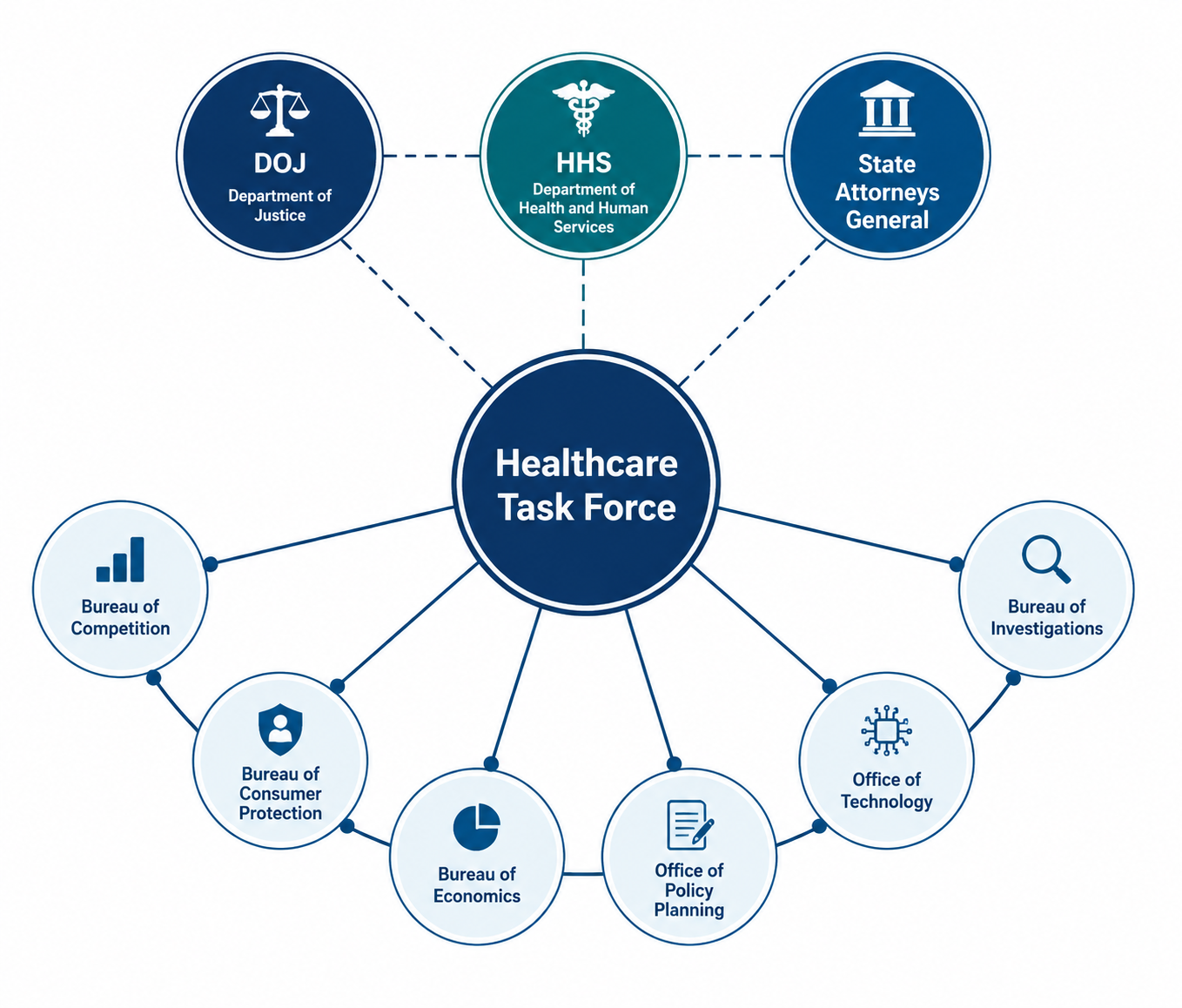
That is a different conversation from the one deal teams became used to having during the prior enforcement cycle. The FTC's Healthcare Task Force, launched on March 20, 2026, brings together the Bureaus of Competition, Consumer Protection, Economics, Policy Planning, and Technology, and coordinates with DOJ and HHS.[1] In practice, that matters less as an org chart than as a review mechanism: the agency can look at facility overlaps, payer contracting, labor-market effects, consumer-protection issues, and related government scrutiny without waiting for each silo to discover the deal on its own.

The better evidence of the shift is not rhetoric about a new chair or a friendlier climate. It is the first-half 2026 consent orders. Sevita/BrightSpring required divestitures of 128 intermediate care facilities and imposed a 10-year prior-notice obligation. Ascension/AmSurg required divestitures of seven ambulatory surgery centers. UnitedHealth/Amedisys required divestitures of 164 locations across 19 states and included labor-market allegations affecting at least 8,000 nurses.[1][2]
Those numbers are enough to prevent a lazy reading of the moment. A consent order is not a soft landing merely because it avoids a complaint seeking to block the deal. It can be a forced redesign of the transaction, with assets removed from the strategic rationale, operational services unwound, buyers vetted under pressure, and regulatory calendars extended while business teams are already treating the transaction as inevitable.
The Three Orders Show a Remedy Posture, Not a Retreat
The three first-half orders do not all involve the same assets, and they should not be flattened into a generic healthcare-merger story. That is precisely why they are useful. Together, they show the FTC accepting structural remedies across different healthcare settings while still requiring divestitures large enough to change the economics and execution of the underlying deal.
| Matter | Required remedy | Drafting consequence |
|---|---|---|
| Sevita/BrightSpring | Divestiture of 128 intermediate care facilities; 10-year prior-notice obligation | Future acquisitions need a notice calendar, not merely a signing checklist |
| Ascension/AmSurg | Divestiture of seven ambulatory surgery centers | Facility-level carveout planning matters even outside full-service hospital combinations |
| UnitedHealth/Amedisys | Divestiture of 164 locations across 19 states; labor-market allegations affecting at least 8,000 nurses | Remedy planning must account for multistate operations and workforce theories |
Sevita/BrightSpring is the most useful timing signal. The 10-year prior-notice obligation is not the same thing as a prior-approval obligation, which was more associated with the Biden FTC's approach.[1] Prior notice still changes behavior. It gives the agency advance visibility into future transactions and forces the company to build antitrust timing into acquisitions that might otherwise have been treated as routine bolt-ons. But it does not require the same affirmative agency approval before closing that a prior-approval provision would demand.
That distinction belongs in the purchase agreement, not in a post-signing memo. A buyer subject to prior notice may need covenants addressing submission timing, information production, cooperation, outside dates, and termination rights for transactions that would previously have moved on a narrower regulatory track. If counsel treats prior notice as a footnote, the business team will experience it later as a delay that nobody priced.
UnitedHealth/Amedisys carries a different message. A divestiture package of 164 locations across 19 states is not a symbolic remedy.[1][2] It requires a buyer or buyers capable of operating real healthcare assets at scale, and it forces the parties to think about continuity of services, employees, local referral relationships, payor arrangements, transition services, and state-by-state regulatory approvals. The labor-market allegations affecting at least 8,000 nurses also show why a healthcare deal review may not stay inside the traditional patient-market box.[2]
Ascension/AmSurg keeps the pattern from being too easy to dismiss as a home-health or intermediate-care phenomenon. Seven ambulatory surgery centers are a smaller package than the other two orders, but the order still points to facility-level structural relief in a provider transaction.[1][2] For hospital systems with outpatient strategies, that matters. The assets most likely to draw scrutiny may sit outside the flagship hospital and inside the ambulatory network that management views as essential to the combined platform.
Why the Task Force Matters to Merger Documents
The Healthcare Task Force changes legal work because it makes parallel questions more likely to arrive in the same review window. The FTC's March 2026 structure is cross-bureau, and its coordination with DOJ and HHS places merger analysis closer to commercial contracting, consumer protection, labor, and policy review than a narrow overlap memo would suggest.[1]
That does not mean every hospital merger now turns on every possible healthcare theory. It means counsel should expect fewer clean boundaries between the antitrust diligence file and the rest of the regulatory file. A labor-market issue may affect the remedy conversation. A payer-contracting issue may bring different agency lawyers into the discussion. A state review filing may force the parties to commit to facts before the federal remedy package has stabilized.
The broader enforcement setting supports that reading, but only up to a point. Whole-of-government coordination has also appeared in scrutiny of commercial contracting practices, including the OhioHealth and NYP matters, and in PBM settlements involving Express Scripts in February 2026, Optum in June 2026, and Caremark in July 2026.[3] Those matters are not hospital-merger precedents. They are evidence that healthcare enforcement is being coordinated across related markets and practices, which is enough to affect diligence discipline without pretending that a PBM settlement decides a hospital transaction.
Divestiture Planning Now Belongs at the Front of the Deal
The practical mistake is waiting for the second request process to reveal the remedy. By then, the parties may have already announced a footprint, socialized synergy numbers, briefed lenders or boards, and promised integration benefits that assume the very assets the FTC may require them to sell. Structural-remedy enforcement punishes that sequencing.
Early antitrust diligence should identify which facilities, service lines, outpatient centers, home-health locations, or other operating units could be separated without destroying the remaining deal. That is not simply a market-share exercise. It requires asking whether the asset has separate books, assignable contracts, licensure issues, management continuity, IT dependencies, shared staff, brand issues, and enough operational coherence to attract a buyer acceptable to the agency.
A divestiture-ready transaction record will usually need answers to four questions before the agency asks them:
- Which assets could be sold while preserving the core rationale for the transaction?
- Who could buy and operate those assets without creating a new competitive problem?
- What transition services would be necessary, and for how long?
- Which state approvals, notices, or waiting periods would control the divestiture calendar?
The buyer question is often the hardest to repair late. A remedy buyer must be credible to the agency and workable for the seller, which means experience, financing, regulatory eligibility, operational capacity, and a plan for continuity. In a hospital or provider transaction, the sale of facilities is rarely just a real-estate transfer. Staff, medical records, managed-care contracts, physician relationships, electronic systems, quality obligations, and state licensure all have to land somewhere.
Transaction documents should make room for that reality. The antitrust covenant should not be limited to a generic obligation to use reasonable best efforts. Parties need to decide whether the buyer must accept any divestiture, whether there is a cap on assets or revenue that may be divested, whether specified assets are excluded from remedy obligations, whether a reverse termination fee applies, and whether the outside date is long enough for both federal review and state process.
State Review Is a Calendar Problem and a Risk-Allocation Problem
Federal consent-order practice is only part of the execution burden. State transaction review regimes can create parallel notice periods, information demands, and closing conditions. Maine's regime, for example, includes a 180-day preclosing notice requirement and potential penalties of $10,000 per day.[1][3] That is not a national rule, and it should not be treated as one. It is a reminder that the slowest required filing may become the deal calendar.
For counsel, this means state review cannot be bolted on after federal strategy is set. A proposed divestiture may itself require state notice or approval. A transition-services arrangement may raise questions different from the main acquisition. A buyer acceptable to the FTC may still need state-level licensure or charity-care commitments. If the purchase agreement assumes one regulatory track while the remedy requires another, the drafting gap becomes leverage for whichever party wants to slow down, renegotiate, or exit.
The right level of preparation is not a fifty-state survey pasted into the data room. It is a closing calendar that identifies applicable notice laws, waiting periods, attorney general review, certificate-of-need or licensure constraints where relevant, and the approvals that would also apply to any likely divestiture buyer. That calendar should feed the outside date, interim operating covenants, financing commitments, and board materials.
What Not to Overread
Three consent orders are meaningful, but they are not a permanent enforcement code. The Sevita/BrightSpring and Ascension/AmSurg orders were finalized in June 2026, and appeal periods may not have expired; the orders could still be modified.[1] A future agency leadership change, a litigated loss, or a transaction with different facts could move the line again.
Cross-market hospital merger theories also remain unsettled. The FTC has never successfully challenged a cross-market hospital merger in court, and the research record for 2026 does not supply a new hospital-merger case that resolves that theory. Counsel should not ignore cross-market concerns, especially where a system's contracting leverage is central to the business thesis, but those concerns are still different from the facility-overlap issues that the 2026 consent orders directly illuminate.
Nor should the Ferguson-era contrast be exaggerated into a conclusion that deals are safer. The observable change is narrower: the FTC appears more willing, at least in these early 2026 matters, to resolve healthcare merger concerns through negotiated structural relief rather than only by litigating to block transactions.[1][2] The size of the required divestitures makes that a procedural opening, not a substantive holiday.
The Deal Question Has Changed
For hospital systems, physician platforms, home-health operators, and the insurers or strategic buyers adjacent to them, the question is no longer only whether the FTC will try to stop the deal. It is whether the transaction can survive a structural remedy without losing the assets, timing, financing, or operating assumptions that made the deal worth signing.
That changes behavior before signing. Antitrust counsel should be in the room when the footprint is still negotiable. Regulatory teams should map federal and state process together. Integration leads should identify shared services that would make a later divestiture painful. In-house lawyers should resist documents that promise broad remedy commitments while leaving the actual separation plan to a future workstream.
The Healthcare Task Force has not made hospital mergers easy. It has made some paths more negotiable, and more architecture-dependent. A deal that can present a credible divestiture package, a qualified buyer, a realistic state and federal calendar, and a workable operating separation will be in a different posture from one that arrives at remedy discussions with only a market-share memo and a signed agreement.
That is the working legal impact: not a friendlier agency in any simple sense, but a review environment in which the remedy has to be designed before the government demands it.
References
- Antitrust & Competition Healthcare 1H 2026 Update, Goodwin Procter LLP.
- Shifting Trends in Healthcare Antitrust Enforcement, Axinn LLP.
- Charting a Path Forward in 2026: Year-End Healthcare Antitrust Report, Holland & Knight.
Comments
Join the discussion with an anonymous comment.