
The FY2027 NDAA negotiations are delayed for a more specific reason than “Congress is divided.” As of July 22, 2026, the bill is caught behind four separate locks: a House floor procedure tied to the SAVE Act, a Senate fight over war powers and the Iran conflict, a sovereignty and counterintelligence dispute over the Israel FUTURES Act, and a $1.15 trillion defense authorization topline that changes what each faction can accept. Any current assessment should also check the House floor status after adoption of H.Res. 1438, because the rule moved on July 21 while the underlying H.R. 8800 status could change quickly thereafter.[1]
That distinction matters because the NDAA’s ordinary reputation as “must-pass” does not itself move the bill. The Congressional Research Service notes that Congress has enacted an NDAA every year since 1961, and that FY2027 marks the first time a procedural vote to begin Senate debate on the annual defense authorization bill has failed.[2] A streak can create pressure; it cannot substitute for floor votes, cloture, or a rule that can survive its own coalition.

The House did not simply clear its problem on July 21
The easiest mistake is to treat the House’s revised rule as a clean breakthrough. It was not. The first rule combining the NDAA with the SAVE Act failed on June 30 by a 198-224 vote, after Republican defections helped sink the procedural measure.[1][3] A revised rule, H.Res. 1438, passed 214-211 on July 21, but the House Rules Committee materials still show the NDAA moving through a rule structure that retains the SAVE Act linkage.[1]
That is a procedural trap, not merely a policy disagreement. A member can support defense authorization and still oppose the election-law attachment. Another can support the SAVE Act but resist a defense bill whose topline, amendments, or foreign-policy provisions are unacceptable. By joining them procedurally, leadership changed the vote from a relatively familiar defense authorization vote into a test of whether enough members will accept the combined vehicle.
The revised rule’s passage narrows one immediate problem: the House found a way to get past the rule vote that failed in June. It does not, by itself, show that the underlying NDAA has a stable majority, that final passage is secure, or that the Senate would accept the House’s procedural bargain. For contractors and agency counsel watching authorization risk, that difference is not semantic. A passed rule can open the door to floor action while leaving the bill’s negotiating geometry almost as difficult as before.
The Senate blockade is three objections, not one
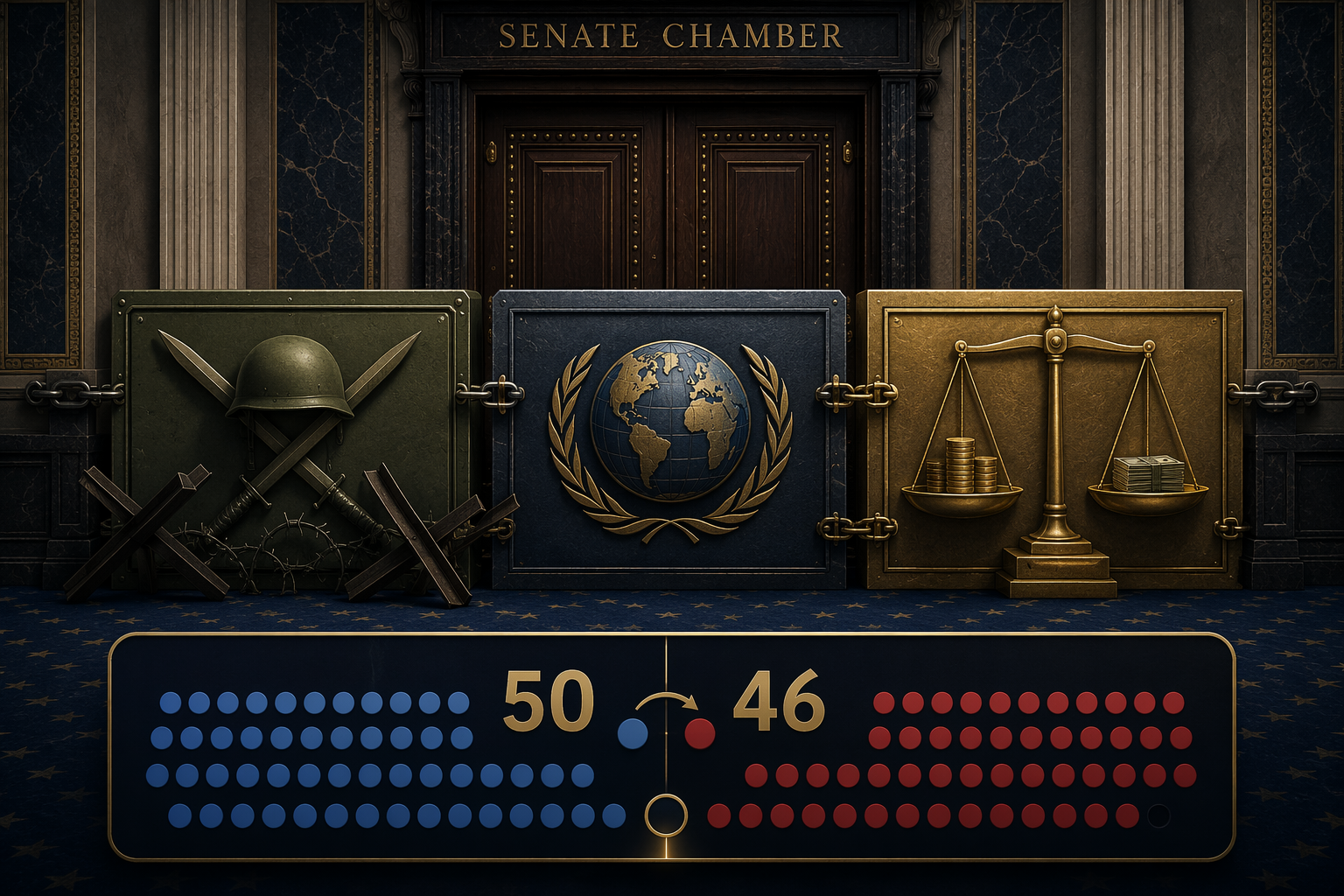
The Senate’s July 14 cloture vote failed 50-46, ten votes short of the 60 needed to begin debate; Senate Majority Leader John Thune changed his vote to “no” to preserve the right to seek reconsideration.[4] That is the procedural fact that stops the bill. The reasons behind it are plural, and treating them as a single Democratic objection obscures why the release conditions are so hard to align.
The Iran dispute is about authorization and restraint
One Senate objection concerns the five-month Iran conflict and whether the NDAA should move without stronger congressional constraints on the administration’s military action. Military.com reported that at least 15 U.S. service members had been killed and that a Pentagon comptroller estimate put costs above $29 billion as of a May 2026 hearing.[5] Those figures should be treated as time-bound: they describe the record available from that reporting and may not reflect updated late-July Defense Department accounting.
The Iran objection blocks through war-powers leverage. Senators withholding cloture are not merely asking for a different weapons account or report language; they are using the motion to proceed to force a fight over whether Congress will authorize, limit, or at least debate the military campaign before advancing the annual defense bill. That is why a side agreement on one procurement line would not necessarily release this lock.
Some reporting has also cited an independent CSIS estimate placing Iran conflict costs at $42 billion, but the available material here attributes that figure second-hand rather than linking to a primary CSIS publication.[6] It is useful as a signal that outside cost estimates may exceed the Pentagon comptroller figure, but it should not be given the same evidentiary weight as a directly sourced government estimate.
The Israel FUTURES Act dispute has a different release condition
A second Senate objection concerns the Israel FUTURES Act, identified in reporting as Section 1217 in the Senate bill and Section 219 in the House bill. The provision would mandate permanent U.S.-Israel defense technology cooperation, while critics have tied their objection to sovereignty, technology transfer, and counterintelligence concerns; Military.com reported that the Defense Intelligence Agency had raised Israel’s counterintelligence threat rating to “critical.”[7] Al Jazeera also reported that Senate Democrats blocked the defense bill while objecting to provisions involving Iran and Israel.[8]
This lock is not the same as the Iran lock. A war-powers amendment could address restraint in the Iran conflict without resolving whether Congress should mandate a permanent bilateral defense-technology framework with Israel. Conversely, modifying the Israel FUTURES Act would not answer whether the administration has adequate authorization for ongoing hostilities. The overlap is foreign policy; the mechanism is different.
The budget topline changes the coalition math
The third Senate objection is the topline. The FY2027 authorization has been reported at $1.15 trillion, including about $1.1 trillion for the Defense Department, $41 billion for Department of Energy nuclear programs, and $11 billion for other defense-related activities; CRS describes the proposal as roughly $600 billion above the FY2026 baseline of about $900 billion.[2][9]
At that size, the topline is not just a number at the top of the page. It affects which amendments are seen as manageable, which offsets are plausible, and which members can claim they are preserving readiness rather than accepting an open-ended expansion. Defense hawks may view the increase as the price of modernization and global posture. Fiscal conservatives may see it as a threshold problem before the bill’s contents are even reached. Democrats objecting to “toxic amendments” or foreign-policy language have less incentive to provide procedural votes for a bill whose aggregate spending level they also oppose.
House Armed Services Committee Ranking Member Adam Smith has already signaled that the topline and “toxic amendments” could drive opposition to final passage.[10] That matters even if the House can pass a rule, because it suggests that the final vote may depend on a narrower and less forgiving coalition than the NDAA usually enjoys.
Why the four-lock structure makes this cycle historically precarious
The NDAA often survives ugly amendment fights because the chamber process leaves negotiators room to separate objections. Members can vote for a rule, lose an amendment, support final passage, and revisit the fight in conference. The FY2027 cycle is harder because several objections are attached to procedural choke points rather than ordinary policy disagreement.
| Lock | Where it operates | What stops movement | What would have to change |
|---|---|---|---|
| SAVE Act linkage | House floor procedure | The NDAA is procedurally tied to election-law legislation | Leadership must sustain a coalition willing to accept the combined rule and underlying vehicle |
| Iran war authorization clash | Senate cloture | Senators withhold votes to force debate or limits on the Iran conflict | War-powers language, amendment access, or another restraint mechanism would need to satisfy enough holdouts |
| Israel FUTURES Act dispute | Senate and cross-chamber negotiations | Mandatory U.S.-Israel defense technology cooperation raises sovereignty and counterintelligence objections | The disputed sections would need revision, removal, or a negotiated safeguard |
| $1.15 trillion topline | Both chambers and conference | The authorization level strains Democratic, fiscal conservative, and leadership vote counts | Negotiators would need a spending level and amendment package that can hold a final-passage coalition |
The table understates one important practical point: these locks do not release in sequence automatically. The House could pass H.R. 8800 and still leave the Senate short of cloture. The Senate could reach a war-powers accommodation and still face objections to the Israel FUTURES Act. Negotiators could modify the Israel provisions and still have no answer to members who reject the topline. That is what makes the current delay structurally different from a normal pre-conference slowdown.
The stakes are authorization authorities, not just political optics
The consequences of missing October 1 should be stated carefully. The NDAA is an authorization bill, not the appropriations bill itself, so delay does not mean every defense dollar immediately disappears. But authorization language often carries permissions, ceilings, program direction, personnel provisions, and procurement authorities that agencies and contractors plan around.
Reporting tied to the FY2027 bill identifies multiyear procurement contracts for Arleigh Burke destroyers, Patriot interceptors, THAAD, F-35, and F-15EX as authorities that could not be awarded without enactment by October 1; the same reporting says Golden Dome expansion would stall and a 3.6% troop pay raise would remain in limbo.[6] Those are not the reason the bill is stuck. They are the consequences that make procedural delay expensive for people who have to schedule awards, advise bidders, and plan force management around statutory authority.
For government-contracting teams, the practical risk is not limited to whether Congress eventually preserves the 66-year streak. The risk is timing: solicitations, multiyear assumptions, production planning, and internal approvals can be pushed into a narrower window even if the bill ultimately passes. For service members, the pay-raise issue becomes bargaining collateral in a negotiation whose real sticking points sit elsewhere.
What would count as real movement
A press conference saying negotiators are talking would not, by itself, change the docket. The first meaningful House signal would be final passage of H.R. 8800 under a rule that can hold despite the SAVE Act linkage, or a decision to alter that linkage. The first meaningful Senate signal would be a successful motion to proceed or a cloture agreement showing that at least ten additional votes have been found after the 50-46 failure.
Substantively, the Iran, Israel, and topline disputes each need their own release path. Iran requires some answer to authorization or restraint. The Israel FUTURES Act requires a decision on whether permanent defense-technology cooperation remains mandatory and, if so, under what safeguards. The topline requires a coalition that can live with the scale of the authorization after amendments are counted.
That is why the FY2027 NDAA delay is unusually precarious. The bill can still preserve the authorization streak, but only if negotiators solve the House procedural trap, the Senate Iran blockade, the Israel FUTURES Act dispute, and the $1.15 trillion topline fight as separate problems. One global bargain may eventually package those answers together. It still has to contain four answers.
References
- H.R. 8800 - National Defense Authorization Act for Fiscal Year 2027, House Rules Committee, http://rules.house.gov/bill/119/hr-8800
- FY2027 NDAA: Status of Legislative Activity, Congressional Research Service, July 17, 2026, https://www.everycrsreport.com/files/2026-07-17_IN12704_ff632080dc7f2354d6577a43beb02d0a2999ddc4.html
- House GOP defectors tank procedural vote to bring NDAA to floor, Breaking Defense, https://breakingdefense.com/2026/06/house-gop-defectors-tank-procedural-vote-to-bring-ndaa-to-floor/
- Senate Democrats block NDAA, The Hill, https://thehill.com/policy/defense/5967878-senate-democrats-block-ndaa/
- NDAA faces uphill battle in Congress as lawmakers urge Trump restraint in illegal Iran war, Military.com, https://www.military.com/ndaa-faces-uphill-battle-in-congress-as-lawmakers-urge-trump-restraint-illegal-iran-war
- Senate Blocks FY2027 NDAA Over Iran War; $1.15T Weapons Programs in Limbo, Tech Times, https://www.techtimes.com/articles/320549/20260715/senate-blocks-fy2027-ndaa-over-iran-war-115t-weapons-programs-limbo.htm
- Senate stalls NDAA with major Israel plan critics call treason, Military.com, https://www.military.com/senate-stalls-ndaa-with-major-israel-plan-critics-call-treason
- Senate Democrats block defence bill over Iran war, Israel provisions, Al Jazeera, https://www.aljazeera.com/news/2026/7/14/senate-democrats-block-defence-bill-over-iran-war-israel-provisions
- NDAA amendments Pentagon House Armed Services, The Hill, https://thehill.com/policy/defense/5911353-ndaa-amendments-pentagon-house-armed-services/
- Smith Statement on Upcoming House Vote for FY27 NDAA, House Armed Services Committee Democrats, July 2026, https://democrats-armedservices.house.gov/2026/7/smith-statement-on-upcoming-house-vote-for-fy27-ndaa
Comments
Join the discussion with an anonymous comment.