
The most legally interesting fact about the Heavenly Spices garlic powder recall is not the word “recall.” It is the $2.00 e-gift card reportedly offered to consumers who had purchased the 70g product through Dollarama, with a return refund also described as available through the retailer’s response.[1] That number is too small to carry the emotional weight of a food-safety notice, but it is large enough to expose the problem that follows many low-value grocery recalls: if nobody is reported sick, what is the recoverable loss?
The Canadian Food Inspection Agency recall notice for Heavenly Spices brand garlic powder, recall RA-82337, identified Bacillus cereus as the reason for the recall and classified the event as Class 2.[2] The notice belongs to the Canadian regulatory system and concerned product sold through Dollarama in Canada, even though the story traveled through U.S. consumer and business media. That jurisdictional fact matters before anyone starts talking about American class actions, Article III standing, or U.S. state consumer protection statutes.

For a disappointed purchaser, “garlic powder recall legal rights” sounds like a broader phrase than the law may be willing to honor. A consumer may have a refund right, a statutory claim, a product-liability claim, or no practical claim at all. The answer turns less on the existence of the recall than on the product actually purchased, the alleged defect, the available remedy, the governing jurisdiction, and whether the claimed injury can survive the first pleading fight.
A Class 2 recall is a regulatory fact, not a civil-liability finding
Recall classification is useful because it gives lawyers a disciplined way to talk about risk. It is less useful when it is treated as a shortcut for liability.
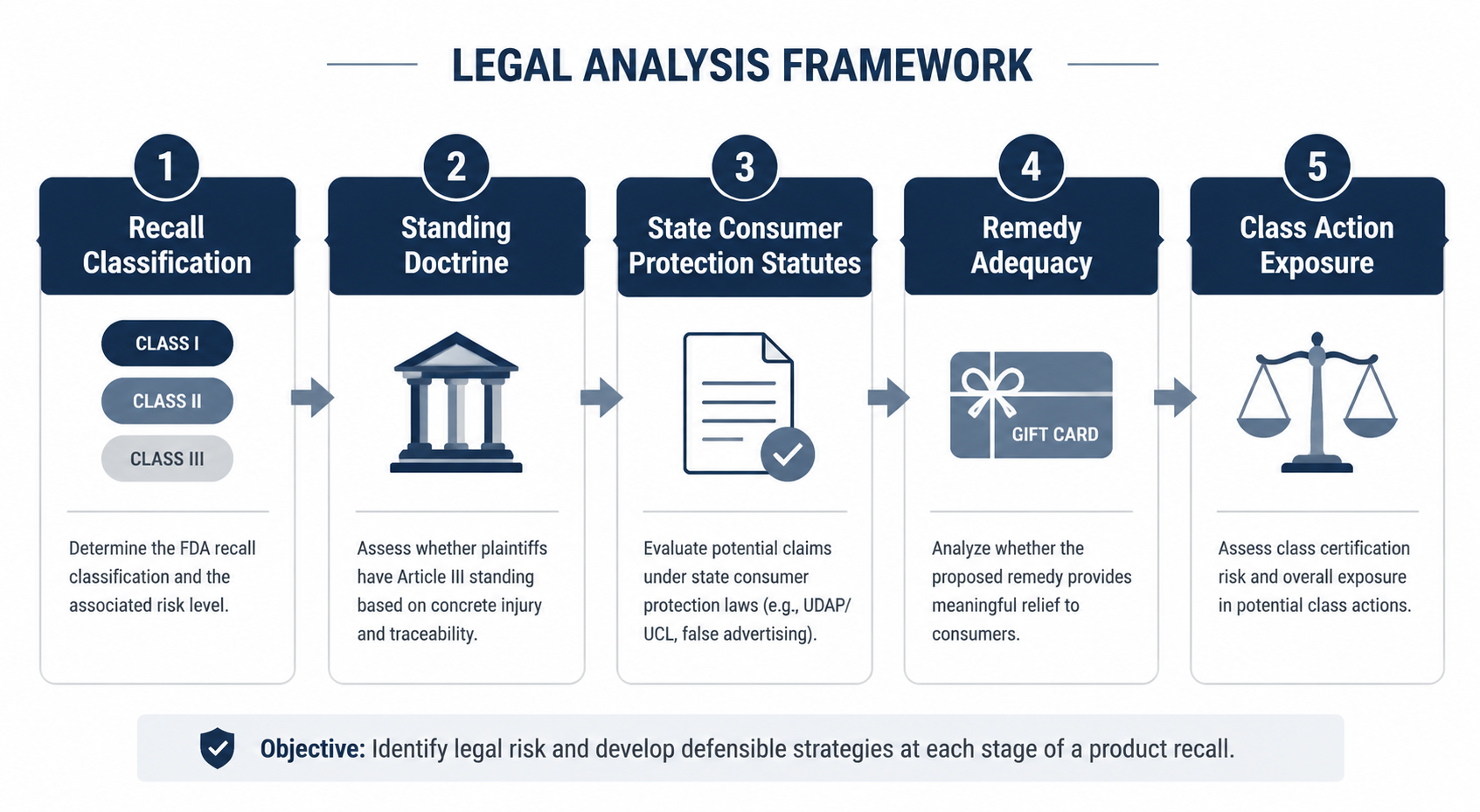
In the U.S. Food and Drug Administration framework, Class I recalls involve a reasonable probability that use of or exposure to the product will cause serious adverse health consequences or death; Class II recalls involve situations where adverse health consequences are temporary or medically reversible, or where the probability of serious adverse health consequences is remote; Class III recalls involve violations not likely to cause adverse health consequences.[3] The CFIA uses a parallel Class 1, Class 2, and Class 3 structure, with Heavenly Spices garlic powder placed in Class 2.[2]
| Recall classification | What it helps establish | What it does not establish by itself |
|---|---|---|
| Class I / Class 1 | A regulator views the health risk as serious enough to warrant the highest recall category. | That a particular plaintiff bought the affected product, consumed it, was injured by it, or can represent a class. |
| Class II / Class 2 | The event presents a recognized but lower regulatory risk, often framed around remote probability of serious consequences or moderate risk. | That every purchaser suffered an economic injury beyond the purchase price or that personal injury can be presumed. |
| Class III / Class 3 | The product may violate regulatory requirements even where adverse health consequences are unlikely. | That statutory damages, benefit-of-the-bargain damages, or classwide relief follow automatically. |
For Heavenly Spices, the Class 2 designation can support a careful allegation that a food regulator identified a safety concern involving the recalled garlic powder. It does not prove that any given jar was contaminated, that any buyer consumed contaminated product, or that the offered refund was legally inadequate. It also does not turn a Canadian recall into a U.S. federal case.
That distinction is often where consumer anger and litigation economics part company. A recall notice tells the market that the product should not remain in ordinary commerce. A complaint still has to identify a plaintiff with a cognizable injury.
The first gate is purchase, injury, and standing
The current U.S. standing landscape for post-recall food cases is not especially forgiving to complaints that treat the recall itself as the injury. Three recent decisions summarized by Cozen O’Connor in March 2026 are now doing much of the practical work in this area: Ward v. J.M. Smucker Co., McLean v. Walmart, and Catalano v. Grimmway Enterprises.[4]
Ward is the cleanest warning against pleading by association. The Sixth Circuit dismissed economic-loss claims where the plaintiff could not plausibly allege that the specific purchased product was contaminated.[4] In recall litigation, that gap appears constantly. A product line may be recalled; a purchaser may own a similar product; a public notice may use broad brand language. None of that necessarily establishes that the named plaintiff bought a unit within the affected lot, production window, geography, or distribution channel.
Ward matters for a garlic powder recall because the purchase is low value and fungible. A consumer may remember buying garlic powder. The law may ask for something narrower: Was it Heavenly Spices? Was it the recalled 70g product? Was it purchased from an affected Dollarama store in Canada? Was it within the recall notice? If the answer is vague, the complaint’s economic-loss theory begins to wobble before damages are even measured.
Catalano pushes the point from a different angle. In that case, the Southern District of New York treated the mere existence of a recall as insufficient for standing.[4] That holding is not surprising, but it is useful because post-recall complaints often rely on a rhetorical sequence that feels stronger than it pleads: product recalled, product unsafe, purchaser injured. Courts can interrupt that sequence at the second step if the plaintiff has not tied the recall to the product actually bought or to a legally recognized economic loss.
McLean supplies the remedy-program piece. The Western District of Arkansas addressed a voluntary recall with an accessible, barrier-free, fully compensatory refund program and concluded that such a program may moot standing.[4] The important word is not “voluntary.” It is “fully compensatory.” A refund process that returns the purchase price without unnecessary friction can narrow, and sometimes eliminate, the live controversy for purchasers claiming only that they paid for a product they should not have received.
That is where the $2.00 Heavenly Spices remedy becomes legally useful, even if it looks unsatisfying. If the product cost roughly that amount and the consumer can obtain the value without an obstacle course, a defense lawyer will argue that the buyer has been made whole for the only pleaded economic injury. If the process is confusing, underpublicized, limited to a gift card the consumer does not want, or otherwise less than the cash value paid, a plaintiff lawyer will argue the remedy did not cure the injury. The fight is no longer about whether recall anxiety is real. It is about whether the remedy extinguishes the legally cognizable loss.
For a deeper discussion of how a remedy program can operate as a class-action defense in this particular recall, see Can Dollarama's Garlic Powder Recall Defeat a Class Action?. The same issue sits underneath many no-illness food recalls: a remedy can be poor customer relations and still powerful litigation positioning.
No reported illness changes the available theories
The Heavenly Spices recall has been reported with no illnesses.[1] That does not make the recall trivial. It does, however, change the legal architecture. Without illness, the case is unlikely to be driven by traditional personal-injury product liability. The more plausible U.S. framing, if U.S. law applied to a comparable recall, would be economic loss under consumer protection statutes, false advertising, warranty, or benefit-of-the-bargain theories.
A benefit-of-the-bargain theory usually says the buyer paid for a food product that was safe, lawful, and fit for ordinary use, but received something worth less because it was subject to recall. That theory does not require a stomachache, a hospitalization, or a doctor’s bill. It requires a measurable economic injury. In a $2.00 garlic powder case, the measurable injury may be the entire purchase price, some reduced value, or nothing remaining after a complete refund.
False advertising theories may appear if packaging, website language, or retailer representations allegedly promised quality, safety, purity, or compliance inconsistent with the defect that caused the recall. But a recall notice alone is not the advertisement. A complaint still has to identify the representation, connect it to the plaintiff’s purchase decision where the statute requires reliance or causation, and explain why the recalled product failed to deliver what was promised.
The economic-loss framing is why food recall class actions can proceed even without physical injury. It is also why they can look disproportionate from a distance. A class of purchasers each claiming a few dollars can create aggregate exposure if the pleaded theory survives standing, causation, reliance, ascertainability, and damages challenges. But small-value does not mean easy. It means the named plaintiff’s facts and the remedy record have to do more work.
The Canadian posture of Heavenly Spices is a separate constraint. U.S. Article III doctrine does not simply migrate into a CFIA recall involving Canadian retail purchases. A Canadian purchaser considering rights under Canadian law faces a different statutory and procedural environment, and a U.S. purchaser who obtained the product cross-border would still have to solve jurisdiction, applicable law, and injury. For a Canadian-law-focused view of why this sort of Dollarama recall may rarely become a lawsuit, see Why a Dollarama garlic powder recall rarely leads to a lawsuit.
Refunds can narrow damages before certification begins
The remedy program is not just a customer-service detail. In low-value recall litigation, it can become the central litigation fact.
A fully compensatory refund may support arguments that the named plaintiff lacks ongoing injury, that damages are individualized, that injunctive relief is unnecessary, or that a class action is not superior to the remedy already available. A partial, conditional, or inconvenient remedy can have the opposite effect. It may help plaintiffs argue that the company tried to cap exposure without actually restoring what consumers lost.
The form of the Heavenly Spices remedy is therefore not a footnote. A $2.00 e-gift card may match the purchase value of a small grocery item, but gift-card relief is not the same as cash in every statutory or practical setting. A consumer who must remain within the retailer’s ecosystem, monitor an email process, or accept a substitute form of value has a different argument than a consumer offered immediate cash at the point of return. The public reporting also should be treated carefully: the $2.00 figure comes from news accounts citing a retailer spokesperson, not from a court-supervised settlement notice or a judicial finding about complete relief.[1]
That caution cuts both ways. A plaintiff should not inflate the recall into a personal-injury case without illness or exposure facts. A defendant should not assume that labeling something a refund program makes it barrier-free, fully compensatory, or class-defeating. The details are mundane, and the mundane details are often dispositive: proof of purchase, lot identification, deadline, form of payment, notice distribution, retailer discretion, and whether consumers who discarded the product can still recover value.
State consumer protection statutes do most of the work in no-injury recall cases
When no one is reported ill, product liability doctrine recedes unless there are exposure, medical-monitoring, or injury allegations that can be pleaded with jurisdiction-specific support. State consumer protection statutes then become the main vehicle. These statutes vary materially. Some require reliance; some focus on deception or unfairness; some allow statutory damages; some restrict class treatment; some interact awkwardly with warranty disclaimers or economic-loss rules.
The broadest viable theory is usually that consumers paid money for a product that was not fit for sale because of the condition that triggered the recall. If the theory is pleaded as price premium, the complaint must explain why the product was worth less at the time of purchase. If it is pleaded as full refund, the plaintiff must explain why the entire value failed. If the defendant already offered a full refund, the plaintiff must explain what loss remains.
These distinctions matter at class certification. A recall may supply common proof that the defendant acted at scale, but it does not automatically supply common proof of exposure, purchase, reliance, damages, or remedy adequacy. A clean SKU-level record helps plaintiffs. Mixed products, unlabeled pantry items, cash purchases, retailer-specific distribution, and discarded packaging help defendants. The garlic powder fact pattern is particularly exposed to those problems because the product is inexpensive, likely consumed or discarded quickly, and not something most households preserve with receipts and lot codes.
A parallel contamination-rights analysis involving Walmart lettuce shows the same pleading pressure from another angle: consumer rights become more concrete when the complaint can tie the alleged contaminant, the product, the purchase channel, and the plaintiff’s harm into one chain. See Consumer Legal Rights for Cyclospora-Walmart Lettuce.
Post-recall class exposure is real, but not every recall sits in the same risk tier
Food recall class actions remain active enough that practitioners are watching them closely in 2026. Hollingsworth LLP reported that FDA-reported recalls rose from 261 in 2024 to 295 in 2025, while Consumer Product Safety Commission recalls rose from 333 to 357 over the same period.[5] Those figures should be treated as a market signal rather than a case prediction for any single product, and they may not reflect later official updates.
The settlement benchmarks explain the attention. Cozen O’Connor identified recent recall-related food class settlements including Quaker Oats at $6.75 million, Mid American Pet Food at $5.5 million, TreeHouse Foods at $4.4 million, and Boar’s Head Provisions at $3.1 million.[4] Those numbers show that post-recall class exposure is not theoretical. They do not show that every small recall with no reported illness has comparable settlement value.
Several variables separate a serious class case from an irritated-consumer file: the seriousness of the hazard, the size and traceability of the affected population, whether consumers can prove purchase, whether illness or medical expense exists, whether the company’s pre-recall statements support a deception theory, whether the remedy made purchasers whole, and whether the governing statutes provide meaningful damages or fees. Heavenly Spices has some facts that attract attention—food product, contamination recall, national media coverage, conspicuously small remedy. It also has facts that restrain the litigation inference: Canadian recall, Class 2 classification, no reported illnesses, and a product value measured in a few dollars.
Product-liability duty questions may still matter in higher-injury recall settings, particularly where a manufacturer, distributor, retailer, or facility operator allegedly failed to control a known hazard. That duty analysis is a different inquiry from whether a disappointed purchaser has economic-loss standing after a modest grocery recall. For a broader duty-of-care framework in another hazard setting, see Why ASHRAE 188 Changed Legionnaires' Disease Lawsuits.
The practical litigation map after a garlic powder recall
A practitioner looking at a garlic powder recall should not begin with the headline. The useful sequence is narrower:
- Identify the recall authority, classification, product, size, lot information, distribution channel, and geography.
- Confirm whether the plaintiff bought the affected product, not merely a similar brand or category.
- Separate personal injury, exposure, and pure economic-loss theories.
- Test standing before merits: injury in fact, traceability, redressability, and any mootness effect from a refund.
- Match the theory to the governing statute or common-law claim, including reliance, causation, damages, and class-treatment requirements.
- Evaluate the remedy program as evidence, defense, and consumer-friction problem.
The $2.00 e-gift card is therefore not proof of wrongdoing, and not proof of legal adequacy either. It is the small object around which the real post-recall analysis turns. After a food recall, legal rights depend less on the emotional force of the notice than on the fit between the purchased product, the alleged harm, the available statutory theory, and the manufacturer’s remedy program. Before any class exposure becomes real, the claim still has to pass through standing, jurisdiction, damages, and state-law limits.
References
- News coverage of Heavenly Spices garlic powder recall and Dollarama remedy, New York Post, July 18, 2026, https://nypost.com
- Heavenly Spices brand Garlic Powder recalled due to Bacillus cereus, Canadian Food Inspection Agency, https://recalls-rappels.canada.ca/en/alert-recall/heavenly-spices-brand-garlic-powder-recalled-due-bacillus-cereus
- What Are Food Recalls and How Do They Work?, National Agricultural Law Center, https://nationalaglawcenter.org/what-are-food-recalls-and-how-do-they-work/
- The Continuing Rise of Post Recall Consumer Class Actions, Cozen O'Connor, March 2026, https://www.cozen.com/news-resources/publications/2026/the-continuing-rise-of-post-recall-consumer-class-actions
- What We're Watching in 2026: Increasing Recalls of Food and Supplement Products in 2026 Will Drive Consumer Class Action Litigation Alleging Violations of State Consumer Protection Statutes, Hollingsworth LLP, January 2026, https://hollingsworthllp.com/blog/what-were-watching-in-2026-increasing-recalls-of-food-and-supplement-products-in-2026-will-drive-consumer-class-action-litigation-alleging-violations-of-state-consumer-protection-statutes/
Comments
Join the discussion with an anonymous comment.