
When the Georgia Bureau of Investigation appears on a search warrant return, the first useful question is not whether Georgia permits search warrants. It does. The first useful question is what put the GBI in the investigation at all. A legal-process review of a GBI search warrant investigation starts with that footing, because the agency does not enter every criminal case through the same door.
The GBI describes its Investigative Division as having more than 350 employees and a statewide regional-office structure, but the more important point for warrant review is the division between requested investigations and independently initiated investigations. The agency says it provides investigative assistance when requested by local law enforcement, district attorneys, or other criminal justice officials, while also identifying specific areas in which it may initiate investigations independently, including drug enforcement, identity theft, and crimes against children.[1]
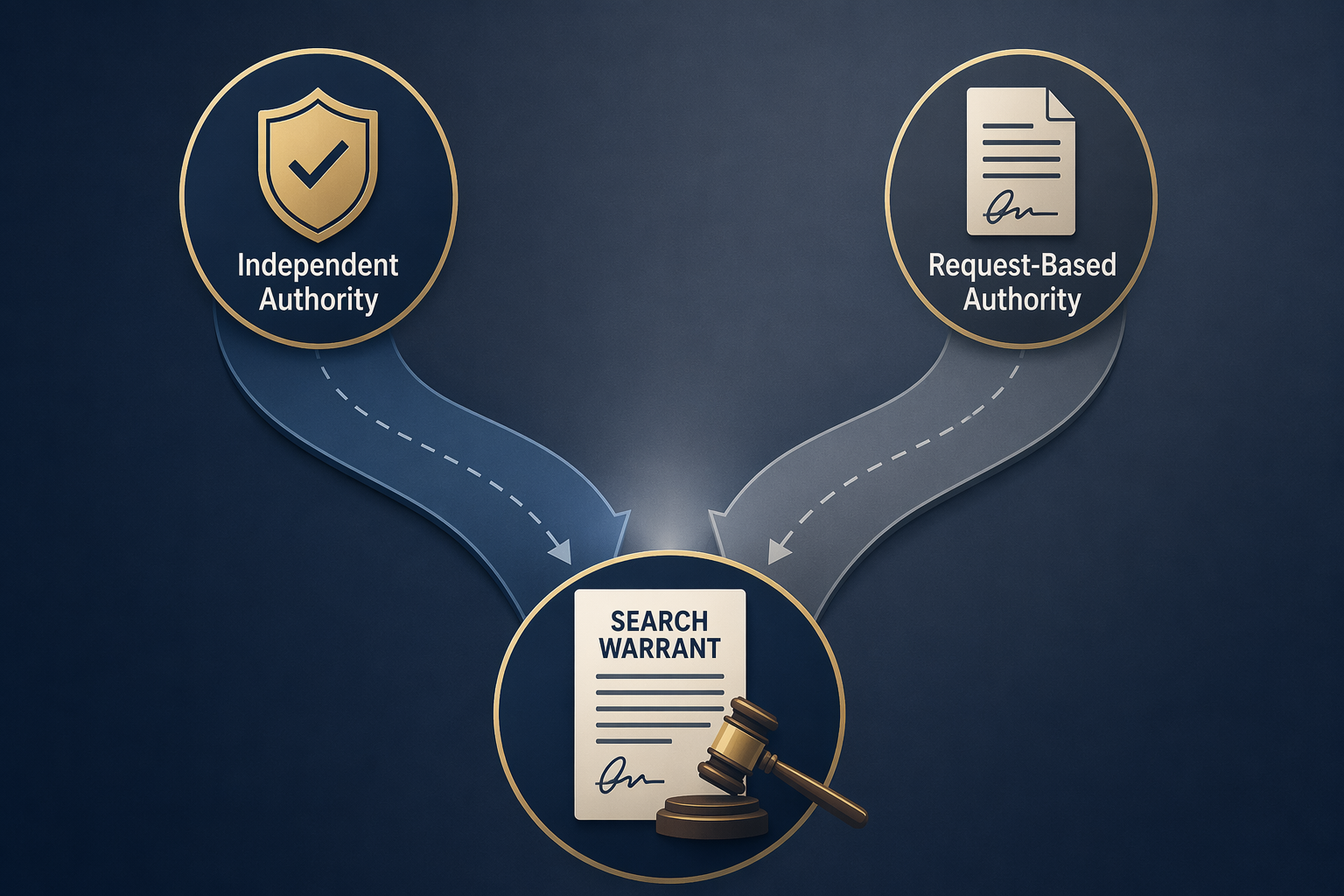
That distinction is not a decorative agency chart. In a narcotics, identity-theft, or crimes-against-children file, the reviewing lawyer should expect the GBI’s independent investigative posture to be part of the record. In a homicide, rape, armed robbery, fraud, or other general felony file, the same review should look for the request that brought the GBI in: who asked, when, and for what investigative assistance. The GBI’s own public materials frame that difference, and the warrant file should not make practitioners infer it from the letterhead alone.[1]
Start With Agency Authority, Not the Search Scene
The GBI’s Investigative Services materials describe a broad law-enforcement role across criminal investigations, forensic support, crime analysis, and specialized services.[2] That breadth can obscure the narrower procedural question in a warrant challenge. The fact that a GBI agent participated does not answer whether the agent was acting under independent authority or in response to a qualifying request.
For file review, the agency-authority question belongs near the front of the checklist. A warrant affidavit may set out probable cause in careful detail and still leave a gap about why the GBI was the agency applying for or executing the warrant in that matter. Sometimes the answer will be obvious from the offense category. Sometimes it will be supplied by a request letter, a district attorney referral, a local agency case supplement, or testimony. Sometimes it will be missing from the documents initially produced.
This is especially important because GBI agents are not merely analysts or consultants. The GBI’s Special Agent job materials describe special agents as certified peace officers with authority, among other duties, to execute warrants, make arrests, and seize contraband under Georgia criminal-procedure law.[3] Once an agent is properly in the case, Georgia’s ordinary search-warrant statutes govern the warrant process. The point is not that GBI warrants live under a separate warrant code. The point is that the agency’s path into the investigation can affect what a careful affidavit and later warrant review should contain.
What the Affidavit Should Make Visible
Search-warrant analysis still begins with familiar constitutional material: a warrant generally rests on probable cause, is issued by a neutral magistrate, and must particularly describe the place to be searched and the things to be seized.[4] In a GBI file, those requirements do not disappear. They become the second layer of review after the agency-authority question is placed correctly.
A useful GBI affidavit usually does more than recite an offense and ask for permission to search. It ties the agent’s role to the investigation type, identifies the facts supporting probable cause, describes why evidence is likely to be found in the location or device to be searched, and confines the requested seizure to items connected to the suspected crime. If the case falls outside the GBI’s independent-investigation categories, the affidavit or supporting file should allow a reviewer to trace the request-based posture without guesswork.
| Review Question | Why It Matters in a GBI File |
|---|---|
| Is the offense within a GBI independent-investigation category? | The GBI identifies drug enforcement, identity theft, and crimes against children as areas where it may initiate investigations independently. |
| If not, who requested GBI assistance? | For other felony investigations, the file should show the request from local law enforcement, a district attorney, a judge, or another authorized criminal justice official. |
| Does the affidavit connect the evidence to the place searched? | Probable cause is not supplied by agency status; the affidavit still must support the search location and items sought. |
| Are the items to be seized described with practical limits? | Particularity becomes critical when the warrant seeks phones, business records, financial files, or broad categories of digital material. |
The probable-cause showing should be read in the same practical way the warrant will be defended or attacked later. Which facts came from witness statements, surveillance, controlled purchases, forensic review, financial records, cyber tips, or another agency? Which facts are stale, which are current, and which actually link the suspected evidence to the search target? A GBI badge may explain who investigated, but it does not itself establish why evidence should be found in a house, vehicle, phone, business office, or cloud account.
Georgia’s Warrant Workflow, Read Like a File
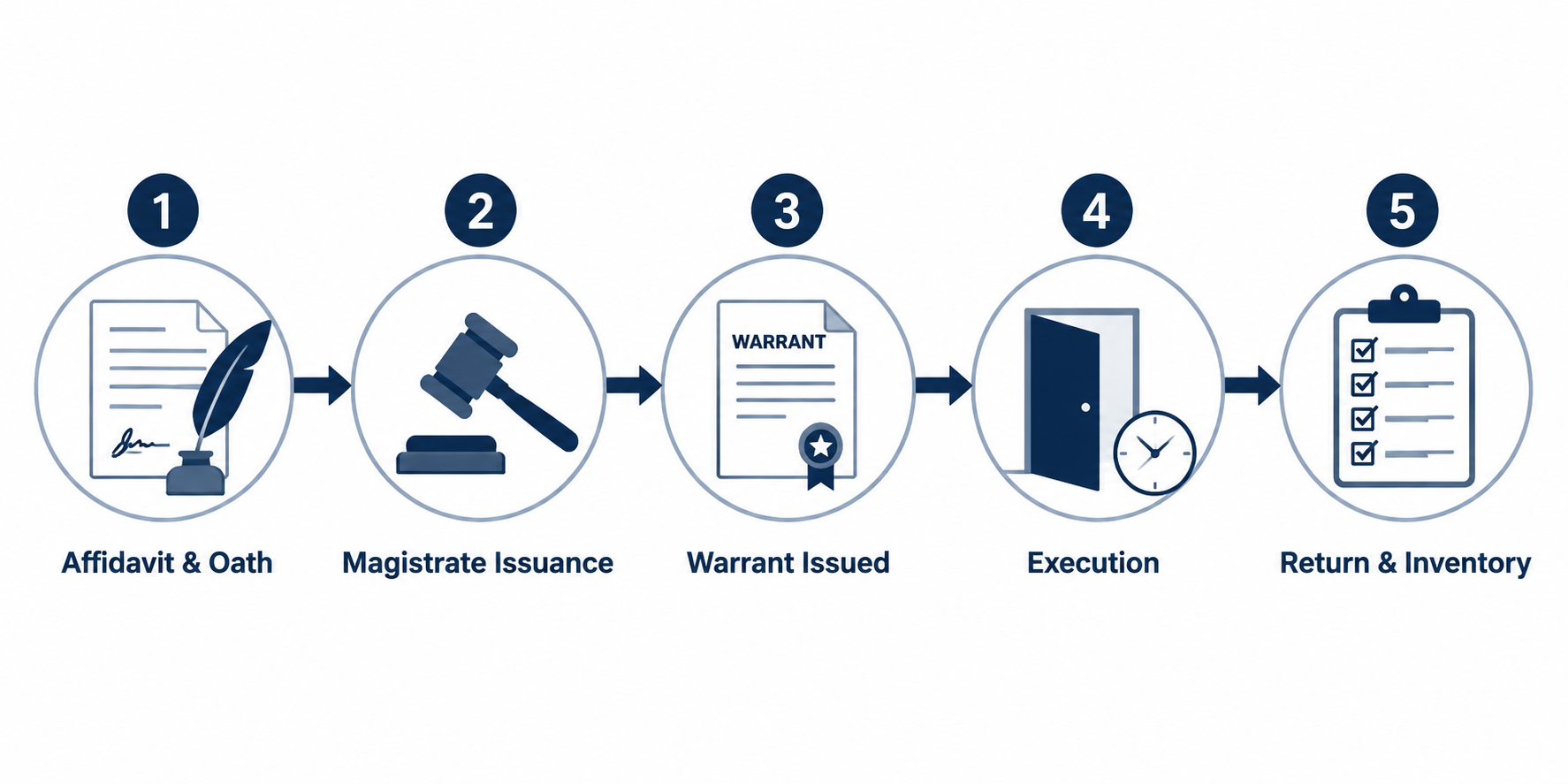
Georgia’s statutory process is not complicated on paper. The risks usually appear in the fit between the paperwork and the search that actually occurred. The review moves from sworn application, to magistrate issuance, to the grounds and scope of the warrant, to execution, seizure, and return.
Affidavit, Oath, and Issuing Magistrate
O.C.G.A. § 17-5-20 is the starting point for issuance. The cited sources describe the statute as requiring a sworn affidavit, made under oath before a judicial officer authorized to issue search warrants, and they note Georgia’s county-level system for magistrate availability.[5] For a practitioner, the immediate questions are direct: who swore to the affidavit, before whom, on what date and time, and what documents were actually presented to the magistrate?
That last question matters because later suppression litigation often turns on the record that existed at issuance, not on what investigators learned after entry. If a GBI agent had additional information in the case file but did not include it in the affidavit or otherwise present it to the issuing judge, the missing material may not rescue a thin warrant. Conversely, a defense review that ignores attachments, incorporated statements, or sealed supplements may underrate the warrant’s showing.
Grounds for Issuance and Particularity
O.C.G.A. § 17-5-21 addresses the kinds of property and evidence that may be seized under a Georgia search warrant, including stolen or embezzled property, contraband, instrumentalities used in committing a crime, and evidence connected to criminal activity. The same materials describe the requirement that the warrant particularly identify the place to be searched and the items to be seized.[6]
Particularity does more work in some GBI cases than others. A warrant for a defined quantity of narcotics at a residence creates one kind of scope problem. A warrant for business records, ledgers, phones, computers, customer lists, bank documents, and communications in a fraud investigation creates another. The broader the evidence universe, the more carefully the warrant should tie the seizure categories to the alleged offense, relevant time period, people or entities under investigation, and places where the evidence is expected to exist.
Practitioner summaries of Georgia warrant law commonly discuss probable cause, particularity, and knock-and-announce in these terms, but the statutory text and the warrant record should carry the analysis.[9] A law-firm article can help identify the vocabulary lawyers use. It should not substitute for checking the warrant against the operative Georgia provisions and the documents in the case.
Execution Timing and Manner
O.C.G.A. § 17-5-25 is the provision to pull when reviewing execution. The cited sources describe a 10-day execution window, a general daylight-execution rule unless special authorization is obtained, and a knock-and-announce requirement before forcible entry.[7] These are not usually the most elaborate issues in the file, but they are easy to mishandle if no one compares the warrant’s issuance time, execution time, and authorization language.
- Confirm the warrant was executed within the statutory window.
- Check whether the search occurred during daylight hours or whether the warrant authorized another manner of execution.
- Compare the entry narrative with the knock-and-announce requirement and any claimed exception.
- Match the seized items against the warrant rather than against the investigation’s broader theory.
- Review the return and inventory for timing, completeness, and consistency with body-camera, evidence logs, or agency reports when available.
Improper-search challenges are not limited to bad affidavits. They may also involve searches outside the warrant’s scope, execution defects, seizure of items not authorized by the warrant or an exception, or law-enforcement conduct that exceeds constitutional or statutory limits. Practitioner discussions of improper searches in Georgia generally organize the issues around those kinds of breakdowns.[10]
Documentary Evidence Is Its Own Problem
Fraud, financial-crime, and business-record searches deserve separate attention because documentary evidence can pull a warrant into additional statutory handling. O.C.G.A. § 17-5-32 addresses warrants seeking documentary evidence and includes special-master procedures in specified circumstances.[8] In practice, that means a reviewer should not treat a business-record warrant as just a longer version of a narcotics warrant.
The first pass is ordinary particularity: which records, for which entities, during which period, connected to which suspected offense. The second pass asks whether the warrant implicated documentary-evidence protections and, if so, whether the required process was followed. The third pass is execution: whether agents seized only the records authorized, whether privilege or third-party record concerns were identified, and whether any later review procedure matched the warrant and order.
This is where the GBI’s request-based posture may matter in a practical way. A general fraud investigation may have begun with a local agency, a district attorney, or another federal or state partner, with the GBI assisting after a request. The affidavit and surrounding file should make that posture understandable, especially when the search reaches business premises or records belonging to people beyond the named target.
A Coordinated Fraud Search: Yurezz Home Center
The Yurezz Home Center matter is a useful illustration because it does not ask the reader to imagine a clean single-agency file. In the Lex Machina Review article Richard and Heather Altman Face Fraud Charges Across Five States, the reported search warrant was executed in Baxley, Georgia, as part of a coordinated investigation involving the GBI and the FBI’s Savannah Resident Agency.
For warrant review, the value of that kind of example is not drama. It is structure. A coordinated fraud investigation raises the questions that matter in the paper record: which agency initiated which part of the investigation, what request or referral brought the GBI into the matter if independent authority did not apply, whether the affidavit separated Georgia-specific probable cause from a broader multistate theory, and whether the warrant’s seizure language handled documentary evidence with enough precision.
Federal involvement does not make the Georgia warrant review disappear. If Georgia officers obtained or executed a Georgia warrant, the Georgia statutory path still has to be reconstructed. If federal agents supplied information, that information should be traceable in the affidavit. If records were seized, the return and inventory should show what was taken and from where. The file may be coordinated; the warrant still has an issuing court, a sworn affiant, a described place, a list of things to be seized, and an execution record.
Suppression Review Without Inventing a Separate GBI Warrant Doctrine
No Georgia appellate line of cases appears to focus specifically on GBI search-warrant challenges. That absence should be handled plainly. It does not mean GBI warrants are immune from challenge, and it does not create a special body of GBI warrant law. It means the challenge usually has to be built from general Fourth Amendment principles, Georgia constitutional and statutory requirements, and the agency-authority facts in the particular record.
The strongest review is therefore sequential. First, identify the investigation type and the GBI’s authority posture. Second, inspect the request, referral, or independent-authority basis. Third, read the affidavit for probable cause, staleness, nexus, and particularity. Fourth, compare the warrant to Georgia’s issuance and execution requirements. Fifth, test the search against the warrant’s actual limits. Sixth, preserve any documentary-evidence issue before the record becomes too scattered to reconstruct.
Defense counsel will read that sequence for suppression issues. Prosecutors will read it for proof points that need to be documented before a hearing. Legal operations teams may read it as a training problem: agents and assistants need warrant templates that prompt the authority posture, not just the search location and probable-cause narrative.
The Practical Test
A GBI warrant file is in better shape when a later reviewer can answer these questions from the documents without relying on institutional memory:
- What offense category gave the GBI its investigative footing?
- If the matter required a request, where is that request documented?
- What facts established probable cause before the warrant issued?
- How did the affidavit connect the suspected evidence to the specific place, device, person, or records searched?
- Did the warrant describe the items to be seized with enough precision for the offense and evidence type?
- Were issuance, execution timing, entry method, seizure, return, and inventory consistent with Georgia’s statutory requirements?
- If documentary evidence was sought, were special statutory procedures considered and followed?
Those questions do not decide every motion. They prevent the most common shortcut: treating “GBI executed a search warrant” as though it answers authority, probable cause, particularity, execution, and return all at once. It answers none of them by itself.
Before relying on any warrant analysis, practitioners should verify the exact current language of the Georgia Code, including O.C.G.A. §§ 17-5-20 through 17-5-25 and § 17-5-32, against official Georgia sources. Case-specific strategy should be evaluated by qualified Georgia counsel.
References
- Investigative Division, Georgia Bureau of Investigation.
- Investigative Services, Georgia Bureau of Investigation.
- GBI Special Agent, Georgia Bureau of Investigation.
- Search Warrant, Cornell Legal Information Institute Wex.
- Georgia Code § 17-5-20, Justia.
- Georgia Code § 17-5-21, Justia.
- Georgia Code § 17-5-25, Justia.
- Georgia Code § 17-5-32, FindLaw.
- Grounds for a Search Warrant in Georgia, McCoy Law, January 12, 2022.
- Improper Searches, Williams Law Group.
Comments
Join the discussion with an anonymous comment.