
Scott Strazik did not sound like a chief executive trying to puncture his own company’s growth story. At the Bernstein Strategic Decisions Conference on May 27, 2026, the GE Vernova CEO acknowledged something more useful than the usual AI-power slogan: “more and more states are pushing back” against data center projects, and customers are “struggling to get projects across the line.” The market understood the implication quickly enough. The remarks helped trigger a multi-day selloff that erased roughly 8.5% of GEV’s market value.[1]
That is the right starting point for assessing GEV’s AI infrastructure risk. The problem is not whether AI needs electricity. It does. The problem is whether the projects sitting behind that demand can become permitted, financed, interconnected, rate-approved infrastructure quickly enough to support the expectations now embedded in the stock.
GEV has been one of the cleanest public-market ways to express the AI infrastructure trade: gas turbines in Power, grid equipment in Electrification, and a wind business that still matters to the broader energy-transition mix. It also has a record backlog and, since its public-market debut, a stock gain that reached 742% by July 2026. Those facts make the legal risk more important, not less. A backlog is not revenue. A turbine order does not by itself solve state siting, cost allocation, environmental review, or interconnection.

The Investment Question Has Moved From Demand to Conversion
The bullish version of GEV is easy to state and still difficult to dismiss. Hyperscale data centers need reliable power. Utilities need generation and grid equipment. Industrial customers want electrification. Governments want domestic infrastructure capacity. GE Vernova happens to sell into each of those lanes.
But the most important question for the next several quarters is not whether the company can point to demand. It is whether that demand converts. Conversion depends on a sequence of approvals that investors too often compress into one word: permitting. In practice, the chain is messier. A data center or utility-backed generation project may need local land-use approval, state environmental review, utility commission treatment, interconnection study progress, transmission upgrades, cost-recovery clarity, and a credible answer to who pays when one large customer forces grid investment.
That is why Strazik’s warning deserves more weight than an outside critic’s complaint. It came from the company with the backlog. It identified the customer bottleneck. It landed in the middle of an investment narrative that had been rewarding GEV for AI-linked infrastructure exposure without fully pricing the possibility that state law and utility regulation could slow the calendar.
State Policy Is Shifting From Recruitment to Control
The state-level wave should be described carefully. More than 300 data center-related bills introduced across more than 30 states in the first six weeks of 2026 does not mean 300 binding restrictions. Many introduced bills die quietly. Some are bargaining chips. Some are messaging documents. Treating that figure as enacted law would overstate the case.[2][3]
Still, legislative volume matters. It shows a policy turn. States that once competed for data centers through tax incentives, land, and utility coordination are now asking how much power these facilities consume, whether residential and small-business ratepayers subsidize grid upgrades, whether water use and emissions fit local policy, and whether existing utility planning processes are being bent around a few exceptionally large customers.
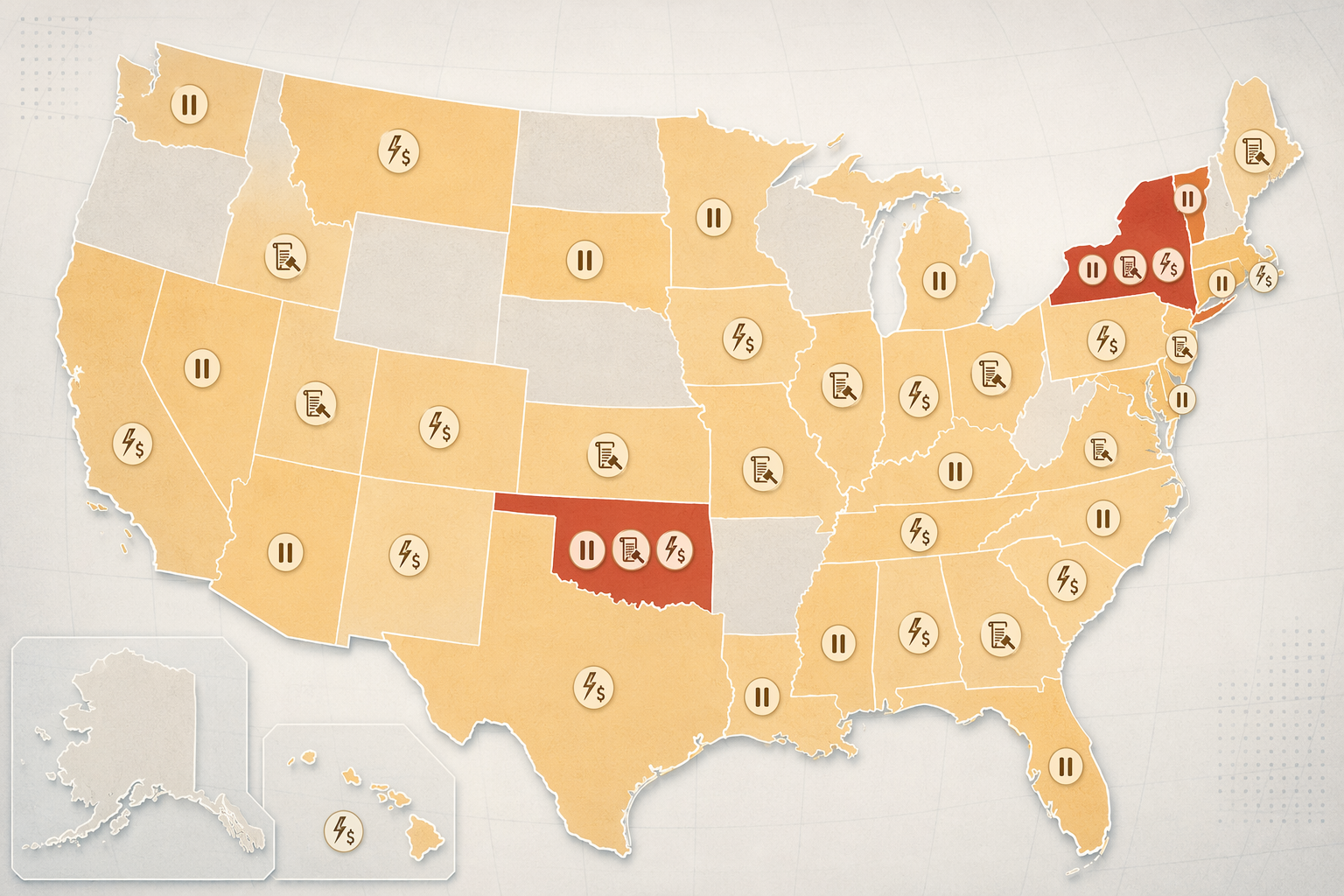
The most visible proposals are moratoriums, but they are not the whole story. New York has had a proposed three-year halt. Oklahoma has had a proposal running until November 2029 for data centers larger than 100 MW. Vermont has had a proposed halt until July 2030. Those proposals sit at the hard end of the spectrum: pause first, sort out consequences later.[2][3]
The more durable regulatory movement may be less dramatic: special rate classes and infrastructure cost-sharing mandates for large energy users. At least 18 states have introduced bills along those lines.[2][3] That is where utility regulation becomes directly material to GEV’s order conversion. A hyperscaler may still want a data center. A utility may still want turbines, transformers, switchgear, substations, and transmission upgrades. But if the commission, legislature, or attorney general insists that the large-load customer bear more of the grid cost, the economics and timing change.
This is not necessarily anti-growth politics. A state commission that asks whether a new data center should pay for transmission upgrades is doing ordinary utility work under unusually intense conditions. The harder legal question is whether a state can slow or condition development without colliding with federal authority over wholesale power markets, transmission, or interstate commerce. Prior coverage of state data center regulation’s constitutional patchwork has focused on those theories: Equal Protection, Federal Power Act preemption, and Dormant Commerce Clause arguments. For GEV investors, the point is narrower. Even a challenge that eventually succeeds can leave a project sitting in uncertainty while the revenue clock keeps moving.
The same practical lesson comes from project-level disputes such as the Nebius Vineland permitting standoff, where environmental justice review became part of the development timeline. The investment consequence is not that every data center is doomed to litigation. It is that the path from announcement to equipment revenue is increasingly exposed to state-law friction.
The Federal Fast-Track Case Is Real
The counterargument deserves serious treatment because it is not imaginary. Federal policy has moved sharply toward AI infrastructure acceleration. Executive Order 14318, issued July 23, 2025, defines data center “covered components” to include natural gas turbines, transmission lines, substations, transformers, and switchgear. Those are not peripheral categories for GEV; they are central product families. The order also directs agencies to establish new NEPA categorical exclusions and expedite Clean Water Act permitting for projects with at least $500 million in capital expenditure.[4]
FERC has also entered the large-load fight. On June 18, 2026, it issued show-cause orders to all six regional grid operators, giving them 60 days to justify or reform interconnection rules for data centers and other large loads.[5][6] If that process forces more standardized treatment of large-load interconnection, it could reduce one of the most important timing risks for AI infrastructure projects.
The proposed DATA Act adds another legal route. As described in 2026 coverage, the Decentralized Access to Technology Alternatives Act would allow off-grid AI data centers to bypass FERC jurisdiction by relying on dedicated on-site generation.[7][8] That structure would make GEV’s gas turbines and microgrid offerings more relevant, especially for customers trying to avoid congested interconnection queues.
A credible bull case can be built from those pieces. If federal agencies narrow environmental review, FERC pressures grid operators to modernize large-load rules, and off-grid generation becomes a more accepted AI infrastructure model, GEV could benefit across generation and grid equipment. The legal machinery points toward exactly the assets GEV sells.
The unresolved question is timing. Federal ambition does not automatically decide state siting, local opposition, retail rate design, environmental justice review, or who pays for distribution and transmission upgrades. It may improve the path. It may even preempt some forms of state resistance. But investors are not valuing a law-school exam. They are valuing 2026 and 2027 order conversion.
Power: Sold-Out Capacity Limits the Easy Upside
GEV’s Power segment is the cleanest AI infrastructure story and, for that reason, the easiest place to overstate the upside. Gas turbines are precisely the kind of dispatchable generation asset data center developers and utilities discuss when reliability becomes non-negotiable. Executive Order 14318’s inclusion of natural gas turbines in covered data center components confirms that federal policymakers understand their role.[4]
But the segment is capacity-constrained. BNP Paribas Exane’s April 2026 downgrade noted that GEV’s gas turbine capacity was approximately 90% contracted through 2030.[9] That matters because incremental upside is not simply a matter of finding new AI-linked buyers. If capacity is already heavily spoken for, the investment sensitivity shifts toward project execution, pricing, delivery schedules, and whether customers with contracted capacity can get their own projects approved.
A delayed data center, a contested utility plan, or a revised cost-allocation order does not have to destroy demand to affect GEV. It only has to push equipment timing, reorder customer priorities, or complicate the path from contracted backlog to recognized revenue. The stock’s AI premium is far more vulnerable to delay than to a clean cancellation narrative.
Electrification: The Backlog Runs Into the Grid Queue
Electrification may be the segment most directly exposed to the regulatory conversion gap. The backlog reached $24 billion in Q2 2025, up nearly 40% year over year.[10] Transformers, substations, switchgear, and related grid equipment are exactly what large-load growth requires. They are also exactly what becomes trapped when interconnection studies, transmission planning, and utility cost recovery slow down.
The International Energy Agency has estimated average grid interconnection delays at 7 to 10 years, and found that 20% of planned data center projects globally face significant delays from grid connection challenges.[10] Those numbers do not prove that every GEV-linked project will wait that long. They do establish that grid connection is not a clerical step after demand appears. It is often the binding constraint.
State rate-class legislation makes this worse in a specific way. If a legislature or commission tells large users to pay more directly for grid upgrades, the underlying equipment still may be needed. But procurement can pause while the parties negotiate tariffs, contribution requirements, utility recovery, and customer commitments. In that window, GEV’s backlog can remain impressive while revenue timing becomes harder to model.
| GEV Segment | AI Infrastructure Link | Legal or Regulatory Conversion Risk |
|---|---|---|
| Power | Gas turbines and related generation capacity for reliable data center load | Customer projects must clear siting, state oversight, environmental review, and cost-allocation disputes; turbine capacity is already heavily contracted through 2030 |
| Electrification | Transformers, switchgear, substations, transmission and grid equipment | Interconnection delays, transmission planning, and special rate-class disputes can slow backlog-to-revenue conversion |
| Wind | Part of broader power supply and energy-transition procurement | Tariff uncertainty and order-flow weakness create adjacent legal and policy risk rather than the central AI data center bottleneck |
Wind Is a Related Risk, Not the Center of This One
Wind should not be forced into the same data center thesis. It matters to GEV’s consolidated results and to utility procurement, but the AI infrastructure legal issue runs more directly through gas generation, transmission, substations, transformers, and large-load interconnection.
The segment still carries legal and policy exposure. Tariff uncertainty has frozen fresh order flow, and Strazik has acknowledged that onshore wind revenue could decline by up to 15% in 2026.[11] That is not the same risk as state data center regulation, but it narrows the margin for error if investors are relying on Power and Electrification to carry the AI-driven premium.
What Investors Should Actually Watch
The useful indicators are not broad AI capex headlines. Alphabet, Microsoft, Amazon, Meta, and other large buyers can raise capex plans without eliminating state-level bottlenecks. For GEV, the more relevant signals are narrower and more legalistic.
- Whether proposed data center moratoriums become enacted restrictions, negotiated study periods, or political dead letters.
- Whether special rate classes for large energy users require upfront contributions that change project economics or delay utility procurement.
- Whether FERC’s show-cause process produces concrete interconnection reforms or mainly procedural filings.
- Whether federal permitting acceleration under Executive Order 14318 reaches the state and local chokepoints that actually hold projects.
- Whether GEV’s backlog disclosures show conversion discipline rather than only headline growth.
There is a temptation to turn every state bill into a bearish datapoint. That would be sloppy. Introduced legislation is not enacted law. Statehouses often use aggressive bills to force disclosure, extract infrastructure commitments, or shift negotiating leverage. A moratorium proposal in one state does not mean a national shutdown of data center development.
The opposite mistake is more dangerous at GEV’s current altitude: treating state regulation as noise because federal policy is broadly supportive. Utility commissions and state legislatures are not spectators in this buildout. They decide rate treatment. They influence cost recovery. They can condition or delay projects. They answer to customers who do not want AI infrastructure embedded in ordinary electricity bills without scrutiny.
The Calibrated Read on GEV
GE Vernova may still be one of the clearest public-market beneficiaries of AI infrastructure spending. Its product exposure is elegant, its backlog is substantial, and federal policy increasingly names the components it sells. A simple bearish story that ignores those facts is no better than a simple bullish story that ignores regulation.
The underweighted risk is more precise. GEV’s AI infrastructure upside depends on customers moving projects through state regulation, utility rate design, environmental review, cost-allocation disputes, and interconnection queues quickly enough to match market expectations. Strazik’s May warning made that risk investable because it came from inside the growth story, not outside it.
Federal fast-tracking can help. It may become a powerful accelerator. But unless it changes the practical state-level path from announcement to approval to grid connection, the central issue for GEV stock is not AI demand creation. It is regulatory conversion.
References
- GE Vernova Stock Drops After CEO Warns of Data Center Pushback, TheStreet, May 2026
- Data Center Legislation: States Shift From Incentives to Regulation, ArentFox Schiff, April 2026
- Data Center Legislation Tracker, MultiState, February/April 2026
- Executive Order 14318, The White House, July 23, 2025
- FERC Issues Show Cause Orders on Large Load Interconnection Rules, White & Case, June 2026
- Show Cause Orders to Regional Transmission Organizations and Independent System Operators, Federal Energy Regulatory Commission, June 18, 2026
- DATA Act Would Support Off-Grid AI Data Centers, DataCenterDynamics, 2026
- Decentralized Access to Technology Alternatives Act Analysis, Foley Hoag, March 2026
- BNP Paribas Exane Downgrade of GE Vernova, BNP Paribas Exane, April 2026
- Electricity Grids and Secure Energy Transitions, International Energy Agency
- GE Vernova Onshore Wind Revenue Warning, GE Vernova
Comments
Join the discussion with an anonymous comment.