
The legal process for a wrongful death settlement after a go-kart crash starts to look different from an ordinary premises case almost immediately. The family is not only asking whether the track was unsafe. Counsel has to know who operated the ride, who wrote and enforced the rules, who owned the kart, who maintained it, whether a manufacturer defect is plausible, what the waiver actually says, whether the rider was a minor, which amusement-ride regulations apply, and whether any defendant has insurance or assets worth pursuing.
The fatal Urban Air go-kart crash in Port St. Lucie, Florida shows why that sequence matters. Six-year-old Emma Riddle was killed in a crash at the venue. Florida agriculture officials found that the operator allowed a child to drive despite an 18-year-old minimum driver rule, failed to ensure seatbelt use, and permitted excessive speeds; the matter led to a $300,000 administrative settlement with the state.[1] That number should not be mistaken for a civil wrongful death settlement. It is a regulatory resolution, and the separate civil recovery question turns on a different record: defendants, insurance, waivers, causation, damages, and collectability.

Why the First Theory Is Usually Too Small
The obvious theory after a fatal recreational crash is negligent supervision: an operator let a dangerous activity proceed under unsafe conditions. That may be correct, but it is rarely complete. A go-kart death may involve premises liability, negligent operation, negligent maintenance, product liability, negligent entrustment, comparative fault allegations, amusement-ride regulatory violations, and a waiver defense in the same file.
Urban Air also illustrates the uncomfortable financial layer. Reporting after the crash described lawsuits, about $270,000 in back rent, $80,000 in delinquent taxes, and a go-kart manufacturer that reportedly did not carry product liability insurance.[2] Those facts do not decide liability. They do decide how quickly counsel should move from “who was negligent” to “which defendant can pay a judgment or fund a settlement.”
Go-kart crashes are not statistical oddities, though the available numbers have limits. One compilation cites roughly 10,500 emergency-room-treated go-kart injuries per year, historical CPSC data showing 113 deaths of children under 15 from go-karts between 1990 and 1999, and recreational off-highway vehicle deaths that doubled from 331 in 2003–2012 to 635 in 2018–2020.[3] The child death figures are old, and the later death category is broader than go-karts. The safer use of the data is modest: these are recognized recreational-vehicle risks, not freak events beyond the reach of safety rules.
The Intake Questions That Change the Case
At intake, the family may describe the crash in human terms: a birthday party, a family outing, a school-age child in a kart, confusion at the track, a waiver signed at a counter or kiosk. Counsel has to translate that account into evidence before the venue, insurers, and product-side entities finish building their own version.
| Intake Issue | Why It Matters in a Go-Kart Death |
|---|---|
| Victim's age and role | A minor passenger, minor driver, adult driver, or bystander creates different waiver, supervision, and comparative fault questions. |
| Who signed the waiver | A parent-signed form may not extinguish the child's own claim, but wording, forum, arbitration, indemnity, and adult claims still matter. |
| Operator rules | Age limits, seatbelt rules, speed rules, height requirements, and ride instructions may become admissions or regulatory hooks. |
| Kart condition | Brakes, throttle, steering, seatbelt, governor, barriers, and maintenance records can separate operator negligence from product or maintenance theories. |
| Venue structure | Franchise, parent-brand, property-owner, and contractor relationships may determine control and insurance access. |
| Regulatory involvement | Agency inspections, citations, settlements, and ride rules may supply duty evidence or support negligence per se arguments. |
The priority is not to draft the complaint first. The priority is to prevent the physical and digital evidence from disappearing. Go-kart venues hold the evidence that often decides liability: surveillance video, point-of-sale waiver logs, incident reports, employee schedules, ride-operator training records, pre-shift inspection sheets, maintenance logs, prior incident records, manufacturer manuals, speed-governor settings, and communications with insurers or regulators.
Preservation Before Pleading
A preservation letter in this setting should be specific enough that later spoliation arguments do not collapse into generalities. “Preserve all evidence related to the crash” is weaker than a demand naming the kart, companion karts, barriers, track layout, telemetry if any, maintenance records, inspection records, surveillance angles, waiver metadata, employee communications, rule signage, admission records, and post-incident repair or alteration evidence.
Physical inspection should follow quickly. If the kart has a seatbelt issue, brake issue, stuck throttle theory, steering problem, or speed-control question, the condition of the machine matters more than a later witness description. Counsel should consider whether to seek a joint inspection protocol, temporary restraining order, or expedited discovery if there is reason to believe the kart, track, or barrier system may be repaired, discarded, or altered.
The same urgency applies to digital records. Waiver systems may preserve timestamps, signer identity, device data, version history, and linked participants. Video may overwrite automatically. Employee texts may sit outside formal incident files. If a regulator has already opened an investigation, counsel should track the agency record without assuming it will capture every civil-litigation issue.
Mapping Defendants and Insurance
The operator is the first defendant most families can name. It may not be the only viable defendant, and it may not be the best-funded one. In a commercial go-kart case, counsel should separate the entities by function rather than brand name.
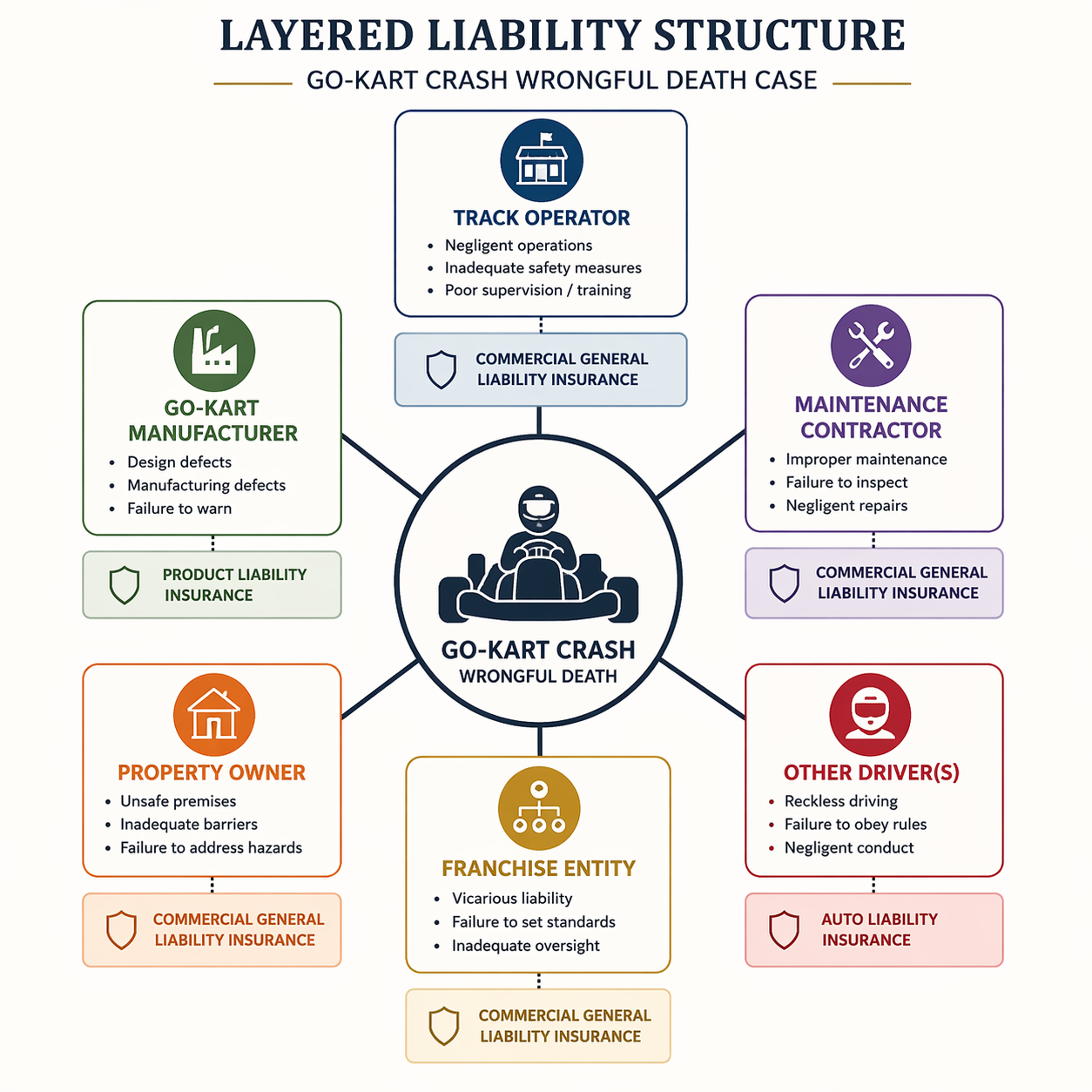
- Track operator: controlled admissions, staffing, rules, supervision, speed control, seatbelt enforcement, and emergency response.
- Franchise or parent-brand entity: may have imposed operating standards, manuals, training requirements, branding, audit rights, or safety protocols.
- Property owner or landlord: may matter if track layout, premises defects, lease obligations, or retained control contributed to the crash.
- Kart manufacturer or distributor: may face design, manufacturing, warning, or component-defect theories if the machine failed or lacked adequate restraints or speed controls.
- Maintenance contractor: may be responsible for inspections, repairs, replacement parts, or ignored defect reports.
- Other driver or supervising adult: may be relevant where unsafe driving, negligent entrustment, or rule violations contributed to the collision.
This defendant map is also an insurance map. The operator may have commercial general liability coverage, an amusement or recreation endorsement, excess coverage, or exclusions tied to motorized vehicles or participant injury. A manufacturer may have product liability coverage, or, as reporting in the Urban Air matter alleged, none at all.[2] A landlord may have premises coverage but no operational control. A franchise entity may deny responsibility while still holding documents that show safety control.
Early policy discovery is not housekeeping. It affects pleading, mediation timing, expert spend, and whether a case should pursue a narrow policy-limits route or a broader liability architecture. A catastrophic set of facts against an insolvent operator can produce less practical leverage than a carefully supported claim against a covered entity whose safety rules were ignored.
The Waiver Is a Defense, Not the End of the File
Go-kart venues often treat waivers as if they settle the legal question at the front desk. In minor injury and death cases, that confidence is usually overstated. A parent may sign a participation agreement, assumption-of-risk form, arbitration clause, or indemnity provision, but analyses of minor waiver law emphasize the recurring rule that parents generally cannot waive a child's own right to sue for negligence before an injury occurs.[4]
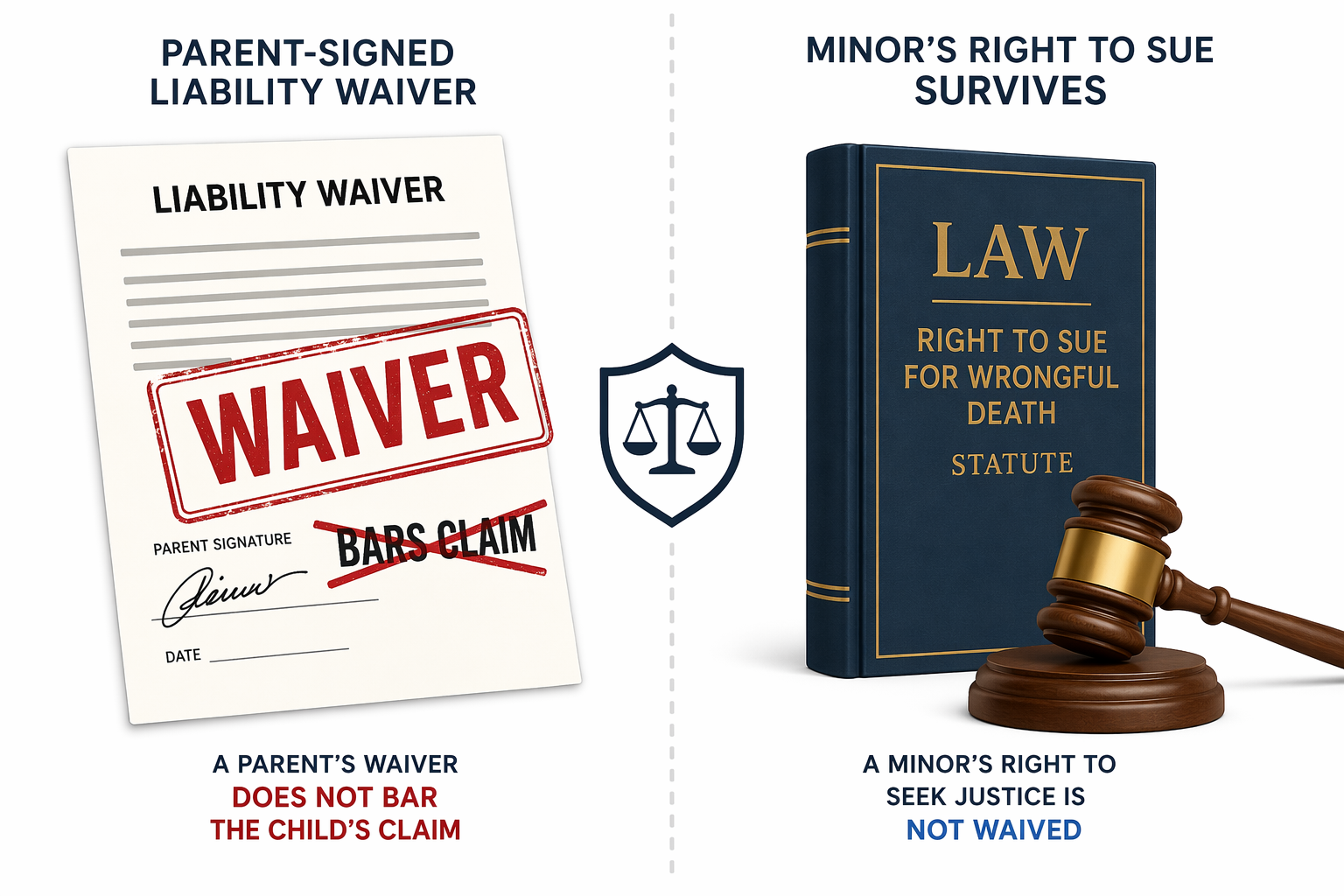
That does not make the waiver irrelevant. Counsel still needs the exact version signed, the date and time, the signer's identity, the child linked to the transaction, the language covering ordinary negligence or gross negligence, any arbitration or venue clause, any severability language, and any indemnity obligation that a defendant may try to assert against the parent. Adult derivative claims may face different treatment from the child's claim. Wrongful death statutes also vary on who owns the claim and how defenses apply.
The waiver analysis becomes stronger when paired with conduct that exceeds ordinary recreational risk. In a 2017 Georgia go-kart case, an adult plaintiff who fractured both ankles overcame a waiver defense by proving gross negligence, resulting in a $1.3 million post-apportionment jury verdict.[5] That case was not a child wrongful death case, and it should not be treated as a valuation proxy. Its usefulness is narrower and more practical: waiver defenses can weaken when the facts support aggravated operator misconduct.
Regulatory Findings Can Convert Outrage Into Proof
A fatal child crash produces understandable anger, but anger does not establish duty, breach, causation, or admissibility. State amusement-ride rules can. When a regulator identifies operator violations, counsel can use that record to frame what the venue was required to do before the crash, which rules employees were supposed to enforce, and why the incident was not merely an inherent risk of recreation.
The Urban Air administrative record matters for that reason. The reported violations were concrete: an underage driver, lack of seatbelt enforcement, and excessive speeds.[1] Those are not vague allegations that a ride was “dangerous.” They are operational failures that can be tied to written rules, staff training, supervision, and causation.
Depending on the jurisdiction, regulatory violations may support negligence per se, evidence of negligence, punitive-damages arguments, or impeachment of a defense expert who characterizes the crash as unavoidable. The distinction matters. Some states allow a statutory or regulatory violation to establish breach if the plaintiff is within the protected class and the harm is the type the rule was designed to prevent. Others treat the violation as evidence for the jury rather than a substitute for the negligence analysis.
Counsel should obtain the governing ride statutes and regulations, agency inspection files, operator correspondence, settlement documents, violation notices, corrective-action records, prior inspection failures, and any manuals incorporated into the regulatory scheme. A civil complaint that cites a rule without proving how it governed the operator's conduct at the time of the crash leaves leverage on the table.
Building the Civil Claim Beside the Agency Record
An administrative settlement can help a family, but it does not do the family's civil work for them. The state may focus on licensing, ride safety compliance, penalties, and corrective action. The civil case must prove legally recoverable damages for the proper beneficiaries against defendants who are liable under state law and collectible in practice.
That separation is especially important in the Urban Air matter because the $300,000 figure was a state administrative settlement, not a reported wrongful death settlement with the family.[1] Treating it as a case-value signal would blur two different systems. It may still matter in civil litigation as part of the factual and regulatory record, subject to admissibility limits and settlement-evidence rules.
The complaint should reflect the investigation rather than merely recite a fatal crash. Claims may include negligent operation, negligent supervision, negligent hiring or training, negligent maintenance, premises liability, product liability, failure to warn, negligent entrustment, survival damages, and wrongful death damages. Which claims belong depends on state law and on what the preserved evidence actually shows.
Damages in a Child Go-Kart Death
Valuation is difficult because the most important losses are often the least spreadsheet-friendly. In a child death case, future earnings may be speculative, while non-economic damages can dominate: loss of companionship, loss of parental relationship, loss of guidance, mental anguish where recoverable, and the family's loss as defined by the governing wrongful death statute.
Survival damages may add a separate issue if evidence supports conscious pre-death pain and suffering. That proof can come from witnesses, video, medical records, emergency-response timing, and expert testimony. Counsel should treat this as an evidence question, not an assumption. A brief interval may or may not support recoverable conscious suffering depending on the facts and state law.
General wrongful death settlement numbers are blunt instruments here. One dataset of 956 wrongful death cases from 2019 through 2024 reports an average settlement of $973,054 and a median of $294,728 across all types of wrongful death claims.[6] Those figures may orient expectations about the spread between average and median outcomes, but they do not predict a child go-kart case. Liability strength, waiver posture, regulatory violations, venue conduct, defendant solvency, insurance limits, jurisdictional caps, and beneficiary rules will do more work than any cross-category average.
Reported go-kart outcomes are also too sparse to carry much valuation weight. Secondary law-firm materials cite an $880,000 Boston go-kart collision settlement, a $90,000 wrongful death settlement from a motorsports park crash, and a $300,000 policy-limits tender by a go-kart track.[7] Those figures are useful only as reminders that outcomes can turn sharply on injury severity, available insurance, proof problems, and venue conduct. They are not a reliable settlement range.
Settlement Posture: Liability Is Only One Lever
A strong settlement posture in a go-kart wrongful death case usually combines several pressures: preserved video or physical evidence, a clear rule violation, a defeated or weakened waiver defense, sympathetic statutory beneficiaries, credible damages proof, and an insurance path. Remove coverage or solvency, and the same liability record may settle very differently.
Insurers will test assumption of risk, comparative fault, parental supervision, causation, product-versus-operator responsibility, waiver language, and damages caps. In a minor case, the defense may be less about barring the child's claim outright and more about narrowing the recoverable claims, shifting blame among defendants, or forcing plaintiffs to spend into expert-heavy product and safety issues.
Policy-limits demands should be built with the same care as a complaint. The demand package should include the waiver analysis, regulatory materials, photographs or video stills where appropriate, incident and inspection records, expert opinions if already developed, beneficiary proof, survival-damages evidence, and a clear explanation of why the insured defendant faces excess exposure. A demand that relies only on the tragedy of the death gives the carrier too much room to reframe the file as an unfortunate recreational accident.
When Trial Becomes the Necessary Forum
Trial may be necessary when defendants deny control, when the waiver defense becomes a legal test case, when insurers dispute coverage, when a manufacturer and operator blame each other, or when the civil value of a child death far exceeds available settlement authority. The trial file should be organized around preventability, not generalized danger.
The most persuasive liability presentation usually shows the sequence of missed protections: the rule that existed, the employee who should have applied it, the inspection or training that should have caught the hazard, the speed or restraint control that should have limited harm, and the point at which compliance would have changed the outcome. Jurors do not need to be persuaded that a child's death is devastating. They need to see why the law assigns responsibility to these defendants.
State law will shape the final trial structure. Wrongful death statutes determine who may bring the claim, who may recover, how proceeds are distributed, whether survival damages are separate, whether caps apply, how comparative fault works, and how quickly suit must be filed. Limitations periods can vary substantially by state, with some state guides listing periods as short as one year and others as long as six years.[8] Distribution rules also vary, and family agreement does not always control court approval or statutory allocation.[8][9]
The Process in Practical Order
- Secure evidence: send targeted preservation notices and pursue inspection before the kart, video, waiver data, or track conditions change.
- Obtain the regulatory record: identify the state amusement-ride rules, inspection history, violation notices, agency findings, and corrective actions.
- Map defendants by function: operator, franchise entity, property owner, manufacturer, maintenance contractor, other drivers, and supervising adults where relevant.
- Map insurance separately: request policies, endorsements, exclusions, excess coverage, indemnity agreements, and certificates of insurance.
- Test the waiver: separate the child's claim, adult derivative claims, arbitration language, indemnity provisions, and gross-negligence or public-policy limits.
- Develop damages under the governing statute: identify beneficiaries, non-economic losses, survival damages, funeral expenses, and any jurisdictional caps or distribution rules.
- Settle or try the case on proof: use rule violations, preserved evidence, expert analysis, and coverage facts rather than relying on the wrongful death label.
That order is not rigid. A pending regulatory investigation may move ahead of inspection. A looming limitations period may force filing before every policy is known. A disappearing video system may require emergency action before a full defendant map is complete. The point is sequencing pressure: the case gets weaker when counsel waits to find out whether the waiver is enforceable, whether the operator violated ride rules, or whether the only obvious defendant has no meaningful coverage.
What Makes These Cases Legally Distinct
A go-kart wrongful death case is not simply a premises claim with a recreational label attached. The operator's safety rules may become admissions. State amusement-ride regulations may supply duty evidence. Parent-signed waivers may fail to bar a minor's own claim while still complicating adult claims. Product, maintenance, property, franchise, and driver theories may expand liability and coverage. Child-death damages may depend more on non-economic proof and statutory beneficiary rules than on lost earnings models.
The strongest cases are built before settlement talks begin: by preserving the machine and the video, obtaining the agency record, separating defendants by control and coverage, confronting waiver language directly, and proving damages under the state statute that actually governs the family. The wrongful death label opens the file. It does not build the case.
References
- Urban Air in Port St. Lucie agrees to pay $300K after investigation into crash that killed 6-year-old, WPTV
- Urban Air faces lawsuits, debt after 6-year-old's death in Port St. Lucie go-kart crash, WFLX, February 20, 2026
- Go Kart Accident Statistics, Rosenfeld Injury Lawyers
- Wrongful Death After a Go-Kart Accident, KM Injury Lawyers
- Go-Kart Accident Leads to $1 Million Verdict, Georgia Injury Lawyer Blog
- Wrongful Death Settlement Calculator, Scheuerman Law
- Go Kart Accident Lawyer, Roxell Richards
- Wrongful Death Settlement Distribution Laws by State, FindLaw
- What Families Should Know About Dividing a Wrongful Death Settlement, Finch McCranie
Comments
Join the discussion with an anonymous comment.