
Legal teams do not buy a chip, but they do pay for one. Every contract review query, due diligence batch, search request, and document analysis pass burns compute somewhere upstream. That is why Google's AI chip and stock price matter when a firm is evaluating legal AI tools: the chip story says something about the cost base under the subscription, and the stock story says something about whether the infrastructure provider behind those tools looks durable.
Why inference costs show up in legal AI pricing
On April 22, 2026, Google said its inference-focused TPU 8i delivers up to 80% better performance-per-dollar and 2x better performance-per-watt than Ironwood for inference workloads [1]. That is Google's own published claim, not an independently verified benchmark, but the procurement implication is straightforward. If the cost of serving each query falls, the room opens up for lower prices, looser usage limits, faster responses, or simply better vendor margins.
- A vendor can pass some of the savings through in seat pricing or usage pricing.
- A vendor can keep the savings and use them to absorb heavier document loads or longer context windows.
- A vendor can also keep prices flat and widen margin, which matters if the market is competitive but not commoditized.
For legal buyers, that is not a semiconductor debate. It is the difference between a pilot that looks affordable and a renewal that still makes sense after usage grows.
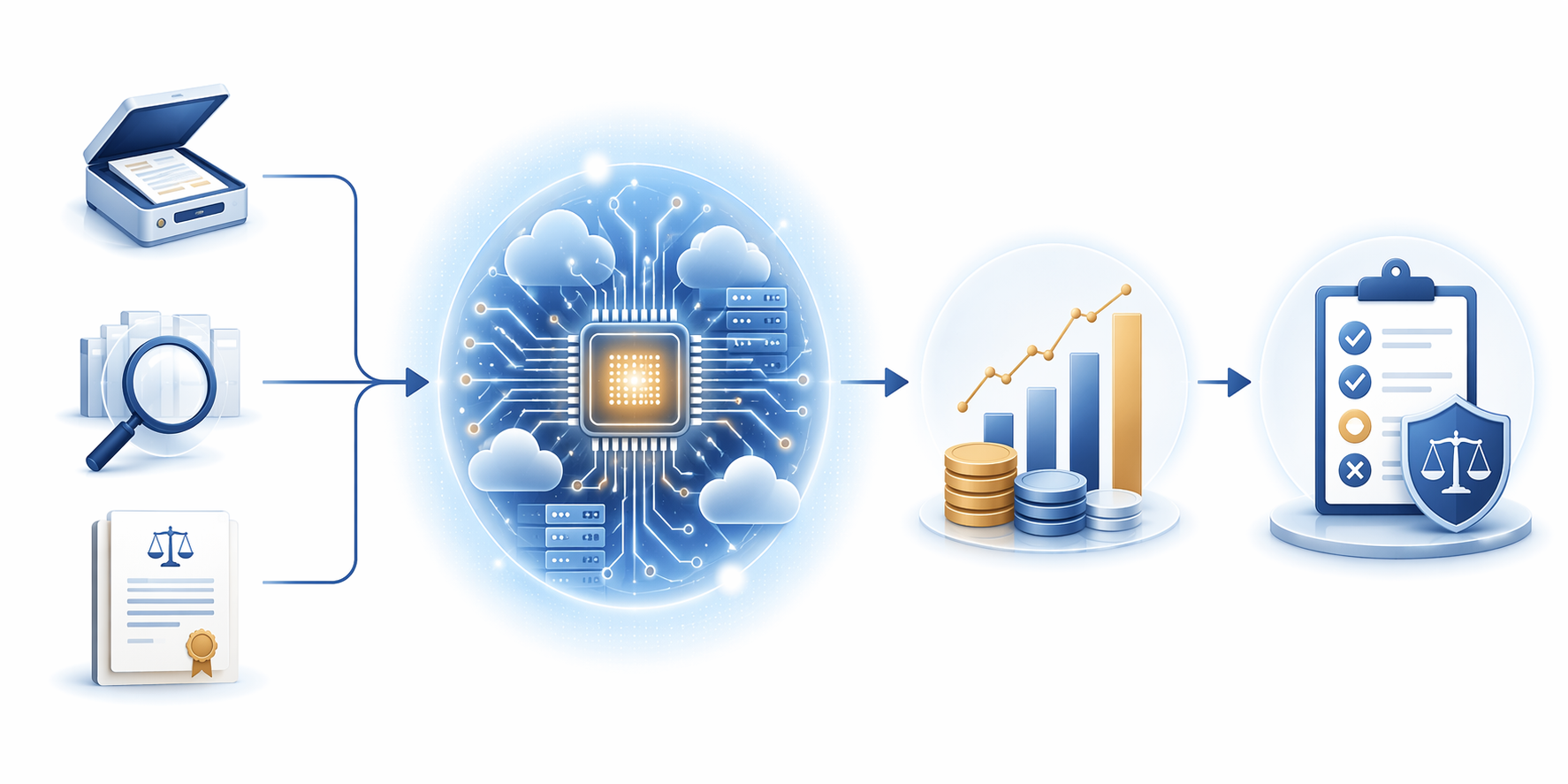
The practical unit is not the chip itself. It is the cost of each legal AI action that chip helps make cheaper: a clause comparison, a redline summary, a search across a data room, a diligence pass over hundreds of documents, or a longer agent workflow that would have been too expensive a year ago. The more those actions are used in production, the more the underlying cloud bill starts to shape procurement decisions.
Alphabet's rally is a vendor-risk signal, not just a market story
Alphabet's shares have risen about 160% in 2026 and briefly pushed the company above Nvidia by market cap in May, which CNBC framed as investors rewarding Google for owning more of the AI stack than most rivals [2]. The same reporting said Google Cloud backlog had nearly doubled to $462 billion, with Mizuho estimating that about $61 billion of that could come from TPU sales through 2027 and DA Davidson valuing TPU plus DeepMind at about $900 billion if separated [2]. Yahoo Finance added that Bank of America analysts have used a $370 to $420 target range [3]. None of those numbers proves a cheaper legal AI invoice. They do suggest a provider with the scale and market confidence to keep spending on chips, cloud capacity, and model infrastructure.
That matters because a legal AI vendor sitting on top of Google Cloud is not only exposed to model quality. It is exposed to whether the cloud provider can keep building, whether it can keep inference capacity ahead of demand, and whether its economics remain strong enough to support the roadmap that the vendor depends on.
The legal market is already big enough for this to be a budget issue
Vendor-commissioned and industry surveys suggest AI use is no longer experimental in legal work. Azumo cites 79% of legal professionals using AI tools and 77% using generative AI for document review, while Thomson Reuters reports 52% of in-house professionals using AI in 2026 [4][5]. Those figures measure adoption, not effectiveness, and they should be read with the usual survey caution. Even so, they explain why infrastructure costs now matter to legal operations rather than only to cloud engineers.
This is also where the infrastructure story stops being abstract. Freshfields has publicly tied Google Cloud to AI agents for due diligence and transactional document analysis [6], and Anthropic said in March 2026 that it would commit up to $200 billion to Google Cloud over five years for 5 GW of compute [7]. Those disclosures do not prove that every legal AI tool runs on Google infrastructure. They do show that the same cloud stack reaching legal workflows also sits underneath major model and enterprise deployments.
What to ask before a legal AI renewal
- Which cloud provider actually handles inference for our workflows?
- Is pricing driven by seats, usage, documents, tokens, or some mix of all four?
- Are model and cloud dependencies disclosed clearly in the contract and security materials?
- What happens to latency, quotas, or renewal pricing if the provider changes its infrastructure economics?
Google's TPU strategy is not, by itself, a reason to choose one legal AI platform over another. It is, however, now part of the procurement math: it affects the cost base beneath the tool, the speed at which vendors can scale, and the confidence a buyer can place in the company supplying the infrastructure.
References
- "Our eighth generation TPUs: two chips for the agentic era" — Google Blog — April 22, 2026
- "Alphabet 160% rally in year reflects value of owning most of AI stack" — CNBC — May 10, 2026
- "Why Google stock is on fire in 2026" — Yahoo Finance
- "90 AI Statistics in the Legal Field for 2026" — Azumo
- "What legal professionals say about the role of AI and law in 2026" — Thomson Reuters
- "Freshfields and Google Cloud on AI agents for due diligence and transactional document analysis" — Bloomberg Law — April 2025
- "Anthropic commits up to $200 billion to Google Cloud over five years for 5 GW of compute" — Anthropic — March 2026
Comments
Join the discussion with an anonymous comment.