
The litigation problem in a shutdown is not that the federal courthouse immediately goes dark. It is that DOJ civil lawyers may be instructed to stop work in non-emergency matters and ask for stays, while federal judges still have live cases, pending motions, discovery schedules, and private parties who are paying for delay.
That is the practical core of government shutdown legal implications in 2024, even if the most useful recent applications come from 2025 and 2026 rather than a rich body of 2024 shutdown litigation. The legal framework did not turn on the calendar year. The recurring question is whether the Antideficiency Act, which constrains executive-branch spending and unpaid work, requires Article III courts to grant government stay requests when appropriations lapse.
The answer is not uniform. In some courts, the government’s funding problem comes close to deciding the motion. In others, a shutdown is treated as a reason the government may raise, not a command the court must obey.
The courthouse and the government lawyer are not the same shutdown problem
Federal court operations and DOJ attorney availability should be separated at the start. The judiciary has its own operating posture during a funding lapse. At the beginning of the October 2025 shutdown, the Administrative Office of the U.S. Courts said the federal judiciary would continue paid operations by using accumulated fee balances and other funds for roughly two weeks; after that, courts would move to work needed to support constitutionally essential functions unless appropriations resumed.[1]
That reserve-fund window matters because it keeps many court functions moving at the moment DOJ civil litigators may be asking judges to stop individual cases. A docket can remain open while the government’s civil litigation capacity is curtailed. The resulting dispute is not simply administrative. It asks who controls the next deadline: the court that entered the schedule, or the executive branch funding rule invoked by government counsel.
The DOJ contingency posture described in current shutdown commentary is straightforward in effect: civil government lawyers are directed to seek stays in non-emergency civil cases during a funding lapse.[2] That may be a sensible executive-branch compliance instruction. It does not, by itself, answer what a judge must do with the motion once it lands on the docket.
Why the Antideficiency Act does not produce one litigation rule
The Antideficiency Act is doing real work here. It is not a litigation inconvenience dressed up as a legal theory. If federal employees are barred from performing non-excepted work without appropriated funds, government counsel have a legitimate reason to avoid merits briefing, discovery conferences, and routine civil motion practice during a shutdown.
But litigation does not run only through executive-branch command. Federal judges control their dockets, issue orders, enforce deadlines, and decide whether a requested stay is justified. The hard question is what happens when those systems point in different directions: DOJ says its lawyer cannot work; the court says the case remains active.
That conflict is sharper in civil cases involving private parties because delay is not evenly distributed. The government may be unable to brief a motion. The contractor, employee, regulated business, benefits claimant, or advocacy group may be unable to get a ruling, close discovery, preserve momentum, or make business decisions. A blanket stay request moves the cost of the funding lapse onto parties who did not create it.
That is why the stay cases matter more than broad shutdown commentary. The operative question is not whether shutdowns are disruptive. They are. The question is whether disruption gives the government a categorical litigation pause.
The circuit split is the center of the risk
The clearest divide, as synthesized in the current commercial-litigation materials, runs between the Sixth Circuit’s treatment of the Antideficiency Act and the D.C. Circuit’s repeated refusal to treat shutdown stay requests as automatic.[2] The point should be handled with some caution: that synthesis begins from a law firm publication, and any filing decision should be checked against the underlying orders, local rules, and current circuit authority. Still, the split it identifies is the practical map litigants need.
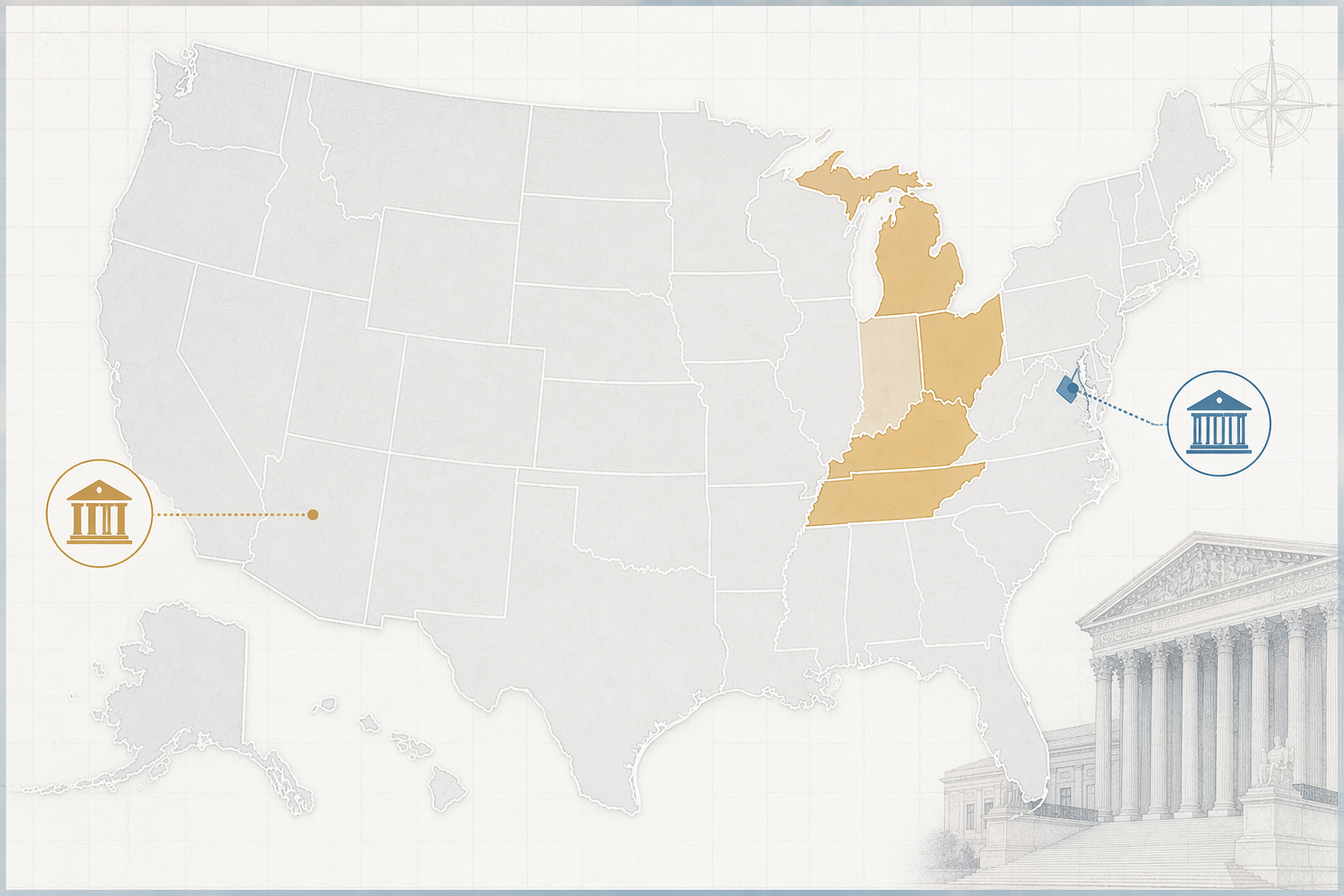
On one side is the Sixth Circuit approach associated with Trevino, described as treating the Antideficiency Act as categorically barring non-emergency work by government attorneys during a shutdown.[2] If that is the governing premise, a civil stay request is not just ordinary docket management. It is a request to avoid forcing government lawyers into work federal funding law forbids.
On the other side is the D.C. Circuit line, including Kornitzky, PETA v. USDA, and US Airways, described as taking a less expansive view of the Act’s force in this setting and routinely denying shutdown-based stay requests.[2] That line treats the court’s authority over pending litigation as an independent institutional fact. A shutdown may explain the government’s position, but it does not necessarily relieve the government from showing why a particular case should stop.
| Forum posture | Operational consequence for a private litigant |
|---|---|
| Sixth Circuit/Trevino approach | The government’s Antideficiency Act concern may carry near-dispositive weight for non-emergency civil work. |
| D.C. Circuit line | The court may require more than a shutdown notice and may keep the case moving despite DOJ’s stay request. |
| District courts outside a clearly controlling line | The result may depend on how the judge balances ADA risk, docket control, prejudice, and professional-responsibility concerns. |
The practical problem is not that one side is obviously frivolous. The problem is that both positions rest on serious institutional claims. The executive branch cannot ignore appropriations limits. The judiciary cannot let every executive funding interruption automatically suspend its docket. Private litigants are left to brief the seam between the two.
Lehman and Dash Markets show how opposite answers reach the docket
The split becomes easier to see in paired district-court handling from the 2025 shutdown materials. In Lehman v. Department of Labor, the Eastern District of Michigan denied the government’s stay request because DOJ had not shown “good grounds” for the requested pause.[2] That is a meaningful formulation. It does not deny that a shutdown exists. It requires the government to connect the shutdown to the case in a way that justifies interrupting the existing schedule.
Lehman also matters because the court reportedly noted that Michigan professional-conduct rules may independently require continued representation when a tribunal orders it.[2] That point should not be overgeneralized. Professional-responsibility rules vary, and government counsel face a different set of employment and appropriations constraints from private counsel. But the reference is a reminder that a stay motion is not only about appropriations. It can implicate duties to the tribunal, duties to the client, and the court’s power to require compliance with its own orders.
Dash Markets v. United States came out the other way. In the Western District of New York, the court granted the shutdown stay, deferring to the Antideficiency Act concern and expressing reluctance to expose government counsel to a risk of violation.[2] For the private litigant, the difference is immediate: the case pauses not because the merits changed, not because the schedule became unworkable for all parties, but because the court accepted the government lawyer’s statutory-risk position as sufficient.
Neither case should be converted into a universal rule. Lehman does not mean every judge will force DOJ civil lawyers to proceed. Dash Markets does not mean every shutdown stay is mandatory. Their value is narrower and more useful: they show the exact point where a federal litigant’s planning can fail. The same appropriations lapse can produce a denied stay in one courtroom and a granted stay in another.
What courts are really deciding when the stay motion is filed
A shutdown stay request may look procedural, but it asks the court to allocate legal risk. If the court denies the stay, government lawyers may argue they are being pushed toward work their agency has classified as unavailable during a lapse in appropriations. If the court grants the stay, the private party absorbs delay, cost, uncertainty, and sometimes strategic harm.
That allocation should not be hidden inside a one-page consent-style order unless the private party has made a deliberate choice not to fight it. In a case with a pending dispositive motion, an imminent hearing, perishable evidence, a regulatory deadline, or a business transaction waiting on judicial action, the stay may have consequences that outlast the shutdown itself.
The better judicial orders tend to identify what is actually being stayed, for how long, and why. A complete halt to all proceedings is different from extending the government’s briefing deadline. Suspending discovery that depends on government witnesses is different from delaying a private party’s already-filed motion. Tolling every deadline is different from requiring a status report when appropriations resume.
The government’s burden also matters. If the forum follows a D.C. Circuit-style approach, a notice that DOJ has been directed to seek stays may not be enough. The court may want a case-specific explanation. If the forum follows the Trevino approach, the private party may need to focus less on whether the ADA applies and more on tailoring the stay, preserving objections, or separating work that does not require government participation.
The 2024 framing: current implications, recent applications
For readers looking specifically for government shutdown legal implications in 2024, the most honest answer is that the key litigation guidance is not a large set of 2024 shutdown orders. The useful materials are the enduring statutory and constitutional conflict, the existing circuit split, and the most recent 2025-2026 examples showing how courts are applying those principles now.
That distinction matters for accuracy. A 2024 label should not be used to imply that a new 2024 rule emerged. The better reading is that shutdown litigation risk remained live in 2024 and has become easier to analyze because later cases and contingency-plan practice show the arguments counsel should expect the next time appropriations lapse.
Broader shutdown-authority litigation, including challenges such as New Jersey v. OMB, belongs in the background of this discussion because it concerns the structure and legality of shutdown administration. On the materials available here, however, it should not be treated as the source of the stay-motion rule. The day-to-day question for federal litigants remains narrower: what will this judge do when DOJ asks to pause this case?
How litigants can prepare without pretending the answer is settled
A party litigating against the federal government should treat a shutdown stay request as likely, not exceptional. That does not mean opposing every stay. It means deciding in advance what delay would actually harm and what parts of the case can continue without forcing non-emergency work by government counsel.
- Check the controlling forum first. A Sixth Circuit case and a D.C. Circuit case may require different briefing strategies before the facts of the dispute even matter.
- Object to blanket treatment when prejudice is concrete. Identify pending motions, discovery deadlines, business consequences, expiring evidence, or statutory timing concerns.
- Ask for a case-specific showing. If the government seeks a full stay, require it to explain why narrower relief would not address the appropriations issue.
- Separate government-dependent work from court-controlled work. A judge may be more willing to extend a DOJ response deadline than to halt a ruling on a fully briefed motion.
- Preserve professional-responsibility arguments carefully. Lehman’s Michigan-specific discussion is useful, but it should be verified against the rules and authority governing the actual tribunal.
The most effective opposition will usually be modest rather than theatrical. A private party does not need to argue that the shutdown is irrelevant. It can accept the government’s funding constraint while insisting that the court still decide the scope, duration, and necessity of any stay.
That approach also protects the record. If the stay is granted, the order may be narrower. If it is denied, the court has a clearer basis for concluding that the government did not meet its burden. If the issue returns after a prolonged lapse, the parties are not starting from a generic shutdown notice.
The practical legal implication
The Antideficiency Act may constrain executive-branch lawyers during a shutdown. It does not, on the current materials, create a nationally uniform rule requiring federal courts to grant every DOJ civil stay request. That is the uncomfortable part for litigants: the law is developed enough to make the issue predictable, but not settled enough to make the outcome predictable.
A shutdown therefore changes federal litigation in a specific way. It does not merely slow the government. It creates a forum-dependent fight over whether the court must slow down too.
References
- Judiciary Still Operating as Shutdown Starts — U.S. Courts, Administrative Office of the U.S. Courts, October 1, 2025.
- A Pattern of Uncertainty: Judicial Decision-Making During Federal Shutdowns — Epstein Becker Green.
Comments
Join the discussion with an anonymous comment.