
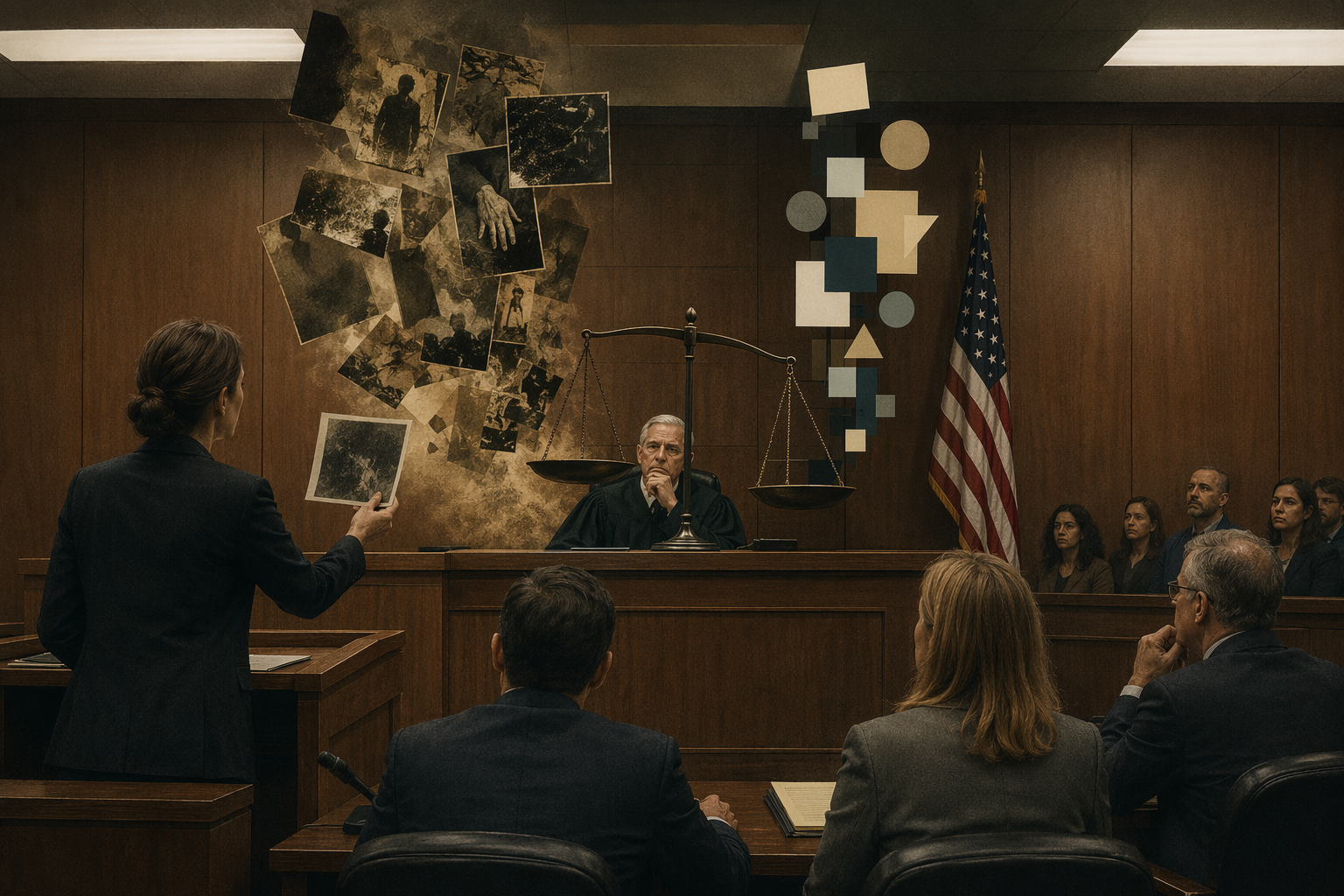
On the first day of the D4vd preliminary hearing, the legal problem did not arrive as an abstract Evidence Code question. It arrived as photographs. Prosecutors displayed images of severed limbs and decomposed remains while Detective Joshua Byers testified that the body had been dismembered with a chainsaw allegedly purchased after the killing; the victim’s parents were in the courtroom as the evidence was shown.[1][2][3]
That is where the legal implications of gruesome evidence in the D4vd case become concrete. A judge is not deciding whether the photographs are disturbing. Everyone in the room already knows they are. The harder question is what legal work the most graphic images do, and whether that work is worth the risk that horror will start doing the work of proof.
The hearing was still unfolding as of July 22, 2026, and preliminary-hearing rulings are not trial rulings. The calculus can change if the trier of fact later becomes a jury rather than a judge. Still, the opening day exposed the evidentiary fault line early: prosecutors may need photographs to prove the condition of the remains, the manner of dismemberment, identity-related facts, concealment, or consciousness-of-guilt theories; the defense must object without appearing to argue that the killing should be described gently.
The Ruling Before the Ruling
Before any final trial fight over photographic admissibility, the court had already confronted the neighboring problem of publicity. Defense lawyers Blair Berk and Marilyn Bednarski moved to seal the prosecution’s 44-page evidence brief, arguing that pretrial exposure would prejudice the case. Judge Charlaine F. Olmedo denied the motion, saying the media attention was “no different than the court has seen in other cases” and that voir dire was the appropriate remedy.[1][2]
That ruling matters because voir dire often becomes the judiciary’s pressure valve for inflammatory facts. If prospective jurors have seen coverage, lawyers can question them. If evidence is graphic, jurors can be instructed on its limited use. If publicity is intense, the court can trust the process to sort the affected from the unaffected.
Sometimes that confidence is earned. Courts do not become helpless simply because evidence is ugly or a case is public. But the D4vd hearing puts pressure on a familiar assumption: that procedural tools can reliably repair the effect of material after human beings have already absorbed it.
The broader record is already unusually large. Prosecutors have described 40 terabytes of digital evidence, and the defendant is being held without bail.[4] For readers tracking the procedural posture rather than the evidentiary doctrine, the preliminary-hearing context belongs with the separate question of probable cause practice; the photographic-evidence issue is narrower. It asks what a court is supposed to measure when the offered proof is both relevant and capable of overwhelming the factfinder.
What “Unfair Prejudice” Is Supposed to Mean
California Evidence Code §352 permits a court to exclude evidence if its probative value is substantially outweighed by the probability that admission will create a substantial danger of undue prejudice, confuse the issues, or consume undue time.[5] Federal Rule of Evidence 403 uses the parallel federal language: relevant evidence may be excluded if its probative value is substantially outweighed by dangers including unfair prejudice, confusing the issues, misleading the jury, undue delay, wasting time, or needlessly cumulative presentation.[6]
The important word is not “prejudice.” All prosecution evidence is prejudicial in the ordinary sense if it helps prove guilt. A photograph that accurately shows the condition of a body may be damaging because the crime itself was damaging. The law’s concern is narrower: evidence becomes unfairly or unduly prejudicial when it tends to push the decision away from proof and toward an improper basis, such as disgust, rage, fear, or punishment for conduct not actually at issue.
That distinction is easy to recite and hard to administer. A judge must identify the photograph’s legitimate evidentiary value, then estimate the risk that its emotional force will distort the factfinder’s reasoning, then decide whether the distortion risk substantially outweighs the legitimate value. The test sounds measured. The scale is not marked.
| Question | What the Court Is Really Testing |
|---|---|
| Is the photograph relevant? | Whether it tends to prove a fact that matters, such as manner of death, identity, concealment, sequence, or intent. |
| Is it merely damaging? | Whether it hurts the defense because it proves something legitimate. |
| Is it unfairly prejudicial? | Whether it risks moving the factfinder toward emotion-driven reasoning rather than proof-based reasoning. |
| Is there a less prejudicial substitute? | Whether testimony, diagrams, stipulations, cropped images, or fewer photographs can prove the same point with less emotional force. |
In the D4vd case, the prosecution has an obvious response to any broad exclusion request: these are not decorative images. If the charged theory involves dismemberment, decomposition, concealment, and the alleged use of a chainsaw, photographs may show details that a witness’s verbal account flattens. The state is not required to prove a sanitized version of its case simply because the facts are brutal.
The defense answer is just as predictable, and not frivolous: once jurors see the most graphic images, the bell cannot be unrung. Cross-examination can test a detective’s description. A stipulation can concede that remains were dismembered. A diagram can locate wounds or separations. A less graphic image can establish condition without inviting the juror to dwell on horror. The admissibility fight is not over whether the jury may learn what happened to the body. It is over how much visual shock the state needs to prove it.
The Science Makes the Boilerplate Look Thin
The National Judicial College has described a recurring arbitrariness problem in Rule 403 decisions over gruesome evidence: courts often acknowledge prejudice, then rely on judicial experience, limiting instructions, or conclusory assurances to say the evidence is not too inflammatory.[7] That critique does not prove every gruesome photograph should be excluded. It does show why the usual language can feel underbuilt for the task assigned to it.
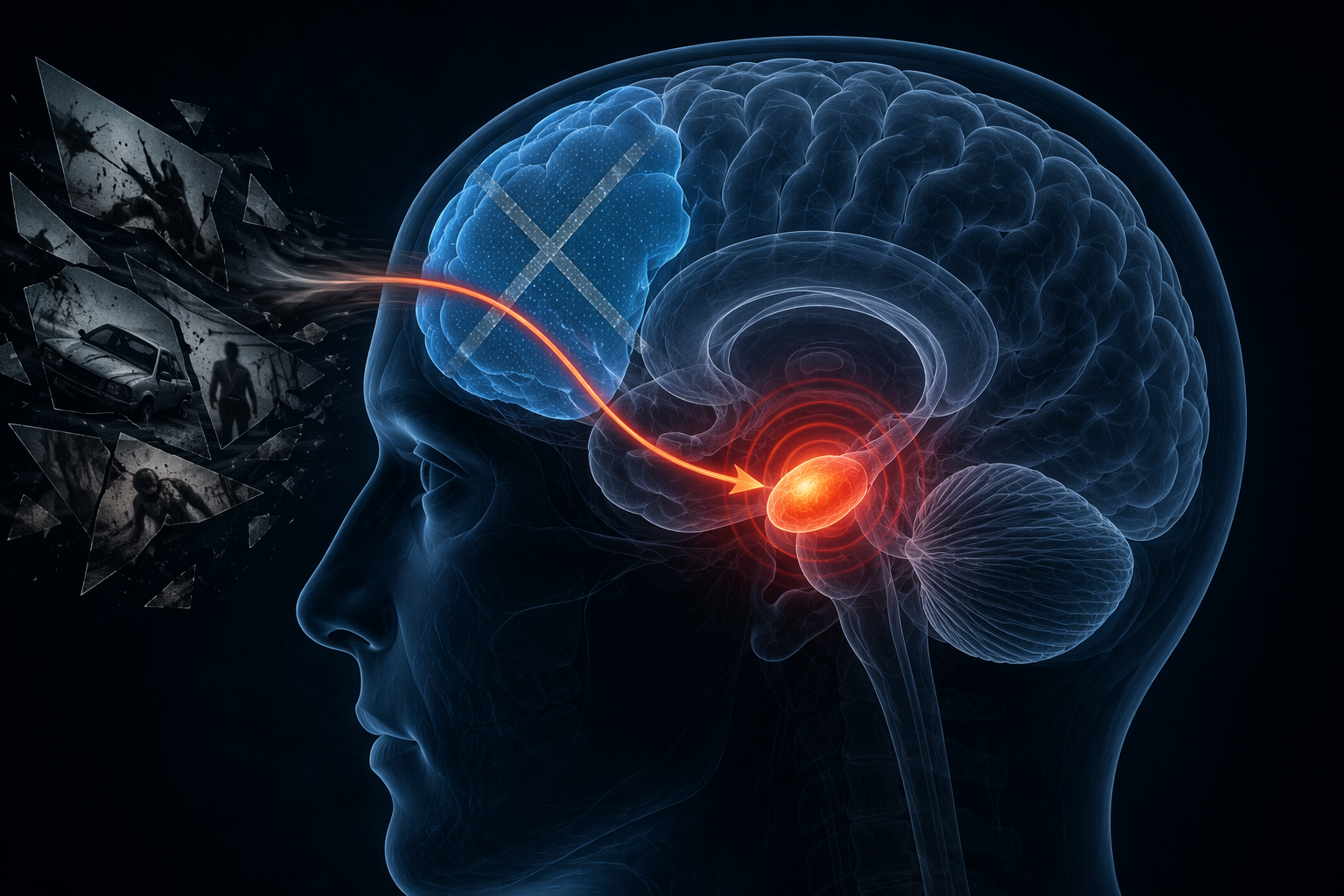
The research summarized by the National Judicial College gives that discomfort empirical weight. Capestany and Harris reported fMRI findings that gruesome images reduce activity in regions associated with rational decision-making in the prefrontal cortex while increasing emotional activity associated with the amygdala.[8] Dolcos and McCarthy likewise found that emotional distraction impairs cognitive control.[9] These studies do not decide admissibility in a murder case. They do make it harder to pretend that looking is a neutral act.
Mock-juror research points in the same direction, though it must be used carefully. Douglas, Lyons, and Ogloff found that gruesome photographs more than doubled conviction rates in a mock-juror study.[10] That does not mean a photograph causes an unlawful conviction in every real case. Mock jurors are not sworn jurors, laboratory settings are not trial courts, and the emotional response to evidence varies by person. But the finding is strong enough to make unsupported confidence look like an evidentiary habit rather than an evidentiary analysis.
The most uncomfortable research concerns the standard remedy. Edwards and Mottarella found that limiting instructions may increase conviction rates rather than decrease them.[11] The point is not that every instruction backfires. It is that judges should hesitate before treating an instruction as a universal solvent for emotional contamination. A command to consider an image only for a narrow purpose may keep the image cognitively available; it may also signal that the evidence is important enough to require special handling.
This is where the law’s phrasing becomes revealing. “Not unduly inflammatory” sounds like a finding. Often it is closer to a conclusion. A scientifically informed §352 or Rule 403 analysis would not require judges to become neuroscientists, but it would ask them to identify the specific factual need for the image, the availability of alternatives, the number and sequencing of photographs, the degree of decomposition or mutilation shown, and the realistic limits of curative instructions.
Old Chief and the Question of Substitutes
Old Chief v. United States matters here because it gives structure to the substitute-proof question. The Supreme Court held that, in applying Rule 403, courts may consider the availability of alternative evidence that proves the same point with less risk of unfair prejudice.[12] The case did not involve gruesome photographs, and it does not give defendants a general right to force the government into the least dramatic presentation possible. Its value is more practical than absolute: it asks what additional probative force the challenged evidence supplies.
That question would be central to any D4vd trial fight over the most graphic images. If a detective can testify that remains were dismembered, if forensic testimony can establish the condition of the body, if a diagram can show locations, and if a less graphic photograph can orient the factfinder, then the prosecution should be pressed to explain what the more disturbing photograph adds. The answer may be legitimate. It may show detail no witness can adequately convey. It may rebut an anticipated defense theory. It may establish sequence, tool use, concealment, or the physical reality of acts that words would make too abstract.
But “the jury is entitled to see the crime” is not enough by itself. That formulation risks converting narrative integrity into a license for maximum impact. Old Chief does not eliminate the prosecution’s right to tell a coherent story; it prevents the court from treating that story as immune from comparison when a less prejudicial route exists.
The same analysis affects volume. One photograph may establish a fact; several may become cumulative. A close-up may prove a wound characteristic; a wider image may prove location with less visceral force. Color, size, sequencing, display duration, and whether the image appears during opening, direct examination, or deliberations can all change the prejudice analysis. The doctrine often speaks in admissible-or-not terms, but courtroom harm is frequently a matter of dosage.
What a Serious Balancing Record Would Look Like
A careful court does not have to exclude every gruesome image to take prejudice seriously. It can require the proponent to identify the evidentiary proposition tied to each photograph. It can ask whether the same proposition is disputed. It can compare the photograph with testimony, diagrams, stipulations, or less graphic images. It can limit number, crop irrelevant portions, control display time, and keep particularly inflammatory images out of openings unless their need is already clear.
- For prosecutors, the strongest record ties each image to a disputed fact rather than to the general severity of the crime.
- For defense lawyers, the strongest objection offers concrete substitutes instead of asking the court to make the case visually painless.
- For judges, the strongest ruling explains why the probative value survives comparison with those substitutes.
- For reviewing courts, the most useful record shows the actual balancing process, not only the result.
That kind of record also respects the family’s presence without making grief the legal standard. The victim’s parents being in court is a human fact, not an admissibility rule.[1] Their presence sharpens the room’s stakes, but the judge’s legal task remains focused on proof, prejudice, and alternatives. A courtroom can acknowledge harm without letting harm decide relevance.
The D4vd hearing also shows why timing matters. At a preliminary hearing, a judge may be assessing probable cause and managing public access in a case still developing. At trial, the danger of unfair prejudice may intensify if jurors become the factfinders. A ruling that makes sense for one procedural moment may not answer the later Rule 403 or §352 question.
The Weakness the Case Exposes
The law has the vocabulary for this problem: probative value, undue prejudice, unfair prejudice, cumulative proof, alternative means. What it lacks is a principled metric for the emotional side of the scale. Judges are asked to estimate how much a photograph will distort reasoning, how well an instruction will contain that distortion, and how much substitute evidence would preserve legitimate proof. They are often asked to do it quickly, in a charged room, with appellate phrases that sound more stable than they are.
The D4vd case does not prove that the graphic photographs shown on Day 1 should be excluded from any eventual trial. The prosecution may be able to show that particular images carry factual content no substitute can fairly provide. But the case does expose the persistent weakness in gruesome-evidence law: courts have balancing tests for photographs of severed limbs and decomposed remains, yet still lack a consistent, scientifically informed way to measure the unfair-prejudice side before the images enter the room.
References
- D4vd preliminary hearing coverage, Courthouse News, July 2026
- D4vd preliminary hearing coverage, NBC News, July 2026
- D4vd preliminary hearing coverage, BBC, July 2026
- D4vd case coverage, ABC7, July 2026
- California Evidence Code § 352, Justia
- Rule 403. Excluding Relevant Evidence for Prejudice, Confusion, Waste of Time, or Other Reasons, Cornell Legal Information Institute
- Gruesome Evidence, Science, and Rule 403, National Judicial College
- The Impact of Gruesome Photographic Evidence on Legal Decisions: A Meta-Analysis, NIH PubMed Central, 2014
- Brain systems mediating cognitive interference by emotional distraction, Journal of Neuroscience, 2006
- The impact of graphic photographic evidence on mock jurors’ decisions in a murder trial, Law and Human Behavior, 1997
- The effect of limiting instructions on juror decision making after exposure to gruesome photographs, National Judicial College, 2014
- Old Chief v. United States, 519 U.S. 172, Supreme Court of the United States, 1997
Comments
Join the discussion with an anonymous comment.