
The first legal point about the Haiti Level 4 travel advisory is the one most likely to be blurred: a State Department “Do Not Travel” advisory is not, by itself, a federal travel ban. The clearest contrast is North Korea. Congress has given the Secretary of State authority to restrict the use of U.S. passports for travel to, in, or through North Korea, subject to limited exceptions; the cited sources identify no parallel general statute that makes travel to every Level 4 country a federal offense for U.S. citizens.[1]
That distinction matters because the phrase “haiti level 4 travel advisory legal consequences” can point to two very different questions. If the question is whether an American citizen commits a federal offense merely by going to Haiti while the advisory is active, the supported answer is no, with the North Korea passport-use restriction kept separate. If the question is whether the advisory can still produce legal, financial, employment, insurance, and passport consequences after something goes wrong, the answer changes quickly.
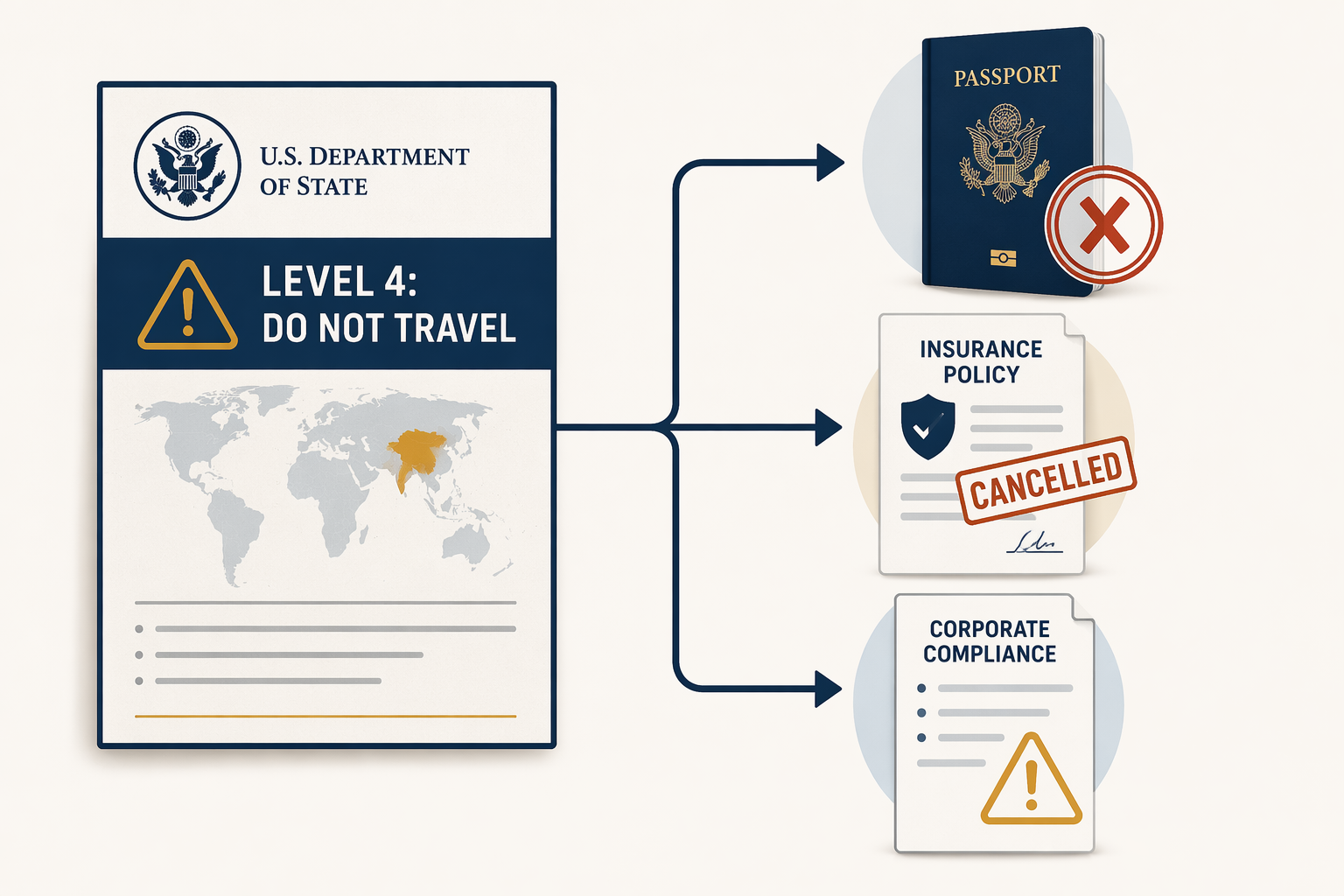
The advisory is not the penalty; it is the trigger
A travel advisory operates as an official risk assessment. It does not sentence the traveler, fine the traveler, or automatically invalidate a passport. But it gives other systems something concrete to rely on: a government-issued warning that the risk was known before departure. That is where the practical legal exposure sits.
For Haiti, the advisory context is unusually important. News reports in July 2026 described the State Department as again warning Americans not to travel to Haiti, with the advisory renewed on July 10, 2026, and with restrictions on the movement of U.S. government employees.[2][3] The same reporting described severe limits on ordinary evacuation assumptions, including no commercial flights operating to Port-au-Prince at the time reported.[2]
Those facts should not be used as scenery. They matter because they affect reliance. A traveler who assumes a normal airport exit may be relying on a condition that is not present. An employer that sends personnel anyway cannot plausibly treat the government warning as background noise. An insurer asked to cover a loss can point to policy language written for exactly this type of known advisory environment.
The most concrete legal pathway: emergency help, repatriation debt, passport restriction
The most enforceable consequence is not a ticket issued at departure. It is the debt-and-passport sequence that can follow emergency assistance abroad. The Foreign Affairs Manual’s repatriation-loan provisions are the documents to read slowly here, because they connect a private travel decision to a federal receivable and then to passport denial.
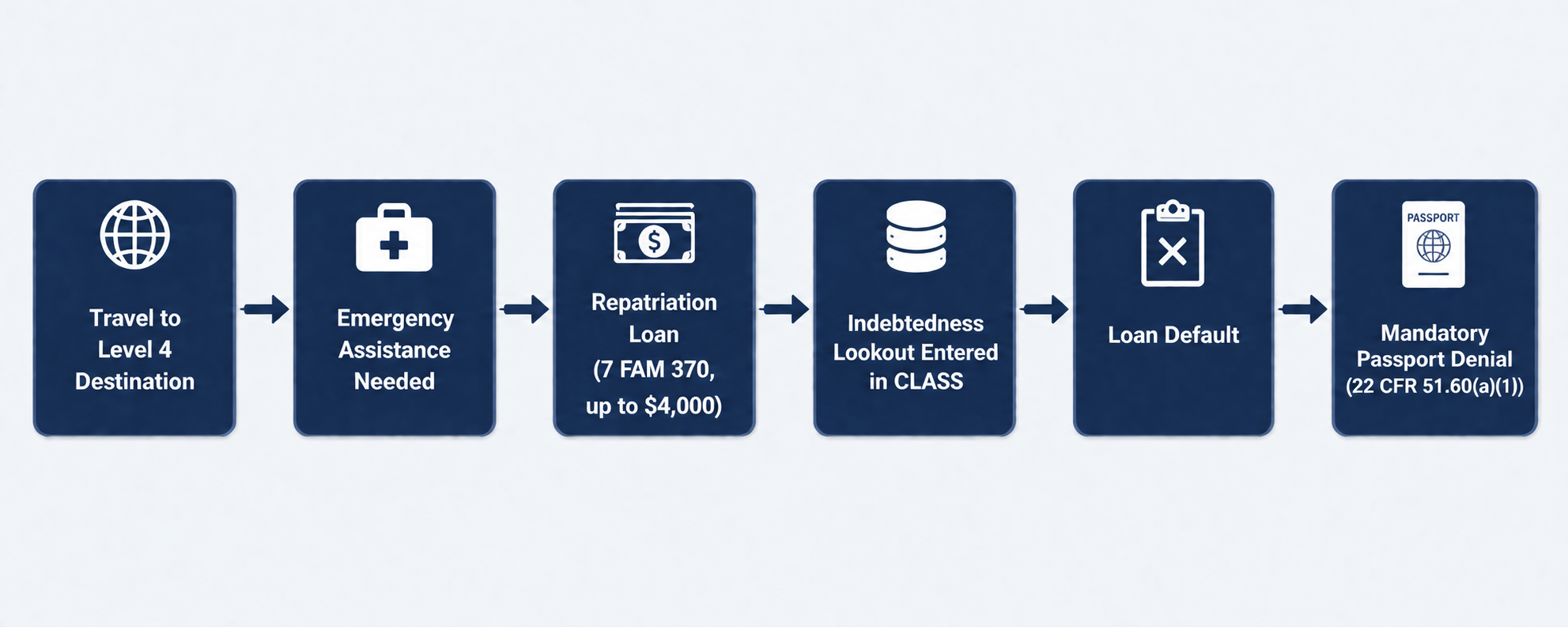
The State Department’s 7 FAM 370 chapter governs repatriation loans for U.S. citizens and certain eligible persons abroad who need emergency return assistance. Under 7 FAM 376.1, a consular post may approve up to $4,000 per applicant without Headquarters approval.[4] The statutory authority for emergency expenditures includes loans to assist destitute U.S. citizens and their dependents abroad with return to the United States.[1]
The permitted uses are practical and limited. The Foreign Affairs Manual allows repatriation-loan funds for items such as airfare, subsistence, visa or exit fees, and immigration penalties, while excluding items such as pre-existing debts, bribes, and pet transportation.[4] That line matters because the government is not acting as a general insurer for the trip. It is financing a defined emergency return mechanism.
At disbursement, the consequence begins to attach. The Foreign Affairs Manual provides for entry of a “D” indebtedness lookout in the Consular Lookout and Support System, known as CLASS.[4] That is the administrative bridge between the emergency loan and future passport processing. The traveler has not been punished for visiting Haiti; the traveler has accepted federal assistance that becomes a debt.
If that debt goes into default, the passport consequence is not merely discretionary. Under 22 CFR § 51.60(a)(1), the Department of State must not issue a passport, except one limited for direct return to the United States, when the applicant has been certified as having a defaulted loan under the relevant repatriation-loan authority.[5] In plain terms: the Level 4 advisory does not itself cancel passport rights, but an emergency extraction financed through a repatriation loan can mature into a mandatory passport denial if the debt is not repaid.
| Event | Legal significance |
|---|---|
| Traveler goes to Haiti while a Level 4 advisory is active | No general federal penalty identified in the cited materials solely for that travel |
| Traveler becomes destitute or unable to return without emergency assistance | Consular repatriation-loan procedures may become relevant |
| Loan is approved and disbursed | A federal debt is created and a CLASS indebtedness lookout is entered |
| Loan defaults | Passport denial becomes mandatory under 22 CFR § 51.60(a)(1), except for direct return to the United States |
There is also a secondary passport provision worth keeping in view. Section 51.60(c)(2) allows discretionary denial or restriction of a passport in certain cases involving an applicant’s debt to the United States arising from assistance abroad.[5] That provision should not be overstated as the main event. The cleaner and more important mechanism is the mandatory denial upon default. But the discretionary authority confirms that federal assistance abroad can follow the traveler back into passport administration.
Consular assistance is real, but it is not a private evacuation contract
A recurring mistake in travel-risk analysis is to treat citizenship as if it guarantees a rescue capacity. The consular system has tools: emergency communications, limited assistance, repatriation loans, coordination where possible. It does not guarantee commercial aviation, local security access, or the ability to move a traveler through an active crisis on demand.
That distinction is especially important where reporting indicates no commercial flights to Port-au-Prince and where U.S. government employee movement is itself restricted.[2][3] If the U.S. government limits its own personnel movements, that fact is relevant to any assumption that a private traveler, contractor, or employee can be reached quickly. The legal issue is not only personal danger; it is the gap between expected assistance and documented limits on assistance.
Insurance is where “advisory” becomes contract language
Travel insurance does not need the advisory to be a statute. It needs the advisory to fit an exclusion, eligibility condition, or known-event clause. Squaremouth’s advisory materials warn travelers that Level 4 destinations can be excluded from coverage and that policies may not provide benefits when travel is booked after a relevant advisory is already in effect.[6][7]
The exact result still depends on the policy. A cancellation benefit, emergency medical benefit, evacuation provision, or “cancel for any reason” upgrade may use different language. Some products distinguish advisories issued before purchase from advisories issued after purchase. Others may focus on whether the loss is caused by the excluded condition. The legally responsible answer is not that every claim is void. It is that the advisory gives insurers a contract hook that ordinary destination risk may not supply.
For counsel, the timing question is usually the first one to ask: was the Haiti trip booked while the Level 4 advisory was already active, and was the policy purchased before or after that point? The next question is whether the policy excludes travel to destinations under a Level 4 or “Do Not Travel” advisory, or whether it excludes losses arising from known, foreseeable, or warned-against events. Those are contract questions, not State Department enforcement actions.
Employer exposure turns on foreseeability and approval records
The employment question is different from the private traveler question. An individual can decide to absorb personal risk. An employer that directs, approves, reimburses, or benefits from travel into a Level 4 environment has to explain its process if the employee is harmed.
Corporate travel-policy materials commonly treat Level 4 travel as either prohibited or subject to senior-level approval. Navan’s travel-advisory guidance describes Level 4 as the highest-risk category and frames corporate response around restriction, approval, and duty-of-care controls.[8] That is not law in itself. It is still useful evidence of what competent travel governance tends to recognize: Level 4 travel is not routine travel with a different color on a map.
For Haiti, foreseeability is difficult to disclaim. The country has been treated as a Level 4 destination for years in public advisory tracking, and July 2026 reporting again described a State Department “Do Not Travel” warning, a national state of emergency context, restrictions on U.S. government employee movement, and severe flight limitations.[2][3][9] An employer approving travel against that backdrop should expect later questions about who approved the trip, what alternatives were considered, what security support existed, and whether the traveler could decline without job consequences.
The failure mode is often documentary. A company may have a travel-risk policy that says Level 4 requires executive approval, but the booking tool allows the itinerary anyway. A manager may approve a trip by email without consulting security. A contractor may be sent under a statement of work that never allocates evacuation responsibility. After an incident, those gaps become easier to see because the advisory establishes that the risk was not obscure.
The minimum defensible record is not complicated: the current advisory text, the business necessity for travel, the approving authority, the insurance and evacuation review, the communication to the traveler, and the contingency plan if commercial departure is unavailable. The more the organization departs from its own policy, the more the approval file has to carry.
Security clearance holders have a separate reporting problem
Cleared travelers should not treat the absence of a general travel ban as the end of their analysis. Foreign travel can carry reporting obligations under agency, contract, or clearance-specific rules, and high-risk destinations tend to receive closer attention. The operative source for a cleared person is not a travel blog or even a general advisory explainer; it is the person’s security office, clearance guidance, and employer or sponsoring-agency procedure.
The legal point is narrower than a universal rule. The Haiti advisory does not automatically prove a clearance violation. But unreported travel to a high-risk destination, unexplained contacts, financial distress abroad, emergency assistance, or a repatriation debt can create facts that a security office may consider relevant. For a cleared traveler, “not prohibited” is a particularly thin answer.
What counsel can say with confidence
The defensible answer begins with a negative finding and then stops short of overclaiming it. The cited sources do not identify a general federal criminal or civil penalty imposed on U.S. citizens solely for traveling to Haiti because Haiti is under a Level 4 advisory. The North Korea passport-use restriction remains the important statutory exception, not the model for Haiti.[1]
From there, the practical answer is more severe. The advisory can become consequential through systems that do have teeth: a federal repatriation loan, an indebtedness lookout, mandatory passport denial upon default, private insurance exclusions, employer duty-of-care analysis, and security reporting rules. None of those consequences requires the advisory to be a criminal prohibition.
- For an individual traveler, the highest legal-risk event is not departure; it is needing emergency government assistance and then defaulting on a repatriation loan.
- For an insured traveler, the key documents are the policy, the purchase date, the booking date, and the advisory language in force at that time.
- For an employer, the advisory is powerful evidence of foreseeability and should trigger documented review before any approval.
- For a cleared traveler, the safe assumption is that reporting and pre-clearance rules must be checked before travel, not reconstructed afterward.
The disciplined conclusion is therefore limited but meaningful: Haiti’s Level 4 advisory does not carry a general statutory penalty for U.S. citizen travel itself, but it changes the legal environment enough that counsel should treat it as a serious trigger. Before applying this analysis to a real person or organization, verify the current State Department Haiti advisory text, current Port-au-Prince flight status, and the exact insurance, employment, or security-clearance rules governing the traveler.
References
- 22 USC 2671 — Emergency expenditures, U.S. House of Representatives
- State Department issues stark Haiti travel advisory warning, Miami Herald
- U.S. warns Americans 'do not travel' to Haiti, AL.com
- 7 FAM 370 REPATRIATION LOANS, Foreign Affairs Manual
- 22 CFR § 51.60 — Denial and restriction of passports, Legal Information Institute
- Travel Advisory Guide: Level 4 Countries for U.S. Citizens, Squaremouth
- Travel Insurance Coverage for Countries With Travel Advisories, Squaremouth
- What is a Travel Advisory? Levels & Guide, Navan
- Map Shows Countries Under Level 4 US Travel Warnings, Newsweek
Comments
Join the discussion with an anonymous comment.