
The phrase that made State v. Wilson travel was not a technical holding about indictment practice, standing, or the scope of Hawaii’s weapons statutes. It was the Hawaii Supreme Court’s statement that “the spirit of Aloha clashes with a federally-mandated lifestyle that lets citizens walk around with deadly weapons.” In the shorthand that followed, the case became the “Hawaii rejects Bruen Second Amendment Aloha Spirit ruling.” That shorthand is not elegant, but it captures the institutional problem: a state high court did not merely criticize the U.S. Supreme Court’s Second Amendment method; it gave that criticism a local constitutional vocabulary and placed it beside a federal rule it considered ill-suited to Hawaii.[1]
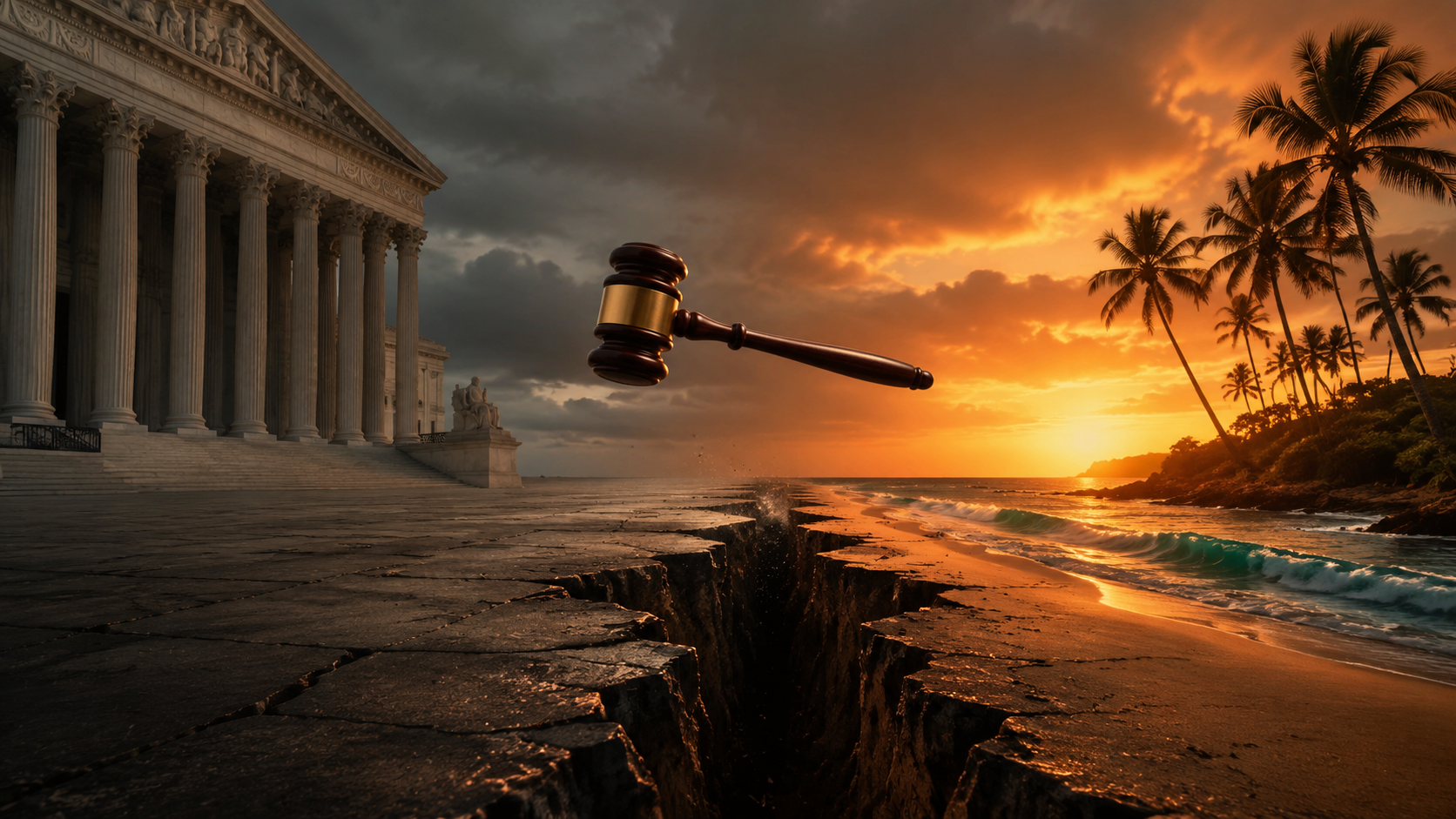
Two years later, the U.S. Supreme Court answered in language almost designed to make Wilson’s rhetorical risk visible. In Wolford v. Lopez, Justice Samuel Alito wrote for a 6-3 Court that “The Second Amendment has the same meaning in all parts of the United States” and “cannot give way to the spirit of Aloha in Hawaii.”[2] The Court was not reviewing Wilson itself; it had declined to do that in 2024. But Wolford supplied the federal answer Wilson had invited: Hawaii may interpret its own constitution, and it may legislate within federal limits, but it may not relocate the federal Second Amendment into a local-values exception.
How Wilson Turned Bruen Into a Values Collision
Wilson arose from a prosecution, not from a test case designed to tee up a national Second Amendment fight. The defendant, Christopher Wilson, was charged after carrying a handgun and ammunition without the required Hawaii licenses and permits. After New York State Rifle & Pistol Association v. Bruen, he argued that the prosecution violated the Second Amendment and Hawaii’s state constitutional analogue. The Hawaii Supreme Court rejected those arguments unanimously in February 2024.[1]
The court’s state constitutional holding was the cleaner part of the opinion. Article I, Section 17 of the Hawaii Constitution, the court held, protects a collective, militia-centric right rather than an individual right to carry firearms for personal self-defense. That conclusion let the court say that Hawaii’s own constitution did not track the federal individual-right doctrine after District of Columbia v. Heller and Bruen. A state supreme court has room to read its own charter more narrowly than the federal Constitution, so long as it does not deny the federal floor. Wilson became consequential because it did not stop at that boundary.[1]

Justice Todd Eddins’s opinion took direct aim at Bruen’s history-and-tradition inquiry. He described the test as “fuzzy” and objected to the idea that modern firearms regulation should turn on historical analogues drawn from earlier eras. The opinion’s most memorable nonlegal quotation came from The Wire: “The thing about the old days, they the old days.”[1] That line did real work in the opinion. It compressed the court’s objection to a federal methodology that asks contemporary judges to reason from historical regulatory practice even when the social conditions, weapons, and legal culture have changed.
There is a legitimate lawyer’s frustration inside that objection. Bruen’s analogue reasoning has forced lower courts to decide how close an old regulation must be to a new one, which historical periods matter, and how to handle silences in the historical record. Wilson’s irritation with that exercise was not invented out of nothing. But appellate hierarchy does not turn on whether a lower court finds the controlling test administrable. Once Bruen supplied the federal rule, Hawaii courts were required to apply it to federal claims unless and until the U.S. Supreme Court changed course.
Wilson’s more hazardous move was to braid that doctrinal objection with Hawaii’s statutory expression of local values. The opinion invoked Hawaii Revised Statutes § 5-7.5, the “Aloha Spirit” statute, which gives the phrase civic and governmental meaning in Hawaii law and directs officials to give it consideration when exercising power. From there, the court concluded that “the spirit of Aloha clashes with a federally-mandated lifestyle that lets citizens walk around with deadly weapons.”[1]
That sentence is why the case did not remain an ordinary post-Bruen state prosecution appeal. It made the federal framework sound not merely mistaken, but culturally alien. It also made the Hawaii Supreme Court’s disagreement unusually quotable. A state court can say that a defendant lacks standing, that a record is inadequate, that a statute survives under Bruen, or that the state constitution does not confer an individual right. Those are conventional judicial moves. Saying that the federal constitutional regime clashes with the spirit of Aloha is a different kind of move, because it frames constitutional supremacy as an intrusion into a local moral order.
The opinion’s defenders could describe it as values-based constitutional jurisprudence, and at least one scholarly treatment later analyzed Wilson in those terms.[3] That description is useful as far as it goes. Wilson did not hide its normative premises. It treated Hawaii’s legal culture, geography, and civic commitments as relevant to what its constitution means and to why Bruen seemed ill-fitting. But that is also the difficulty. Values-based reasoning may illuminate state constitutional meaning; it cannot subtract from a federal constitutional right that binds the states through the Fourteenth Amendment.
The Federal Claim Wilson Could Not Make Disappear
Wilson’s state-law holding and federal-law posture need to be kept separate. On the state side, Hawaii’s high court had final authority to say that Article I, Section 17 is collective rather than individual. On the federal side, it did not have final authority to decide that Bruen’s framework was too fuzzy, too mainland, or too historically backward to govern Hawaii prosecutions. That distinction is the legal hinge of the entire episode.
The court did offer federal reasons for rejecting Wilson’s challenge, including procedural and standing analysis. But the opinion’s broader language made it read like something more ambitious than a narrow affirmance. It announced dissatisfaction with the governing federal methodology in a way that invited a higher court to ask whether Hawaii had given the Second Amendment the respect vertical precedent requires.
The U.S. Supreme Court did not immediately take the bait. In December 2024, it denied certiorari in Wilson v. Hawaii on interlocutory grounds. That denial did not endorse the Hawaii Supreme Court’s reasoning. Justice Clarence Thomas, joined by Justice Alito, wrote that the Hawaii court had “failed to give the Second Amendment its due regard.” Justice Neil Gorsuch wrote separately to criticize the standing analysis.[4]
As Supreme Court signals go, that was not subtle. The case was procedurally unattractive, so the Court let it pass. But three justices put Hawaii on notice that the substance of Wilson had registered. For lawyers watching the docket, the denial functioned less like a closing than a preservation order: the Court had not yet chosen the vehicle, but the state court’s treatment of Bruen had become part of the record.
Wolford Gave the Court a Cleaner Vehicle
Wolford v. Lopez reached the Court through a different Hawaii law. After Bruen, Hawaii enacted Act 52, which included a rule for private property open to the public. The challengers and later shorthand called it a “vampire law”: a person with a carry permit could not carry on such private property unless the owner, lessee, operator, or manager gave affirmative permission, such as through clear signage or direct authorization. In practical terms, the default rule was no carry unless the property holder opted in.[2]
That issue was better suited for Supreme Court review than Wilson. It was prospective, civil, and focused on a specific statutory default. It did not require the Court to sort through the procedural posture of a criminal prosecution. It also put Hawaii’s post-Bruen legislative response squarely before the justices: after the Court recognized a right to carry firearms in public for self-defense, how far could a state go in turning large categories of publicly accessible private property into no-carry zones by default?
On June 25, 2026, the Court struck down the Act 52 private-property consent rule in a 6-3 decision.[2][5] Alito’s majority opinion treated the Hawaii default as incompatible with the Second Amendment because it broadly restricted carry on private property open to the public unless the property owner affirmatively consented. The decision did not say private owners must allow guns. It preserved the ordinary premise that owners may exclude firearms from their own premises. The constitutional problem was Hawaii’s decision to make exclusion the legal default across that category of property.
That distinction matters for governance after Wolford. A restaurant, hotel, shop, or other private actor can still post a no-gun sign if state law permits that method of exclusion. What Hawaii could not do, under the majority’s reasoning, was treat silence as a statewide prohibition for permit holders entering private property otherwise open to the public. The burden shifted too much of the public-carry right into a permission-seeking exercise.
The Sentence Wilson Made Available
The Wolford majority could have decided the private-property question without mentioning Wilson’s Aloha language. It did mention it, and that choice is part of the decision’s force. Alito wrote that “The Second Amendment has the same meaning in all parts of the United States” and that it “cannot give way to the spirit of Aloha in Hawaii.”[2] The first sentence states the vertical rule. The second turns Wilson’s own rhetoric into the example of what the vertical rule forbids.
For a state court, that is the danger of colorful constitutional resistance. Wilson’s phrasing may have captured a genuine feature of Hawaii’s civic self-understanding. It may also have expressed a real institutional unease with Bruen’s historical test. But once a state court casts federal doctrine as a “federally-mandated lifestyle” incompatible with local spirit, it gives the U.S. Supreme Court an easy way to restate supremacy in memorable terms.
Wolford’s answer was not that Hawaii lacks distinctive traditions, or that state constitutional law must mimic federal law. The answer was narrower and firmer: distinctiveness does not change the meaning of an incorporated federal right. A state may provide more protection than the federal Constitution, and it may sometimes provide less under its own charter, but it may not make the federal right less operative within its borders.
The majority also rejected Hawaii’s historical analogue arguments, including reliance on an 1865 Louisiana Black Code. Alito called that reliance “remarkable,” and Justice Amy Coney Barrett wrote separately: “it is beyond me why Hawaii would claim that these vile laws can justify its present-day restriction.”[2] That exchange was not incidental. Under Bruen, historical analogues are supposed to illuminate the tradition of permissible regulation. A racially oppressive post-Civil War law is a dangerous candidate for that role, and Barrett’s concurrence made the objection explicit.
Here, again, the litigation lesson is institutional before it is ideological. A state defending a modern firearms restriction under Bruen has to choose historical materials that can bear normative and doctrinal weight. If the analogue is so morally compromised that a justice calls it “vile,” it may do more damage than silence. Historical reasoning after Bruen is already difficult; using discredited laws as affirmative support makes the difficulty worse.
What Wolford Settled, and What It Did Not
Wolford settled the private-property default question before the Court and the larger federalism point that Wilson had made unavoidable. Hawaii cannot use the Aloha Spirit, state constitutional tradition, or a locally preferred account of public order to reduce the federal Second Amendment right. That is the holding’s most portable feature, and it is why the decision matters beyond Act 52.
It did not settle every Hawaii firearms dispute. Nor did it erase Hawaii’s ability to regulate public carry through rules that survive the federal test. Sensitive-place restrictions, licensing rules, age-based limits, and signage mechanics remain separate questions unless directly resolved by the Court or by lower courts applying Wolford and Bruen. The practical consequence is not deregulation by slogan. It is a narrower instruction: when Hawaii regulates carry, it must do so inside the same Second Amendment framework that binds every other state.
The post-decision governance began almost immediately. Honolulu Civil Beat reported that Governor Josh Green criticized the ruling, Representative David Tarnas acknowledged that Hawaii would likely need to amend its signage law, and the Hawaii Hotel Alliance planned for hotels to post no-gun signs. Civil Beat also reported that more than 3,700 concealed carry permits had been issued as of 2025 and that a separate challenge to Hawaii’s age restrictions remained pending.[6]
Those details are modest compared with the constitutional language of Wilson and Wolford, but they show where Supreme Court doctrine finally lands: with legislators revising text, agencies counting permits, property owners choosing signs, and lower courts sorting the next set of challenges. The Aloha Spirit did not disappear from Hawaii law. It simply could not do the work Wilson asked it to do against a federal constitutional rule.
That is the arc from Wilson to Wolford. Wilson made the most direct state judicial challenge to Bruen by pairing a collective-right reading of Hawaii’s constitution with an openly skeptical account of the federal test and a culturally grounded rejection of public carry as a federally imposed lifestyle. Wolford answered that state courts may interpret their own constitutions, but they cannot make the federal Second Amendment mean something different in Hawaii because local spirit points the other way.
References
- State v. Wilson, Hawaii Supreme Court, 2024.
- Wolford v. Lopez, Supreme Court of the United States, June 25, 2026.
- Noho Kiʻekiʻe Ke Aloha: Aloha Reigns — An Example of Values-Based Constitutional Jurisprudence, Missouri Law Review, June 2025.
- Wilson v. Hawaii, Supreme Court of the United States, 2024.
- Supreme Court strikes down Hawaii gun restriction, SCOTUSblog, June 25, 2026.
- After Supreme Court Blow To Gun Restrictions, What’s Next For Hawaii?, Honolulu Civil Beat, June 26, 2026.
Comments
Join the discussion with an anonymous comment.