
The phrase that matters in analyzing Hayden Panettiere’s custody decision is not “gave up custody.” It is “custody papers.” Panettiere has reportedly said she signed papers transferring custody of her daughter, Kaya, to the child’s father, Wladimir Klitschko, while believing the arrangement was temporary, but without a formal review date built into the documents.[1][2] That distinction is the legal center of the story.
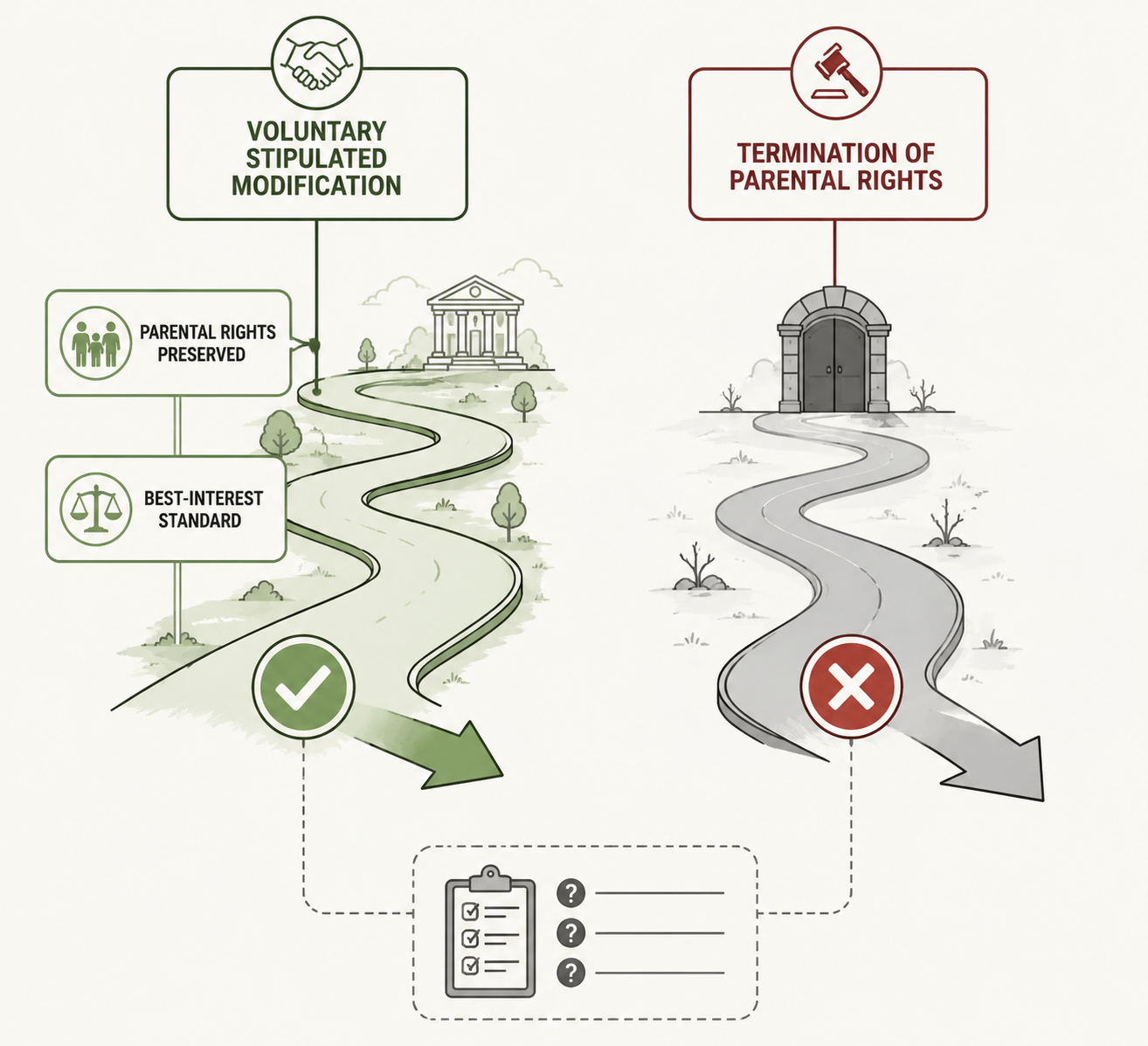
On the public record, this was not a termination of parental rights. It was not a court announcing a celebrity-specific rule about postpartum depression. It was a private, stipulated custody modification made during a period when Panettiere had described postpartum depression and substance-use struggles, followed by her child living primarily with Klitschko in Ukraine and later reports of stable co-parenting.[1][2]
That kind of arrangement can be lawful, humane, and child-protective. It can also become hard to unwind if the document says “temporary” in spirit but not in mechanics.

Status, Custody, And Rights Are Not The Same Thing
A parent can agree that the other parent should have primary physical custody without agreeing to stop being a parent. That is the first legal separation practitioners have to preserve for clients in crisis.
Physical custody concerns where the child lives and who handles day-to-day care. Legal custody concerns decision-making authority. Parental status is more basic still: the legal relationship between parent and child. A stipulated custody modification may alter the first two. It does not, by itself, erase the third.
California law makes that separation visible. Family Code § 3010 recognizes that parents have a right to custody of their minor children, subject to the court’s power to determine custody in the child’s best interest. Family Code § 3025 separately protects a parent’s access to records even when that parent does not have physical custody, unless the court orders otherwise.[3] Those provisions do not make every custody arrangement equal. They do show why a voluntary transfer of day-to-day care should not be casually described as a forfeiture of parenthood.
Tennessee’s custody statute approaches the question through best-interest factors, including the child’s needs, the strength and stability of relationships, each parent’s past and potential performance of parenting responsibilities, and the effect of continuity in the child’s life.[4] Nothing in that framework turns a parent’s honest recognition of illness or temporary incapacity into an automatic legal penalty.
The public record does not confirm which U.S. state formalized Panettiere’s custody agreement, and it would be careless to declare California or Tennessee controlling from the available facts. The point of comparing them is narrower: under either type of best-interest framework, a court can approve a stipulated arrangement that protects a child’s immediate stability while preserving the recovering parent’s legal status.
What A Court Would Likely Care About
If a parent presents a custody agreement during a mental-health crisis, the court’s question is not whether the parent has used the right emotional vocabulary. The question is whether the proposed order serves the child’s best interest and whether the parent’s consent is informed, voluntary, and sufficiently documented.
In California, Family Code § 3022 gives the court continuing authority to make custody orders during a child’s minority. Family Code § 3011 identifies best-interest factors, including health, safety, welfare, abuse history, and the nature and amount of contact with both parents. Family Code § 3087 governs modification of joint custody orders, allowing modification when required by the child’s best interest because of a significant change in circumstances.[3]
That statutory structure leaves room for a stipulated modification when a parent is ill. The parent’s condition may be a changed circumstance. The agreement may reduce immediate instability. The court may approve it without treating the parent as having abandoned the child. But the same structure also leaves a later evidentiary problem: when the parent recovers, what exactly has changed back, and what did the original order contemplate?
Tennessee Code § 36-6-106 similarly directs courts toward a fact-specific best-interest analysis. The statute asks about continuity, emotional needs, parenting history, each parent’s willingness to facilitate the child’s relationship with the other parent, and other circumstances bearing on the child’s welfare.[4] A parent who voluntarily places the child with the other parent during treatment may be acting consistently with those factors, not against them.
| Legal Question | Why It Matters In A Voluntary PPD-Related Transfer |
|---|---|
| Was parental status terminated? | The available public facts support a custody modification analysis, not a termination-of-rights analysis. |
| Was the agreement stipulated? | A voluntary stipulation is evaluated differently from an involuntary removal or a finding of unfitness. |
| What best-interest findings supported the arrangement? | The child’s stability, safety, continuity, and relationship with both parents remain central. |
| What did the order say about review? | Recovery matters legally only if the order gives the parent a procedural route to present it. |
Practitioner commentary has cited California Judicial Council data indicating that roughly 85% of California custody modifications are reached by agreement rather than litigation.[2] That statistic should not be stretched into proof that Panettiere’s exact arrangement was typical. It does, however, explain why stipulated custody changes are ordinary legal work, not an exotic exception.
The Drafting Problem Was Temporariness Without A Clock
The dangerous part of a temporary custody arrangement is not the temporary transfer. It is the absence of terms that tell the parties, the court, and later counsel how temporary status will be reviewed.
A parent in treatment may hear “temporary” as a promise: when I am well, the prior parenting arrangement can be restored. A court order does not operate on that kind of implicit understanding. Later, the recovering parent may face a record showing that the child has been living safely and consistently with the other parent for a substantial period. Stability then becomes both the reason the original transfer made sense and the reason a court may hesitate to disrupt the child’s routine.
A better stipulation does not guarantee restoration of custody. It preserves a pathway for asking. The document should identify the next court or mediation date, the treatment documentation the parent may submit, the interim parenting schedule, and the conditions under which expanded time will be considered.
- A review date, set at the time of the stipulation rather than left to future goodwill.
- Objective treatment-linked documentation standards, such as provider letters, program completion records, or compliance summaries where appropriate.
- A staged parenting-time schedule that moves from contact, to supervised or supported time if needed, to expanded unsupervised time when conditions are met.
- A decision-making access clause preserving records, school information, medical updates, and participation in major decisions unless safety findings require limits.
- A clear statement that the modification is not abandonment, not consent to termination, and not a waiver of the parent’s right to seek future modification.
Those terms do not turn medical recovery into a custody entitlement. They do something more modest and more useful: they prevent the recovering parent from having to reconstruct intent from silence.
Postpartum Depression Makes This Recurring Legal Work
Postpartum depression is not rare enough for family-law documents to treat it as an edge case. The American Psychiatric Association has reported that approximately 1 in 7 new mothers experience postpartum depression, while CDC figures commonly place the rate at about 1 in 8.[5][6] Those are prevalence estimates, not predictions about any individual parent’s capacity or recovery.
The treatment window matters for drafting because it gives lawyers a reason to build review points into the order. Public health reporting cited in the available materials states that roughly 80% of mothers with postpartum depression respond to treatment within three to six months.[5][6] A custody stipulation can use that window to schedule reassessment, but it should not promise that recovery, relapse, parenting readiness, or the child’s adjustment will follow a medical average.
The diagnosis trend also undercuts any assumption that these cases are isolated. A 2024 PubMed-indexed analysis reported that postpartum depression diagnosis rates increased significantly across all racial and ethnic groups over the prior decade.[7] Increased diagnosis is not the same thing as increased severity, and it does not establish that courts are seeing identical custody patterns. It does suggest that lawyers should expect more clients to disclose PPD during parenting-plan negotiations.
Panettiere’s public discussion also involved substance use, which is another reason the fact pattern has practical relevance. A 2023 Journal of Public Health study found that 1 in 4 postpartum mothers drank at harmful levels.[8] That finding does not explain any individual parent’s conduct by itself. It does show why custody planning for postpartum mental health cannot be drafted as though depression and substance use always arrive in separate files.
International Placement Does Not Change The Voluntary Character
Kaya’s residence with Klitschko in Ukraine understandably draws attention, but it should not distort the legal analysis. Ukraine has been a Hague Convention signatory since 2006.[9] In a non-voluntary removal or disputed retention case, Hague Convention issues could matter immediately: habitual residence, wrongful retention, consent, acquiescence, and available remedies would become central.
That is not what the public facts describe. The reported transfer was voluntary. Hague remedies were not triggered on the known record. The preventive lesson is still real: when a custody stipulation allows a child to live abroad, the order should state travel authority, residence expectations, communication schedules, forum expectations, and the parent’s continuing access to records and major decisions.
What Practitioners Should Take From The Panettiere Arrangement
The question is not whether Panettiere’s decision set a precedent for postpartum depression. Private custody stipulations do not work that way, and the available record does not support a broad doctrinal claim. The better question is what the arrangement teaches about preserving parental rights while protecting a child during a parent’s recovery.
The answer starts with careful characterization. A stipulated custody modification is not abandonment merely because one parent accepts reduced time. It is not termination merely because the other parent assumes full-time care. It is not proof of permanent unfitness merely because the reason for the transfer includes postpartum depression or substance use.
It ends with drafting discipline. If the arrangement is meant to be temporary, the order should say how temporary status will be tested. If treatment matters, the order should say what documentation will matter. If the child’s continuity matters, the order should stage any increase in parenting time rather than pretending restoration is a single switch. If parental rights are being preserved, the order should preserve the recovering parent’s access to information and a meaningful route back to court.
This article is informational legal analysis, not legal advice. Families facing a mental-health-related custody modification need jurisdiction-specific counsel before signing any custody papers.
References
- Hayden Panettiere's Custody Decision: A Lesson In Putting Children First, Forbes, May 21, 2026.
- Hayden Panettiere Custody Decision: What California Law Says About Temporary Agreements, Divorce.law, May 2026.
- California Family Code §§ 3022, 3011, 3087, 3010, 3025, California Legislative Information.
- Tennessee Code § 36-6-106, Justia.
- Hayden Panettiere Felt Like Her Soul Was Dead After Giving Birth, Business Insider.
- Why Hayden Panettiere's Honesty Matters for Moms, Parents.com.
- Postpartum depression diagnosis rates increased significantly across all racial and ethnic groups over the past decade, PubMed, 2024.
- Harmful drinking among postpartum mothers, Journal of Public Health, 2023.
- Status table, Hague Conference on Private International Law.
Comments
Join the discussion with an anonymous comment.