
The useful starting point for the latest Hezbollah weapons smuggling legal probe is not a theory of the regional arms trade. It is a truck, an alleged cargo, and a border point.
On July 16, 2026, Syrian authorities said they had seized advanced weapons near al-Tanf, close to the Iraq-Syria border, and alleged that the shipment was bound for Hezbollah in Lebanon. The reported cargo was not described in vague “arms cache” language: it included Almas anti-tank missiles, FPV drones, and cruise missile components concealed inside an oil tanker using the Iraq-Syria Baniyas oil route.[1] AP’s account the next day placed the interdiction in the same border geography and framed it against Syria’s post-Assad turn away from the facilitation role long associated with the prior regime.[2]
Iraq then moved quickly, at least administratively. Middle East Eye reported on July 17 that Prime Minister Mohammed Shia al-Zaidi ordered a high-level investigative committee to examine the alleged smuggling route and that the matter was being handled through Iraq’s Joint Operations Command channel.[3] FDD’s Long War Journal treated the oil route as a significant feature of the case, not because an oil tanker is legally magical, but because concealment inside a civilian-commercial channel changes what investigators must prove: origin, knowledge, custody, route, and the point at which a legitimate transport chain allegedly became a weapons pipeline.[4]
That is enough to make the case consequential, but not enough to make it legally clean. Hezbollah’s reported categorical denial matters for that reason. A denial does not erase a seizure. It does, however, mark the difference between a government announcement and a record that can support a criminal prosecution, a sanctions designation, a customs action, an asset freeze, or intelligence-sharing with another government. Those are not the same exercise.
The seizure creates evidence before it creates jurisdiction
Syria is the jurisdiction that reportedly stopped the shipment. That gives Syrian authorities the most immediate control over the physical evidence: the tanker, the compartments, the weapons components, the driver or accompanying personnel if detained, route documents, communications devices, and whatever customs or military records exist at the point of interception.
Control over evidence is not the same as control over the full case. If the shipment began in Iraq, crossed into Syria, and was allegedly intended for Lebanon, Syria’s enforcement power is strongest at the point of interdiction and weakest when it tries to reach backward into Iraqi actors or forward into Lebanese recipients. A Syrian file can document what was found and where it was found. It cannot, by itself, compel Iraqi political factions, Lebanese defendants, foreign banks, or international bodies to accept its attribution.
The weapons categories are relevant because they support the seriousness of the allegation. They should not swallow the legal problem. Anti-tank missiles, drones, and cruise missile components imply a shipment more sophisticated than loose small arms; the oil-tanker concealment suggests planning rather than opportunistic movement.[1][4] But a courtroom or sanctions record still has to join the pieces: who procured the items, who loaded them, who controlled the tanker, who knew what was inside, who paid, who expected delivery, and whether the intended recipient can be identified by admissible or designable evidence rather than by inference alone.
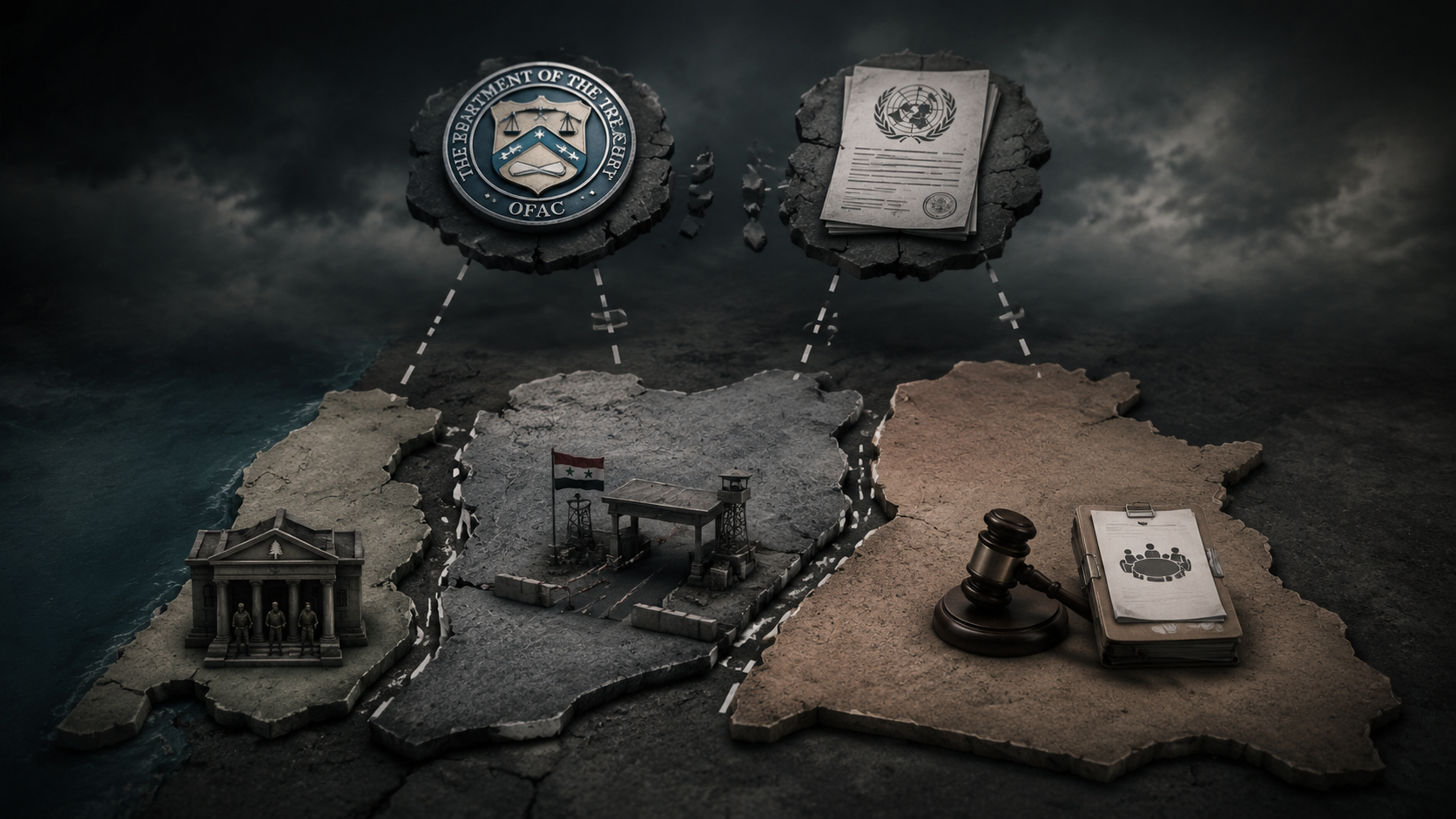
Iraq can investigate the route, but the probe has to become more than a signal
Iraq’s role is indispensable if the reported route is accurate. A shipment said to exploit an Iraq-Syria oil corridor cannot be fully investigated only from the Syrian side of the border. Iraqi authorities would need to examine departure points, vehicle ownership, loading records, militia or security-service interference, customs documentation, oil-route permissions, and any communications linking Iraqi territory to the alleged Lebanese destination.
The committee announced by al-Zaidi therefore matters. It creates a domestic investigative channel and gives Iraqi institutions a formal reason to collect documents, summon officials, and coordinate with security bodies.[3] For enforcement professionals, that is the difference between a press denial and a file that might later be shared, audited, or used to justify action against specific actors.
It is also exactly where caution is needed. Middle East Eye cited a Chatham House analyst characterizing the Iraqi probe as a “tactical gesture to signal to Washington,” rather than proof of a durable Iraqi policy shift.[3] That does not make the committee meaningless. It does mean the legal value of the probe depends on what happens after the announcement: whether evidence is preserved, whether witnesses are interviewed, whether chain-of-custody records are produced, whether names are disclosed, and whether the file survives pressure from political actors with an interest in keeping the case administrative rather than prosecutable.
A high-level committee is often legible to foreign governments before it is useful to a court. It shows attention. It shows hierarchy. It can create a diplomatic answer by the end of the week. None of that proves that the committee can or will identify the actors who controlled the tanker, expose an Iraqi logistics node, or transmit evidence to Syria, Lebanon, or the United States in a form those systems can actually use.
Syria’s reversal is meaningful, but still provisional
The Syrian side of the case is striking because it cuts against the Assad-era pattern of facilitation and tolerance that shaped much of the older enforcement analysis. AP described the July 2026 stop in the context of Syria’s post-Assad policy reversal.[2] FDD’s Long War Journal reported that Syria had conducted at least seven documented interdictions since December 2025, which makes the al-Tanf seizure look less like an isolated customs event and more like an emerging enforcement pattern.[4]
Emerging pattern is not the same as settled doctrine. Repeated interdictions can change risk calculations for smugglers and insurers, and they can give foreign governments something concrete to cite. But the legal durability of the shift depends on ordinary institutional questions: who commands the border units, who stores seized materiel, who authenticates forensic records, who approves cross-border sharing, and whether Syrian authorities are willing to name suppliers or intermediaries whose exposure may create diplomatic costs.
That is why the al-Tanf seizure should not be treated as a referendum on Damascus’s seriousness in the abstract. The narrower question is better: can Syria repeatedly convert border interdictions into records that other jurisdictions can trust? If it can, the seizures may become operationally significant even before Syria develops a fully coherent regional anti-smuggling doctrine. If it cannot, the public effect of each seizure will outrun its enforceable value.
Lebanon supplies destination context, not control over the route
Lebanon enters the legal map differently. It is the alleged destination jurisdiction, not the place of seizure or the reported point of origin. That gives Lebanese law potential relevance to recipients, political-military structures, possession, support networks, and domestic proceedings involving Hezbollah-linked questions. It does not give Lebanon automatic control over evidence seized in Syria or investigative records held in Iraq.
Legal Agenda’s May 2026 analysis of Hezbollah before Lebanon’s Military Court is useful here because it shows that Lebanese domestic law can place Hezbollah-related conduct inside an institutional legal process, including questions around Article 288 of the Penal Code.[5] That is destination-jurisdiction context. It is not a substitute for proving the cross-border logistics chain alleged in the July al-Tanf case.
The distinction matters for anyone assessing enforcement risk. A Lebanese proceeding may address domestic conduct, association, public order, or military-court jurisdiction. A Syrian seizure file may address physical weapons and border movement. An Iraqi probe may address origin and route. They may point toward the same alleged network, but they do not automatically merge into one evidentiary record. Each system has its own thresholds, political constraints, and remedies.
US sanctions can isolate actors, not prosecute the route
The United States sits outside the territory of the alleged movement but remains central to the risk architecture. OFAC sanctions can name individuals and entities, restrict access to the US financial system, chill correspondent banking relationships, and force compliance teams to screen counterparties, vessels, companies, and facilitators even when no US court is prosecuting the smuggling episode itself.
That external leverage was active before the al-Tanf seizure. Al Jazeera reported on May 21, 2026 that the US Treasury sanctioned nine individuals, including elected Hezbollah MPs and Lebanese security officials, in what it described as the first sanctions action since the Iran memorandum of understanding.[6] The legal relevance is not that those May designations prove the July shipment. They do not. The relevance is that US sanctions create a parallel financial enforcement environment in which the same ecosystem of political, security, and logistics actors may become commercially toxic even without a regional criminal judgment.
That power is substantial and still incomplete. OFAC can designate, freeze property within US jurisdiction, and expose non-US actors to secondary or derivative risk depending on the applicable authority. It cannot seize evidence at al-Tanf, compel an Iraqi committee to produce a prosecutable file, or make a Lebanese court accept Syrian attribution. Sanctions can make a network harder to finance. They cannot, alone, establish the territorial criminal record for the July shipment.
UNSCR 1701 gives vocabulary, not an enforcement machine
UN Security Council Resolution 1701 is often invoked because it supplies the international legal vocabulary for arms flows, Lebanese sovereignty, and the post-2006 security framework in southern Lebanon. In a case like the al-Tanf seizure, that vocabulary matters. It gives diplomats and lawyers a way to describe the alleged shipment as part of a broader problem of unauthorized armed capacity and cross-border supply.
But vocabulary should not be mistaken for machinery. UNSCR 1701 does not create a single evidence locker, a regional prosecutor, a standing tribunal, or an automatic mechanism that fuses Syrian seizures, Iraqi investigative committees, Lebanese military proceedings, and US sanctions files. Its enforcement bite depends on states and institutions that remain separate. The resolution can frame the wrong; it cannot independently investigate the tanker.
Where the file can fail
The failure points in the July 2026 case are not exotic. They are the ordinary weak points that appear whenever physical evidence, intelligence attribution, political messaging, and sanctions exposure are asked to do one another’s jobs.
| Failure Point | Why It Matters In The Al-Tanf Case |
|---|---|
| Evidentiary mismatch | A border seizure may prove possession of weapons in a tanker, while a sanctions action may require a different showing about ownership, control, facilitation, or support. |
| Territorial limits | Syria can control the interdiction site, Iraq can examine the alleged origin and route, and Lebanon can address destination-side conduct, but none automatically commands the others. |
| Attribution dispute | Hezbollah’s denial does not defeat the allegation, but it raises the standard for anyone trying to turn the allegation into a durable legal record. |
| Political dependency | Iraq’s committee may gather evidence or merely answer diplomatic pressure; Syria’s new posture may harden or remain episodic; Lebanon’s institutions face their own constraints. |
| Remedy mismatch | Seizure, prosecution, designation, asset freeze, and UN reporting are different remedies. Success in one does not equal success in the others. |
The evidentiary mismatch is the most immediate problem. A Syrian officer may be able to testify that weapons were found in a tanker. That does not automatically prove who placed them there, whether the driver knew, whether an Iraqi official facilitated passage, whether Hezbollah ordered the shipment, or whether a named financier can be designated for material support. Each additional claim needs its own evidentiary bridge.
The territorial problem follows quickly. If an Iraqi-origin theory depends on records or witnesses in Iraq, then Syrian evidence is incomplete without Iraqi cooperation. If the alleged destination is Lebanon, then Lebanese authorities may need access to Syrian and Iraqi material before domestic proceedings can do more than address the endpoint. If the United States wants to use the incident in sanctions reasoning, it must decide whether the available record is reliable enough for designation and defensible enough for future administrative or judicial challenge.
Attribution is the pressure point that separates intelligence confidence from legal consequence. Governments may be comfortable announcing that a shipment was bound for Hezbollah based on sources and methods they will not disclose. Sanctions authorities sometimes operate with classified or administrative records that would not resemble a criminal trial file. A domestic prosecution may need witness testimony, forensic handling, documentary authentication, and a clearer chain of custody. None of these standards is inherently superior in every context. They are simply different, and the differences are where cross-border cases often thin out.
The practical reading for compliance and enforcement teams
For sanctions compliance officers, the July seizure should be treated as a live risk signal, not as a completed legal finding. The reported use of an oil tanker and a recognized Iraq-Syria route is the type of fact pattern that should sharpen screening around transport counterparties, beneficial ownership, cargo documentation, route anomalies, and counterparties exposed to Iraqi, Syrian, or Lebanese political-security networks. The point is not to assume every oil-route actor is implicated. It is to recognize that ordinary commercial infrastructure can become the surface layer of a weapons logistics allegation.
For government lawyers, the case is a reminder to separate what each file can actually do. A Syrian seizure file can preserve physical facts. An Iraqi committee can trace domestic origin and official complicity if it is empowered to do so. A Lebanese proceeding can address destination-side legal questions. OFAC can impose financial consequences on actors it can identify under its authorities. UNSCR 1701 can frame international concern. These mechanisms may reinforce one another politically, but legally they remain partial.
That is the enforcement gap exposed by the Hezbollah weapons smuggling legal probe. The al-Tanf seizure and Iraq’s immediate response may matter, especially if the record is preserved and shared. They do not prove that a coordinated enforcement machine now exists. They show a set of overlapping silos: border interdiction, domestic investigation, destination-jurisdiction proceedings, external financial sanctions, and an international resolution with limited operational bite. The practical judgment is therefore narrower, and more useful: risk has to be assessed across the overlap, because no single probe, designation, prosecution, or UN framework can independently disrupt the full supply chain.
References
- Syria seizes advanced weapons it says were bound for Lebanon’s Hezbollah, Al Jazeera, July 16, 2026.
- Syria stops weapons smuggling to Hezbollah at Iraq border, AP News, July 17, 2026.
- Iraqi government orders probe over weapons smuggling to Hezbollah in Lebanon, Middle East Eye, July 17, 2026.
- Syria intercepts advanced weapons bound for Hezbollah from Iraq, FDD’s Long War Journal, July 2026.
- Hezbollah Before the Military Court, Legal Agenda, May 12, 2026.
- US sanctions elected Hezbollah MPs and Lebanese security officials, Al Jazeera, May 21, 2026.
Comments
Join the discussion with an anonymous comment.