
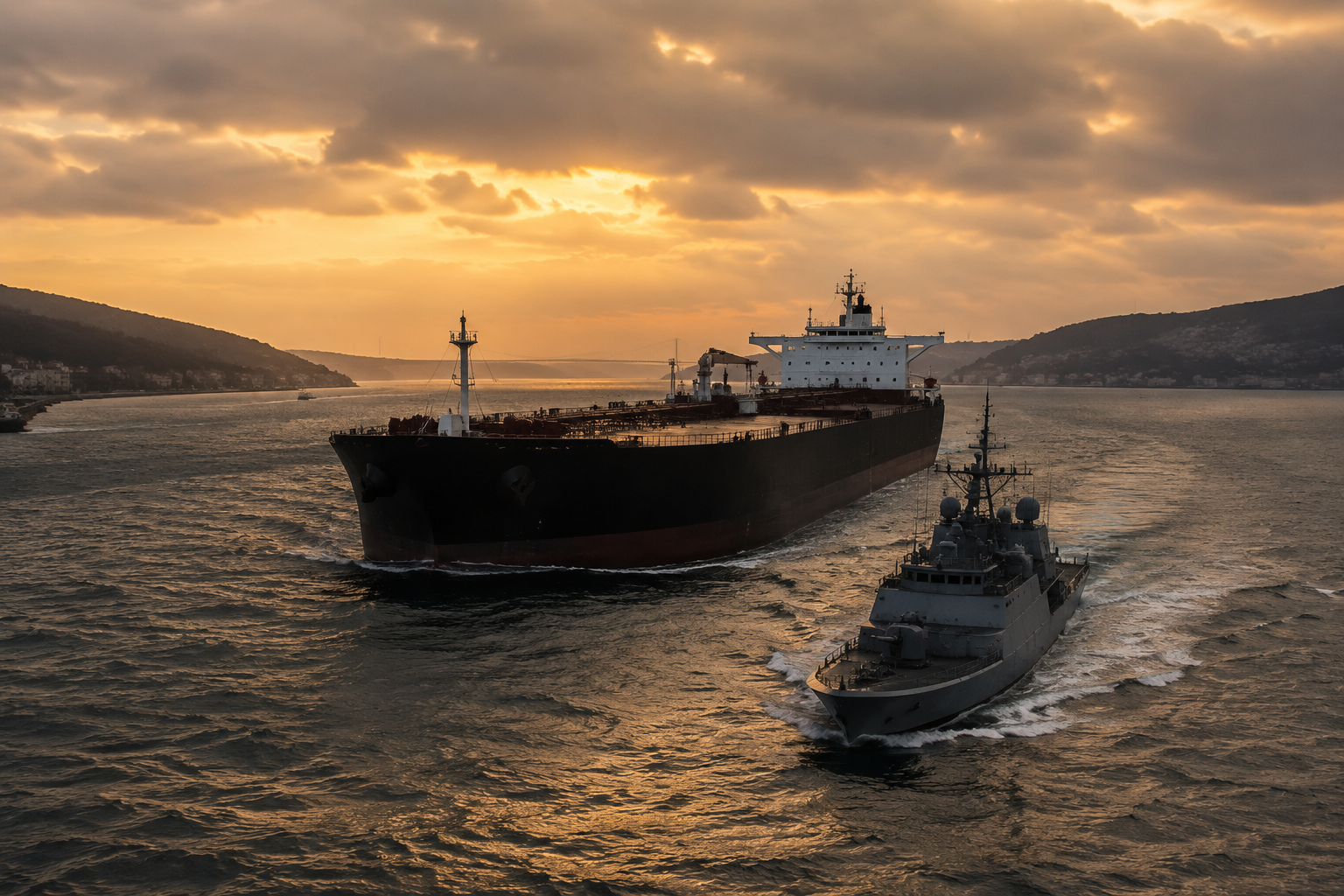
A tanker moving through the Strait of Hormuz under naval escort looks, at first, like the most legally cautious response to a tanker seizure crisis. The warship is there to deter interference, reassure insurers, and keep transit passage alive through a strait used for international navigation. Yet the same escort can change the legal meaning of the merchant vessel it is protecting. Under the law of the sea, the convoy is a safeguard for passage. Under the law of naval warfare, a merchant vessel traveling under military convoy, or serving as a supply ship for a belligerent fleet, may become a lawful military objective under San Remo Manual Rule 60(b) and Rule 60(g). That is the central legal problem in the Strait of Hormuz tanker crisis: one physical act can be protective in one legal room and targetable in another.[1][2]
This is not a lawyer’s puzzle detached from the sea. It is an operational trap. A neutral shipowner that asks for escort may be trying to avoid seizure, mining, or missile attack. The flag state may believe it is preserving a right of transit passage. The crew may care only that the next leg is not sailed alone. But once the vessel is visibly associated with a naval force, an opposing belligerent can argue that the facts have moved out of ordinary navigation and into naval warfare. The more serious the threat becomes, the stronger the incentive to escort; the stronger the escort, the easier it becomes to characterize the vessel as participating in the conflict’s maritime architecture.
The Escort Problem Comes First
The convoy contradiction deserves priority because it reveals the crisis before the vocabulary hardens. If the issue is described only as “closure,” the reader is sent toward UNCLOS. If it is described only as “blockade,” the reader is sent toward the law of naval warfare. If it is described only as “self-defense,” the reader is sent toward Article 51 of the UN Charter. The escorted tanker sits at the point where all three labels compete.
Just Security’s analysis of Hormuz treats escort and transit passage as an operationally necessary but legally unstable combination: naval escorts may be used to protect passage through the strait, yet the same facts can be invoked by an adversary to argue that merchant shipping has lost ordinary civilian protection. Opinio Juris makes the same regime-comparison point from the naval warfare side, emphasizing that the San Remo Manual permits attack on merchant vessels that are incorporated into a military convoy or make an effective contribution to military action.[1][2]

The difficult part is not that one of these bodies of law is obviously irrelevant. The difficult part is that each has a plausible claim to the same facts. The law of the sea sees a strait used for international navigation and asks whether transit passage is being obstructed. The law of naval warfare sees belligerent naval forces, merchant traffic, mines, attacks, and convoying, then asks whether objects have become military objectives. Jus ad bellum sees prior attacks and asks whether defensive force is necessary and proportionate. None of those questions is foolish. None is complete.
That matters most for states and commercial actors that are not choosing the confrontation. A neutral tanker does not become less exposed because lawyers can assign the same transit to different doctrinal boxes. The flag state, owner, charterer, cargo interests, P&I insurer, and crew all need a usable answer before the voyage, not a tribunal’s reconstruction after the loss. The legal system supplies rules, but it does not supply a traffic controller with authority to resolve the collision in real time.
Transit Passage Is Strong, But It Does Not Control the Whole Crisis
The law-of-the-sea answer is still the strongest starting point. UNCLOS Article 38(1) protects transit passage through straits used for international navigation, and Article 44 provides that such passage shall not be suspended. International Law Blog and ASIL commentary treat that non-suspension rule as one of the central protections applicable to Hormuz, precisely because the strait connects large volumes of international navigation and because unilateral coastal-state interruption would affect the rights of many states, not merely the vessels immediately present.[3]
But the strength of the rule should not be confused with ease of application. Neither the United States nor Iran is party to UNCLOS. The United States has long treated the transit-passage rules reflected in UNCLOS Articles 37 through 44 as customary international law. Iran has taken the opposite route: it has asserted a persistent-objector position and has historically applied an innocent-passage framework instead. JuWissBlog’s discussion of Iran’s 1993 Act on Marine Areas emphasizes that Iran’s domestic law codifies this narrower approach, under which Tehran claims broader regulatory authority over foreign warships and passage.[4]
The difference is not academic. Transit passage cannot be suspended. Innocent passage, in the territorial sea, can be subject to more coastal-state control, and UNCLOS Article 25(3) allows temporary suspension of innocent passage in specified circumstances. If Iran’s view controlled, it would have more room to regulate or impede certain passage. If the U.S. customary-law view controlled, Iran’s ability to close or suspend the strait would be sharply constrained. The operational world does not wait for that dispute to be conclusively settled.
Chatham House captures the scale of the problem with unusual precision: Hormuz is “a matter of global regulation affecting the rights of all states.” That framing is useful because it does not pretend that the dispute belongs only to Washington and Tehran. It also does not pretend that a rule protecting all states automatically gives all states an effective enforcement mechanism. Passage rights may be general; the costs of resisting interference are not.[5]
This is where the doctrinal confidence of transit passage begins to thin out. A neutral state may insist that its vessels enjoy non-suspendable passage. Iran may answer that it is not bound by the UNCLOS transit-passage regime as treaty law and disputes its customary status in the relevant form. The United States may escort vessels to vindicate the customary rule. The escort may then be used to recast those vessels under naval warfare rules. The legal categories remain intelligible; their combined effect becomes unstable.
Closure, Blockade, and Self-Defense Overlap Rather Than Replace One Another
Calling the crisis a “closure” does not avoid blockade law. Iran’s conduct, as described in the available analyses, has not taken the clean form of a declared blockade satisfying the traditional requirements of declaration, effectiveness, impartial application, notification, and time for neutral vessels to exit. Instead, the reported pattern combines threats, attacks, mining, and a toll scheme said to require payment of $2 million per vessel at Larak Island.[2][6]
| Claim | What the law tends to ask | Why Hormuz strains the answer |
|---|---|---|
| Transit passage | Can passage through a strait used for international navigation be suspended? | UNCLOS says no, but Iran contests the customary-law claim and relies on a narrower innocent-passage position. |
| Blockade or closure | Has a belligerent declared and maintained a lawful blockade with notice, effectiveness, impartiality, and exit time? | Reported threats, mining, attacks, and tolls do not fit neatly into a formally declared blockade. |
| Self-defense | Is force necessary and proportionate to the armed attack that triggered it? | The proportionality test does not adequately price the stranded neutral ships, crews, and states affected by chokepoint disruption. |
The legal consequences differ depending on which label is doing the work. A lawful blockade is not simply a political announcement that traffic will be stopped. It is a regulated method of naval warfare, and its legality depends on conditions meant to protect neutral shipping from arbitrary seizure or destruction. Opinio Juris and Hill Dickinson both emphasize that an undeclared blockade or mining campaign against neutral shipping sits uneasily with Hague Convention VIII and San Remo Manual rules, including rules concerned with notification and safe alternative routes.[2][6]
Mines are especially revealing because they convert legal uncertainty into physical uncertainty. A paper closure can be challenged diplomatically. A minefield makes even lawful passage dependent on risk tolerances that no treaty text can remove from the master, insurer, or flag state. If mines are laid without adequate notice, discrimination, or safe alternatives for neutral shipping, the problem is not merely that navigation is inconvenient. The method itself undermines the legal premise that neutral commerce can be separated from belligerent pressure.
The United States’ announced formal blockade of Iran on April 13, 2026 complicates the picture further. Just Security describes the resulting dual-blockade dynamic: the United States claims blockade authority against Iran’s ports, while Iran’s conduct effectively obstructs the Gulf and the Strait. Existing naval-warfare instruments do not give a settled account of how two opposing blockade claims should operate in a single chokepoint through which neutral states also claim non-suspendable passage rights.[1]
That novelty should not be overstated into legal emptiness. There are still rules. A blockade must be declared and notified. It must be effective. It must be applied impartially. It must allow neutral vessels time to leave. It must not use prohibited or indiscriminate methods. But the presence of rules does not answer the hardest operational question: who gets to enforce which rule, against whom, while tankers are waiting and naval forces are already deployed?
Self-Defense Measures the Wrong Margin
Article 51 arguments are inevitable once tankers are seized, struck, or threatened and states begin escorting or using force. The familiar jus ad bellum questions are necessity and proportionality. The International Court of Justice’s Oil Platforms judgment is commonly invoked for the proposition that proportionality in self-defense is assessed against the armed attack that provoked the response.[7]
That test has a chokepoint problem. It asks whether the defensive measure is proportionate to the triggering attack. It does not have a satisfactory doctrinal mechanism for weighing the distributed harm imposed on neutral states, commercial actors, and crews when a narrow strait becomes the theater in which proportionality is performed. A strike may be proportionate to an attack on a vessel and still produce massive collateral disruption to states that are not parties to the underlying dispute.
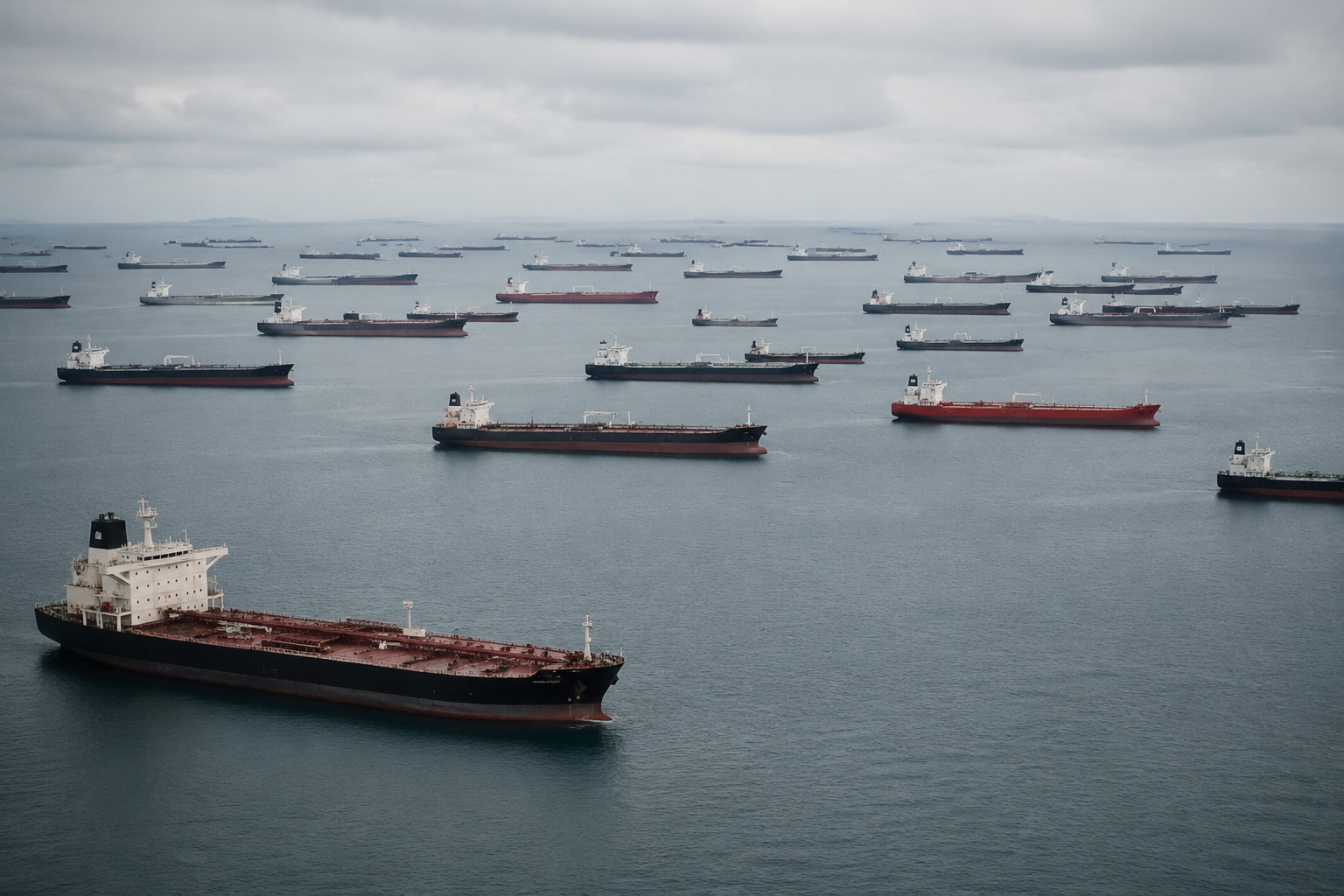
The human and administrative scale is not incidental. Lawfare reports that the IMO had identified roughly 20,000 mariners and 2,000 ships stranded by April 2026. That figure is a better measure of the crisis than another abstract reference to energy markets, because it shows who waits while legal categories are being asserted: crews unable to move, ships unable to complete voyages, cargo interests unable to plan, insurers recalculating risk, and government lawyers trying to advise without a stable hierarchy among regimes.[8]
Self-defense law can condemn excessive force, and it can reject measures not necessary to repel or respond to an armed attack. What it does less well is absorb the regulatory interest of all the states whose vessels are trapped by the defensive exchange. The proportionality inquiry is bilateral in structure even when the chokepoint consequences are multilateral in fact.
Neutral Rights Are Where the Doctrines Fail Each Other
For neutral third-party states, the problem is not simply that Iran may breach the law or that the United States may overreach in response. Those questions matter, but they do not exhaust the legal injury. The deeper difficulty is that each regime offers a partial protection that can be weakened by the operation of another regime.
- Transit passage protects movement through the strait, but the treaty-custom dispute limits practical certainty when a coastal state contests the rule.
- Naval warfare rules protect neutral commerce in principle, but convoy association and military contribution rules can reclassify merchant vessels when protection becomes militarized.
- Blockade law restricts coercive closure methods, but it depends on declaration, notification, and enforcement at precisely the moment when states may prefer ambiguity.
- Self-defense law constrains armed responses, but its proportionality test does not adequately account for third-party shipping paralysis.
This is why the crisis should not be reduced to whether Hormuz is “open” or “closed.” A strait can be formally open and practically unusable. It can be legally protected and commercially uninsurable. A vessel can have a right to pass and still be advised not to sail. A naval escort can vindicate a right and create a targeting argument. In each case, the rule remains recognizable while its protective function deteriorates.
Nor should too much weight be put on any single technical move. Iran’s non-party status to UNCLOS does not give it a free hand to interfere with all passage. The U.S. view that transit passage is customary law does not eliminate the operational consequences of Iran’s objection and domestic law. San Remo targeting rules do not transform every escorted tanker into a lawful target. Article 51 does not license whatever force is useful to reopen a chokepoint. The hard case exists because these propositions can all be true at once.
The Advantage Goes to the State That Moves First
International law has a familiar weakness in fast maritime crises: it often speaks most clearly after the operational choices have already been made. A tanker is seized, escorted, mined around, delayed, rerouted, or insured at a different price before any authoritative body can settle the doctrinal hierarchy. The harmed neutral state may be right on the law and still too late to protect the voyage.
That does not mean law is irrelevant. The rules on transit passage, blockade, mining, neutral shipping, military objectives, and self-defense all constrain what states may plausibly claim. They shape diplomatic pressure, insurance decisions, naval rules of engagement, and later accountability. But constraint is not the same thing as real-time resolution. In Hormuz, the gap between those two things is large enough to become a strategic asset.
The state most willing to breach settled rules, exploit contested ones, and force others to respond inside multiple legal frameworks gains time. It can call interference a security measure, closure, countermeasure, blockade-like enforcement, or self-defense-adjacent necessity, depending on the audience. Opposing states then have to answer not only the act, but the classification. Neutral actors pay while the classification fight proceeds.
The legal failure in the Strait of Hormuz is therefore not the absence of law. It is the presence of several bodies of law that attach different consequences to the same conduct and lack a reliable mechanism for neutral states to vindicate their rights before the damage is done. Transit passage is strong but contested. Naval warfare rules can turn protective association into targeting significance. Blockade law condemns important methods but depends on enforcement. Self-defense proportionality does not properly price third-party harm. For legal advisers in this crisis, the immediate danger is not pure lawlessness. It is a grey zone in which the actor willing to move first and litigate later can make neutral rights the cost of everyone else’s caution.
References
- Legal and Operational Issues in the Strait of Hormuz: Transit Passage — Just Security.
- The Closure of the Strait of Hormuz by Iran: Considerations over the Law of the Sea and Law of Naval Warfare — Opinio Juris, May 6, 2026.
- Does Iran Possess the Right to Close the Strait of Hormuz under International Law? — International Law Blog, April 6, 2026.
- JuWissBlog analysis of Iran’s persistent objector claim and 1993 Act on Marine Areas — JuWissBlog, 2026.
- Strait of Hormuz: Shipping and the law — Chatham House, April 2026.
- Strait of Hormuz closure — Hill Dickinson.
- How International Law Restricts the Use of Military Force in Hormuz — EJIL: Talk!
- The Strait of Hormuz and the Limits of Maritime Law — Lawfare.
Comments
Join the discussion with an anonymous comment.