
The Houthis’ July 20, 2026 declaration of a Red Sea and Bab el-Mandeb blockade reached immediately for the language of maritime belligerency. Within a day, reporting tied the declaration to threats against tankers using Saudi Arabian ports, and Saudi Arabia publicly condemned the move as a threat to navigation and regional security.[1][2] The legal implications of the Houthi-Iran Red Sea blockade claim turn on a narrower question than the politics surrounding it: can an unrecognized non-state armed group impose blockade duties on neutral states and neutral shipping?
On the present record, the answer is no. The defect appears before the usual debate over whether a blockade has been properly declared, notified, and enforced. Blockade is a belligerent right developed for international armed conflict between states. A non-state party to a non-international armed conflict may have coercive capacity at sea; that does not give it legal authority to close an international strait to third-state commerce or to visit, search, capture, or attack neutral merchant vessels as blockade runners.
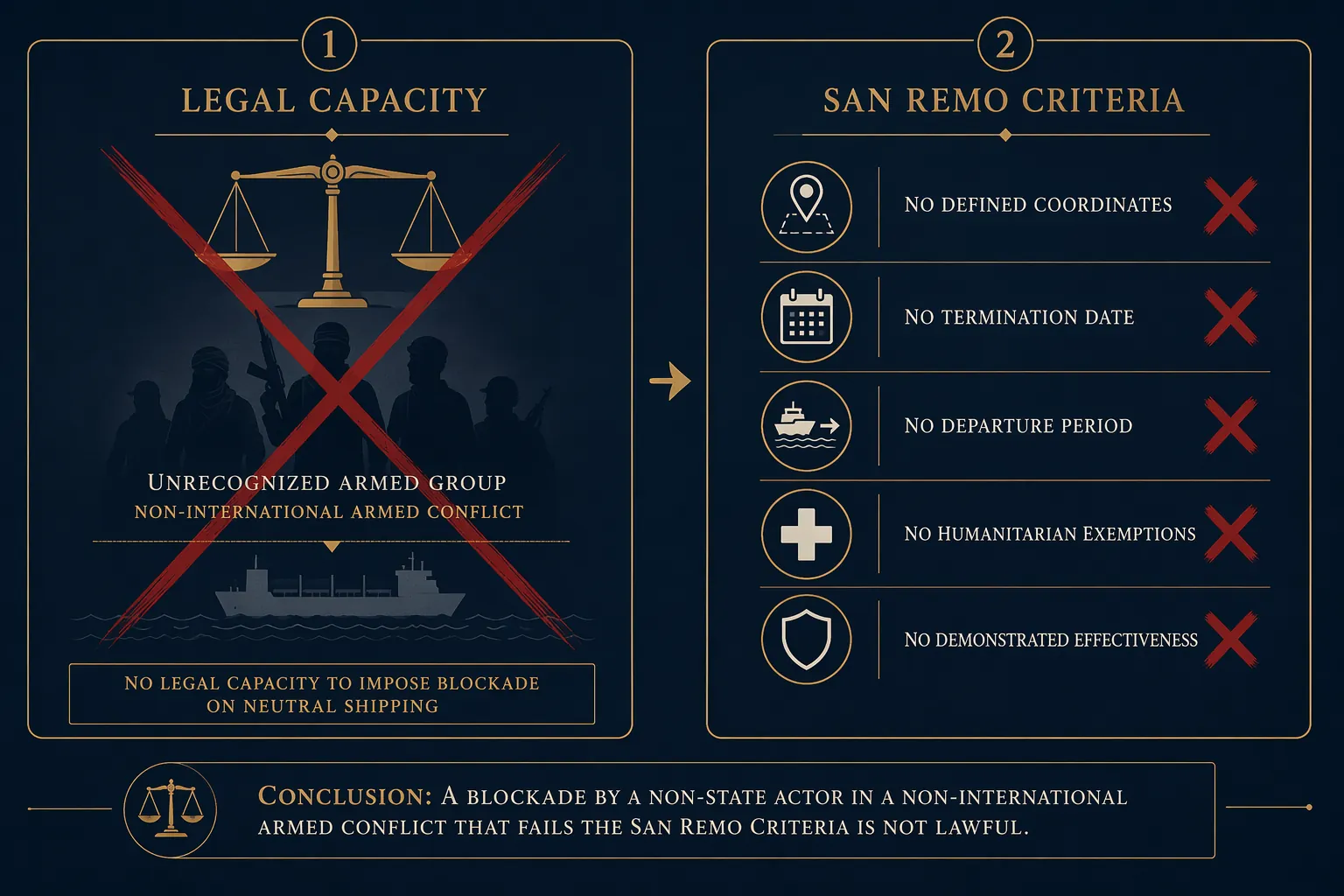
The First Question Is Legal Capacity
A lawful blockade is not merely a threat backed by missiles, drones, coastal surveillance, or control over nearby territory. It is a legal status that changes the rights and risks of third states. Once validly imposed, it can expose neutral vessels to interception if they knowingly attempt to breach it, and it can reshape the commercial decisions of shipowners, insurers, charterers, masters, flag states, and cargo interests. That is why the source of authority matters before the facts of enforcement are even reached.
The most directly relevant July 2026 analysis frames the problem in two stages: whether the Houthis have any legal capacity to impose a blockade opposable to neutral shipping, and, if that capacity were assumed, whether the declaration satisfies the San Remo Manual’s requirements for a lawful blockade.[3] That sequence is the right one. A group cannot cure lack of legal authority by drafting better coordinates.
The San Remo Manual treats blockade as part of the law of naval warfare. Its rules on declaration, notification, effectiveness, impartial application, access to neutral ports, and humanitarian relief presuppose belligerents with the legal status to regulate neutral shipping during an international armed conflict.[4] The Houthis are not a recognized state. The conflict in Yemen has long involved layers of international support and intervention, but the Houthis’ own declaration does not become a state blockade merely because they exercise de facto control over territory, ports, weapons systems, or stretches of coastline.
Common Article 3 of the Geneva Conventions does not fill that gap. It binds parties to a non-international armed conflict to minimum humanitarian obligations. It does not create prize jurisdiction, confer belligerent rights against neutral states, or authorize a non-state armed group to impose maritime exclusion obligations on third-state vessels. That distinction is not formalism for its own sake. Neutral rights are not owed to the strongest coastal gunner; they are structured around recognized legal relations among states.
There are scholarly arguments for functional maritime interdiction powers in some non-international armed conflicts, especially where armed groups control coastlines and where arms, fuel, or dual-use cargoes move by sea. The available materials identify that debate but do not show state practice accepting a non-state actor’s unilateral power to impose a blockade on neutral commerce.[3][5] At most, those arguments describe a pressure point in the law. They do not supply an existing rule that shipowners, flag states, or neutral crews must treat as binding in Q3 2026.
| Question | Legal consequence |
|---|---|
| Does the actor have blockade authority? | If no, neutral shipping is not legally bound by the purported blockade. |
| If authority were assumed, was the blockade lawfully declared and maintained? | If no, the declaration still fails under ordinary blockade doctrine. |
| Does control of weapons or coastline change either answer? | It may change the risk assessment, but not the source of legal authority. |
Even on the Most Generous Assumption, the Declaration Fails
Assume, only for argument’s sake, that the Houthis could invoke blockade law. The July 20 declaration still does not look like a lawful blockade. The San Remo Manual requires a blockade to be declared and notified, to specify its commencement, duration, location, and extent, and to be effective in the sense that it is maintained by a force sufficient to prevent access to the enemy coastline.[4] The available July 20-22 record does not establish those elements.
The declaration, as summarized in the available July 2026 legal analysis, omitted defined geographic coordinates, a termination date, a departure period for neutral vessels already in the affected area, humanitarian exemptions, and inspection arrangements.[3] Those are not clerical details. Coordinates tell a master whether the vessel is inside the claimed zone. A departure period protects vessels that entered before the legal risk was announced. Humanitarian exemptions and inspection procedures separate lawful control from indiscriminate intimidation.
- No defined coordinates: vessels cannot identify the precise closed area from the declaration itself.
- No termination date or clear duration: neutral operators cannot assess how long the claimed legal condition is meant to last.
- No departure window: vessels already near the route are not given a legally meaningful chance to leave.
- No humanitarian carveout: relief, medical, or other protected shipments are not addressed in the announcement.
- No inspection mechanism: the declaration substitutes threat for a lawful visit-and-search framework.
Effectiveness is the other missing piece. Blockade law does not recognize a purely paper blockade; it requires the blockading force to maintain real control over access. Threatened tanker attacks and public warnings may affect routing decisions, insurance pricing, and crew safety, but they do not by themselves demonstrate the sustained control required by blockade doctrine. The first 48-hour record after July 20 did not show that the Houthis had established and maintained effective blockade control over Bab el-Mandeb or the Red Sea approaches.[3]
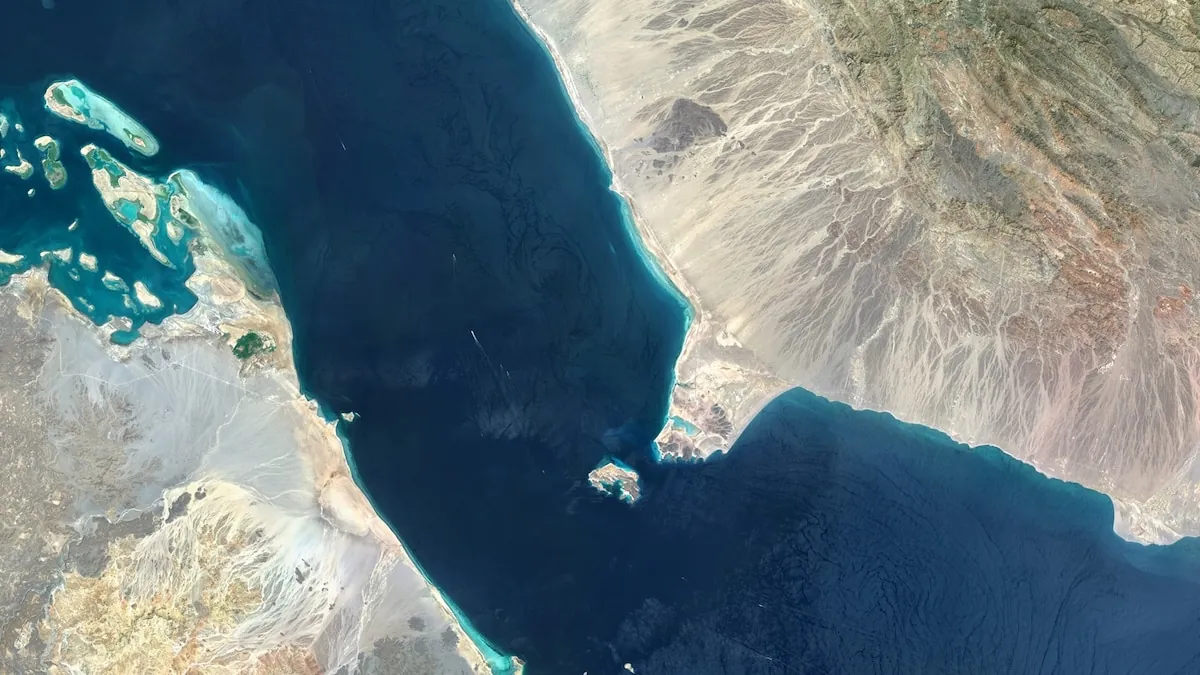
Nor can the analysis ignore where the asserted closure sits. Bab el-Mandeb is an international strait connecting the Red Sea and the Gulf of Aden. Under UNCLOS Articles 37-44, ships and aircraft enjoy transit passage through straits used for international navigation, and bordering states must not hamper that passage.[6] A non-state armed group is in no stronger position than a bordering state. A claimed blockade that functionally closes or chills transit through the strait collides with a law-of-the-sea regime designed precisely to prevent coastal control from becoming a veto over international navigation.
Neutral Shipping Bears the Practical Risk Without the Legal Duty
The legal conclusion does not make the route safe. It means something more precise: neutral vessels are exposed to factual danger without being legally bound as blockade runners. A master may still divert because a missile threat is credible. An insurer may still reprice cover. A flag state may still warn its vessels away from the route. None of those operational reactions validates the blockade.
This distinction matters for later accountability. If a neutral tanker is attacked after using a Saudi port, the legal characterization is not automatically “enforcement of a blockade.” The more immediate questions are whether the attack violates the law of armed conflict, the law of the sea, the Convention for the Suppression of Unlawful Acts against the Safety of Maritime Navigation, or rules on the use of force and self-defense. ELIAMEP’s January 2024 analysis of Red Sea attacks treated those frameworks as distinct rather than interchangeable, which remains the sound approach for the July 2026 declaration.[5]
The same caution applies to labels such as quarantine, embargo enforcement, or maritime security operation. Lieber Institute analysis of possible maritime enforcement measures against Houthi arms flows distinguishes blockade from other interdiction tools and emphasizes the need for a separate legal basis for each form of maritime coercion.[7] Calling a measure a quarantine does not avoid the legal problem if it still purports to impose duties on neutral shipping without state authority, Security Council authorization, flag-state consent, or another recognized basis.
The Security Council Context Does Not Supply the Missing Authority
Security Council Resolution 2826, adopted in July 2026, extended the reporting mandate on Houthi attacks and kept the Council engaged with threats to navigation in the Red Sea.[8] That context is important, but it does not transform the Houthis into a lawful blockading authority. The Council can condemn attacks, support reporting, authorize measures, or adjust sanctions architecture. The materials identified here do not show a Council authorization for the Houthis to regulate neutral passage through Bab el-Mandeb.
The result is asymmetrical but familiar: international law may recognize that the Houthis can violate shipping rights, trigger defensive responses, and create security risks, while still refusing to recognize their asserted blockade as legally opposable to neutral states. Legal disability and military capability can coexist in the same waterway.
Iran’s Reported Role Is a Separate Attribution Question
Iran cannot be used as a shortcut through the blockade question. Reporting before the declaration said Iran had asked the Houthis to block the Red Sea if the United States struck Iranian energy sites.[9] Other legal commentary on Houthi attacks has discussed Iranian weapons support, intelligence, and the possible involvement of Iranian personnel.[10][11] Those facts matter if the issue is state responsibility, self-defense, or attribution of particular operations to Iran. They do not automatically make the Houthis’ July 20 declaration a lawful state blockade.
The attribution framework is demanding. Under ILC Article 8 and the Nicaragua effective-control approach, the question is whether a state directed or controlled the specific conduct at issue, not merely whether it supported, encouraged, armed, or benefited from the non-state actor’s campaign.[10][11] A reported request to block the Red Sea may be evidence in an attribution inquiry, but it is not the same thing as Iran openly declaring and administering a blockade in an international armed conflict.
If later evidence showed Iranian effective control over particular attacks, that could alter responsibility for those attacks and the self-defense analysis of states responding to them. It would still require careful separation from the threshold issue addressed here: whether the Houthis themselves can impose blockade duties on neutral shipping. The present materials support the narrower conclusion, not a broader finding that every Houthi maritime act is legally attributable to Iran.
Self-Defense May Answer Attacks, Not Validate the Blockade
States whose vessels, nationals, or forces are attacked may invoke self-defense arguments, depending on the facts of the attack, necessity, proportionality, and attribution. Lieber Institute analysis of U.S. and UK strikes against the Houthis treats self-defense as a separate legal track from the Houthis’ status or the legality of their maritime threats.[10] That separation should be preserved. A defensive strike against an unlawful attack does not retroactively make the attacker’s blockade lawful, and an unlawful blockade claim does not automatically answer every question about the legality of responses to it.
For neutral shipping, this means the law does not collapse into a simple binary of obeying the Houthis or relying on naval protection. A vessel may be entitled to transit passage, may not owe blockade-runner obligations to a non-state group, and may still face serious operational risk in a contested maritime space. Those positions are uncomfortable together, but they are legally distinct.
The Yemen Blockade Precedent Cuts the Other Way
Yemen has already generated blockade litigation and legal controversy, especially around coalition restrictions on access to Yemeni ports. The ICRC casebook’s Yemen naval blockade materials are useful because they show how blockade analysis focuses on declaration, effectiveness, humanitarian access, proportionality, and the rights of neutral vessels.[12] They also show why the current Houthi claim cannot be assessed merely by saying that blockades have appeared in the Yemen conflict before.
The coalition precedent involved states claiming belligerent or Security Council-linked authority and was still legally contested. The Houthi declaration starts from a weaker position: an unrecognized non-state actor asserting authority over neutral shipping in and near an international strait. If state-led restrictions in Yemen required close scrutiny, a non-state blockade claim against third-state commerce requires at least as much.
The July 20-22 Record Leaves No Lawful Blockade
Facts may evolve after the first 48 hours. The Houthis may issue more detailed notices, attempt more sustained enforcement, or expand attacks against vessels linked to Saudi ports. Those developments would change the evidentiary record on danger and perhaps on effectiveness. They would not, by themselves, solve the legal-capacity problem.
As of Q3 2026, and on the available July 20-22 record, the Houthi Red Sea blockade is coercive in fact but not a lawful blockade opposable to neutral shipping under existing international law. It lacks a recognized legal source because a non-state actor in a non-international armed conflict has no established blockade authority over third-state vessels. Even if that authority were assumed for argument’s sake, the declaration fails the San Remo requirements for notice, definition, humanitarian protection, inspection, and effectiveness, and it runs into the independent transit-passage regime governing Bab el-Mandeb.
References
- Saudi Arabia slams Houthi blockade, Al Jazeera, July 21, 2026.
- Houthis threaten to attack shipping tankers if they use Saudi Arabian ports, The Guardian, July 21, 2026.
- The Legality of a Houthi Bab el-Mandeb Blockade under International Law, Diplomacy & Law.
- San Remo Manual on International Law Applicable to Armed Conflicts at Sea, International Institute of Humanitarian Law, 1994.
- Red Sea Attacks and the International Response: An International Law Insight, ELIAMEP, January 2024.
- United Nations Convention on the Law of the Sea, United Nations, 1982.
- Imposing a Maritime Quarantine to Enforce the Houthi Arms Embargo, Lieber Institute, West Point.
- Security Council Extends Reporting Mandate on Houthi Attacks in Red Sea, Adopting Resolution 2826 (2026), UN Press, July 14, 2026.
- Iran asks Houthis to block Red Sea if US hits energy sites, The Hill, July 16, 2026.
- The Law of Self-Defense and the U.S. and UK Strikes against the Houthis, Lieber Institute, West Point.
- Houthi Attacks in the Red Sea: Assessing Legal Ramifications under International Humanitarian Law, Jindal Forum, April 2024.
- Yemen, Naval Blockade, ICRC Casebook.
Comments
Join the discussion with an anonymous comment.