
The phrase “Houthi blockade” does more political work than legal work. For lawyers asked to assess the legal implications of Houthi attacks on Red Sea shipping, the first question is not whether the attacks are grave. They plainly are. The harder question is what legal consequence follows when a particular attack is placed under piracy, non-international armed conflict at sea, the Convention for the Suppression of Unlawful Acts Against the Safety of Maritime Navigation, or Article 51 self-defense.
That classification decides who may board a vessel, who may prosecute suspects, who may strike targets ashore, who may invoke state responsibility, and who must settle for documentation, condemnation, or commercial risk controls. It also decides how shipowners, insurers, sanctions counsel, flag states, and government lawyers describe exposure without overstating the authority available.
The live diplomatic record reflects that uncertainty. On July 14, 2026, the Security Council adopted Resolution 2826, renewing the Secretary-General’s monthly reporting requirement on Houthi attacks against merchant and commercial vessels in the Red Sea; China and Russia abstained, and the Council “took note of” measures undertaken by member states without itself authorizing the use of force.[1] That distinction matters. A Council text can recognize danger, preserve reporting, and support political pressure without becoming a Chapter VII strike authorization.
The reported July 20, 2026 blockade declaration is even fresher. As of July 22, it should be treated as a developing factual claim, not as a settled legal category. A declared blockade, if it is to operate as a term of art, belongs to the law of armed conflict and carries demanding requirements. A press statement or threat to shipping does not by itself answer whether the relevant conduct is piracy, a war crime, a treaty offense, or part of an Article 51 claim.

The Same Attack Can Move Through Different Legal Doors
A merchant vessel in the Red Sea is not just a merchant vessel for legal purposes. Its flag, ownership, cargo, route, conduct, connection to a party to an armed conflict, and the means used against it can all change the analysis. A missile attack on a third-state commercial ship does not raise the same enforcement questions as an armed boarding by a crewed skiff. A vessel effectively contributing to military action is not in the same position as an ordinary container ship carrying civilian goods. A strike by a state against launch sites ashore is not legally justified merely because the initial target was commercial.
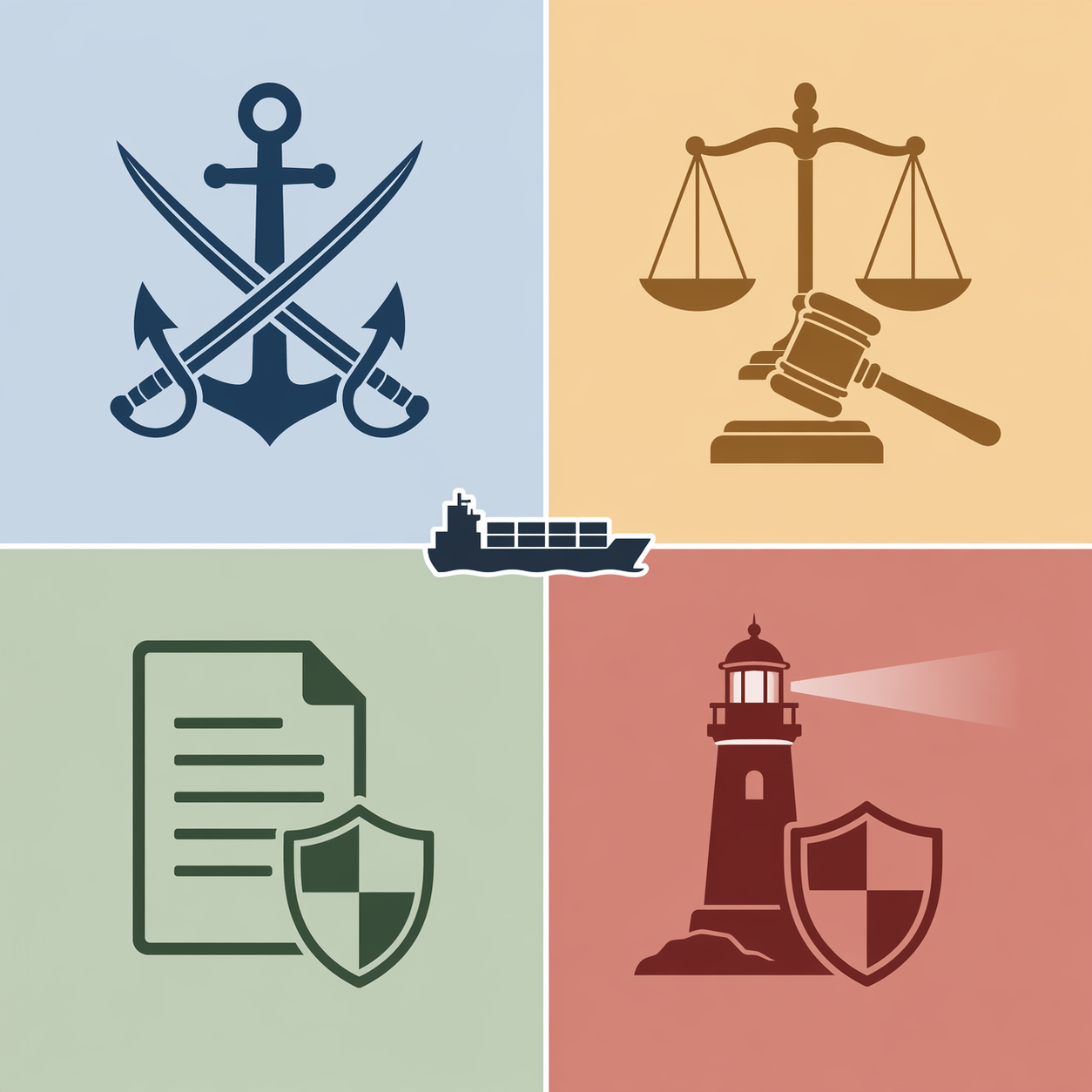
Papastavridis’s analysis is useful because it resists the temptation to make one label carry all the facts. It treats piracy, armed conflict at sea, the SUA Convention, and self-defense as overlapping but distinct legal frameworks, each with its own threshold and consequence.[2]
| Classification | What It Helps Answer | Main Legal Consequence | Main Limit |
|---|---|---|---|
| Piracy under UNCLOS | Can states board, seize, and prosecute under universal jurisdiction? | Articles 101, 105, and 110 can open jurisdiction and enforcement possibilities. | The private-ends requirement and the two-ship, high-seas framework make many Houthi attack patterns difficult to fit. |
| NIAC at sea | Is the vessel a lawful military objective or a protected civilian object? | Law-of-armed-conflict rules govern targeting, distinction, and war-crime analysis. | Ordinary commercial vessels remain civilian objects unless they effectively contribute to military action. |
| SUA Convention | Can missile or drone attacks on merchant vessels be prosecuted as maritime security offenses? | States gain treaty-based criminal jurisdiction and extradite-or-prosecute obligations. | SUA does not itself authorize interdiction, armed enforcement, or strikes. |
| Article 51 self-defense | May a state use force against Houthi targets in response? | The United States and United Kingdom have relied on self-defense to justify strikes. | Whether sporadic non-state attacks on commercial vessels qualify as armed attacks remains contested. |
Piracy Is Powerful, but It Is Not a Universal Solvent
Piracy is attractive because it does something other labels do not. Under UNCLOS, piracy can permit universal jurisdiction; Article 105 addresses seizure of pirate ships and arrest of persons, while Article 110 provides a right of visit in defined circumstances.[2] For a flag state, naval commander, or prosecutor, that is a serious practical difference. A classification that opens boarding, seizure, and prosecution powers is not merely descriptive.
The problem is Article 101. Classic piracy requires illegal acts of violence, detention, or depredation committed for private ends by the crew or passengers of a private ship or aircraft, directed against another ship or aircraft, on the high seas or in a place outside any state’s jurisdiction. Houthi attacks sit awkwardly inside that formula. Some attacks are politically framed. Some involve missiles or drones rather than a crewed attacking ship. Some factual scenarios may occur in or near territorial seas. Those details are not lawyerly decoration; they are elements.
The “private ends” debate is especially easy to flatten. One view reads private ends broadly enough to include politically motivated non-state violence outside recognized state authority. Another treats ideologically or militarily motivated attacks as outside piracy’s traditional commercial depredation model. Papastavridis treats this as a real controversy rather than a pleading inconvenience.[2] That is the right caution. Calling every Houthi attack piracy may make jurisdiction sound simple, but it risks building enforcement advice on the most disputed element in the definition.
There may still be narrower facts where piracy deserves analysis: a crewed attack launched from one vessel against a third-state merchant vessel beyond the territorial sea, especially if the conduct can be characterized as serving private ends under the broader view. But missile and drone attacks against merchant shipping are a poor fit for piracy’s inherited architecture. They may be unlawful, prosecutable, or evidence of war crimes under other frameworks without becoming piracy.
Armed Conflict at Sea Changes the Civilian-Vessel Question
The law of non-international armed conflict at sea is where the analysis becomes both more concrete and more uncomfortable. It does not ask whether a ship is commercially important or politically symbolic. It asks whether, under the applicable rules of distinction and targeting, the vessel is a military objective or remains a civilian object.
The San Remo Manual and the Newport Manual provide the main working vocabulary. Under the San Remo framing, merchant vessels are generally protected, but they may become military objectives if they make an effective contribution to military action and their destruction, capture, or neutralization offers a definite military advantage. San Remo Articles 41, 67, and 166 are central to that analysis, including the treatment of enemy merchant vessels and the protection of civilian objects.[2]
That means a vessel flagged to, operated by, or closely connected with a party to a non-international armed conflict may raise a different question from an ordinary third-state merchant vessel. A ship carrying military equipment, transmitting military intelligence, acting under military direction, or otherwise effectively contributing to military action may be assessed differently from a bulk carrier with no such role. The test is functional, not rhetorical. The fact that a ship trades with, is insured in, or is owned through a state politically aligned with a party does not automatically make it targetable.
This is where the attacks on the MV Magic Seas and MV Eternity C matter. Human Rights Watch reported that the Houthis attacked and sank the two cargo ships in July 2025 and characterized the attacks as apparent war crimes, emphasizing the civilian nature of the vessels and the harm to crew members.[3] JURIST separately reported condemnation of the attacks as war crimes in July 2025.[4] Those incidents do not prove the legal status of every later attack, but they show why the civilian-vessel issue cannot be kept abstract.
The war-crime label depends on more than outrage. If a merchant vessel is civilian, and if it is intentionally attacked without qualifying as a military objective, the law-of-armed-conflict analysis can move toward unlawful targeting and individual criminal responsibility. If the vessel has crossed the military-objective threshold, the analysis changes again: proportionality, precautions, warning, capture rules, and the treatment of survivors become central. The same sea lane can contain both categories of vessel. The law does not make the classification convenient for shipping schedules.
SUA Captures More Modern Attack Methods, but It Does Less Than Some Want
The SUA Convention is often less dramatic than piracy in public discussion, but for missile and drone attacks on merchant vessels it may be more useful. The 1988 Convention, as amended, addresses unlawful acts against the safety of maritime navigation and can cover violence against ships, placing destructive devices, and conduct likely to endanger safe navigation.[2] It is not trapped in the same way by the classic image of one private ship attacking another on the high seas.
That makes SUA a better fit for many attacks on non-party merchant vessels. If a drone or missile is launched against a commercial ship with no sufficient nexus to a party’s military action, the prosecution question does not need to wait for piracy doctrine to stretch around the hardware. SUA can give states a treaty route for criminal jurisdiction, including the familiar extradite-or-prosecute structure.
Its limit is just as important. SUA is a criminal-law and cooperation instrument. It does not, by itself, authorize naval forces to board any suspect vessel at sea. It does not authorize strikes on launch sites. It does not convert a treaty offense into a general enforcement license. For prosecutors and sanctions counsel, SUA may be central. For a military lawyer asked to approve kinetic action, it is not enough.
This division of labor is easy to miss in crisis language. A state may have jurisdiction to prosecute individuals involved in an attack and still lack a free-standing right to use force in response. A flag state may have a claim based on harm to its vessel and crew without thereby acquiring authority to interdict unrelated shipping. The legal system separates accountability from armed enforcement more often than political statements admit.
Article 51 Is the Broadest Claim and the Most Contested
The United States and United Kingdom have relied on UN Charter Article 51 self-defense to justify strikes against Houthi targets.[2] That puts the question on a different plane. Piracy asks about universal jurisdiction and maritime enforcement. SUA asks about treaty offenses and prosecution. NIAC at sea asks whether a vessel is a lawful military objective. Article 51 asks whether a state may use force in response to an armed attack.
The argument is not frivolous. Repeated attacks on merchant shipping can threaten vessels, crews, flag-state interests, and navigation through a critical route. State practice since 2024 has included military responses framed in defensive terms. Security Council Resolution 2722 belongs to that background, and Resolution 2826 confirms that the Council continued to treat the attacks as a matter requiring regular attention in 2026.[1]
But the legal threshold remains difficult. Papastavridis’s critique is that International Court of Justice doctrine has not clearly extended “armed attack” status to sporadic attacks on commercial vessels by non-state actors in the way the U.S. and U.K. position requires.[2] That does not prove the position unlawful. It does mean legal advisers should not describe it as settled simply because the underlying attacks are serious.
Resolution 2826 is relevant here mainly for what it does not do. The Council renewed reporting, addressed Houthi attacks, and took note of measures by member states; it did not grant a use-of-force mandate.[1] For government lawyers, that distinction affects the source of authority. For private counsel, it affects how to evaluate sanctions exposure, contract frustration arguments, force majeure notices, war-risk insurance, and the legal status of countermeasures affecting clients.
What the Classification Changes in Practice
The practical legal consequences are not interchangeable. A piracy analysis may support universal jurisdiction and limited boarding or seizure powers where UNCLOS elements are met. A NIAC analysis may support military-objective targeting in one case and war-crime allegations in another. A SUA analysis may support prosecution and extradition obligations without armed enforcement authority. An Article 51 analysis may support state uses of force only if the armed-attack and necessity-proportionality requirements are satisfied.
- For shipowners, the classification affects routing decisions, charter-party notices, insurance claims, and whether a vessel’s conduct could be characterized as contributing to military action.
- For insurers, it affects whether losses are treated through war-risk, terrorism, piracy, or other policy language.
- For flag states, it affects whether the state has a direct injury claim, a criminal jurisdiction route, a right to request cooperation, or a possible basis for defensive action.
- For prosecutors, it affects whether the case is built around piracy, SUA offenses, domestic terrorism statutes, war crimes, or ordinary homicide and destruction-of-property offenses.
- For sanctions and compliance counsel, it affects how to describe counterparties, facilitation risk, insurance exclusions, and dealings with vessels connected to parties to the conflict.
It also affects professional responsibility. A lawyer advising a client in this setting should not reduce the analysis to “the Houthis are pirates” or “the blockade makes everything a war measure.” Either sentence may be directionally useful in a boardroom for five minutes. Neither is a safe legal conclusion without facts about location, means of attack, vessel status, flag, cargo, command link, and the authority being invoked.
A Narrower Answer Is the More Reliable One
The current record supports a narrower and more useful conclusion than the public vocabulary usually permits. Houthi attacks may be evidence of war crimes where civilian merchant vessels are intentionally attacked without military-objective status. They may be SUA offenses where missiles, drones, or other methods endanger maritime navigation. They may be arguable piracy in a narrower set of crewed-vessel, high-seas attack scenarios if the private-ends element can be satisfied. They may form part of a state’s asserted Article 51 self-defense justification, though that justification remains legally contested.
That is not semantic housekeeping. It is the precondition for judging lawful enforcement, jurisdiction, state responsibility, insurance and sanctions exposure, and the advice legal professionals owe clients and governments when the facts are unstable and the law has not politely arranged itself into one category.
References
- Security Council Extends Monthly Reporting Requirement on Houthi Attacks in Red Sea, United Nations Security Council, July 14, 2026.
- Red Sea attacks and the international response: an international law insight, ELIAMEP.
- Yemen: Houthis’ Attacks on Cargo Ships Apparent War Crimes, Human Rights Watch, July 23, 2025.
- Houthi attacks on Red Sea cargo condemned as war crimes, JURIST, July 2025.
Comments
Join the discussion with an anonymous comment.