
Selena Gomez’s deleted January 2025 Instagram video became a familiar kind of public event: a celebrity crying on camera, a political counterattack, then a rapid migration of the story into partisan shorthand. News coverage described Gomez as tearfully responding to immigration raids and enforcement actions affecting schools, churches, and courthouses; former Senate candidate Sam Parker posted that she should be deported; and border czar Tom Homan defended the enforcement campaign, saying the administration was “going to do this operation without apology.”[1][2][3]
That exchange was the ignition, not the engine. The more durable legal question is what happened after the outrage cycle moved on: which legal tools the administration used, which people those tools reached, and how federal courts responded when detainees filed habeas petitions against ICE custody.

By July 2026, the court record was no longer anecdotal. Politico’s manually compiled habeas database found more than 15,500 rulings against ICE in the first year of the mass detention policy, compared with roughly 2,200 rulings for the government. The same analysis counted 464 federal judges rejecting the government’s position and 54 sustaining it, with the Justice Department conceding or declining to defend ICE detention in more than 200 individual habeas cases.[4]
Those figures do not mean every immigration detention question is settled. They do mean the policies behind the January 2025 protests produced a measurable institutional response: thousands of liberty rulings, across hundreds of judges, on compressed records, often after detainees had already spent weeks or months trying to get a bond hearing.
The Enforcement Machinery Behind the Protest
The policies Gomez was reacting to were not a single raid program. They were a stack of enforcement choices: rescinding or narrowing limits on arrests in sensitive places such as schools, churches, and courthouses; increasing detention capacity and detention use; expanding expedited removal; invoking older national-security statutes; and litigating constitutional questions over citizenship and removal authority.
The detention piece became especially important after ICE issued a July 8, 2025 memorandum interpreting 8 U.S.C. § 1226(c), the mandatory detention statute, to require detention without bond for virtually anyone who entered the United States without permission, regardless of community ties or length of residence.[5] In practical terms, the memo moved many noncitizens from the ordinary bond-hearing track into a no-bond category unless a court intervened.
The scale was visible in detention data. Vera Institute’s explainer and December 2025 detention analysis, drawing on the Deportation Data Project, reported that more than 290,000 people had been detained through mid-October 2025, a 19% year-over-year increase, and that 68,442 people were in detention as of December 13, 2025.[6] Those figures may not match ICE’s own public dashboard methodology, but they are useful for the point that matters here: the legal disputes were not isolated test cases. They sat on top of a large detention system.
- Mandatory detention: ICE treated § 1226(c) as covering a far broader group of entrants, limiting access to bond hearings unless detainees sued.
- Expedited removal: the administration expanded a fast-track removal mechanism that reduces ordinary immigration-court process.
- Sensitive-location enforcement: arrests and enforcement activity reached schools, churches, courthouses, and nearby community settings that had previously carried stronger practical limits.
- Alien Enemies Act removals: the administration attempted to use a 1798 wartime statute for deportations tied to alleged foreign threats.
- Birthright citizenship litigation: the administration’s citizenship position reached the Supreme Court in Trump v. Barbara, argued April 1, 2026, with a decision still pending in the research record as of July 20, 2026.
The New York City Bar Association’s July 2026 updated summary treated these changes as part of a broader immigration-law overhaul rather than as disconnected enforcement episodes.[7] That framing fits the docket evidence. The habeas cases were not just challenging where ICE arrested people; they were challenging the government’s claim that whole categories of people could be detained without individualized bond review.
What the Habeas Numbers Show — And What They Do Not
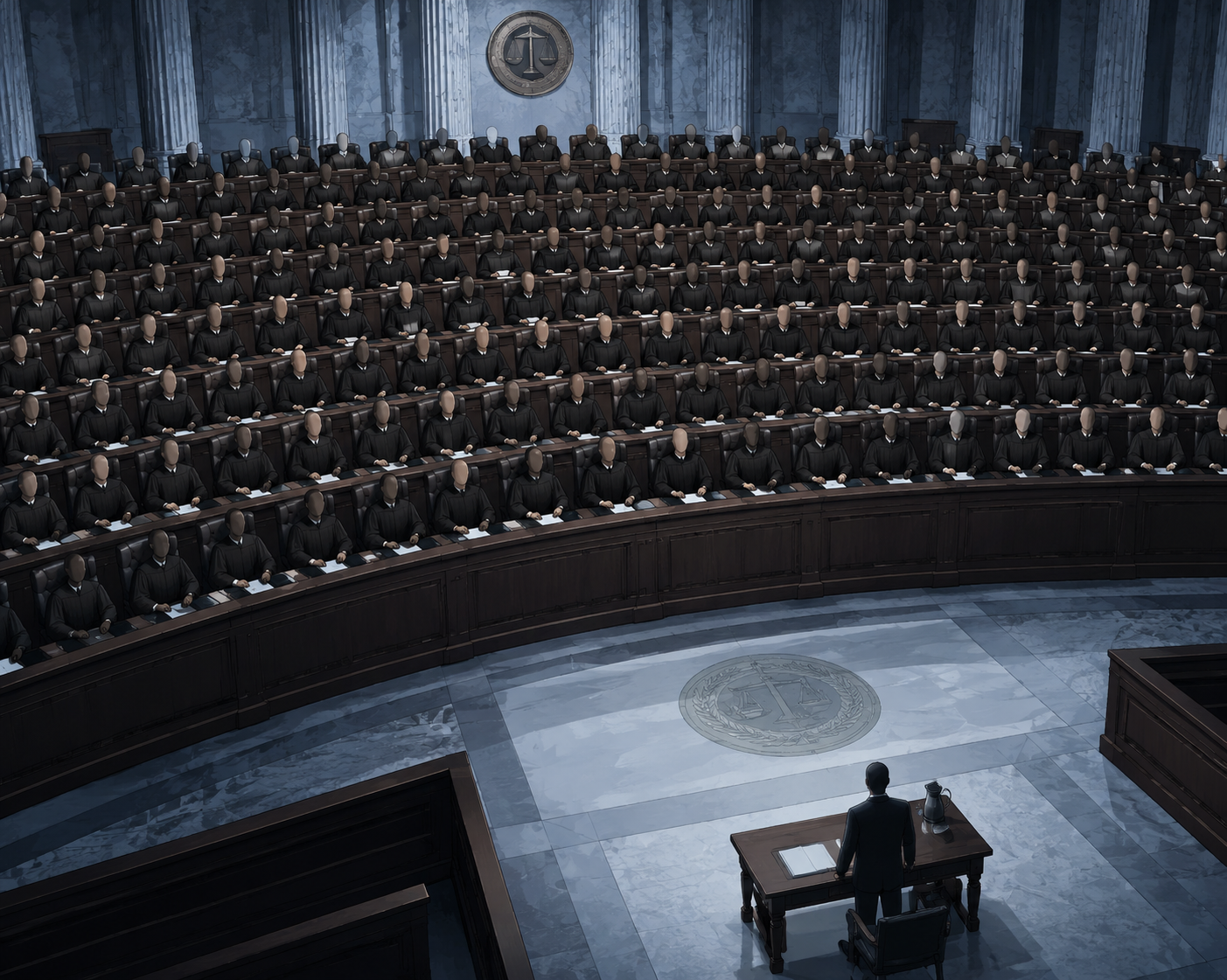
Politico’s July 9, 2026 analysis is the center of the legal story because it tries to count outcomes rather than collect anecdotes. Its database showed more than 15,500 habeas rulings against ICE and about 2,200 rulings for the government, a result Politico described as roughly 90% against ICE.[4]
| Metric | Reported Result |
|---|---|
| Habeas rulings against ICE | More than 15,500 |
| Habeas rulings for the government | Roughly 2,200 |
| Federal judges rejecting the government’s position | 464 |
| Federal judges sustaining the government’s position | 54 |
| Cases where DOJ conceded or declined to defend detention | More than 200 |
The number to linger over is not only the win-loss ratio. It is the distribution. A single district judge can become a political symbol. Four hundred sixty-four federal judges rejecting the government’s position is something else: a cross-court pattern in emergency litigation over physical custody.[4]
The database still has limits. Politico manually compiled it, and manually compiled litigation databases can miss orders, duplicate procedural events, or flatten distinctions among release orders, bond-hearing orders, temporary stays, and merits rulings. A habeas ruling against ICE also does not necessarily decide the immigrant’s removability, lawful status, asylum claim, or final right to remain in the United States.
But those caveats cut only so far. Habeas is about custody. When thousands of federal orders reject the government’s detention position, the narrow conclusion is still significant: courts repeatedly found that the administration’s detention theory, as applied in individual custody cases, exceeded what judges were willing to allow on the records before them.
Mandatory Detention Became the Main Pressure Point
The legal fight over § 1226(c) matters because it changes who gets to ask a judge for release. Under ordinary detention practice, many noncitizens can seek a bond hearing where an immigration judge considers flight risk and danger. Under the July 2025 ICE interpretation, a much broader group was treated as subject to mandatory detention, which means no ordinary bond hearing at all.[5]
That interpretation produced the circuit split now shaping the field. The Second, Sixth, Tenth, and Eleventh Circuits rejected the government’s broad mandatory-detention position, while the Fifth and Eighth Circuits upheld it.[4] That split is why the habeas numbers cannot be read as a final national settlement. A detainee’s access to a bond hearing can still depend heavily on geography.
Even in the Fifth Circuit, the government’s position did not remain untouched. On July 2, 2026, a divided Fifth Circuit panel required bond hearings within 90 days for ICE detainees in the nation’s busiest detention state.[8] The ruling did not erase the circuit split, but it imposed a time limit in a jurisdiction that had otherwise been more receptive to the administration’s detention theory.
That is the kind of distinction that gets lost when the public debate stays at the level of whether a celebrity was too emotional or an administration official sounded too blunt. The operational injury was detention without a bond hearing. The statutory dispute was whether § 1226(c) could be stretched to cover the people ICE placed in that category. The judicial response was not uniform, but it was overwhelmingly adverse in the habeas docket Politico examined.
Expedited Removal Met a Due Process Wall
Expedited removal is built for speed. It allows the government to remove certain noncitizens without the full process available in ordinary removal proceedings. That speed is exactly why expansion of the process becomes legally volatile: fewer hearings, less time to collect evidence, and greater risk that a person with a viable claim is removed before a court can review the case.
On August 29, 2025, the Eastern District of New York blocked the administration’s expedited removal expansion in Make the Road NY v. Noem, grounding the ruling in Fifth Amendment due process concerns.[9] The ruling did not abolish expedited removal as a statutory tool. It rejected the challenged expansion on constitutional process grounds.
That distinction matters. Courts were not saying the political branches lack immigration-enforcement power. They were saying that speed does not eliminate the Constitution’s demand for process where liberty and removal are at stake. In practice, that meant the administration could not rely on scale and administrative urgency as substitutes for procedures that give affected people a meaningful chance to contest the government’s action.
The Alien Enemies Act Fight Remains a Contested Edge

The Alien Enemies Act litigation occupies a different place in the map. It is vivid, old, and consequential, but it is not the same as the mass § 1226(c) habeas fight. The administration invoked a 1798 statute associated with wartime authority, and the litigation quickly reached questions about executive power, judicial review, and the minimum process required before removal.
Courthouse News reported Supreme Court due process proceedings arising from Alien Enemies Act deportations, including 261 deportations to El Salvador in March 2025.[10] Separately, the Fifth Circuit ruled on September 2, 2025, that the government could not use the Act on the theory presented there, finding “no invasion or predatory incursion.”[10]
That language is unusually direct, but the posture still requires caution. The Fifth Circuit ruling itself acknowledged the possibility of Supreme Court review, and the cited sources do not establish that the high court has finally resolved the Alien Enemies Act question as of July 20, 2026. The safer conclusion is narrower: lower courts, including the Fifth Circuit, rejected the administration’s use of the Act on the record before them, while final nationwide doctrine may still depend on further Supreme Court action.
Birthright Citizenship Is Not Part of the Habeas Count, But It Shapes the Same Legal Climate
Trump v. Barbara, the birthright citizenship case argued at the Supreme Court on April 1, 2026, sits outside the habeas database. It does not measure detention rulings. It does, however, address the same administration project of testing long-settled assumptions about immigration, citizenship, and executive power.[11]
SCOTUSblog’s March 2026 analysis framed the case around the administration’s birthright citizenship position and the constitutional arguments heading into oral argument.[11] In the cited materials, the decision remained pending as of July 20, 2026. That pending status matters because a Supreme Court ruling could affect more than the citizenship question immediately before the Court; it could also signal how the justices view the administration’s broader claims of immigration authority.
It would be a mistake, though, to merge birthright citizenship, expedited removal, mandatory detention, and the Alien Enemies Act into one undifferentiated legal controversy. Different statutes, different constitutional provisions, and different procedural postures are doing the work. The administration has lost heavily in habeas detention cases; it has faced due process barriers to expedited removal; it has seen lower-court resistance to Alien Enemies Act removals; and it is awaiting Supreme Court resolution on birthright citizenship.
A Legal Scorecard, Not a Viral Verdict
The court record does not prove that every raid Gomez lamented was unlawful. It does not prove that every person detained by ICE had a right to release. It does not turn an Instagram video into legal authority. It shows something more precise and more important: the enforcement structure associated with those raids produced an extraordinary volume of successful habeas challenges.
For lawyers and policy analysts, the useful scorecard is this: mass detention under the administration’s broad § 1226(c) theory has been rejected at scale, though not uniformly across circuits; expedited removal expansion was blocked on Fifth Amendment grounds in a major district-court ruling; Alien Enemies Act removals have faced serious due process and statutory limits, with possible Supreme Court review still relevant; and birthright citizenship remains a pending Supreme Court question in the cited materials.
That is a judicial rebuke without a modern parallel in the available data, but not a stable endpoint. Appellate splits and high-court rulings can still alter the framework. For now, the clearest statement the record supports is that the policies Gomez protested did not merely generate public criticism. They generated thousands of federal court orders requiring the government to justify detention in a system that had tried to make individualized review the exception.
This analysis is for informational purposes only and is not legal advice.
References
- Coverage of Selena Gomez’s deleted Instagram video, The Guardian, January 2025.
- Coverage of Sam Parker’s response to Selena Gomez, The Hollywood Reporter, January 2025.
- Coverage of Tom Homan’s response to Selena Gomez, BBC, January 2025.
- 1 year in, ICE’s mass detention policy is on the ropes, Politico, July 9, 2026.
- July 8, 2025 ICE mandatory detention memorandum, U.S. Immigration and Customs Enforcement, July 8, 2025.
- Weaponizing the System, Vera Institute of Justice, December 2025.
- July 2026 updated summary of the administration’s immigration law changes, New York City Bar Association, July 2026.
- Fifth Circuit July 2, 2026 bond-hearing ruling, U.S. Court of Appeals for the Fifth Circuit, July 2, 2026.
- Make the Road NY v. Noem, U.S. District Court for the Eastern District of New York, August 29, 2025.
- Coverage of Supreme Court due process proceedings on Alien Enemies Act deportations, Courthouse News, 2025.
- March 2026 analysis of Trump v. Barbara birthright citizenship arguments, SCOTUSblog, March 2026.
Comments
Join the discussion with an anonymous comment.