
The July 2026 NTSB evidence docket moved the Hudson River helicopter case out of the ordinary fog of early crash litigation. Investigators reported bird remains on the helicopter’s main rotor blades and horizontal stabilizer, including evidence associated with Canada geese and a black-backed gull; a severed bird wing recovered from a rooftop about 2,000 feet from the main wreckage was confirmed through the Smithsonian Feather Identification Lab.[1][2] For any defendant, that is meaningful causation evidence. It makes a bird-strike defense plausible in a way speculation never could.
It does not, by itself, answer the liability question. The legal problem is not whether birds hit the aircraft. It is whether the operator, in that corridor and with that equipment, took reasonable precautions against a foreseeable hazard before the birds arrived.
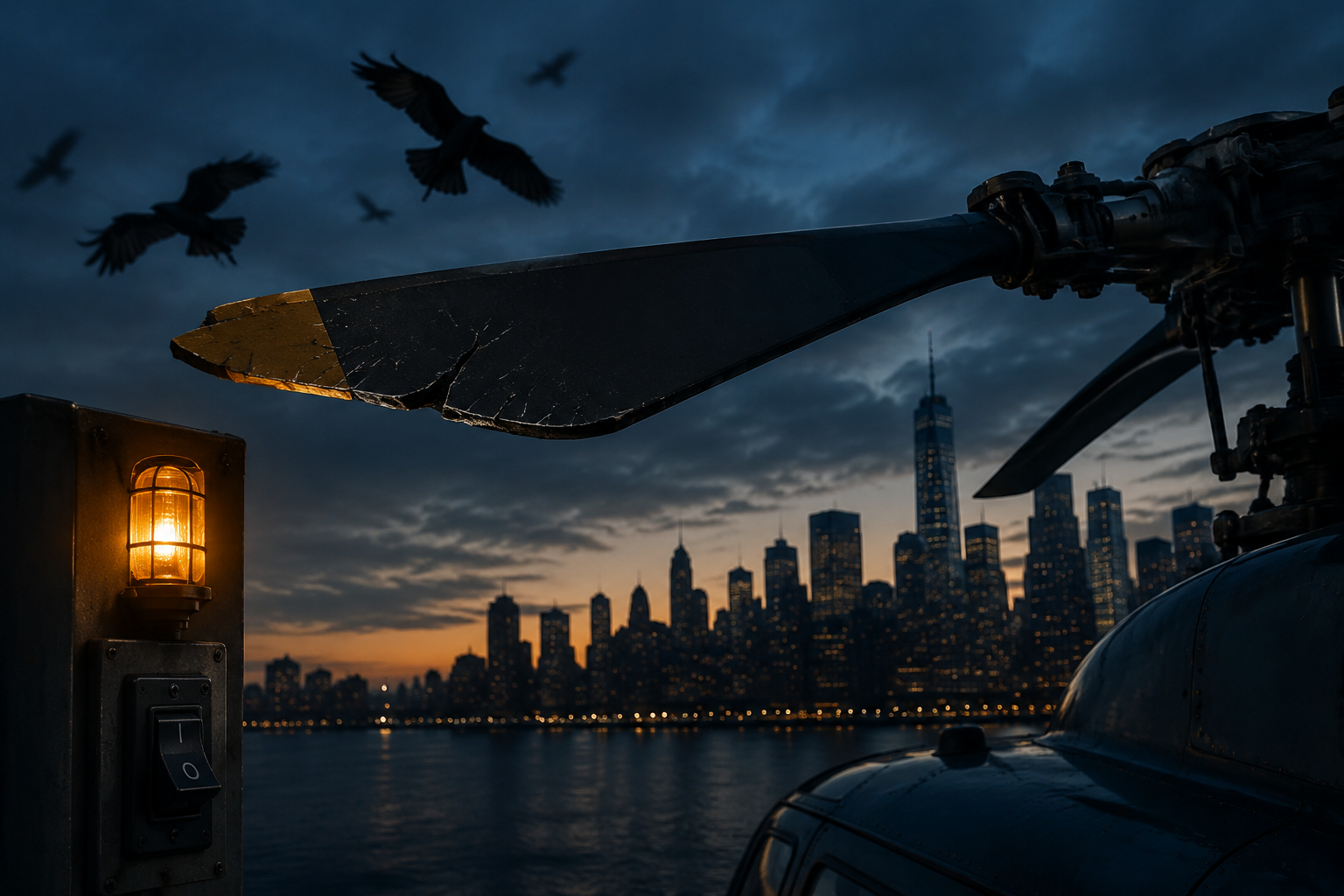
That distinction is where the pending wrongful death claims now sit. The family’s complaint, as characterized by plaintiffs’ counsel, names New York Helicopter Charter, New York Helicopter Tours LLC, and CEO Michael Roth, and alleges willful and wanton disregard for passenger safety.[3] The complaint is advocacy, not a finding. But it identifies the lane plaintiffs are likely to press: not that the operator caused birds to fly, but that it allegedly failed to maintain, install, use, or respond to safety measures meant to reduce a known operational risk.
What the Bird Evidence Gives the Defense
The NTSB evidence helps defendants on the first and most visceral issue: external initiating event. Multiple bird remains on critical helicopter components and a separated wing found far from the wreckage give the defense more than a generic “act of God” argument.[1][2] They support a factual narrative in which the aircraft encountered a sudden biological hazard, suffered severe damage, and then broke up in flight.
That matters because plaintiffs in aviation cases often must separate bad outcome from negligent conduct. A confirmed strike can narrow arguments that the crash began with ordinary mechanical neglect, pilot recklessness, or a maintenance failure unrelated to birds. It can also complicate causation if defendants can show that the strike was unavoidable even with reasonable precautions.
The defense value is strongest if the final record shows three things: the birds were not reasonably detectable in time, the aircraft was maintained and configured as required, and available deterrent or conspicuity systems were either properly installed or not material to the collision. The July docket does not establish all of that. It identifies biological evidence and crash sequence clues; it does not yet close the maintenance file, the operational decision file, or the warnings file.
Why Causation Does Not End the Negligence Case
Aviation liability usually forms in the gap between an external event and the precautions taken before it. A bird strike may explain the physical trigger of a crash while leaving open whether the operator negligently exposed passengers to that trigger, failed to use available mitigation, or ignored earlier warnings.
The operator-negligence record has several concrete points plaintiffs can use. AP reporting described a voluntary daytime pulsing light system intended to reduce bird-strike risk, with the relevant toggle switch allegedly not installed or not used; the same reporting said an operations director who raised safety concerns had been fired.[4] Those are not peripheral allegations. In a wrongful death case shaped by a bird strike, a missing or unused switch is not a symbol of corporate indifference. It is a factual hinge: what equipment existed, who knew about it, who had authority over it, and why it was unavailable or dark on the day of the flight.

Foreseeability will be the next pressure point. The FAA reported 20,876 bird strikes to civilian aircraft in 2024, and reporting on this crash included a witness account of a large goose flock taking flight before the accident.[7][2] Those facts do not prove this operator breached a duty on this flight. They do make it harder to treat birds in the New York airspace environment as an unimaginable hazard.
That is the practical reason the plaintiffs’ “willful and wanton” framing matters. If the case were only a tragic encounter with wildlife, damages exposure would still be serious, but the conduct story would be thinner. If discovery supports an argument that management knew bird risk was elevated, knew a mitigation device was missing or unused, fired a safety official after warnings, and continued passenger operations without adequate correction, the bird-strike finding becomes compatible with a much more damaging liability theory.
The Operator Record Is the Most Developed Exposure Path
As of Q3 2026, the operator defendants face the clearest present exposure because the available public record is most developed against them. The wrongful death complaint targets the tour operator entities and CEO Michael Roth, not merely an unidentified maintenance actor or a remote manufacturer.[3] The factual allegations that matter most are operational: aircraft configuration, safety equipment, management response to warnings, and economic pressure around the business.
The financial history is not proof of negligence, but it gives plaintiffs a motive-and-capacity story that discovery can test. AP reported that the business had gone through bankruptcy in 2019, that revenue declined from $4.5 million in 2017 to $3.9 million in 2018, that staff fell from 30 to 13, and that two debt-collection suits were filed in early 2025: a $1.4 million lease-default suit and an $83,000 cash-advance lender suit.[4] In litigation, those facts will matter only if they connect to maintenance, staffing, training, inspection, or safety decisions. Standing alone, financial distress is not a tort.
The more useful plaintiff sequence is narrower and more evidentiary: the Hudson corridor presented a recurring bird hazard; the operator had access to a voluntary pulsing light system; the relevant switch was allegedly missing or unused; a safety official allegedly raised concerns and was fired; and the aircraft then encountered birds with catastrophic consequences. Each link is contestable. Each link is also the kind of issue that produces document requests, deposition exhibits, maintenance logs, purchase records, emails, and testimony about who approved flights and equipment status.
The absence of cockpit voice and flight data recorders makes that paper trail more important. The Bell 206L-4 did not have a cockpit voice recorder or flight data recorder, and proposed federal legislation, the Helicopter Safety and Parity Act, was introduced to close that kind of helicopter recorder gap.[5][6] For plaintiffs, the missing data does not automatically create liability. It does, however, deprive the case of the cleanest evidence on cockpit awareness, aircraft performance, warnings, and pilot response.
That evidentiary absence cuts both ways. Defendants lose data that might have shown a sudden unavoidable strike and an appropriate emergency response. Plaintiffs lose data that might have shown warning cues, system status, or a preventable sequence. The side with better maintenance records, internal communications, and credible witness testimony will gain unusual leverage because the aircraft itself cannot tell the story through recorders.
Manufacturer Theories Remain Possible, Not Mature
Bell Textron and Rolls-Royce are more difficult to evaluate from the public record. The aircraft was a Bell 206L-4, and the crash involved an in-flight breakup reported at about 675 feet.[2] Those facts are enough to explain why product-liability counsel and insurers would watch the design, structural integrity, and engine evidence closely. They are not enough to say a design defect, manufacturing defect, warning defect, or engine-related failure caused the loss.
A manufacturer case would need a different evidentiary spine from the operator case. Plaintiffs would need to move from “birds hit the helicopter” to a supported theory that the aircraft or a component failed in a legally defective way when exposed to a foreseeable bird-strike load, or that warnings and instructions were inadequate for the operating environment. That requires engineering analysis, certification history, inspection evidence, comparable-event data, and expert work. The July docket opens the door to those questions; it does not answer them.
This distinction matters because public commentary often treats every in-flight breakup as a product case. In litigation, sequence is not enough. The physical breakup must be tied to a defect theory that survives alternative explanations: impact forces, rotor damage, pilot response, maintenance condition, and prior operational history. Until the final NTSB report and discovery provide more, manufacturer exposure remains contingent.
Bird Strike Doctrine Helps Frame the Argument, but It Will Not Decide This Record
Bird strikes have long occupied the uneasy space between extraordinary circumstance and foreseeable operational hazard. The 2009 “Miracle on the Hudson” is the familiar reference point for American readers, but its main use here is limited: it reminds litigants that a bird strike can be a true external emergency without ending every inquiry into preparation, training, routing, and response.[9]
European doctrine is sometimes invoked through the Peškova line of cases, where bird strikes were treated as extraordinary circumstances in the passenger-compensation context.[10] That is useful orientation, not a shortcut for New York tort exposure. Passenger-compensation doctrine, common-law negligence, wrongful death damages, and aviation product liability do not ask identical questions.
The better U.S. frame is duty-based. A bird strike may be an act of God in the colloquial sense and still leave liability if the defendant failed to take reasonable precautions against a known risk. Secondary legal commentary on bird-strike liability makes the same broad point, but the case-specific answer will turn on the actual operating record, not on a generalized label.[11]
Insurance Limits Explain Why Defendant Identity Matters
The practical stakes of manufacturer attachment are not abstract. The Insurer reported aviation market estimates that the operator liability sub-limit was under $20 million, with materially greater available coverage if manufacturer liability attached.[8] That is why the defendant map matters as much as the doctrine. If the case remains primarily an operator-negligence action, available insurance may become a major settlement constraint. If a viable Bell or Rolls-Royce theory develops, the coverage picture may change.
The damages side also cannot be treated as routine. The victims included high-income Siemens executives, a fact that supports substantial wrongful death economics if liability is established.[8] That does not make the operator negligent and does not make the manufacturer defective. It does mean that coverage, indemnity, reservation-of-rights positions, and allocation strategy will sit close to the merits from the beginning.
What Would Change the Exposure Analysis
The final NTSB report, expected later in 2026, is the obvious next event, but it is not the only one that matters. The most consequential liability evidence may come from discovery before or around that report: maintenance records for the pulsing light system, work orders concerning the missing toggle switch, internal safety complaints, communications about bird hazards, pilot training materials, inspection records, and financial documents tied to maintenance or staffing decisions.
| Issue | Evidence That Would Strengthen Plaintiffs | Evidence That Would Strengthen Defendants |
|---|---|---|
| Bird-strike foreseeability | Prior internal warnings, route-specific bird reports, or ignored hazard communications | No unusual bird activity known to the operator and no reasonable opportunity to avoid the flock |
| Pulsing light system | Records showing the switch was missing, disabled, deferred, or known to management | Records showing the system was installed, functional, immaterial, or not required for safe operation |
| Retaliation allegation | Documents linking the fired operations director’s concerns to unresolved safety defects | Personnel records showing unrelated grounds for termination and adequate safety follow-up |
| Manufacturer exposure | Expert evidence tying breakup or component failure to a defect or inadequate warning | Engineering evidence showing impact damage and breakup were consistent with unavoidable strike forces |
| Insurance strategy | Evidence supporting claims beyond operator negligence and into product or component theories | A record limiting causation and breach to operator-specific conduct or unavoidable external event |
The bird-strike finding therefore strengthens the defense narrative but does not neutralize the negligence theory. As of Q3 2026, the operator defendants carry the most developed exposure record; manufacturer liability remains possible but unconfirmed; and the case’s practical shape will depend on whether discovery turns the missing-switch, safety-warning, maintenance, and financial-distress evidence into a coherent breach story or leaves the crash as a sudden wildlife encounter that reasonable precautions could not have prevented.
References
- Helicopter crash in New York's Hudson River last year most likely caused by bird strike, NTSB says — CBS News
- Bird strike likely caused New York City helicopter crash in Hudson River: NTSB — ABC News
- Family of Fatal Helicopter Crash Victims File Wrongful Death Lawsuit — PRNewswire
- Helicopter business in deadly NYC crash had faced debt lawsuits — AP via ClickOrlando
- U.S. lawmakers seek to impose airline rules on helicopter operators — Vertical Mag
- Nadler, Malliotakis, Menendez, Goldman, Espaillat Introduce Helicopter Safety and Parity Act — Nadler.house.gov
- Bird strike may have caused NYC helicopter crash that killed 6, NTSB says — AOL/AP
- Fatal Hudson River heli crash adds to aviation liability incidents — The Insurer
- Are Airlines Liable for Bird Strike Accidents? — Aviation Disaster Law
- Liability for Damage in Case of Bird Strike – a Holistic Approach — SSRN
- Bird Strikes against Aircraft - Issues of Liability — Transportation Law Journal / DU
Comments
Join the discussion with an anonymous comment.