
An involuntary psychiatric commitment order answers one question: whether the state may confine a person under the governing civil commitment statute. It does not, by itself, answer the next question that matters in a hunger strike: whether the hospital may put nutrition into that person’s body over objection.
For lawyers working through the legal rights at stake in a forced-hospitalization hunger strike, the first move is to resist the administrative shortcut. A committed patient may be dangerous, gravely disabled, psychotic, medically fragile, or profoundly ambivalent. None of those descriptions is the same as a judicial finding that the patient lacks capacity to refuse artificial nutrition. If the patient is competent, Cruzan supplies the constitutional floor: a competent person has a protected liberty interest in refusing unwanted medical treatment, and the Supreme Court treated artificial nutrition and hydration as medical treatment for that purpose.[1]

Commitment Is Not a Capacity Finding
Cruzan did not involve a psychiatric hospital hunger strike. It involved withdrawal of life-sustaining treatment from a patient in a persistent vegetative state. Still, its baseline matters because the Court recognized a competent person’s constitutionally protected interest in refusing life-sustaining medical intervention, while also allowing states to require clear and convincing evidence of an incompetent person’s wishes.[1] That distinction—competent refusal versus surrogate or state decision-making after incompetency—is exactly where many institutional disputes should slow down.
The more direct analogy for civil commitment comes from Rivers v. Katz. The New York Court of Appeals held unanimously that involuntarily committed psychiatric patients retained a substantial liberty interest in refusing antipsychotic medication, and that forced medication could not proceed without a judicial determination of incapacity, except in emergencies.[2] The important point is not that medication and artificial feeding are identical interventions. They are not. The point is that therapeutic confinement did not erase bodily integrity.
Rivers is a state constitutional decision, not a nationwide Supreme Court rule. But it is the load-bearing authority for the proposition that civil commitment is not a blank treatment warrant. A hospital may have lawful custody and still lack authority to impose a particular invasive intervention unless the patient lacks capacity, an emergency exception applies, or a court authorizes treatment under state law.[2]
The Question the Facility Has to Answer
Once a committed patient refuses food, the facility’s legal analysis should not begin with the label “hunger strike” as if the label decides the case. Staff and counsel need to identify what is being refused, whether the refusal includes artificial nutrition and hydration, what medical risk has developed, and whether the refusal is capacitated.
| Question | Why it matters |
|---|---|
| Is the patient refusing ordinary meals, artificial nutrition, hydration, or all medical monitoring? | Different interventions carry different bodily intrusion and different urgency. |
| Does the patient understand the nature and consequences of refusal? | Capacity cannot be presumed from commitment status or from the seriousness of the choice. |
| Is the refusal an expression of protest, a symptom-driven act, a delusional belief, or something else? | Motive does not automatically decide capacity, but it may affect the capacity assessment. |
| Has an emergency developed that requires temporary action before court review? | Emergency authority is usually narrow and should be documented as such. |
| Does state law require judicial authorization for nonemergency forced treatment? | Civil commitment statutes and forced-treatment procedures vary by jurisdiction. |
Capacity is decision-specific. A patient may meet commitment criteria and still understand the consequences of refusing artificial nutrition. Another patient may be unable to appreciate those consequences because of psychosis, severe depression, cognitive impairment, or another condition affecting decision-making. The law becomes dangerous when it treats those two patients as the same person.
Malta Gives Physicians the Ethical Standard Law Often Leaves Thin
The World Medical Association’s Declaration of Malta is not binding U.S. law. It is medical ethics guidance. But it is useful because it says plainly what a legal memo can sometimes obscure: physicians must assess whether a hunger striker has decision-making capacity, including whether mental conditions undermine that capacity, and a competent hunger striker must not be force-fed.[3]
That formulation fits the civil commitment problem better than a slogan about autonomy or suicide prevention. A hunger strike may be a political act, an institutional grievance, a manifestation of illness, an attempt to obtain transfer, or several things at once. Malta does not ask clinicians to romanticize the refusal. It asks them not to skip the capacity inquiry.[3]
For a psychiatric hospital, the capacity assessment should be more than a conclusory progress note. The record should show what the patient was told, what the patient understood, whether the patient appreciated the likely medical consequences, whether reasoning was impaired by symptoms, whether less intrusive engagement was attempted, and whether the patient’s decision remained stable over time. Those facts matter both clinically and procedurally if the facility later asks a court to authorize forced feeding.
Why Prison Hunger Strike Cases Do Not Transfer Cleanly
Most reported hunger strike litigation comes from prisons and detention settings, not civil psychiatric hospitals. Those cases are tempting because they discuss force-feeding directly. They are also easy to misuse.
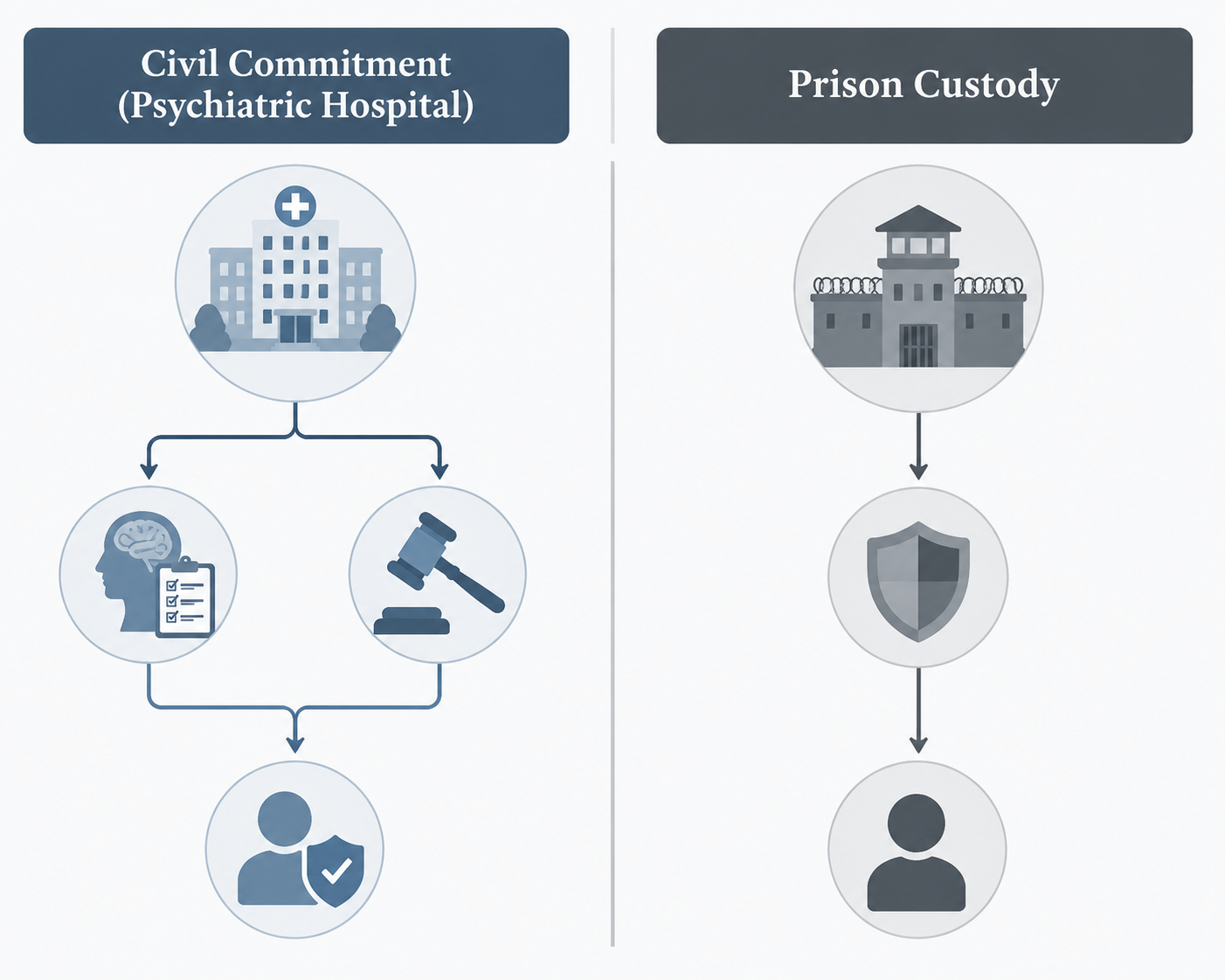
In Washington v. Harper, the Supreme Court upheld a prison policy allowing involuntary antipsychotic medication of a prisoner with serious mental illness when the prisoner was dangerous and treatment was in the prisoner’s medical interest, using a standard that gave substantial weight to prison administration.[4] Turner v. Safley likewise instructs courts to uphold prison regulations burdening constitutional rights when they are reasonably related to legitimate penological interests.[5] Those doctrines rest on punishment, custody, institutional order, and security—interests that are not the same as the therapeutic premise of civil commitment.
Bezio v. Dorsey shows the dominant prison approach. The New York Court of Appeals applied Turner and allowed force-feeding of a prisoner hunger striker, crediting prison interests in preserving life, preventing suicide, maintaining order, and avoiding copycat hunger strikes.[6] That reasoning may be powerful inside a prison. It should not be treated as an automatic answer inside a psychiatric hospital, where the state has justified custody by treatment need and civil commitment criteria rather than criminal sentence and prison security.
There is also a minority prison line. In Zant v. Prevatte, the Georgia Supreme Court held that a prisoner’s privacy right to bodily integrity prevented forced feeding.[7] In re Sanchez took a more pragmatic path, distinguishing a hunger strike used instrumentally to obtain a prison transfer from a refusal framed as expressive protest, and allowing intervention in that setting.[8] These cases are useful for mapping the arguments courts have entertained. They do not eliminate the threshold problem in a civil hospital: confinement for treatment does not itself establish incapacity to refuse treatment.
The Premise Difference Matters
A prison can argue that a hunger strike threatens security, discipline, staffing, and institutional order in a facility built around custody after conviction or detention. A psychiatric hospital can certainly face safety risks too. A patient’s deteriorating medical condition may create urgent clinical duties, and staff may be left managing grave risk in real time. But the legal rationale for the hospital’s custody is narrower: treatment under a civil commitment statute. If the state wants to cross from custody into forced bodily intervention, the justification usually has to become more specific.
That is why Rivers and Cruzan should frame the civil commitment analysis before prison cases enter the room. Prison precedents may inform how courts think about state interests in life and order. They should not supply a substitute for a capacity determination in a therapeutic facility.
What Existing Custodial Data Can and Cannot Prove
Recent custodial research confirms that hunger strikes often arise in institutions already managing mental health, coercion, and weak procedural records. It does not prove that psychiatric hospitals may force-feed committed patients.
A 2025 Journal of the American Academy of Psychiatry and the Law study examined 213 hunger strikes in the New Jersey Department of Corrections. The study found that 45.4% of hunger strikers were on the mental health roster, personality disorder was the most common diagnosis, and malingering was documented in 29.1% of pre-reform cases.[9] Those figures are specific to New Jersey’s prison system and its reform context. They should not be generalized to psychiatric hospitals, but they do show why a hunger strike file often contains both medical and behavioral interpretations.
The ACLU and Physicians for Human Rights reported that, from 2013 through 2017, U.S. Immigration and Customs Enforcement recorded 1,378 hunger strikers from 74 countries across 62 facilities in 24 states, and the report criticized ICE force-feeding orders as obtained with minimal evidence.[10] That is detention evidence, not civil hospital evidence. Its value here is cautionary: when a closed institution asks for authority to invade a person’s body, the record supporting that request deserves scrutiny.
The Procedural Gate for Forced Feeding
Because the Supreme Court has not directly decided whether a competent hunger striker may be force-fed, and because published U.S. cases involving involuntarily committed psychiatric patients are thin, counsel should be careful about claiming a single national rule. The safer practitioner conclusion is narrower: where the patient is competent, Cruzan protects refusal of artificial nutrition; where the patient is involuntarily committed, Rivers-type reasoning requires a separate incompetency determination before nonemergency forced treatment; and state law supplies the operative procedures.[1][2]
That means the facility’s route generally runs through capacity assessment, documentation, and, if refusal is contested and the case is not an immediate emergency, judicial authorization. A hospital that believes mental illness has destroyed the patient’s ability to make the nutrition decision should be prepared to prove that point. It should not simply point to the commitment order.
Emergency treatment remains a hard category. Rivers recognized an emergency exception in the forced-medication setting.[2] A hunger strike can eventually create medical instability that does not wait politely for a briefing schedule. But emergency authority should stay tethered to immediacy: what is the risk, why must action occur now, what intervention is necessary, and why is court review unavailable before the intervention? The more planned and repeated the artificial feeding becomes, the weaker the claim that the hospital is operating only in a temporary emergency posture.
Disability rights advocates have long warned against routine forced treatment, with the Bazelon Center taking the position that forced treatment should occur only in rare circumstances involving serious and immediate safety threats.[11] That position is advocacy, not a complete statement of every state’s law. It is still a useful reminder that forced treatment authority is supposed to be exceptional, not a convenience doctrine for difficult patients.
What the Hospital Must Do While the Dispute Is Unresolved
A facility does not have to choose between immediate force-feeding and passive observation. While capacity, medical risk, and legal authority are being resolved, the hospital still has duties that are less intrusive than artificial nutrition and more serious than waiting for collapse.
- Continue ordinary clinical engagement, including offers of food, fluids, monitoring, and treatment alternatives.
- Assess and reassess decision-making capacity for the specific refusal at issue, rather than relying on the commitment order.
- Document the medical trajectory, including what risk is present now and what risk is anticipated if refusal continues.
- Separate clinical facts from institutional frustration, security concerns, family pressure, or disagreement with the patient’s reasons.
- Identify the state-law procedure for forced treatment, guardianship, substitute decision-making, or emergency authorization.
- Seek judicial review when incompetency or forced treatment authority is contested and the situation is not limited to a true emergency.
Those steps protect the patient, but they also protect staff. Nurses and physicians should not be left to carry a constitutional decision through a clinical order set. If the hospital believes forced artificial nutrition is legally and medically necessary, the record should be built for the forum that can authorize it.
The Narrow Answer
A competent adult who is involuntarily hospitalized for psychiatric treatment retains the right to refuse artificial nutrition. Civil commitment does not automatically convert that refusal into incompetence, and the hospital’s therapeutic purpose does not, standing alone, authorize forced feeding.
Forced artificial nutrition may become legally available if the patient lacks capacity, if an immediate emergency justifies temporary intervention, or if a court authorizes treatment under the applicable state procedure. Prison cases may help identify state interests in custody and order, but they do not automatically control the psychiatric hospital setting. This article is informational and not legal advice; the governing answer will turn on state commitment law, the patient’s capacity, the medical record, and the procedural posture when the facility seeks authority to act.
References
- Cruzan v. Director, Missouri Department of Health, Cornell Legal Information Institute, June 25, 1990, link
- Rivers v. Katz, Justia, June 10, 1986, link
- WMA Declaration of Malta on Hunger Strikers, World Medical Association, revised 2017, link
- Washington v. Harper, Oyez, February 27, 1990, link
- Turner v. Safley, Oyez, June 1, 1987, link
- New York’s High Court Affirms Force-Feeding Hunger-Striking Prisoner, Prison Legal News, April 15, 2014, link
- Zant v. Prevatte, Justia, October 5, 1982, link
- Force-Feeding Prisoners on Hunger Strike, Prison Legal News, February 15, 2007, link
- Hunger Strikes in a State Prison System: Patient Characteristics and Operational Reform, Journal of the American Academy of Psychiatry and the Law, 2025, link
- Behind Closed Doors: Abuse and Retaliation Against Hunger Strikers in U.S. Immigration Detention, Physicians for Human Rights, 2021, link
- Forced Treatment, Bazelon Center for Mental Health Law, link
Comments
Join the discussion with an anonymous comment.