
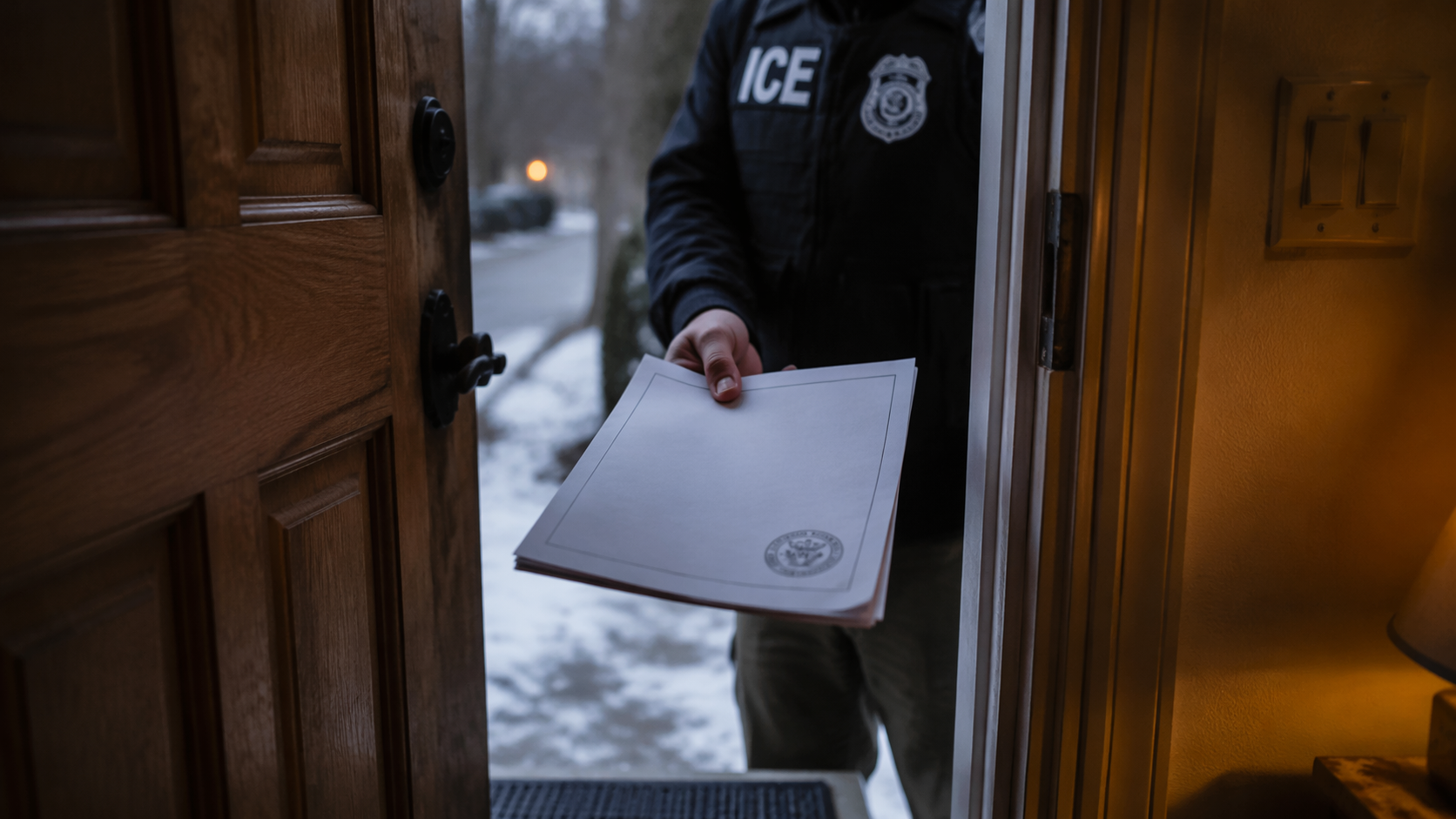
The hardest version of the question starts at the threshold. ICE officers arrive at a residence to make a civil immigration arrest. The paper they show is Form I-205, a “Warrant of Removal/Deportation,” signed inside the immigration enforcement system by an immigration officer. No judge has signed it. No neutral magistrate has reviewed probable cause for entry into the home. The officers say the document is enough.
That is the point at which ordinary advice about ICE arrest legal rights and immigration law becomes too blunt. The issue is not whether ICE has civil arrest authority in general. It does. Nor is it whether the government may ever enter a home. It may, with the right legal basis. The narrower question is whether an administrative immigration warrant, generated by the enforcement agency itself, can do the constitutional work that home-entry doctrine usually assigns to a judicial officer.
A May 2025 Department of Homeland Security memo is now the load-bearing document in that fight. According to the Brennan Center’s analysis, the memo instructed ICE officers that I-205 administrative warrants alone authorize home entries for civil immigration arrests; the memo was obtained through whistleblower disclosure and made public in January 2026.[1] This article is informational analysis, not legal advice for any person facing an encounter with ICE.
The Signature Matters
Calling a document a warrant does not answer the Fourth Amendment question. The Constitution is not satisfied by the word on the form; it asks who made the probable-cause judgment, under what authority, and for what intrusion.
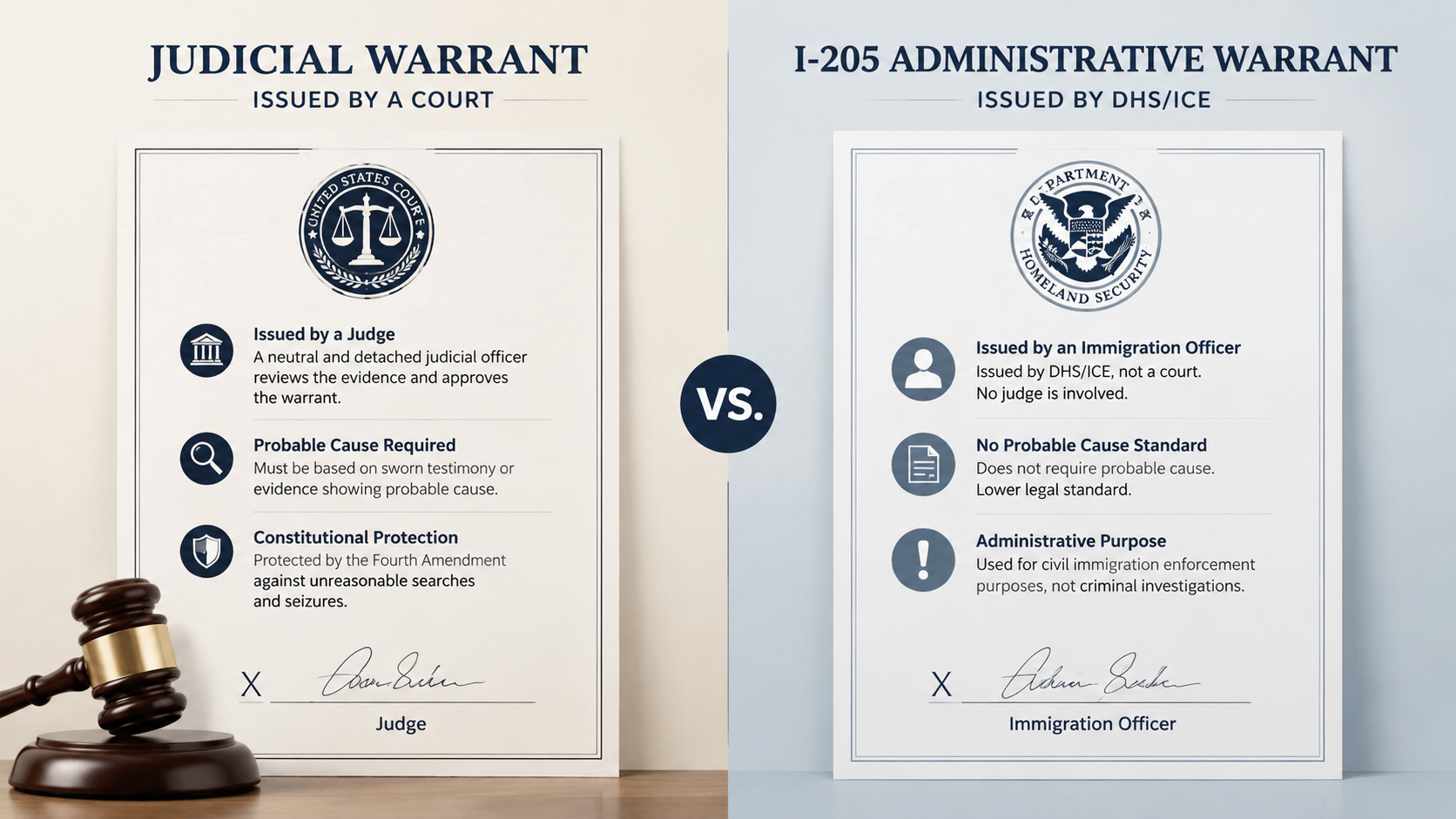
A judicial warrant is issued by a neutral and detached magistrate. An I-205 is not. It is an administrative immigration document signed by an immigration officer within DHS. That distinction matters most when the government seeks to cross the line into a home, because the home is where Fourth Amendment doctrine has been least tolerant of executive self-authorization.
The Brennan Center reports that the May 2025 memo reversed roughly six decades of prior agency practice, as reflected in DHS training materials and earlier litigation concessions cited in its analysis.[1] That history does not by itself decide the constitutional issue. Agencies can change legal positions. But when the new position tells line officers that an agency-generated document opens the door to home entry, the change deserves careful scrutiny.
| Document | Signer | Function at issue |
|---|---|---|
| Judicial arrest warrant | Judge or neutral magistrate | Traditional basis for entering a home to make an arrest when Fourth Amendment requirements are met |
| I-205 administrative warrant | DHS immigration officer | Civil immigration enforcement document whose sufficiency for home entry is disputed |
Why Home Entry Is Different
The pressure point for DHS is not merely that administrative warrants are executive documents. The government uses administrative processes in many settings. The pressure point is the home.
In Coolidge v. New Hampshire, the Supreme Court’s warrant doctrine emphasized the need for a neutral and detached decision-maker rather than an officer engaged in law enforcement. Shadwick v. City of Tampa likewise treated neutrality and detachment as essential to the warrant function. Payton v. New York then made the home-entry rule unmistakable in the arrest context: absent consent or exigent circumstances, the Fourth Amendment draws a firm line at the entrance to the house.[1]
That line is why the I-205 question is not a paperwork technicality. If the officer who seeks to make the arrest, or an officer within the same enforcement chain, can supply the warrant substitute, the neutral-magistrate safeguard has largely disappeared at the moment it matters most. The resident sees a document with official markings. The constitutional question asks whether anyone outside the enforcement agency has approved entry into the home.
DHS’s position appears to rely on the premise that a civil immigration arrest warrant is enough because Congress and immigration regulations authorize immigration officers to issue such warrants. But authority to arrest and authority to enter a home are not the same thing. An officer may have statutory authority to arrest a person and still need a judicial warrant, consent, or exigent circumstances before entering a residence to do it.
Abel and Lucas Do Less Work Than DHS Needs
The administration’s cited authorities complicate the analysis, but they do not cleanly answer the doorstep question. Abel v. United States is the older and more tempting citation. In Abel, the Supreme Court discussed an administrative immigration arrest warrant in a case involving the arrest of a noncitizen. But the Brennan Center and the Volokh Conspiracy analysis both note the central limitation: the Court did not squarely hold that an administrative warrant authorizes entry into a home for a civil immigration arrest.[1][2]
The timing also matters. Abel came before Payton’s modern home-entry framework. A pre-Payton discussion of administrative arrest authority is a slender reed for a post-Payton rule allowing executive officers to enter homes without a judicial warrant. It may be relevant; it is not the same as a direct holding on the present question.
United States v. Lucas is also an uneasy fit. The administration has pointed to Lucas, but the en banc Eighth Circuit divided 5–5 on the administrative-warrant question, and the case involved a prison escapee rather than a civil immigration arrest.[1] A tie in a different factual setting is not much of a foundation for a nationwide operational instruction to enter homes with I-205s.
The Lower Courts Are Split, Not Silent
The strongest current rulings for residents come from district courts that have refused to treat the I-205 as a home-entry warrant. In Kidd, a federal district court in California held that ICE administrative warrants do not authorize home entry.[1][2] That ruling tracks the home-entry cases in the most straightforward way: if the Fourth Amendment requires a neutral magistrate for entry, a document signed by an immigration officer is not enough.
A federal district court in Minnesota reached a similar result in January 2026, finding that an ICE home entry violated the Fourth Amendment.[3] The Minnesota ruling matters because it treats the harm as the entry itself, not only what happened after officers were inside. That is the correct place to look if the constitutional defect is the absence of judicial approval before the threshold is crossed.
Hendrix, from a federal district court in Texas, points the other way, though not as broadly as DHS would prefer. The court suggested Abel may support the government’s view that administrative warrants can authorize home entry. But the Volokh Conspiracy analysis notes an important limit: the agents in Hendrix had not actually entered a home.[2] That makes the reasoning significant, but not a clean holding approving the challenged practice on home-entry facts.
So the legal landscape as of Q3 2026 is neither settled nor empty. California and Minnesota district court decisions cut against DHS’s policy. Texas district court reasoning gives the government something to cite. No federal court of appeals or the Supreme Court has definitively resolved whether an I-205 alone satisfies the Fourth Amendment for home entry in a civil immigration arrest.
Wrongful Entries Show the Procedural Stakes
The doctrine can sound abstract until the person at the door is the wrong person. The record now includes reported wrongful home-entry incidents involving U.S. citizens, including Chong Ly Thao in Minnesota and Marcos Charles in Portland.[1][3] Those examples do not prove that every I-205-based entry is unlawful, and they should not be made to carry more weight than they can bear. They do show why the identity of the signer is not a clerical detail.
Neutral review is supposed to slow the government down before the intrusion, not merely give a court something to assess afterward. When the government enters a home first and litigation follows later, the threshold has already been crossed. For a resident, including a U.S. citizen misidentified or swept into an enforcement operation, the remedy is necessarily retrospective.
The Lawsuits Are Now Testing the Memo Directly
The May 2025 memo has become a litigation target. The New York Times reported that Protect Democracy and the ACLU brought lawsuits challenging the policy, and that a Minnesota judge also issued an order restricting ICE retaliation against protesters.[3] Those disputes add procedural pressure around the memo, but the core constitutional issue remains the home-entry theory: whether an agency-signed I-205 can substitute for judicial authorization at the doorway.
There is also a data problem that should keep the analysis disciplined. DHS’s public ICE statistics page publishes figures only through December 31, 2024. That makes 2025–2026 enforcement patterns difficult to assess using official ICE statistics. Third-party FOIA-based datasets may be useful for other questions, but they are not necessary to decide the constitutional one here.
What the Current Law Supports—and What It Does Not Yet Decide
The strongest reading of Fourth Amendment home-entry doctrine cuts against DHS’s May 2025 instruction. Coolidge, Shadwick, and Payton place real weight on neutral review before the government enters the home. An I-205 signed by an immigration officer is not that kind of review. The memo also appears to depart from long-standing agency practice, which makes the new position look less like a routine clarification and more like a constitutional gamble.[1]
But the question is not finally adjudicated. Abel gives the government language to invoke. Hendrix gives it district court reasoning to cite. Kidd and the Minnesota ruling give challengers stronger home-entry holdings in the other direction. Until an appellate court or the Supreme Court decides the administrative-warrant question directly, the legality of I-205-only home entries remains unsettled.
The bounded conclusion is the most accurate one: DHS’s policy is constitutionally vulnerable because it treats an enforcement-agency document as if it were a judicial home-entry warrant, but lower courts have not yet produced a final national rule. At the threshold, that distinction is the whole case.
References
- DHS Warrantless Home Entry Memo's Fourth Amendment Problem, Brennan Center
- Can ICE Enter a Home to Make an Arrest With Only an Administrative Warrant?, Reason / Volokh Conspiracy, January 22, 2026
- ICE Lawsuit Forced Entry Warrants, The New York Times, April 2, 2026
Comments
Join the discussion with an anonymous comment.