
Tom Homan’s July 19 announcement deserves to be taken seriously in its strongest form: ICE vehicle stops are now supposed to include at least one body-worn camera. For a roadside immigration stop, where the official report can become the spine of the legal record before counsel, witnesses, or family members ever see a file, that is not a cosmetic change. Reuters reported the new requirement as applying to ICE officers during vehicle stops, and The Guardian likewise reported Homan’s statement that officers would use body cameras in those encounters.[1][2]
But the analysis cannot stop at the announcement. The operative question is what happens after the press line: whether a camera is actually present, whether it is activated, whether footage is retained and disclosed, and whether anything enforceable follows when the policy is not obeyed. In federal oversight work, the most consequential language often lives several pages below the mandate, in the exception, the retention rule, or the sentence that says who must explain noncompliance.
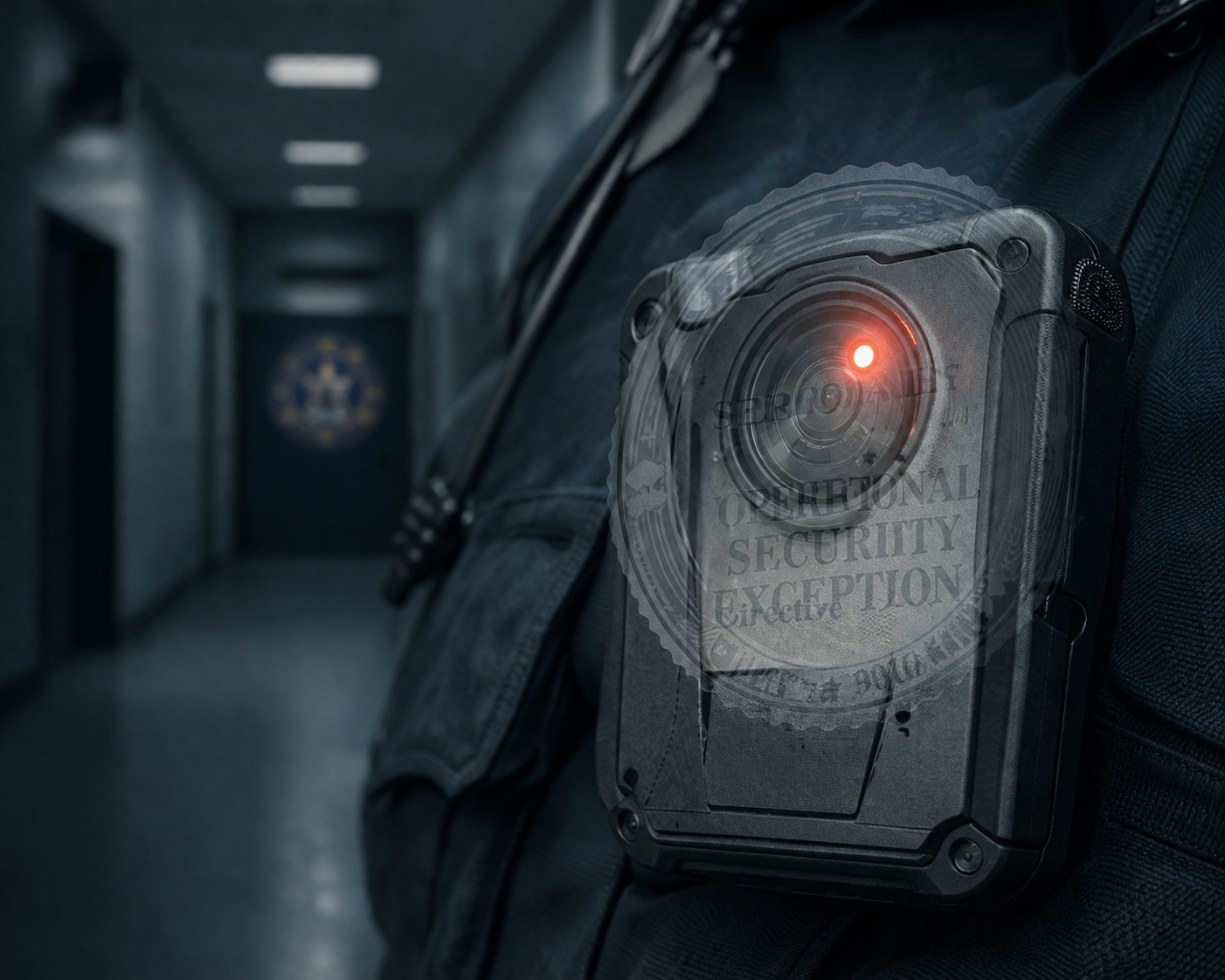
The mandate is real, but the directive carries the weight
The legal machinery underneath Homan’s announcement is ICE Directive 19010.3, issued in February 2025. The Immigration Policy Tracking Project describes the directive as setting body-worn camera requirements for enforcement activities, including rules on activation and exceptions.[3] That distinction matters. Homan’s July 2026 statement is not a statute. It is not a codified congressional command. On the materials available, it does not create a freestanding penalty scheme for an officer who conducts a stop without a camera or fails to activate one.
Directive 19010.3 does require written explanation when an officer does not record as required, but that is an internal accountability mechanism, not the same thing as a statutory remedy. A written explanation may help later reviewers identify a pattern. It may give immigration counsel a basis to press for discovery. It may expose a pretext if the stated reason does not match other evidence. It does not, by itself, tell a court to suppress evidence, dismiss a case, award damages, or discipline an officer.
That is the first limit on the reform. A body-camera rule can be meaningful without being statutory. Agencies often change behavior through policy manuals, training, supervision, procurement conditions, and internal discipline. But the durability of that change depends on the same agency continuing to fund, train, audit, and enforce it. A future leadership team can revise an agency directive more easily than Congress can repeal a statute.
The operational-security exception is where the hard cases will go
The most important phrase in Directive 19010.3 is not the requirement to record. It is the carveout allowing exceptions when activation is “not feasible due to operational-security concerns.” The directive also recognizes exceptions involving healthcare settings, courtrooms, and activity protected by the First Amendment, including press and religious activity.[3]
Some of those exceptions are easy to defend. A camera rule that ignores medical privacy, courtroom restrictions, confidential operations, or First Amendment-protected activity would create its own legal problems. The difficulty is that “operational-security concerns” can expand quickly in the field. It is broad enough to cover real tactical danger. It is also broad enough to cover the moment when recording would be most valuable: a tense approach to a vehicle, a disputed order, a claimed furtive movement, a forced extraction, or the first seconds after force is used.
The Brennan Center’s March 2026 analysis of ICE body-camera policy emphasized this problem in comparison with state and local practices: a policy’s value turns not only on whether cameras exist, but on activation rules, access, retention, discipline, and limits on officer discretion.[4] That is exactly the pressure point here. A broad exception does not make the mandate useless. It makes the audit trail indispensable.
A useful written-explanation requirement would answer basic questions: who invoked the exception, at what point in the encounter, under whose review, with what supporting facts, and with what consequence if the explanation is boilerplate. Without that, the exception becomes less a safety valve than a second policy sitting beside the first.
Why footage matters: the Martinez record problem
The case for cameras is strongest when the official account and outside accounts do not line up. American Oversight’s materials on ICE use-of-force training and records describe discrepancies between ICE’s official account of the shooting of Ruben Ray Martinez and witness statements.[5] The point is not that a camera would resolve every disputed fact. Cameras miss angles, capture partial audio, fail in bad light, and can become another object of selective interpretation. The point is narrower and more important: contemporaneous footage can prevent one version of events from hardening into the administrative record before anyone else can test it.
For immigration lawyers and civil rights litigators, that difference is practical. A vehicle stop later becomes a packet of forms, declarations, incident narratives, radio logs, and after-action memoranda. If the encounter was not recorded, counsel is left reconstructing distance, sequence, tone, timing, and visibility from people who experienced the same event under stress and from an agency file the government controls. If the encounter was recorded and preserved, the litigation posture changes before anyone reaches the merits.
That is why it would be a mistake to dismiss Homan’s mandate as pure theater. A single camera at a stop can preserve the first order given, the first claimed consent, the moment an officer identifies himself, the location of passengers, or whether a driver was boxed in before questioning began. Those details can matter in Fourth Amendment litigation, administrative immigration proceedings, damages actions, internal discipline, and public review.
Deployment is still the threshold question
The cleanest activation rule does not help if the agent at the window has no camera. As of March 2026, the Brennan Center reported that fewer than one-quarter of ICE agents had body cameras.[4] Mid-July reporting attributed to DHS said more than half of field offices had cameras and that the remaining offices were expected to receive them within 60 days.[6] Those two facts are not contradictory, but they measure different things. An office-level deployment claim does not tell a court, a family, or a detainee whether the agents who conducted a particular stop had working cameras assigned to them.
| Implementation Question | Why It Matters Legally |
|---|---|
| Was a camera assigned to at least one officer at the stop? | Without assignment, the mandate has no evidentiary effect in that encounter. |
| Was it activated before the contested conduct? | Late activation may preserve aftermath but not the facts that created the dispute. |
| Was any exception invoked in writing? | The explanation becomes the first test of whether non-recording was justified or routine. |
| Was footage retained and disclosed? | A recorded event that cannot be obtained does little for litigation or public accountability. |
| Was noncompliance disciplined or audited? | A policy without consequences can become a recommendation in operational clothing. |
The planned scale also matters. ICE has approximately 22,000 employees, while available reporting describes a plan to purchase roughly 5,000 cameras.[4] That number may be enough for a phased program, particular operational units, or shared deployment models. It is not, on its face, a one-camera-per-employee program. The public record also lacks the nationwide deployment plan that would explain the sequencing. American Oversight has said the March 2025 nationwide deployment plan has not been made publicly available through its FOIA litigation materials.[5]
That missing plan is not a paperwork complaint. It is the document that would show whether the agency prioritized high-risk operations, high-volume field offices, units with prior complaints, or politically visible locations. It would also show whether deployment was tied to training completion, supervisor review capacity, retention systems, and disclosure protocols. In an accountability system, procurement is only the first step. Distribution is where the policy begins to reveal its priorities.
Funding shows commitment, and contradiction
The funding record is uneven enough to matter. Brookings reported in January 2026 that the Trump administration had proposed cutting ICE’s body-camera budget by 75%, from $20.5 million to $5.5 million, while ICE had hired more than 12,000 new agents.[7] Congress then allocated $20 million for cameras in April 2026.[6] On July 19, Homan said cameras “have been purchased” and that “training the trainer” was underway.[6]
Those facts do not support a simple accusation that the agency refuses cameras. They support a more familiar administrative concern: implementation depends on a moving political apparatus. A proposed cut, a later congressional allocation, a large hiring surge, and a train-the-trainer rollout are not interchangeable signs of readiness. They describe an agency trying to expand enforcement capacity and retrofit oversight capacity at the same time.
Training is not a ceremonial requirement for body cameras. Officers need to know when recording begins, when it stops, how to narrate or avoid narrating during an encounter, what to do around bystanders, how to handle sensitive locations, how exceptions are documented, and what happens if a camera fails. Supervisors need a different training: how to review footage without turning review into confirmation, how to compare video against written reports, and when to refer noncompliance for discipline.
R Street’s federal body-worn camera commentary makes the same implementation point in institutional terms: federal programs require clear policies for activation, retention, access, privacy, and oversight if cameras are to do more than collect files.[8] That is especially true for ICE because the relevant encounters often involve people who may not know the officers’ names, may be moved quickly, and may have limited ability to demand records before removal proceedings advance.
The fatal-encounter record should be read carefully
The body-camera announcement arrived amid reporting on fatal immigration-enforcement encounters, but the numbers in the public record should not be flattened into one dramatic count. The Guardian reported 11 fatal shootings involving federal immigration officials since the start of Trump’s second term.[2] Newsweek reported that six people had been killed during ICE enforcement actions since January 2025.[6] Those figures appear to use different scopes: one broader category involving federal immigration officials, and one narrower category tied to ICE enforcement actions.
The dispute over investigations is also part of the accountability story. The Guardian reported on July 19 that the FBI had opened investigations into shootings in Houston and Maine.[2] Newsweek reported a joint DOJ/DHS statement the same day denying that FBI investigations had been opened.[6] The point is not to resolve that dispute without a firmer record. The point is that disagreement over whether an independent investigation exists is precisely the kind of institutional uncertainty that makes independently reviewable footage valuable.
Cameras do not substitute for independent investigation. They do not decide whether a stop was lawful, whether force was reasonable, or whether an officer’s fear was objectively justified. They can, however, reduce the number of critical facts that depend entirely on agency narration.
What happens when the camera is absent?
The hardest accountability question is not whether ICE now has a recording policy. It is what follows when the expected recording does not exist. Directive 19010.3’s written-explanation requirement gives reviewers something to examine, but the available materials do not identify a statutory penalty for noncompliance with Homan’s July 2026 vehicle-stop mandate.[3]
That absence will matter differently in different forums. In immigration court, counsel may argue that missing footage affects credibility or supports an adverse inference, but immigration judges operate under their own evidentiary rules and constraints. In civil litigation, plaintiffs may seek discovery into activation failures, retention practices, and supervisory review. In internal discipline, the agency may treat non-recording as a policy violation. None of those consequences is automatic on the record available here.
This is where federal enforcement differs sharply from many local accountability debates. Brookings noted that ICE operates under civil enforcement authority that exempts it from local civilian review boards, and the Trump administration has asserted absolute immunity for ICE officers in use-of-force cases.[7] Those structural features do not make body cameras irrelevant. They make the policy’s internal enforcement and disclosure rules more important, because the usual local oversight channels may not exist.
A durable accountability system would therefore need more than a camera at the stop. It would need auditable activation logs, documented exceptions, retention periods long enough for affected people to obtain counsel, disclosure rules that do not depend entirely on litigation leverage, supervisor review independent of the officers involved, and known consequences for avoidable non-recording. Those are not decorative details. They determine whether the body camera becomes evidence or merely equipment.
A meaningful procedural addition, not a completed oversight system
Homan’s July 2026 mandate changes the baseline for ICE vehicle stops. If at least one camera is present and activated, the government, the respondent, counsel, and reviewing bodies may have a record that did not exist before. That can affect charging decisions, custody disputes, suppression arguments, civil rights claims, media scrutiny, congressional oversight, and internal discipline. In close cases, footage can make a weak official account harder to preserve and a false accusation harder to maintain.
The mandate is not yet a durable accountability regime. It rests on an agency directive rather than a statutory framework; it incorporates a broad operational-security exception; deployment remains uneven by the available agent-level measures; the public has not seen the nationwide deployment plan; funding has moved through contradictory signals; and the available materials do not show automatic legal consequences when the rule is violated. That combination leaves the reform dependent on agency discretion at the very moment accountability requires something more reviewable.
The practical judgment is therefore narrow. The body-camera requirement for ICE vehicle stops is a real procedural addition with evidentiary value. It is not, standing alone, proof that federal immigration enforcement has acquired an enforceable oversight system.
References
- ICE officers to wear body cameras during vehicle stops, border czar says, Reuters, July 19, 2026.
- ICE officers to use body cameras during vehicle stops, Trump 'border czar' says, The Guardian, July 19, 2026.
- ICE issues directive on body-worn camera requirements for enforcement activities, Immigration Policy Tracking Project.
- Can Body Cameras Help Hold ICE Accountable?, Brennan Center, March 2026.
- What We Know About How ICE is Being Trained on the Use of Force, American Oversight.
- ICE to Require Body Cameras During Vehicle Stops Following Fatal Encounters, Newsweek, July 19, 2026.
- ICE expansion has outpaced accountability. What are the remedies?, Brookings, January 2026.
- Making Federal Body-Worn Cameras Work in Practice, R Street.
Comments
Join the discussion with an anonymous comment.