
The legally important part of the Maine shooting is not only what ICE officer David Brouillette did after he received a badge. It is what the hiring file appears to have contained, or could have contained, before the government moved him toward that badge. For lawyers watching lawmakers demand ICE vetting and policy changes after the shooting, the first question is not whether DHS can now condemn violence. It is whether the agency had enough warning, in a discoverable record, to make later violence foreseeable.
The Associated Press investigation supplies the harder version of that question. ICE added 12,000 new hires in six months, processed 220,000 applications, offered $50,000 signing bonuses, lowered the minimum age to 18, did not require college degrees, and used tentative selection letters before some full background checks were complete. Some applicants began work on temporary status while background investigations were still pending. Training was cut to 50 days before being restored to 71 days, and a former ICE academy instructor testified in February 2026 that use-of-force, firearms-safety, and protesters' rights training had been cut.[1]
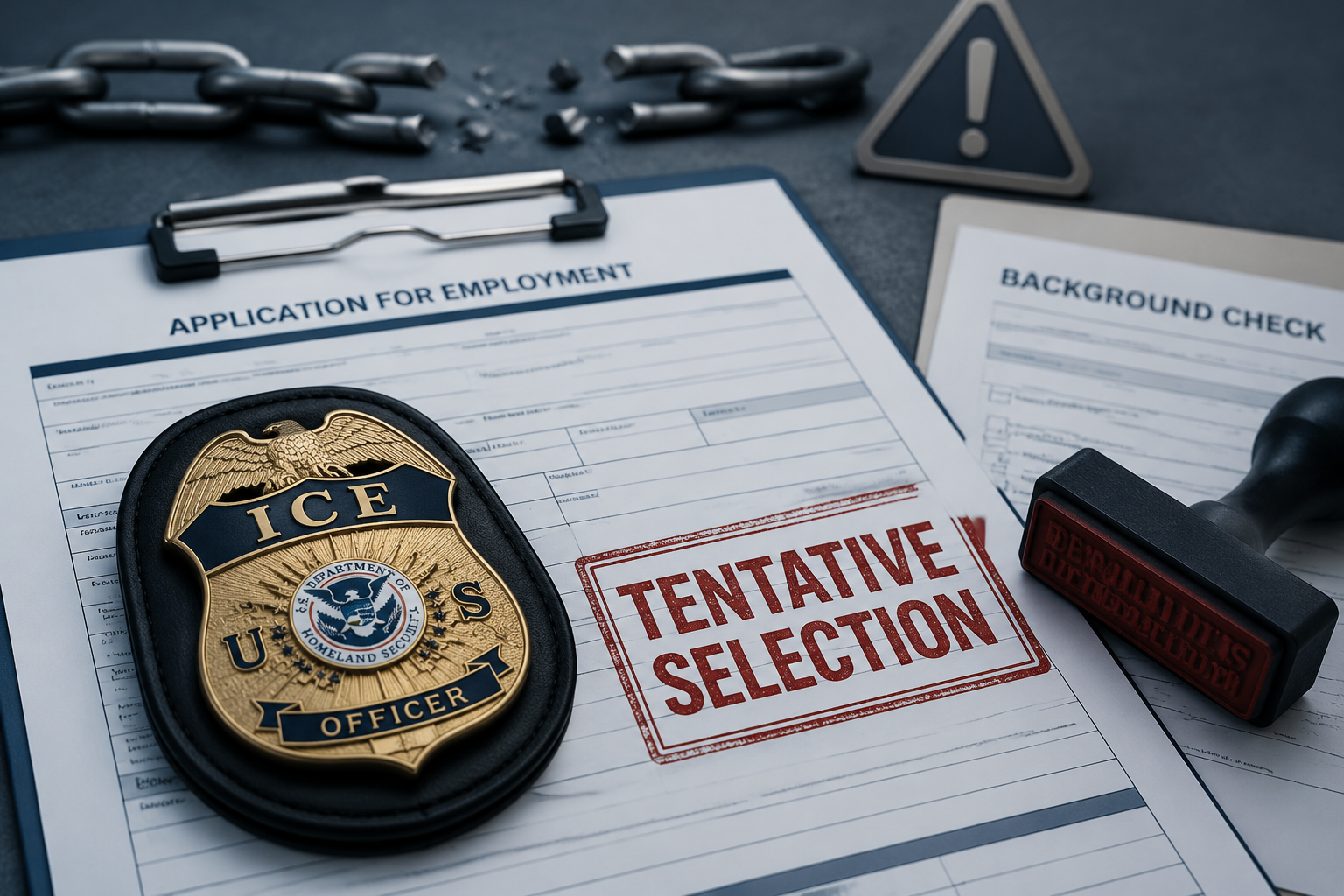
That sequence matters because negligent hiring is rarely proved by hindsight alone. The issue is notice: what the employer knew, what it should have known through ordinary screening, and whether the job made the omitted information material. A clerical gap in a low-risk position is one thing. A temporary onboarding system for armed federal enforcement officers, used while background checks remained unfinished, is a different kind of administrative choice.
The File Was Not Empty
Brouillette was not described as a candidate with a single ambiguous blemish. The AP and PBS accounts identify a 37-year-old Army veteran with a childhood bipolar diagnosis, multiple suicide attempts, documented domestic violence, family court protective-order material, short-lived law-enforcement jobs, known mental-health hospitalizations, and a voicemail telling an ex-wife she should have her throat cut.[1][2]
No one detail, standing alone, answers the liability question. Medical history has legal protections. Military service does not disqualify a person from federal law enforcement. Family court allegations require care. But a hiring system exists to see patterns before the public has to absorb their consequences. In this file, the pattern was not obscure: violence in intimate relationships, self-harm, instability across law-enforcement roles, and records located in places a serious background process is supposed to reach.
The broader AP findings make the Maine case harder for DHS to isolate. The investigation found ICE hires that included officers with two bankruptcies and six law-enforcement jobs in three years, a deputy who fabricated evidence in a case that led to a $75,000 settlement, and a recruit who failed police academy.[1] Those examples do not prove that every accelerated hire was dangerous. They do suggest that the agency's expansion was not merely fast; it was fast in ways that reduced the practical force of credentials, prior discipline, and completed background review.
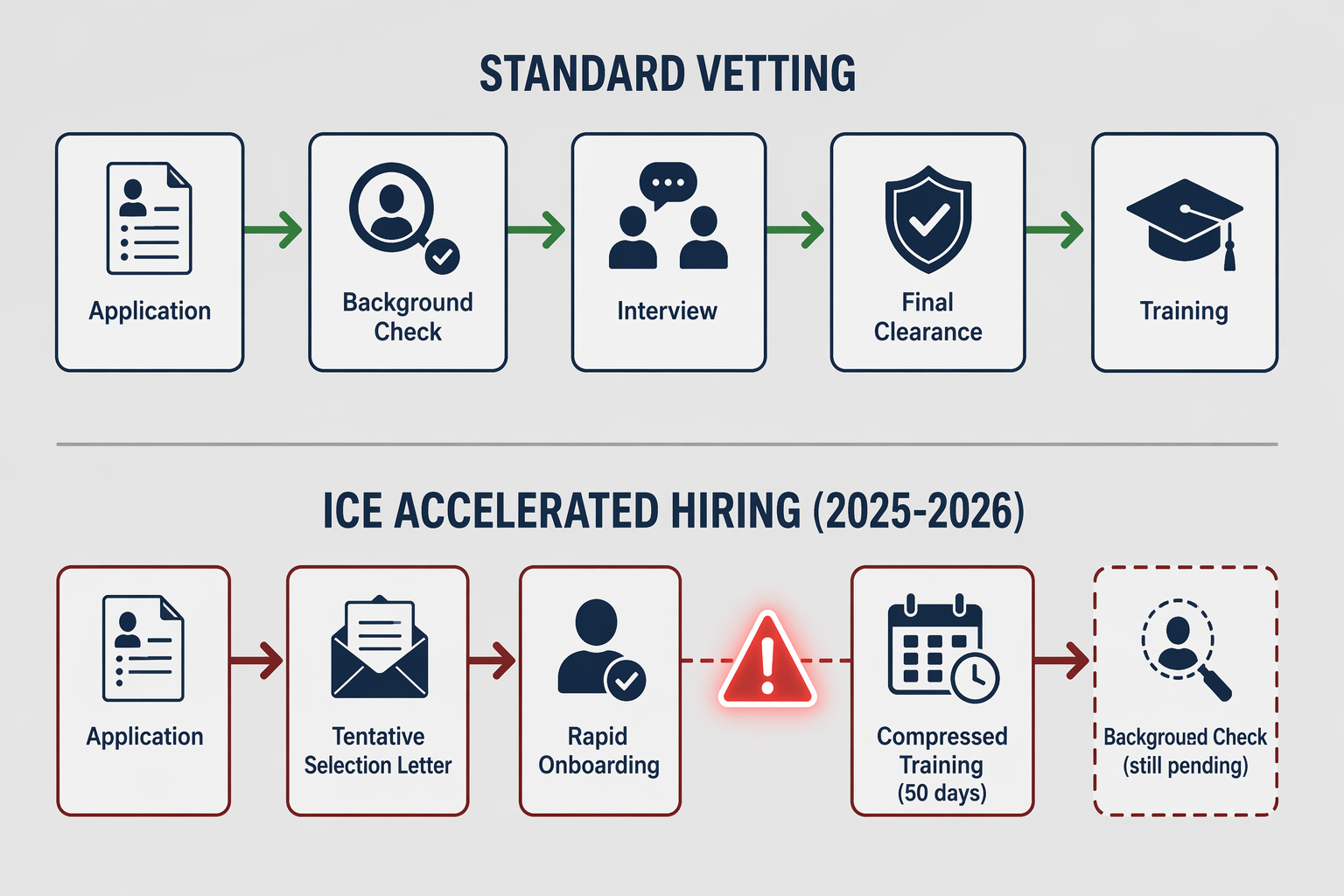
The most damaging fact is the order of operations. A background check that finishes before selection can stop a candidate. A background check still pending after tentative selection has a weaker institutional posture. It must interrupt momentum, disappoint staffing targets, and force someone to defend delay in a hiring surge. That does not make clearance impossible. It does make ignorance more useful.
| Vetting fact | Legal significance |
|---|---|
| Tentative selection before completed background checks | Supports an argument that DHS accepted risk before full notice was developed |
| Temporary work status while investigations remained pending | Moves the issue from paperwork delay to operational exposure |
| Compressed training during rapid expansion | Strengthens negligent-supervision and failure-to-train theories when force is later used |
| Prior records involving violence, instability, or failed law-enforcement roles | Makes foreseeability more particular than a generic concern about rushed hiring |
Why Foreseeability Is the Liability Center
Under a Federal Tort Claims Act theory, the government is not liable simply because an officer later commits a wrongful act. The stronger theory is institutional: DHS, acting through ICE, negligently hired, retained, trained, or supervised an officer whose risk profile should have been detected before he was placed into armed enforcement work. That theory depends on a chain of notice, not moral surprise.
Brouillette's file gives plaintiffs a way to argue constructive notice. Constructive notice does not require a plaintiff to prove that the final decision-maker personally read every damaging document. It asks whether the employer would have learned the information had it used reasonable procedures. VA disability records, family court records, protective-order material, prior law-enforcement employment, and hospitalization history are not rumors overheard after the fact. They are the kinds of records a background process is built to collect, evaluate, and escalate.
DHS can answer that a large federal agency faced a real staffing demand, that tentative selection letters are not final clearances, and that no screening process eliminates all future misconduct. Those points matter. Rapid hiring is not automatically negligent. Nor does a diagnosis or family dispute mechanically disqualify an applicant. The problem is narrower and more serious: the agency allegedly accelerated the parts of hiring that create commitment while delaying or weakening the parts that create caution.
That is why the training evidence belongs in the same liability frame. If ICE placed armed officers into the field after compressed instruction, while instructors were warning that use-of-force, firearms-safety, and protesters' rights training had been cut, plaintiffs do not need to portray the shooting as a mysterious one-off.[1] They can present it as the foreseeable operational result of a hiring program that enlarged authority faster than it tested judgment.
The Shooting Counts Are Messy, but the Notice Problem Is Not
The public record does not give one clean shooting total. House Democrats cited 22 DHS shootings, including 6 fatal shootings. AP reported that at least 10 people had died. The Trace identified 16 shootings, 4 of them fatal, at the time of its analysis.[3][1][4] Those differences may reflect different time windows, agencies included, definitions of DHS involvement, or publication dates. They should not be smoothed into a single confident number.
For liability analysis, the count is not the strongest evidence anyway. A pattern of shootings can support oversight pressure and show why Congress is paying attention. But the Maine case turns less on the national denominator than on the particular hiring file. If the records were discoverable before Brouillette's appointment, the question becomes whether DHS's process converted those records into actionable warnings or treated them as obstacles to a staffing schedule.
Use-of-force policy evidence still matters. The Trace and Stanford Law discussions focus on DHS's own policy against firing at moving vehicles absent a threat of death or serious physical harm, and they analyze whether shootings by immigration agents may have violated that standard.[4][5] That does not resolve the Maine facts by itself. It does show that plaintiffs and investigators will not be limited to asking whether an officer fired a gun. They will ask whether the agency trained, supervised, and disciplined officers against a known policy line.
Bivens Is Available to Argue, Not Safe to Assume
A Fourth Amendment excessive-force claim is the most intuitive constitutional frame for a shooting by a federal officer. It is also the point at which legal analysis should slow down. Bivens remedies have been narrowed substantially by the Supreme Court, and courts are cautious about extending damages remedies into new federal-enforcement contexts. Stanford Law's Robert Weisberg described federal agents as having a "uniquely wide berth" in this area, a phrase that captures the practical difficulty without making dismissal inevitable.[5]
That makes Bivens a narrower route than the FTCA theory. A plaintiff may be able to plead that a particular officer used excessive force in violation of the Fourth Amendment. The harder step is preserving a damages remedy in a setting where the Court has repeatedly warned lower courts against creating new implied causes of action. If the claim looks like a conventional excessive-force claim against an individual federal officer, it has a better chance than a broad challenge to immigration-enforcement policy. If it tries to become a systemwide hiring case under Bivens, it is on weaker ground.
The FTCA does more of the institutional work. It lets plaintiffs focus on government negligence in hiring and supervision rather than forcing every system failure into an individual constitutional remedy. That distinction matters in a case where the central evidence may be recruitment targets, conditional onboarding, unfinished investigations, and training decisions made far above the line officer.
Oversight Pressure Is Now Part of the Record
The congressional response matters less as theater than as record-building. Nearly 200 House Democrats demanded an investigation into ICE deaths "without interference," giving oversight committees, litigants, and inspectors general a public benchmark against which later agency cooperation can be measured.[3] ABC News separately reported lawmakers demanding answers after the AP account of the Maine shooting, reinforcing that the Brouillette file has moved from investigative reporting into formal political scrutiny.[6]
The concern is not wholly partisan. Republican senators also questioned Homeland Security Secretary Kristi Noem's handling of a Minneapolis ICE shooting, which weakens any agency instinct to dismiss scrutiny as a Democratic messaging exercise.[7] That does not mean Congress will produce a legislative fix. With Republicans controlling both chambers and a large ICE expansion funded through the Secure America Act's 2025 reconciliation package, oversight pressure runs against a structural funding commitment. But litigation does not require Congress to reverse course before a plaintiff can ask what DHS knew and when it knew it.
The DHS Inspector General is another unfinished piece. AP reported that the inspector general announced an audit of ICE hiring and training in August 2025, with no findings released as of July 2026.[1] The absence of findings is not proof of misconduct. It is, however, an accountability gap at an awkward time: the agency expanded rapidly, outside reporting surfaced troubling hires, lawmakers demanded answers, and the internal audit record still has not supplied public conclusions.
What DHS Must Now Defend
The strongest defense of DHS will likely be procedural: tentative selection was conditional, background checks could still disqualify applicants, and expansion did not eliminate standards. The strongest plaintiff response will be practical: conditional selection changes incentives, temporary work status creates exposure, and compressed training reduces the time available to correct judgment failures before public contact.
A serious defense also has to explain who owned the risk. If headquarters set hiring targets, authorized bonuses, lowered entry barriers, permitted temporary starts, and shortened training, then line supervisors and academy instructors inherited risk they did not create. Later litigants inherit it too, because they must reconstruct an administrative path that may have been designed to move faster than documentation could mature.
The Maine shooting does not prove, by itself, that DHS will lose an FTCA case. It does not establish that every ICE shooting is unlawful or that every accelerated hire was unqualified. Its legal force is more specific. It turns ICE vetting from a personnel controversy into a notice problem: a file with discoverable warnings, an agency hiring system built for speed, and an armed enforcement role where missed warnings carry predictable human costs.
References
- ICE went on a hiring spree. Sterling credentials were not required, AP investigation finds — AP News
- AP report: ICE officer in Maine shooting has history of violent behavior — PBS NewsHour
- Nearly 200 House Democrats demand investigation into ICE deaths 'without interference' — The Hill
- Immigration Agents Are Shooting People. Is It Legal? — The Trace
- Can ICE Agents Be Prosecuted? — Stanford Law
- Lawmakers demand answers after 'bombshell' report of ICE officer shooting in Maine — ABC News
- GOP senators question Kristi Noem's handling of ICE shooting in Minneapolis — The Hill
Comments
Join the discussion with an anonymous comment.