
Current as of July 19, 2026, the Judge John E. Steele impeachment story begins with a procedural oddity, not with a completed trial. Steele issued a habeas ruling on July 8. He died on July 14. Representative Greg Steube introduced articles of impeachment against him on July 15, one day after the judge’s death, according to contemporaneous reporting on the sequence.[1][2][3]
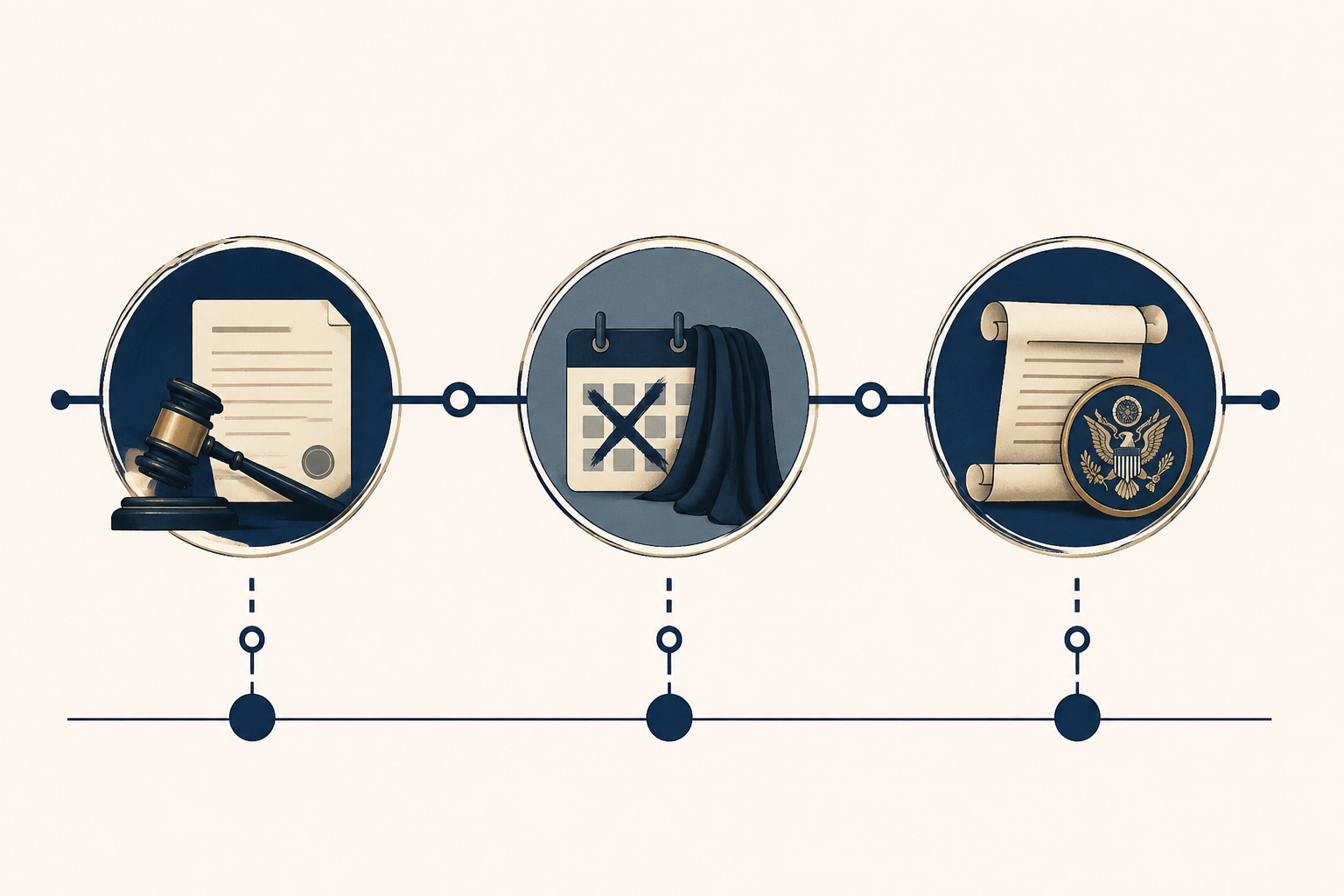
That order matters. Impeachment is often described loosely as punishment, condemnation, or removal. In constitutional terms, it is a sequence of institutional acts: accusation by the House, trial by the Senate, possible conviction, possible removal, and possible disqualification from future office. Steele’s death before the House process publicly advanced puts pressure on the first premise of the machinery: impeachment is built around an officeholder who can be removed.
Federal judicial impeachments are rare enough that the baseline is worth setting before the Steele matter is treated as routine. The Federal Judicial Center’s historical database identifies 15 impeachments of federal judges, 8 convictions, and an average rate of roughly one judicial impeachment every 14 years.[4] Those numbers do not make any particular article meritorious. They do show that moving against an Article III judge is not an ordinary method of registering disagreement with a court ruling.
What Actually Starts When Articles Are Introduced
The House has the constitutional power to impeach. The Senate has the constitutional power to try impeachments. For federal judges, the ordinary route begins when a member introduces impeachment articles or when the House otherwise authorizes an inquiry. The Brennan Center’s process explainer describes the familiar path: introduction, referral or committee consideration, possible Judiciary Committee action, a House vote, transmission to the Senate, trial, and a two-thirds Senate vote for conviction.[5] FindLaw’s guide tracks the same basic division of labor between House accusation and Senate trial.[6]
| Stage | Institutional actor | What it means in the Steele matter as of July 19, 2026 |
|---|---|---|
| Articles introduced | House member | Representative Greg Steube introduced articles on July 15, after Steele’s July 14 death. |
| Committee consideration | House Judiciary Committee or House leadership process | No public committee action is shown in the materials available for this article. |
| House impeachment vote | Full House | No House vote has occurred in the available record. |
| Senate trial | Senate | No Senate trial has begun, and a trial would not be automatic merely because articles were introduced. |
| Conviction and removal | Senate, by two-thirds of members present | The ordinary removal remedy is difficult to apply cleanly if the judge is already dead. |
| Possible disqualification | Senate, after conviction | The materials do not show any Senate action reaching this question. |
The word “introduced” therefore carries less weight than it may appear to carry in a headline. It means a member has placed articles into the House process. It does not mean the House has impeached the judge. It does not mean the Senate has acquired a live trial. It does not mean any finding has been made about the allegations.
That distinction is especially important here because the available materials do not include a directly accessible Congress.gov text of H.Res.1431. The operative language has to be attributed to Steube’s own release and to reporting that quoted or summarized the resolution, rather than to independent review of the full congressional text.
The Allegation Congress Was Being Asked to Treat as Impeachable
Steube’s announcement framed the articles around Steele’s July 8 habeas ruling and characterized the conduct as “high crimes and misdemeanors,” the constitutional phrase used for impeachable offenses. The release and local reporting described the articles as accusing Steele of abusing judicial authority through that ruling, rather than alleging a financial crime, bribery scheme, or private misconduct unrelated to judging.[7][8]
That does not answer whether the charge is legally persuasive. It identifies the object of the proposed impeachment. The House would not be asked merely to express disapproval of a judicial opinion; it would be asked to convert the asserted abuse of judicial power into an impeachable offense. That is a much sharper institutional claim, and one that would ordinarily require committee development before the House could responsibly decide whether the accusation belongs in the impeachment category.
The constitutional phrase “high crimes and misdemeanors” is not limited to indictable crimes, but it is also not a magic label. In practice, the House must decide whether the charged conduct is grave enough to justify impeachment, and the Senate must decide whether it warrants conviction. In a judicial case, that inquiry is particularly sensitive because federal judges are expected to decide cases independently, including cases that produce unpopular results.
The House Stage: An Accusation Is Not Yet an Impeachment
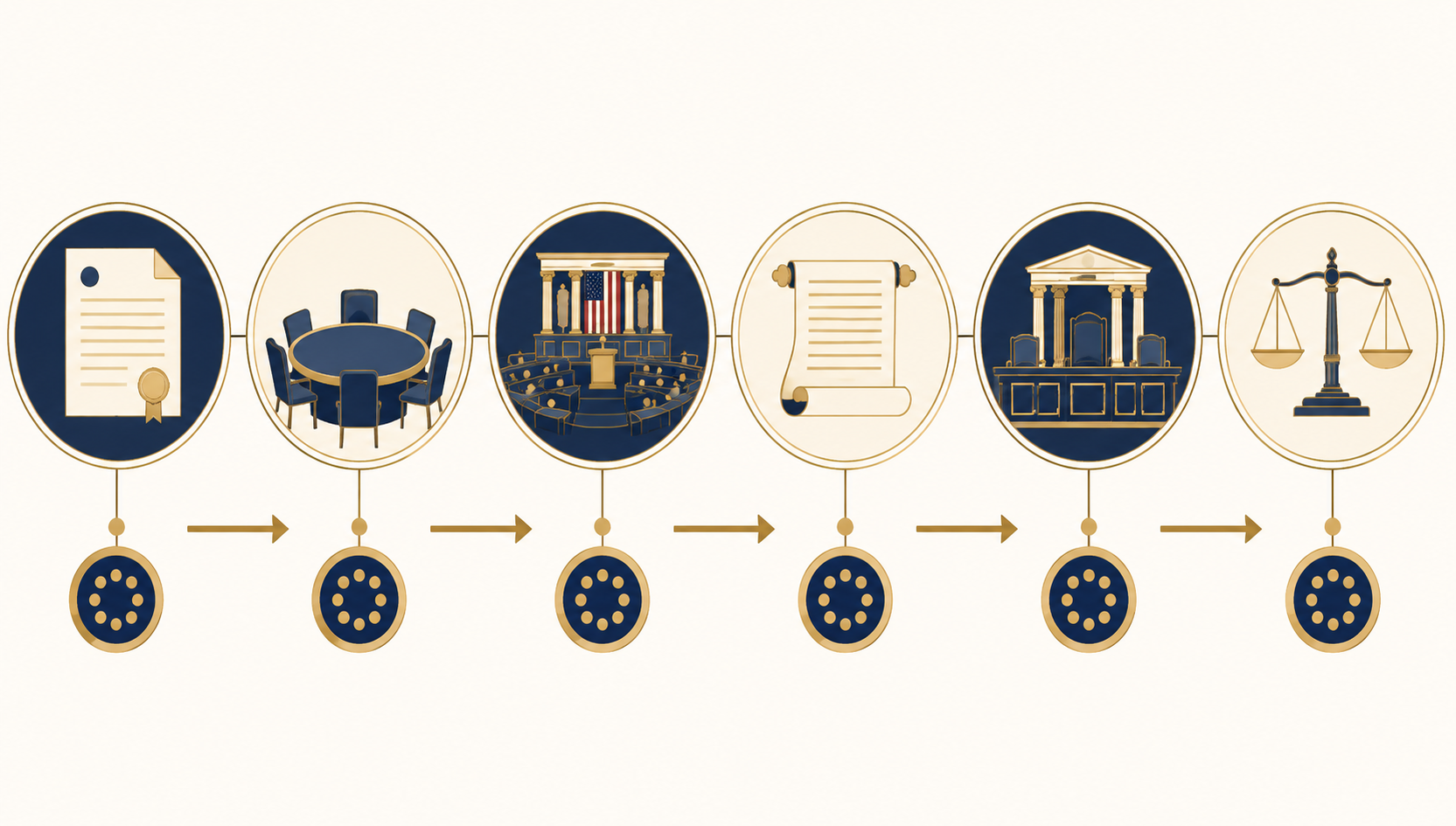
If the Steele articles followed the ordinary path, the first real institutional test would be in the House. Impeachment articles may be referred to the Judiciary Committee, where the committee can investigate, hold hearings, mark up articles, decline to proceed, or report articles to the full House. The House may also act through other procedural routes, but the central point is the same: committee or House action must occur before introduction becomes impeachment.
A full House impeachment vote requires only a simple majority of those voting, assuming a quorum. If the House approves at least one article, the judge is impeached in the constitutional sense. That is still not removal. It is the equivalent of a formal accusation by the body constitutionally empowered to accuse.
As of July 19, 2026, the record described in the available materials stops before that point. Steube introduced articles. The House Judiciary Committee has not publicly acted in the materials available for this article. The House has not voted. No impeachment by the House has occurred on this record.
The Senate Stage: Trial, Conviction, Removal, and Disqualification
Only after House impeachment would the process move to the Senate. The House appoints managers, transmits the articles, and prosecutes the case. The Senate receives the articles and sets trial procedures. Senators sit as the impeachment court. For conviction, the Constitution requires two-thirds of the senators present to vote to convict.[5][6]
For a sitting federal judge, conviction ordinarily carries removal from office. The Senate may also vote to disqualify the convicted official from holding future federal office. Those consequences are related but distinct. Removal addresses the present office. Disqualification addresses future officeholding. The distinction becomes important whenever the present office has already ended.
In the Steele matter, the Senate stage remains hypothetical as of the publication date. There has been no House impeachment, no transmission to the Senate, no trial, no conviction vote, and no Senate judgment on whether death prevents or permits further proceedings.
Why Death Creates the Hard Question
Death is not a scheduling complication. It goes to the remedy that gives impeachment its ordinary constitutional purpose. A deceased judge cannot be removed from office. If removal is impossible before the House has acted, the question becomes whether the articles are automatically moot, whether the House may still vote on them, whether the Senate may still try them after House impeachment, and whether disqualification alone could sustain the proceeding.
The available materials do not supply a direct precedent answering that question for a federal judge who dies before House action on introduced articles. That absence should not be covered over with confidence. The ordinary process is settled; the application of that process to a deceased Article III judge at this procedural moment is not.
One could imagine several institutional responses. The House could take no further action. A committee could acknowledge the judge’s death and decline to proceed. The House could attempt to vote anyway, forcing the Senate to decide whether it has anything to try. Or leadership could treat the matter as effectively extinguished because the principal remedy is unavailable. Those are procedural possibilities, not predictions drawn from a public ruling.

The Closest Analog: Samuel Kent, and Why It Does Not Fully Fit
The closest modern analog is Judge Samuel B. Kent. In 2009, the House impeached Kent, but he resigned before the Senate completed a trial. After the resignation, the Senate dismissed the impeachment proceedings.[9] That episode shows that Congress can end an impeachment when the official no longer holds the office that impeachment would remove.
Kent does not decide Steele. Resignation before Senate trial is not the same as death before House action. In Kent, the House had already impeached, the Senate had a proceeding before it, and the officeholder’s resignation removed the immediate need for removal. In Steele, the judge was already dead when the articles were introduced, and the House had not yet converted the articles into an impeachment.
The distinction matters because mootness is not merely factual; it is institutional. A chamber may decline to spend time on a remedy it can no longer impose. But whether it lacks power to proceed, or merely has no practical reason to proceed, is a different question. The Steele matter sits precisely at that boundary.
What Can Be Said Now
The careful answer is narrower than the political noise around the filing. Articles were introduced after Steele’s death. The introduction did not itself impeach him. The House has not publicly advanced the resolution in the materials available as of July 19, 2026. No Senate trial exists. Steele’s cause of death has not been officially released in the materials available for this article, and the procedural consequence of death at this point has not been settled by a public congressional decision.
That is why the case is procedurally useful even if it never moves. It separates each verb in the impeachment process: introduce, refer, investigate, report, impeach, try, convict, remove, disqualify, dismiss. Most public accounts compress those verbs until impeachment appears to be a single event. Steele’s posthumous articles make that compression untenable.
The Steele impeachment is not important because it has already produced a constitutional answer. It is important because it shows where federal judicial impeachment is highly structured, where it depends on choices by the House and Senate, and where death may leave impeachment law without a direct precedent.
References
- Judge John Steele impeachment timeline reporting, Newsweek.
- Judge John Steele impeachment timeline reporting, Fox News.
- Judge John Steele impeachment timeline reporting, Hindustan Times.
- Impeachments of Federal Judges, Federal Judicial Center.
- How Does Impeachment Work?, Brennan Center for Justice.
- How the Impeachment Process Works, FindLaw.
- Steube Introduces Articles of Impeachment Against Judge John E. Steele, Office of Representative Greg Steube.
- Reporting on H.Res.1431 and Judge John E. Steele, The News-Press.
- Proceedings Against Judge Samuel B. Kent, United States Senate, 2009.
Comments
Join the discussion with an anonymous comment.