
The inflation mistake that creates legal exposure in retirement planning is rarely a dramatic-looking error. It is usually a tidy assumption in a projection: 3%, perhaps 2%, carried across decades until the chart says the client can retire, gift, convert, distribute, or spend. The problem is that a small rate does not stay small. SGL Financial’s 2026 comparison shows that a 1–2 percentage point underestimation of inflation can compound into a 40–60% difference in nominal income needs over 25 to 30 years; on an $80,000 annual base, a 2% assumption produces a need of about $131,000 in 25 years, while a 4% assumption produces about $213,000.[1]
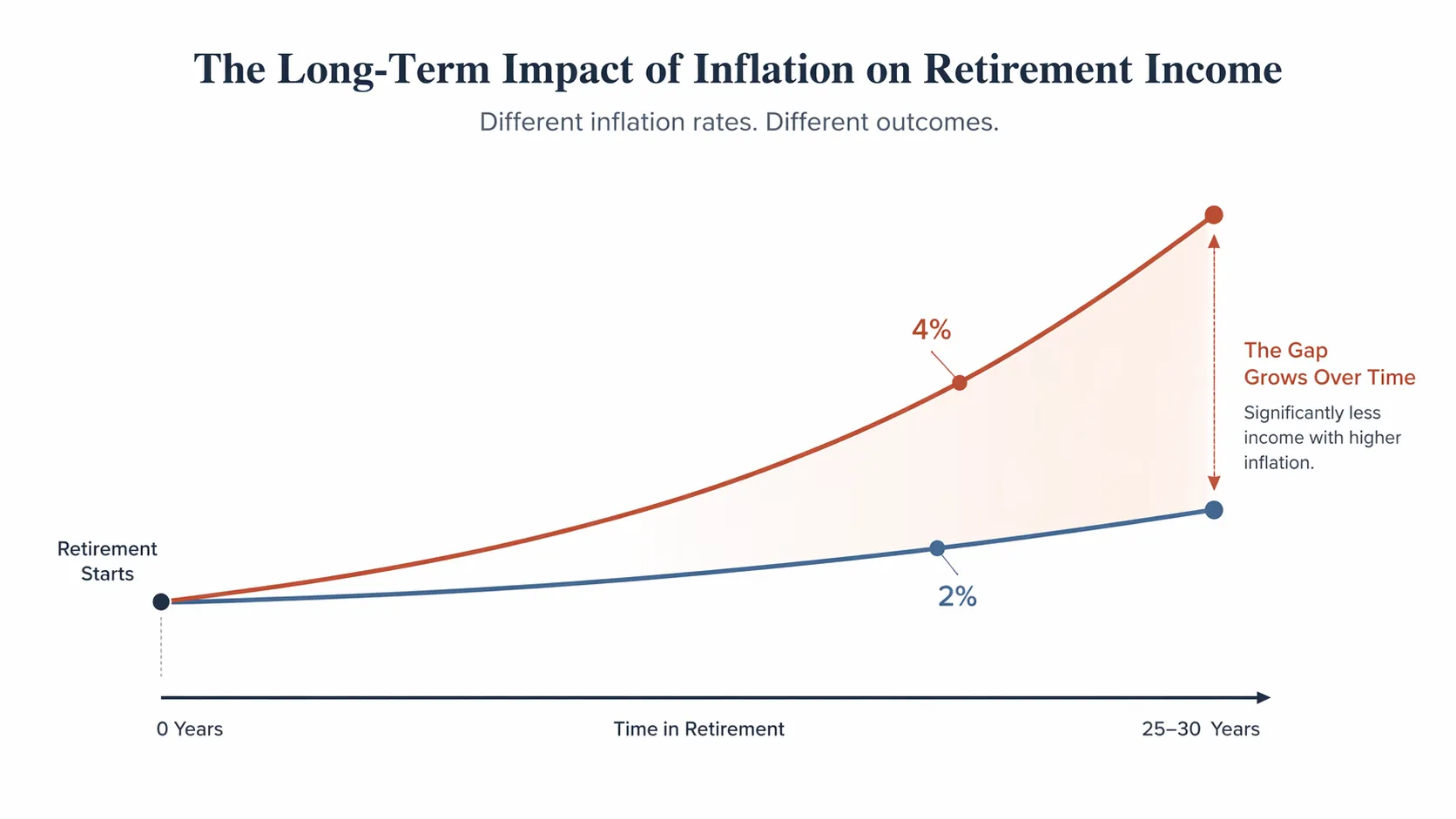
That gap is not merely a planning inconvenience. If an estate planning attorney uses the lower path to support a gifting strategy, a trust distribution plan, a spend-down recommendation, a Roth conversion schedule, or a retirement-income projection attached to the estate plan, the number becomes part of the professional file. Years later, the question will not be whether anyone could have predicted inflation perfectly. It will be whether the assumption was reasonable when selected, whether it was tested against plausible alternatives, and whether the attorney can show how it affected the advice.
The quiet error is compounding, not prediction
A projection can be wrong for innocent reasons. Markets disappoint. Health costs change. Family circumstances move faster than the documents. Inflation is different because the error is visible in the math before the future arrives. A 1% or 2% difference does not just affect the final year of retirement; it changes the income stream the client must fund across the entire period.
That is why a single neat rate deserves more care than it often receives. A 3% line item may look like a background setting, but it can influence how much the client is told to retain, how much can safely be transferred, and whether a legal strategy leaves enough liquidity outside the estate plan. If the assumption is undocumented, the file may later contain the projection but not the professional judgment behind it.
Historical variability makes the single-point habit even harder to defend as a complete process. Hanna and Kim, citing U.S. Bureau of Labor Statistics data, noted that U.S. annual inflation since 1914 ranged from -10% to +20%, and that 10-year periods averaged as high as 8.7% for the period ending in 1982.[2] Those figures do not tell an attorney what inflation will be in the next client’s retirement. They do show why a bare 3% assumption, with no sensitivity analysis, is a thin record.
The mathematical critique that turns a bad assumption into a duty problem
The strongest liability theory does not begin with the claim that inflation is hard to forecast. It begins with the claim that a standard method used in retirement planning can treat inflation in a way that is mathematically inconsistent with economic theory. Hanna and Kim’s 2017 Journal of Financial Planning article argued that the standard textbook treatment of inflation makes first-year contribution burdens unreasonably dependent on the assumed inflation rate.[2]
That point matters for lawyers because the first-year recommendation is often the number that clients act on. A projection may tell a client to save more, spend less, retain assets rather than gift them, delay retirement, or accept that a proposed estate strategy is feasible. If a small change in the inflation assumption produces a dramatically different first-year contribution or income recommendation, the assumption is not a harmless estimate. It is a lever.
In ordinary file review terms, the question becomes direct: if 2%, 3%, and 4% inflation would have produced materially different recommendations, why did the attorney show only one? If the answer is that the software defaulted to it, the file has a problem. If the answer is that the client preferred a simple presentation, the file still has a problem unless the omitted analysis exists somewhere else.
| File Question | Why It Matters |
|---|---|
| What inflation rate was used? | The rate drives nominal income needs and may affect retention, gifting, and distribution advice. |
| Why was that rate selected? | Reasonableness depends on judgment, not merely on a software default or an inherited template. |
| What alternatives were tested? | Sensitivity analysis shows whether the recommendation changes under plausible inflation paths. |
| How did the assumption affect legal advice? | The closer the number is to the estate-planning recommendation, the harder it is to characterize as incidental. |
The Hanna and Kim article is not a malpractice case, and it does not establish a legal standard of care. Its importance is narrower and more practical: it gives a plaintiff, expert witness, insurer, or disciplinary reviewer a way to describe the error as methodological rather than merely unlucky. A projection based on a flawed or unexplained inflation treatment can be challenged at the point where professional judgment entered the file.
Why the first-year number is legally sensitive
Estate planning clients do not usually experience a projection as a set of abstract assumptions. They experience it as permission. They can make the gift. They can fund the trust. They can retire with the distribution plan. They can accept a lower reserve because the plan says the income need remains manageable.
That is where the math-to-harm pathway becomes plausible. A low or poorly tested inflation assumption can understate future nominal spending needs. The understated need can support a recommendation that leaves fewer liquid assets available. The client may then discover, years later, that the estate plan worked on paper while the retirement-income plan did not. The legal claim would still require proof of duty, breach, causation, and damages, but the compounding calculation supplies a concrete damages theory rather than a vague complaint about bad forecasting.
When financial planning becomes part of the legal service
The professional-responsibility issue turns on integration. An attorney who merely refers a client to an outside financial advisor is in a different position from an attorney who prepares the projection, discusses its assumptions, and uses it to support legal recommendations. The risk rises when the retirement analysis is not distinct from the estate planning engagement.
North Carolina State Bar RPC 238 states that when a lawyer provides financial planning services in circumstances that are not distinct from the lawyer’s legal services, the Rules of Professional Conduct apply.[3] The opinion is from one state, and it should not be treated as a national rule. But it is a useful framework because it asks the right factual question: was the financial advice separate, or was it part of the legal representation?
For an estate planning attorney, that distinction can collapse quickly. A retirement-income projection may appear in the same meeting as the revocable trust, tax planning, beneficiary designations, Medicaid planning, or lifetime gifting. If the attorney uses the projection to reassure the client that the legal strategy is affordable, the inflation assumption is no longer a detached financial-planning detail. It is part of the reasoning that supports the legal work.
This does not mean every attorney who mentions inflation has assumed a financial planner’s full role. The degree of integration is fact-specific. Engagement letters, meeting notes, deliverables, billing entries, email language, and the client’s reasonable understanding all matter. A file that clearly says the attorney is relying on an independent advisor’s projection is different from a file where the law firm generates the projection and then uses it to justify the estate plan.
External fiduciary benchmarks will not stay outside the room
Professional liability analysis often borrows from adjacent standards when the professional has stepped into adjacent work. The CFP Board’s fiduciary standard, effective in 2019, requires all CFP professionals to act in the client’s best interest at all times.[4] That standard does not automatically govern a lawyer who is not a CFP professional. It may still shape expectations when an attorney holds the designation, markets financial-planning capability, or collaborates closely with CFP professionals in delivering a retirement projection.
The more the attorney’s role resembles integrated financial planning, the more a reviewer may ask whether the attorney’s process looked like a prudent planning process. That does not require clairvoyance. It does require more than a single unsupported number. A best-interest framework makes documentation, comparison, and stress testing look less like optional polish and more like evidence that the assumption was chosen with care.
This is especially important for dual-credentialed lawyers. A lawyer who also holds a financial-planning credential may have difficulty arguing that inflation assumptions were outside the scope of professional competence if the engagement used those assumptions to support client action. The file should be able to separate legal advice, financial-planning analysis, and third-party inputs with enough clarity that a later reviewer can see who was responsible for what.
What a defensible inflation file looks like
The safest answer is not for estate attorneys to avoid every retirement-income discussion. Many clients need the documents and the retirement picture to be coordinated. The exposure comes from making the projection look authoritative while leaving the assumptions unsupported.
- Identify the inflation rate used and the source or rationale for choosing it.
- Run at least a limited sensitivity analysis when the recommendation would change under nearby inflation assumptions.
- Record whether the projection is prepared by the law firm, by a financial advisor, or jointly.
- Tie the assumption memo to the legal recommendation it affects, such as gifting, trust funding, distributions, or asset retention.
- Tell the client when the projection is illustrative, but do not rely on that label as a substitute for analysis.
A cautious assumption memo does not need to be long. It needs to answer the questions that will matter later: what rate was used, why it was used, what alternatives were considered, what changed under those alternatives, and whether the client’s legal plan depended on the result. The memo is also the place to note when the attorney relied on a financial advisor’s analysis rather than independently selecting the rate.
Client communication still matters, but a polished presentation is not a substitute for the working file. The retired couple may remember the reassuring chart. The malpractice carrier, disciplinary counsel, or expert witness will ask for the assumptions behind it.
The boundary of the current risk
No direct malpractice precedent was found in which an estate planning attorney was successfully sued specifically for inflation-assumption errors in retirement projections. That absence matters. The current risk should be described as an emerging professional liability theory, not as a settled rule.
The theory is still serious because its components are concrete. The compounding harm can be quantified. The standard inflation method has been challenged in a professional financial-planning journal. Ethics guidance shows how financial advice can fall under lawyer conduct rules when integrated with legal services. Fiduciary standards in adjacent planning practice create a benchmark for reasonableness. Taken together, those points make an undocumented or untested inflation assumption more than a financial-planning footnote when it supports estate-planning advice.
References
- How Do 1–2% Inflation Errors Impact Retirement?, SGL Financial, 2026, https://www.sglfinancial.com/blog/how-do-1-2-inflation-errors-impact-retirement/
- The Treatment of Inflation in Retirement Planning Calculations: An Improved Method, Journal of Financial Planning, January 2017, https://www.financialplanningassociation.org/article/journal/JAN17-treatment-inflation-retirement-planning-calculations-improved-method
- RPC 238, North Carolina State Bar, 1996, https://www.ncbar.gov/for-lawyers/ethics-and-governing-rules/ethics-opinions/opinions/rpc-238/
- Raising the Bar: Elevating the Fiduciary Standard for CFP Professionals, Journal of Financial Planning, June 2018, https://www.financialplanningassociation.org/article/journal/JUN18-raising-bar-elevating-fiduciary-standard-cfp-professionals
Comments
Join the discussion with an anonymous comment.