
On February 16, 2026, UN experts used unusually plain language for an institutional failure. The Justice Department’s flawed Epstein files disclosures, they said, had subjected survivors to “institutional gaslighting” and undermined accountability for grave crimes. The phrase appeared in a formal OHCHR press release, not in a protest sign or a social-media thread. It was attached to a specific sequence: the release of more than 3.5 million pages, failed redactions, the exposure of 43 of 47 victims’ names, and the later removal of about 9,500 documents after the damage had already occurred.[1]
That matters because “institutional gaslighting” can easily become a phrase so broad that it loses legal usefulness. The record supports something more exacting. Institutional gaslighting is not a new tort, and it does not rewrite the Crime Victims’ Rights Act. It is a descriptive and advocacy framework for a recurring institutional pattern: withholding information, countering victims’ accounts, diverting attention, trivializing harm, and denying responsibility. Brown Political Review has described the framework in those terms, emphasizing how institutions can protect themselves or powerful wrongdoers by making victims doubt the legitimacy of their own perception of the failure.[2]

The Epstein record is a hard test for that framework because it is not one event. It contains at least three distinct phases, each with a different mechanism of harm: the secret 2008 non-prosecution agreement and the government’s communications with victims; the 2026 disclosure failure that exposed survivor identities after officials controlled the documents; and the July 2026 meeting in which survivors said they were met with condescension and evasion when they asked for accountability.
The first phase: a secret deal, then a fight over whether victims had enforceable rights
The 2008 non-prosecution agreement remains the most legally difficult phase because the moral injury and the binding legal rule do not line up cleanly. Federal prosecutors reached a deal with Jeffrey Epstein without notifying the victims. Later litigation over that agreement produced a record of official concealment that even the Eleventh Circuit majority described as “a tale of national disgrace.” But the same court held, by a 2-1 vote in In re Wild, that the CVRA was not triggered because prosecutors had never filed federal charges.[3]
That distinction is not a technicality to be waved away. It is the hinge of the legal problem. In 2019, Judge Kenneth Marra found that federal prosecutors had violated the CVRA by failing to confer with victims before entering the non-prosecution agreement and by misleading them about the status of the federal investigation. The Eleventh Circuit later rejected the victims’ petition, concluding that the CVRA’s rights did not attach before the filing of federal criminal charges.[3]
The majority’s rule limited the remedy. It did not cleanse the conduct. Judge Hull’s dissent, running to 60 pages, treated the government’s behavior as an extraordinary failure of victim notification and candor. Her dissent supplied much of the procedural force that still animates the public understanding of the case: victims were not simply disappointed by an outcome; they were kept outside the process while the government resolved the federal exposure of the man who had abused them.[3]
This is where the gaslighting framework does useful work, so long as it is not confused with doctrine. The claimed injury was not only that prosecutors exercised discretion badly. It was that the government controlled the facts victims needed in order to assert their rights, then communicated in ways that left them believing no deal had been struck or that the matter remained something other than what it had become. The law, as applied by the Eleventh Circuit majority, did not give them the remedy they sought. The institutional pattern still remains visible.
The 2026 disclosure failure turned process into exposure
The second phase is less doctrinally tangled and more brutally concrete. On January 30, 2026, the Justice Department’s Epstein Files Transparency Act disclosures released more than 3.5 million pages. The redactions failed badly enough that 43 of 47 victims’ names were exposed, and about 9,500 documents later had to be removed from public access.[1]
There is no need to inflate that injury. The numbers are sufficient. Survivors whose privacy was supposed to be protected saw their identifying information placed into a public disclosure system because the government’s own redaction process failed. The institution decided when to release the files, how to process them, and what safeguards were adequate. Survivors bore the consequence when those safeguards did not hold.
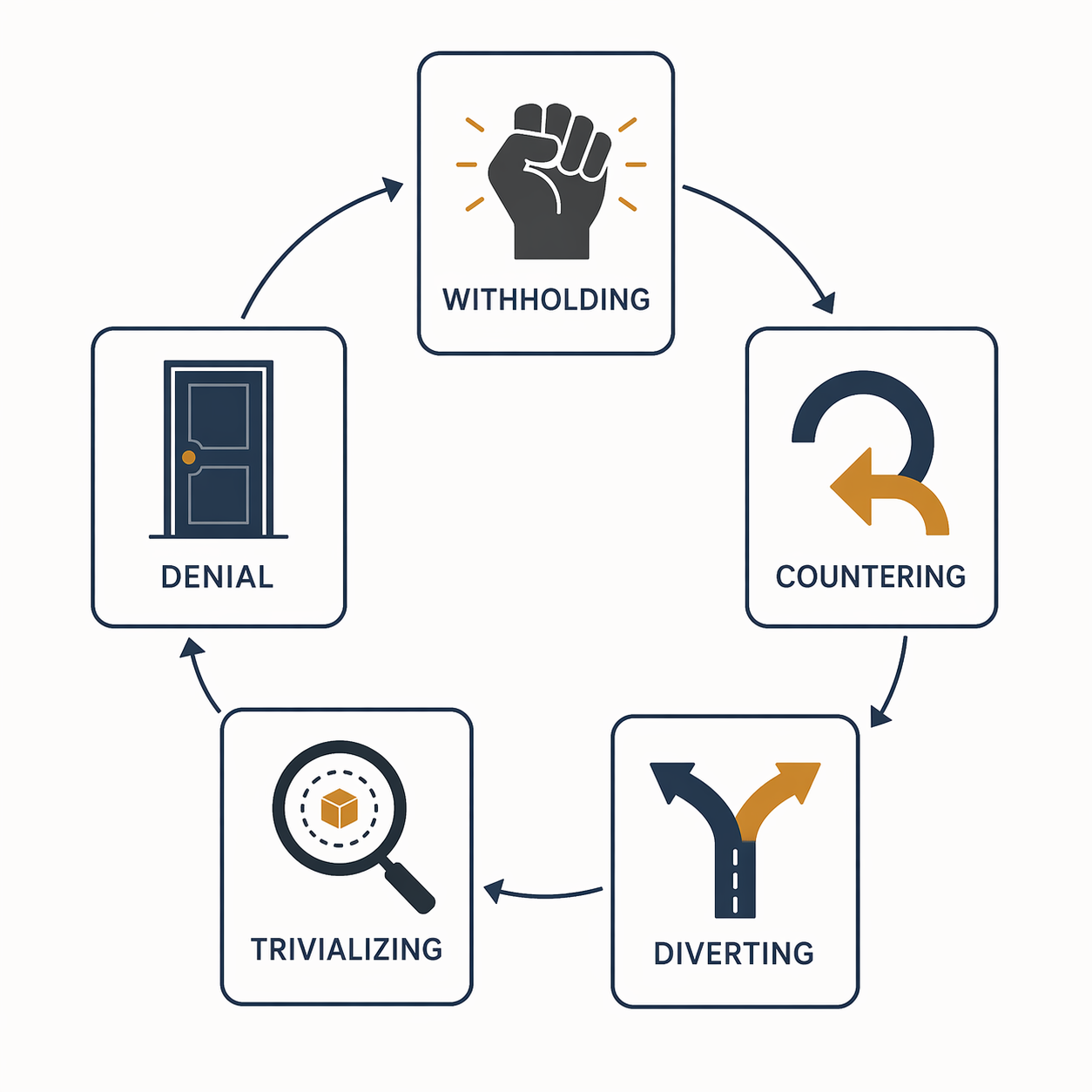
The OHCHR release did not treat the disclosure problem as a mere clerical defect. It linked the failed release to the larger treatment of survivors, warning that flawed disclosures could retraumatize victims and weaken accountability. Its use of “institutional gaslighting” rested on the way survivors were made to navigate a system that first mishandled their information and then framed the controversy through official process language rather than through the privacy harm they experienced.[1]
For lawyers and victim-witness professionals, this phase should be especially uncomfortable because it involves familiar bureaucratic vocabulary. “Disclosure,” “redaction,” “review,” and “compliance” are ordinary words in legal administration. They also describe decisions that can expose a person who had no meaningful control over the timing, method, or verification of release. A survivor does not need an abstract theory of institutional betrayal to understand the practical result: the government held the files; the government published them; the survivor’s name appeared.
This is also why adoption and effectiveness have to be separated. A transparency statute or release protocol may show that an agency has adopted a process. It does not show that the process protected victims. The pulled-back documents are evidence of attempted correction, but not of harmlessness. Once identifying information has been disclosed in a high-profile criminal matter, removal does not restore the survivor to the position she occupied before publication.
The July 2026 meeting: testimonial evidence of dismissal, not a court finding
The third phase is the most current and the least adjudicated. In July 2026, survivors met with Acting Attorney General Todd Blanche after Senator Thom Tillis had made the meeting a prerequisite for Blanche’s confirmation vote. Survivors including Lara Blume McGee, Dani Bensky, and Annie Farmer later described the meeting in terms that echoed the gaslighting framework: condescension, evasion, and a refusal to engage their central questions as legitimate demands for accountability.[4]
Those accounts should be handled as what they are: named survivor testimony reported after a mandatory political-legal meeting, not findings by a court and not an official remedial record. Blanche’s camp contested the characterization. That caveat matters. But it does not make the accounts irrelevant, especially when they follow two earlier phases in which courts and UN experts had already documented or criticized institutional conduct toward the same survivor community.[4]
A mandatory meeting can itself become another site of injury when the participants most affected experience it as a performance of listening rather than an exercise in accountability. The relevant question is not whether officials used polite words. It is whether survivors left with clearer answers about who authorized prior decisions, how privacy failures would be remedied, and whether future victim consultation would be structurally different.
Why the legal category still matters
Calling this pattern institutional gaslighting does not create a freestanding claim. A complaint cannot simply plead “gaslighting” and bypass statutory triggers, sovereign immunity, causation, or remedial limits. The term is doing different work. It names a recurring institutional dynamic that victims’ rights law often recognizes in principle but does not always remedy in practice.
The CVRA promises crime victims rights including notice, reasonable protection, and an opportunity to be heard at specified stages of federal criminal proceedings. The Epstein litigation exposed how fragile those rights can become when prosecutors resolve a matter before charges are filed. Under the Eleventh Circuit majority’s reading, the absence of federal charges meant the statutory rights had not yet attached, even though the government’s pre-charge conduct had already shaped the victims’ practical ability to participate.[3]
That gap is not theoretical. If officials can negotiate a non-prosecution agreement before filing charges and avoid CVRA obligations because no charges exist, then the timing of the government’s own charging decision becomes the gatekeeper for victim participation. Judge Marra’s finding and Judge Hull’s dissent treated that result as inconsistent with the purpose of victims’ rights protections. The Eleventh Circuit majority treated it as compelled by the statute’s trigger.[3]
The 2026 disclosure failure presents a different accountability gap. It is not primarily about whether victims were allowed to participate in plea negotiations. It is about whether an agency that controls sensitive files can satisfy transparency demands without imposing new privacy harms on the very people whose abuse gave the files their public significance. A redaction protocol that fails at that scale is not just poor administration. It changes the survivor’s risk environment.
The legislative response shows what the courts did not supply
The Courtney Wild Reinforcing Crime Victims’ Rights Act, introduced by Representatives Debbie Wasserman Schultz and Tim Burchett in September 2025, was a direct legislative response to the gap exposed by the Epstein litigation. The bill was framed around strengthening crime victims’ rights before charging decisions foreclose meaningful participation, the very point on which the Eleventh Circuit majority had limited the CVRA’s reach.[5]
That response is important because it keeps the analysis in the right legal lane. If Congress believes the CVRA should apply earlier or more forcefully, Congress can amend the statute. Courts applying existing text may not supply the same remedy, even where the facts are ugly. The Epstein record therefore supports both moral criticism and statutory reform, but not the fiction that the current doctrine already solves the problem.
For legal institutions, the practical lesson is narrower and more demanding than a general appeal to empathy. Victim notice cannot depend on whether disclosure is convenient for prosecutors. Privacy protection cannot be treated as a removable layer on top of mass transparency. Listening sessions cannot substitute for answers about decision-making authority, error correction, and future safeguards.
There is a professional-responsibility dimension here as well. Lawyers who work inside institutions often describe failures as process problems because that is the vocabulary available to them. But professional judgment requires asking who is harmed when the process fails and who has power to repair it. That obligation sits beside, not beneath, the formal legal analysis. For a broader discussion of institutional duties in legal practice, see this site’s discussion of the AI ethics stack every lawyer needs in 2026.
What the Epstein record can support
The strongest supported conclusion is bounded. The Epstein case shows a documented pattern of institutional gaslighting across three phases: secret bargaining and misleading communications in 2008; a 2026 disclosure failure that exposed survivor names after the government controlled the files; and a July 2026 meeting that multiple named survivors experienced and described as dismissive or evasive. The first phase has court findings and appellate limits. The second has official UN commentary and concrete disclosure numbers. The third rests on survivor accounts and reported official responses.
That is enough to explain why the term has moved beyond rhetoric in this case. It captures the sequence by which institutions deny meaningful notice, mishandle survivor information, and then answer objections in ways survivors experience as minimization. It does not replace CVRA doctrine. It explains why the doctrine’s limits have become politically and legally intolerable to the people forced to live inside them.
References
- Flawed Epstein files disclosures undermine accountability for grave crimes, OHCHR, February 16, 2026.
- Institutional Gaslighting: How Investigations Vane Silence Victim & Protect Perp, Brown Political Review.
- Court Rejects Petition for Crime Victims in Epstein Case, University of Utah S.J. Quinney College of Law.
- Epstein survivor says Todd Blanche attorney general meeting was ‘gaslighting’, The Independent, July 2026.
- Wasserman Schultz, Burchett Introduce Courtney Wild Reinforcing Crime Victims’ Rights Act, Office of Congresswoman Debbie Wasserman Schultz, September 2025.
Comments
Join the discussion with an anonymous comment.