
The immediate legal question around Iran's enriched uranium is not whether disposal would be desirable. It is whether any actor can presently point to an operative instrument and say, with legal and practical precision: this is the stockpile, this is the disposal obligation, this is the authorized method, and this is how completion will be verified.
As of July 19, 2026, that chain is broken in more than one place. The IAEA Board of Governors found Iran in breach of its non-proliferation obligations in June 2025, the first such finding against Iran in nearly 20 years, creating the institutional predicate for Security Council involvement under the safeguards system.[1] But the agency's later post-war reporting describes a more severe problem than breach: it has lost continuity of knowledge over Iran's nuclear material, including an estimated 440.9 kilograms of uranium enriched to 60 percent and roughly 9,000 kilograms of total enriched uranium.[2]
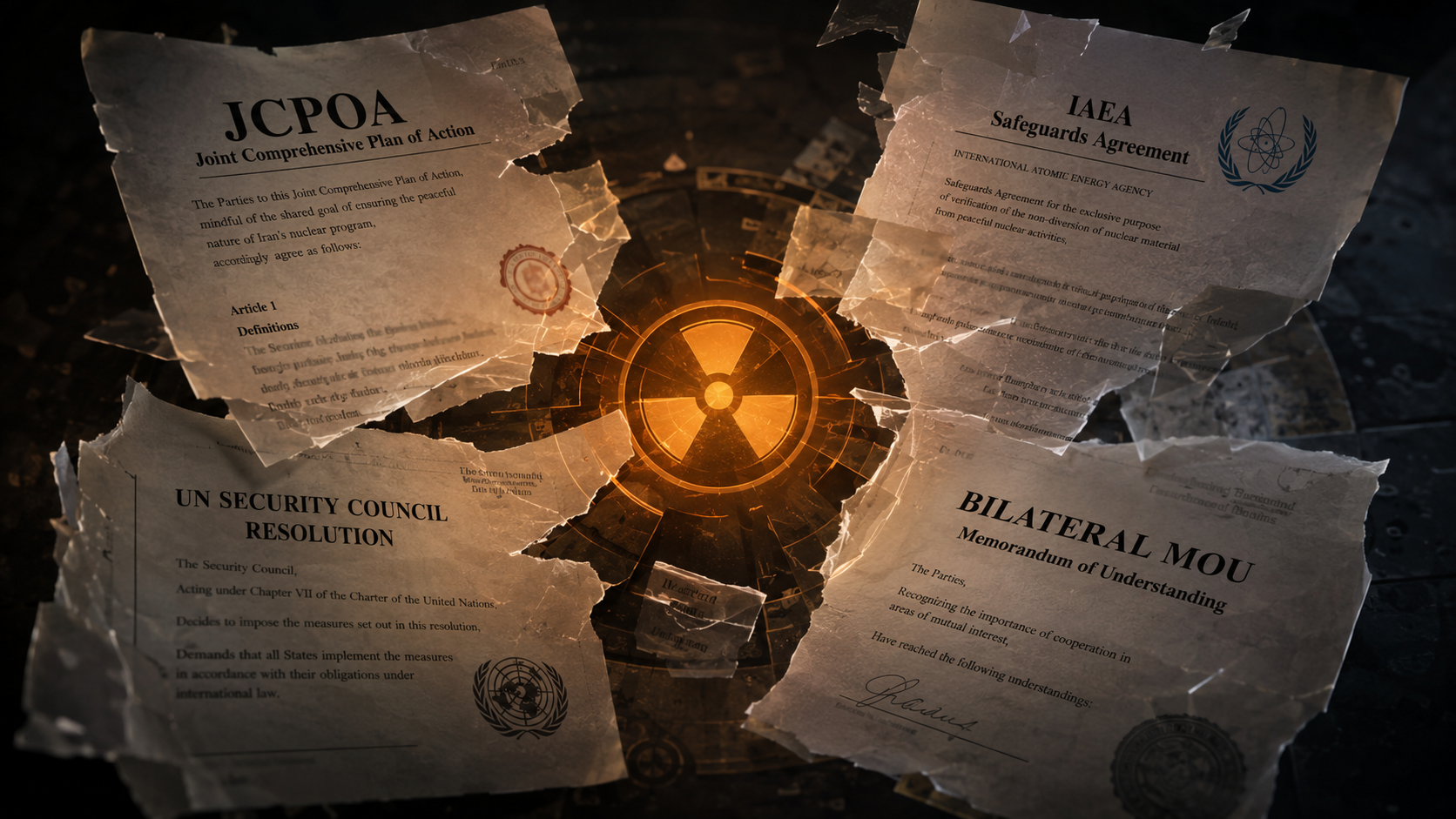
That distinction matters. A breach finding can move a file from Vienna to New York. It does not, by itself, locate drums, verify enrichment levels after military strikes, compel export, select a dilution site, or certify destruction. The legal instruments still exist, but each now fails a different part of the disposal task.
The Verification Problem Comes First
In safeguards practice, "continuity of knowledge" is not a diplomatic nicety. It is the evidentiary thread that lets inspectors account for nuclear material over time: where it was, whether seals and cameras remained reliable, whether declared transfers match records, and whether the agency can say the material it is seeing today is the same material it previously verified.
The September through November 2025 IAEA reporting, as analyzed by the Institute for Science and International Security, describes a post-war safeguards environment in which the agency no longer had that thread over all nuclear material in Iran. ISIS reported that the 440.9 kilogram figure for 60 percent enriched uranium was an estimate built from pre-war IAEA reporting and post-strike analysis, not a quantity newly verified by inspectors after access was lost.[2]
This is why legal debates over disposal can sound cleaner than they are. A Security Council measure, a revived JCPOA pathway, or a bilateral memorandum might describe what Iran must do with enriched uranium. None can prove that the right material was moved, diluted, exported, converted, or destroyed unless the verification system can first identify and follow the material.
Modified Code 3.1 belongs in that same evidentiary category. It is a safeguards design-information rule requiring early notification to the IAEA when a state decides to construct a new nuclear facility, rather than later notification shortly before nuclear material is introduced. Its value is not ceremonial. Early design information gives inspectors a lawful basis to understand the facility before material appears there, which becomes critical when a state has damaged sites, possible relocations, and disputed declarations.
What the JCPOA Once Made Administratively Possible
The Joint Comprehensive Plan of Action did not merely set political expectations. It translated Iran's enriched uranium problem into administrable limits. Under the JCPOA, Iran was limited to 300 kilograms of uranium enriched up to 3.67 percent for 15 years, and material above that limit had to be addressed through defined routes such as export, downblending, or conversion into oxide form for fuel fabrication.[3]
Downblending means mixing higher-enriched uranium with lower-enriched or natural uranium so the resulting material has a lower enrichment level. Oxide conversion changes the chemical form of uranium into oxide, which can be used in certain fuel-fabrication pathways and is not the same as simply leaving enriched uranium hexafluoride in a form readily suitable for further enrichment. Export is the most legally legible option when it works: material leaves the state's territory under agreed arrangements, and the receiving state or entity becomes part of the verification chain.
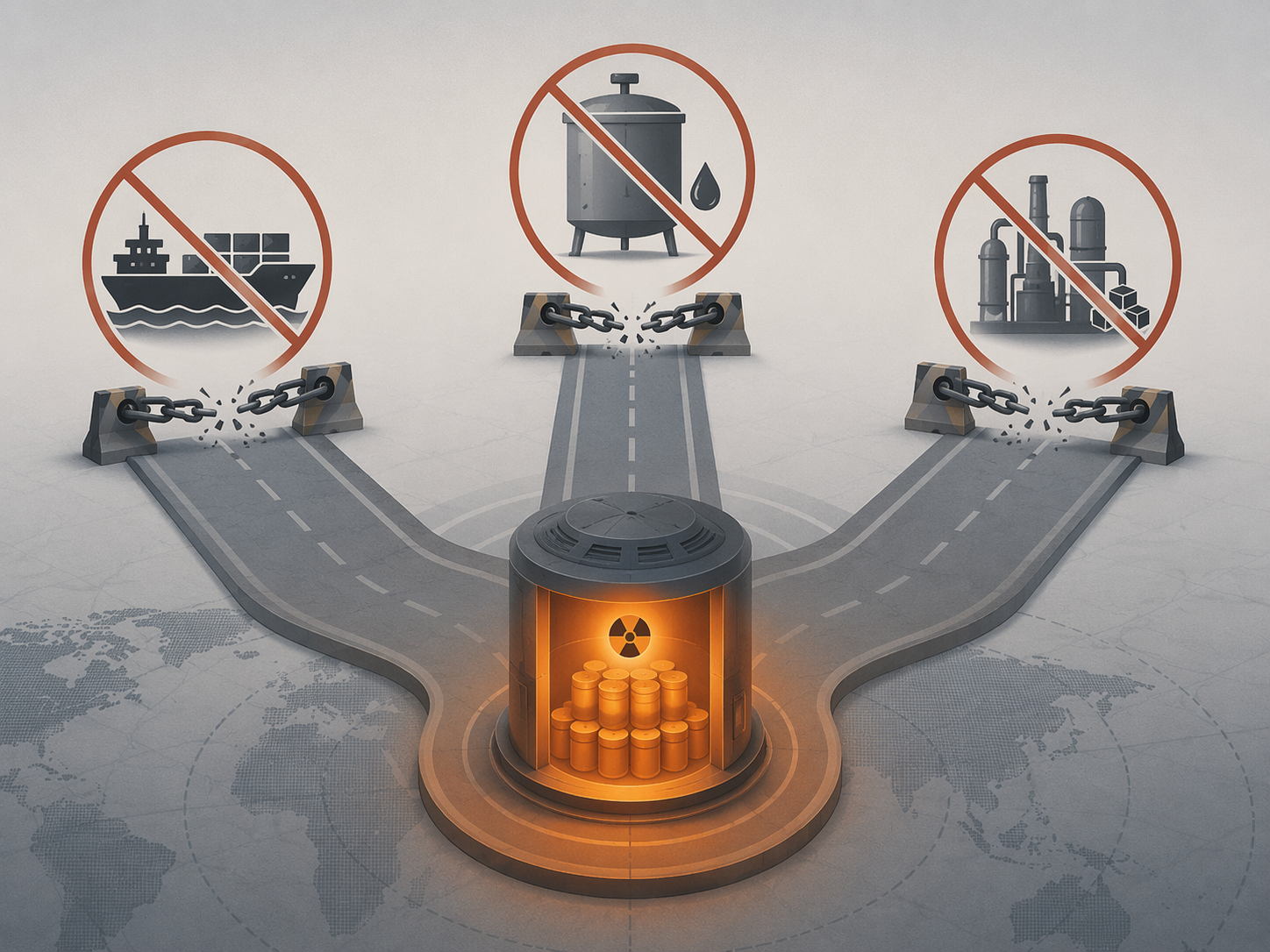
Those mechanisms are now compromised in a more serious sense than ordinary expiration. Export requires a willing destination, agreed custody terms, transport arrangements, sanctions compatibility, and inspector confidence that the exported material corresponds to the declared inventory. Downblending requires access to the material, monitoring of the process, and confidence that no parallel quantity remains outside the accounting system. Oxide conversion depends on technical infrastructure and on a safeguards baseline that inspectors can trust.
The JCPOA can still describe what a controlled stockpile regime looked like. It cannot now, without further legal and operational acts, perform the work it once organized. The old architecture assumed a functioning verification relationship, declared facilities subject to monitoring, and parties willing to execute disposal routes. Post-2025, those assumptions are the disputed facts.
Snapback Is a Collision, Not a Shortcut
The Security Council track appears, at first glance, to offer the harder legal instrument. If UN sanctions are back, implementing states have domestic hooks for asset freezes, procurement controls, travel restrictions, and other measures. But the snapback dispute is not a quiet technical disagreement over drafting. It is a direct conflict over whether the asserted reapplication of prior UN measures has legal effect at all.
At a June 2026 Security Council meeting, the formal UN record reflected the competing positions: the Secretariat had confirmed the reapplication of UN sanctions, while Russia and China rejected the snapback as having "absolutely no legal basis."[4] For sanctions lawyers, that is not an academic footnote. It affects whether a port authority, bank, insurer, customs agency, or procurement regulator can treat the restrictions as clearly in force.
The 1737 Committee problem follows from that disagreement. A sanctions committee can clarify implementation, list entities, process exemptions, and channel state practice only if members accept that there is a sanctions regime to administer. Where permanent members reject the legal premise of reapplication, committee machinery is not simply slow; it is institutionally disabled.
Even on the E3 and U.S. view that snapback was validly triggered and sanctions are in force, the mechanism does not by itself solve disposal. Sanctions can prohibit transfers, restrict procurement, and pressure counterparties. They do not automatically create a verified disposal route for 60 percent enriched uranium after continuity of knowledge has been lost. On the Russia and China view, the asserted measures lack legal effect, making coordinated implementation still less plausible.
The IAEA Can Find Noncompliance, But It Cannot Invent Custody
The IAEA's authority is strongest where the question is safeguards compliance: declarations, access, material accountancy, design information, and verification. Its June 2025 Board finding gave formal weight to the conclusion that Iran was not meeting its non-proliferation duties.[1] That matters because the safeguards system is the lawful route by which technical noncompliance becomes a matter for the Security Council.
But safeguards authority is not the same thing as disposal authority. The agency can report that it cannot verify a stockpile. It can request access, evaluate declarations, and state whether safeguards conclusions can be drawn. It cannot, without an operative agreement or Security Council mandate that actually functions, compel Iran to ship enriched uranium to a particular state, select a downblending method, or take legal custody of the material itself.
The post-war reporting therefore creates a legal paradox. The weaker the agency's visibility becomes, the more urgent disposal appears. Yet that same loss of visibility makes any claimed disposal harder to verify. A disposal agreement concluded after the loss of continuity would need to rebuild the evidentiary base before it could credibly certify completion.
The May 2026 MOU Is Not Yet a Legal Answer
The reported May 2026 U.S.-Iran understanding is tempting because it appears to address exactly the operational problem the older frameworks no longer solve. CBS News described negotiations over a two-step arrangement involving Iran's highly enriched uranium, and the Jerusalem Post reported on the Islamabad Declaration as an agreement in principle tied to uranium disposition.[5][6]
The restraint required here is simple: the full legal text has not been publicly released. The available details come from official briefings, media reporting, and state-aligned accounts rather than an instrument that implementing authorities can read, apply, and test. Until the text is public, it is not possible to determine whether the arrangement creates binding obligations, who the parties are for enforcement purposes, what law governs breach, what disposal method is authorized, or what role the IAEA would have.
A memorandum could still matter politically. Informal understandings can open access, sequence concessions, and reduce immediate military risk. But political utility is not the same as disposal authority. If the stockpile is to be exported, the arrangement needs receiving-state commitments, transport and custody rules, sanctions compatibility, and inspection procedures. If it is to be diluted or converted inside Iran, the arrangement needs a verification protocol capable of addressing reversibility and undeclared retention.
There is also a threshold factual problem. The Council on Foreign Relations' July 2026 backgrounder noted that the ceasefire deal may have collapsed by mid-July 2026.[7] If the ceasefire context has failed, the practical and legal assumptions behind any disposal memorandum may have failed with it. That does not prove the MOU is void; it means the public record does not support treating it as the governing disposal framework.
Dilution Answers One Question and Leaves Several Others
Downblending is often discussed as if it were a compromise between doing nothing and removing the material from Iran. Technically, it can reduce enrichment level. Legally, however, the relevant question is not only whether the uranium is less enriched at the end of the process. It is whether the process is authorized, complete, irreversible enough for the governing standard, and independently verified.
The Foundation for Defense of Democracies argued in June 2026 that dilution on Iranian soil would be reversible and could allow Iran to retain material for later re-enrichment.[8] That is a policy argument for preferring export or destruction over in-country dilution, not a neutral statement of what international law independently requires. Still, the argument identifies a real legal pressure point: if a disposal method leaves material under Iranian control, the verification terms must do more work.
A legal instrument could, in theory, accept downblending as sufficient. The JCPOA itself contemplated downblending as one route to meeting stockpile limits.[3] But the sufficiency of that route depends on the governing text and on the verification facts. In the present setting, the problem is not that dilution is legally impossible. It is that no public, uncontested instrument presently specifies the dilution obligation, the monitoring protocol, the disposition of the resulting material, and the consequence of nonperformance.
A Practical Legal Test for Any Claimed Framework
The competing frameworks can be tested without choosing a preferred diplomatic outcome. Each must answer four operational legal questions:
| Question | Why it matters now |
|---|---|
| Can it identify the stockpile? | The IAEA has lost continuity of knowledge, and the 60 percent HEU figure is an estimate rather than a newly verified post-war quantity. |
| Can it impose a disposal obligation? | A breach finding or sanctions claim may create pressure, but disposal requires an operative obligation directed at the material. |
| Can it authorize or compel the method? | Export, downblending, oxide conversion, and destruction require different legal permissions, counterparties, and custody arrangements. |
| Can it verify completion? | Without restored access and material accountancy, a declared disposal event may not prove that all relevant material was addressed. |
On that test, the JCPOA supplies historical routes but not a presently functioning disposal machine. The IAEA safeguards system supplies verification authority and noncompliance reporting, but not custody or compulsory disposal power. Snapback supplies asserted sanctions authority for some states and no legal authority for others. The May 2026 MOU may supply a diplomatic opening, but not yet a public legal instrument.
The result is not an empty legal field. It is an overcrowded one. Safeguards law, JCPOA remnants, asserted UN sanctions, disputed snapback authority, and an unpublished bilateral understanding all point toward the same material while failing to align on authority, method, and verification.
That is the legal gridlock as of Q3 2026. No single enforceable legal mechanism currently governs disposal. A future political agreement could change that, but only if it produces a public legal text, selects a viable disposal method, and restores or rebuilds IAEA verification capacity enough for inspectors to certify what happened to the material.
References
- IAEA board declares Iran in breach of non-proliferation duties, Reuters.
- Analysis of IAEA Iran Verification and Monitoring and NPT Safeguards Reports, September 2025, Institute for Science and International Security.
- Restoring JCPOA's Nuclear Limits, Arms Control Association.
- Security Council Meeting Record SC/16382, United Nations, June 2026.
- Iran peace deal negotiations highly enriched uranium, CBS News.
- Iran News Article 897164, Jerusalem Post.
- What Is the Iran Nuclear Deal?, Council on Foreign Relations, July 2026.
- Dilution Is Not the Solution: Disposing of Iran's Enriched Uranium Stockpile, Foundation for Defense of Democracies, June 16, 2026.
Comments
Join the discussion with an anonymous comment.