
This is not an article about betting slips or gambling winnings. The tax question is narrower and more awkward: when a foreign national team earns World Cup prize and performance income from matches played in the United States, what part of that income is U.S.-source, who must withhold, and what later changes the result?
Spain is the cleanest current example. MarketWatch, published through Morningstar, reported that the 2026 World Cup champion won $50 million after the July 19 final, though public references to the winning amount are not perfectly uniform and some secondary discussions use $51 million instead.[1] That figure is useful because it gives the analysis a place to start. It is not, by itself, the taxable answer.
Three amounts have to be kept separate from the outset: the federation-level prize reported in the press, the portion treated as U.S.-source income because it is connected to matches and services performed in the United States, and the amount withheld upfront under the nonresident alien withholding rules. Collapsing those three into “the IRS gets a cut” is how a withholding story turns into a false liability story.

The U.S. Tax Hook Is Source, Not the Trophy
Foreign athletes and foreign entities can be brought into the U.S. tax system when they receive fixed or determinable annual or periodical income from U.S. sources, and the IRS materials for foreign artists and athletes place compensation for U.S. performances inside that framework.[2] The general nonresident alien withholding rule then starts from a blunt place: 30% gross withholding on U.S.-source FDAP income unless an exception, treaty claim, or approved withholding arrangement changes the treatment.[3]
For the Spain fact pattern, the important public fact is not simply that Spain won the tournament. It is that the final and most of Spain’s matches were played on U.S. soil. That makes U.S.-source characterization relevant for the allocable portion of the prize and related performance income. It does not convert every dollar mentioned in a headline into a final U.S. tax bill.
The statutory labels matter because different parties can sit in different places in the chain. Individual nonresident athletes are analyzed under rules that include IRC § 871 and withholding under IRC § 1441; foreign corporations and comparable entities can raise IRC § 1442 issues. A federation-level payment, a player bonus, a coaching payment, and a commercial appearance fee may all be discussed in the same tournament article, but they are not the same payment for tax administration purposes.[2][3]
Why the $50 Million Figure Has to Be Allocated
The practical question for Spain is allocation. The public reporting gives a total championship prize attributed to the winning federation, not a confirmed public ledger showing how much went to the federation, how much was contractually passed through to players, how much went to coaches or staff, and how the governing body treated each component for withholding. Without that split, no outside observer can calculate Spain’s actual U.S. tax cost with confidence.
For the 2026 tournament, practitioner discussion has centered on a match-based allocation approach tied to a June 10, 2026 consensus among the IRS, Canada Revenue Agency, and Mexico’s SAT. The publicly available support for that point is the Taxpayer Advocate bulletin and the IRS general resource notice, not the full text of the consensus itself.[4][5] That distinction is not clerical. If the operative agreement is unpublished, a careful analysis should cite the public administrative guidance and avoid pretending to quote terms it cannot inspect.
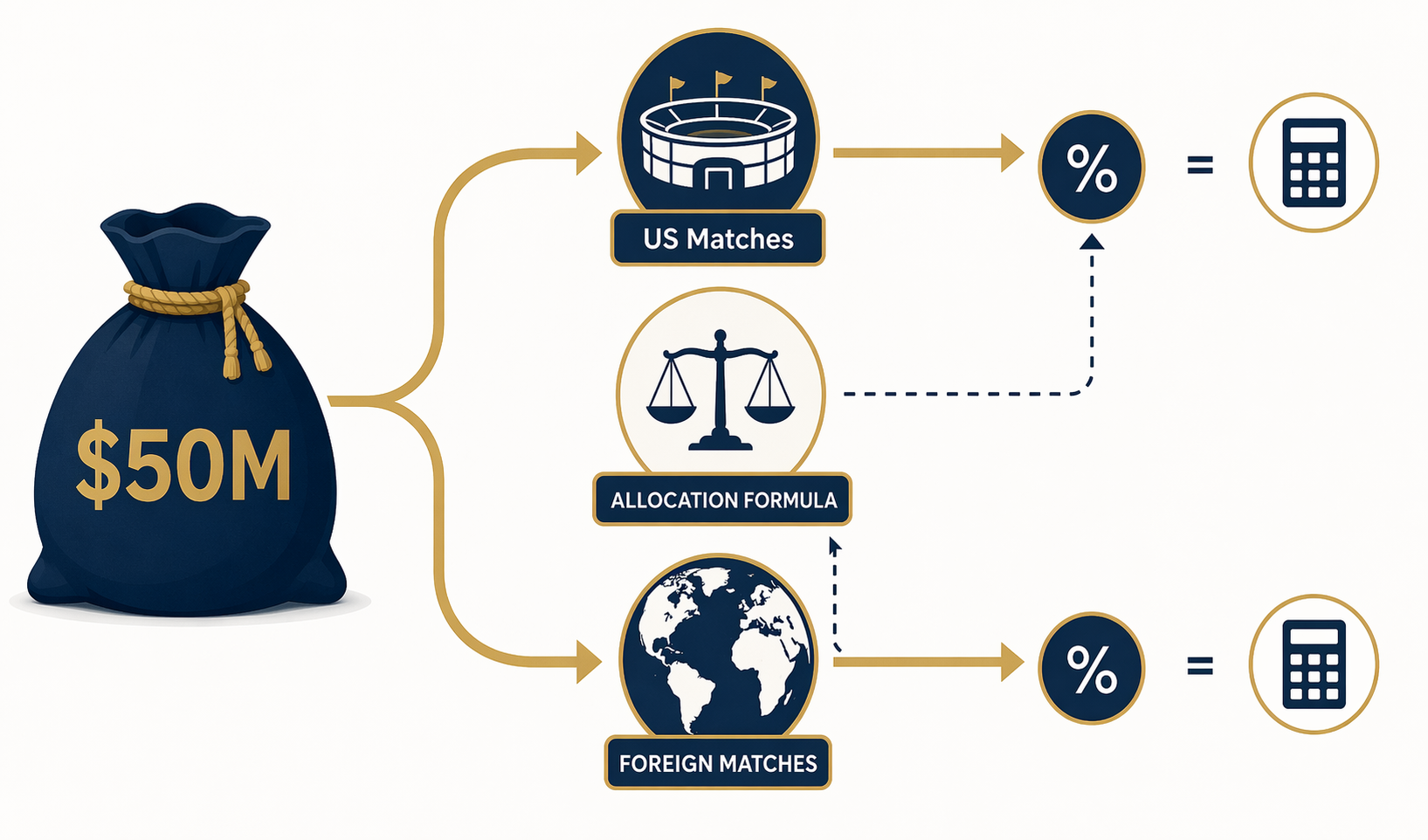
In plain terms, allocation asks how much of the tournament income belongs to U.S. match activity rather than foreign match activity. If a team played matches in more than one host country, the withholding analysis should not treat the entire prize as if every performance occurred in the United States. If, however, the decisive matches and most of the relevant appearances were in U.S. venues, the U.S.-source portion may still be substantial.
| Item | What It Measures | Why It Matters |
|---|---|---|
| Reported championship prize | The public-facing amount attributed to the winning federation | It starts the analysis but does not identify the taxpayer-level or U.S.-source amount |
| Match-based U.S. allocation | The portion connected to matches or services performed in the United States | It determines what enters the federal withholding frame |
| Default withholding | The amount held upfront under the 30% NRA withholding regime | It protects collection but is not necessarily the final tax liability |
| Final liability | The result after treaty claims, deductions where available, credits, refund claims, and filings | It is the number the public record usually cannot prove |
A hypothetical example shows the difference without pretending to know Spain’s books. If a federation prize were first allocated between U.S. and non-U.S. match activity, only the U.S.-source share would sit inside the federal NRA withholding calculation. If the federation later paid bonuses to players, those player-level payments could raise their own documentation and treaty questions. The real Spain allocation depends on tournament facts and payment documents that have not been publicly released.
Withholding Is a Collection Mechanism
The default 30% rule is easy to report and easy to misunderstand. Withholding is the amount a withholding agent holds back and reports because the payee is foreign and the payment is U.S.-source income within the withholding rules. It is not a judicial finding that the payee owes exactly that amount after every treaty, expense, filing, and refund question is resolved.[3]
That timing difference matters in tournament administration. The withholding agent may have to act before the athlete or federation has finished gathering residency certificates, treaty support, individual taxpayer identification numbers, compensation agreements, expense documentation, or a complete match-allocation schedule. The IRS regime is designed to make collection happen early; the final tax position is often built later through paperwork.
For a foreign player, the downstream paper trail can include Form 1042-S from the withholding agent and Form 1040-NR from the athlete if a U.S. nonresident return is required or a refund claim is being made. Sprintax’s 2026 World Cup tax compliance guide also flags ITIN timing, describing a 7-to-11-week procurement window that can become a real obstacle when tournament income, treaty claims, and refund procedures collide on a short calendar.[6]
The federation-level story can be just as document-heavy. A payer needs to know whether it is paying a foreign federation, a player, an agent, a loan-out company, or another intermediary. It also needs a defensible basis for the source allocation and the applicable withholding rate. When that work is delayed until after the final, the tax issue has already become a cleanup project.
Treaty Relief Helps Only If the Facts Fit
The Spain-U.S. treaty discussion is more precise than a generic “treaty reduces tax” sentence. Practitioner summaries of the 1990 treaty point to Article 19 treatment for athletes and entertainers, including a $10,000 de minimis threshold and a public funds clause requiring substantial government support.[7][6] Those features can matter, but they are fact filters, not magic words.
The de minimis threshold is unlikely to do much work for a star player with a meaningful tournament bonus or other U.S.-source compensation above the threshold. It may matter more for lower-paid participants, staff, or narrow categories of appearance income, depending on the payment facts. The public funds clause is also not a shortcut; the relevant question is whether the support satisfies the treaty standard as applied to the actual Spanish-side funding and payment structure.
That is where treaty analysis can become administratively unfair in small cases. The athlete with modest U.S.-source income still needs documentation, a return posture, and often professional help to claim what may be a limited benefit. Anchin’s discussion of 2026 World Cup tax implications cites professional fees in the $5,000-to-$15,000 range per athlete from non-treaty nations, a cost that can be disproportionate when the income at issue is not headline-level money.[8]
The CWA Is Planning, Not a Post-Final Rescue
A Central Withholding Agreement is the other major federal tool, and it works differently from treaty relief. The IRS CWA program allows eligible foreign athletes and entertainers to agree in advance to withholding based more closely on estimated net income rather than the default gross withholding approach. The IRS describes Form 13930 as the application vehicle and requires advance submission before the event; 2026 World Cup practitioner guidance emphasizes the 45-day pre-event timing point.[9][8]
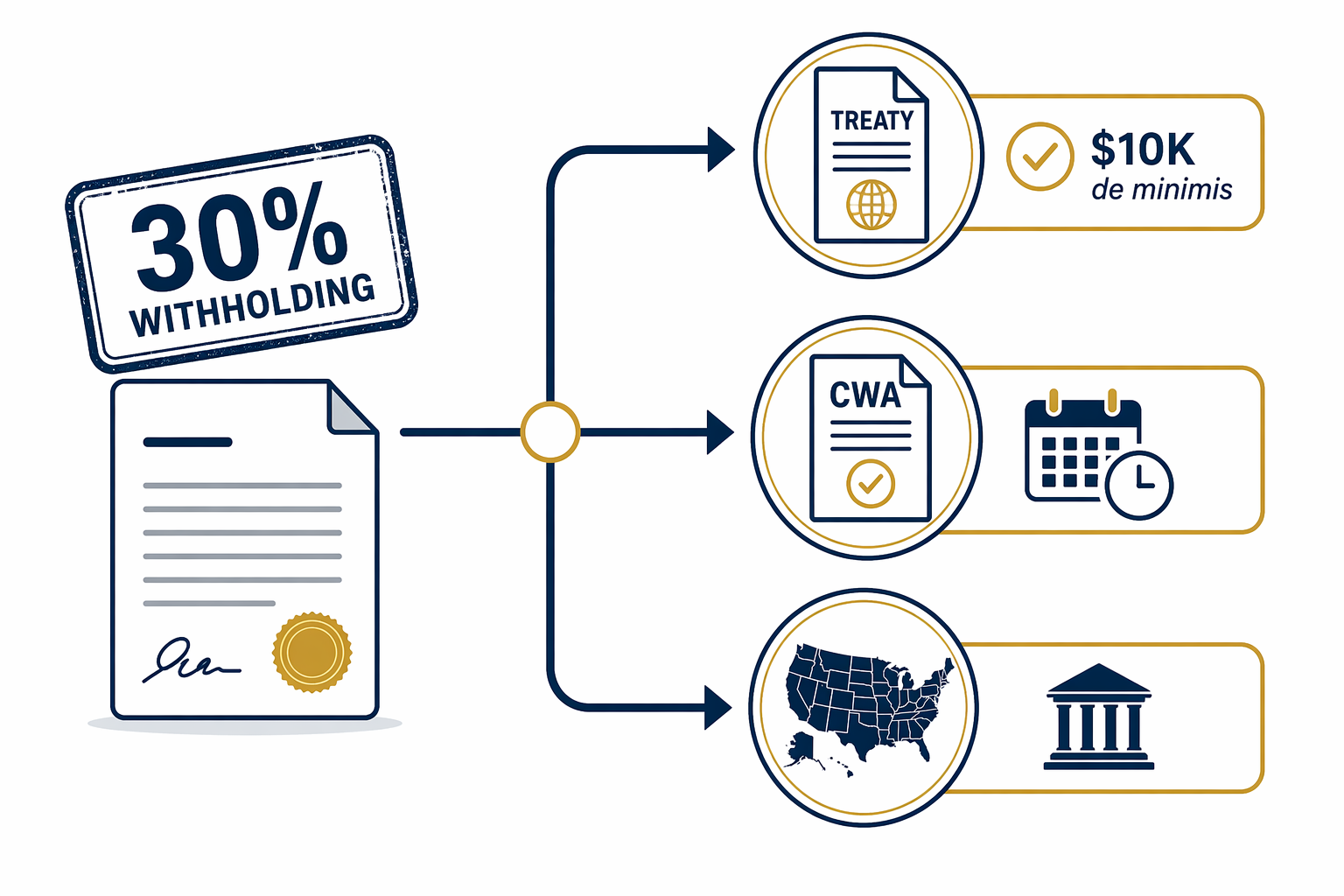
The difference is consequential. A CWA can reduce overwithholding where the athlete has deductible expenses, a reliable compensation estimate, and enough lead time to submit a package the IRS can evaluate. It does not help much if the team first asks the question after the trophy ceremony, or if the documentation does not support the projected income and expense numbers.
For Spain, the public record does not show whether any relevant CWA was obtained for players, staff, or connected entities. That absence should not be filled with an assumption. The correct conclusion is conditional: if a valid CWA covered particular payments, withholding may have been calibrated below the default gross rate; if not, the withholding agent would generally begin from the ordinary NRA withholding framework and available treaty documentation.
State Jock Taxes Do Not Wait for the Treaty Answer
Federal treaty analysis is not the end of the venue problem. State income tax regimes can apply to athlete income connected to days, games, or services performed in a state, and federal income tax treaties generally do not eliminate state tax exposure. Greenback’s 2026 jock tax research identifies California’s top rate at 13.3% and New Jersey’s at 10.75%, two numbers that matter because major tournament venues sat in high-tax states.[10]
This is where a match schedule becomes more than a sports document. A semifinal in New Jersey, a final in California, or earlier matches in other U.S. venues can produce state-level allocation questions separate from the federal source analysis. The state calculation may depend on duty days, event days, compensation formulas, or state-specific sourcing rules; the key point is that a favorable federal treaty position does not automatically erase the state file.
Georgia deserves an accuracy footnote rather than a detour. Greenback’s May 2026 research may need to be read against Georgia HB 463, signed May 11, 2026, which retroactively changed the state rate and can affect Atlanta venue examples. Any calculation that uses Georgia as a match location should verify the applicable period and rate before turning an illustrative allocation into advice.[10]
What the Compliance File Has to Prove
A defensible file for foreign World Cup prize income does not begin with the headline number. It begins with payment identity and source. Who received the FIFA prize? Who later received bonuses? Which payments were compensation for services, which were federation receipts, and which were reimbursements or commercial arrangements? Which matches or required appearances occurred in the United States?
- Identify each payee before applying a rate: federation, player, coach, agent, company, or other intermediary.
- Separate the reported federation prize from player-level compensation and staff payments.
- Allocate income between U.S. and non-U.S. match activity using the available 2026 administrative guidance.
- Document treaty residency, Article 19 eligibility, and any public funds position before reducing withholding.
- Confirm whether a CWA was requested and approved in time for the covered payments.
- Track state venues separately, especially California, New Jersey, and any Georgia allocation affected by 2026 rate timing.
The filing consequences then follow the file. A withholding agent that pays U.S.-source income to a foreign person may have Form 1042-S reporting duties. A nonresident athlete who needs to report income, claim treaty treatment, or seek a refund may need Form 1040-NR and an ITIN if no taxpayer identification number is already available.[6] Those forms do not decide the economics on their own, but missing them can turn a manageable withholding issue into a prolonged refund or notice problem.
The Defensible Answer on Spain
Spain’s reported $50 million World Cup prize created U.S. tax obligations because substantial prize-related performance activity occurred in the United States. The default federal posture is 30% withholding on the U.S.-source portion under the NRA withholding framework, with separate analysis for individual athletes and foreign entities under the relevant Code provisions and IRS guidance.[2][3]
The final burden, however, cannot be read from the press amount. It turns on match-based allocation, the unknown federation-to-player split, treaty eligibility under the Spain-U.S. treaty, any timely CWA planning, and state venue exposure. The public materials support that conclusion. They do not support a confident public calculation of Spain’s actual U.S. tax bill.
This article is for general legal and tax information about foreign World Cup prize and performance income. It is not legal or tax advice, and it does not determine the liability of Spain, any federation, any player, or any withholding agent.
References
- World Cup champion Spain just won $50 million — and the IRS gets a cut — Morningstar / MarketWatch, July 18, 2026.
- Taxation of foreign artists and athletes — IRS.
- NRA withholding — IRS.
- The Tax Playbook for Foreign Participants in the 2026 FIFA World Cup — Taxpayer Advocate Service, June 2026.
- General Tax Resources for the 2026 FIFA World Cup — IRS.
- FIFA World Cup 2026: Tax Compliance Guide for Players & Federations — Sprintax.
- 2026 FIFA World Cup & Cross-Border Tax Compliance — Greenback Tax Services.
- Goals, Glory, and Taxes: Foreign Athletes Face U.S. Tax Implications for World Cup 2026 — Anchin.
- Overview of the Central Withholding Agreement program — IRS.
- Jock Tax 2026: How the World Cup Divides the Tax Field — Greenback Tax Services, May 2026.
Comments
Join the discussion with an anonymous comment.