
The clean federal estimate is about $13.1 million. That is not 30% of Spain’s entire $50 million World Cup winner’s prize. It is 30% of the portion treated as U.S.-source income under the tournament allocation formula: 7 U.S. matches out of 8 total matches, or 87.5%, producing a $43.75 million U.S.-source slice. Apply the default 30% federal withholding rate to that slice, and the result is $13.125 million before treaty claims, exemption status, refund procedures, or state taxes enter the picture.[1][2][3][4][5]
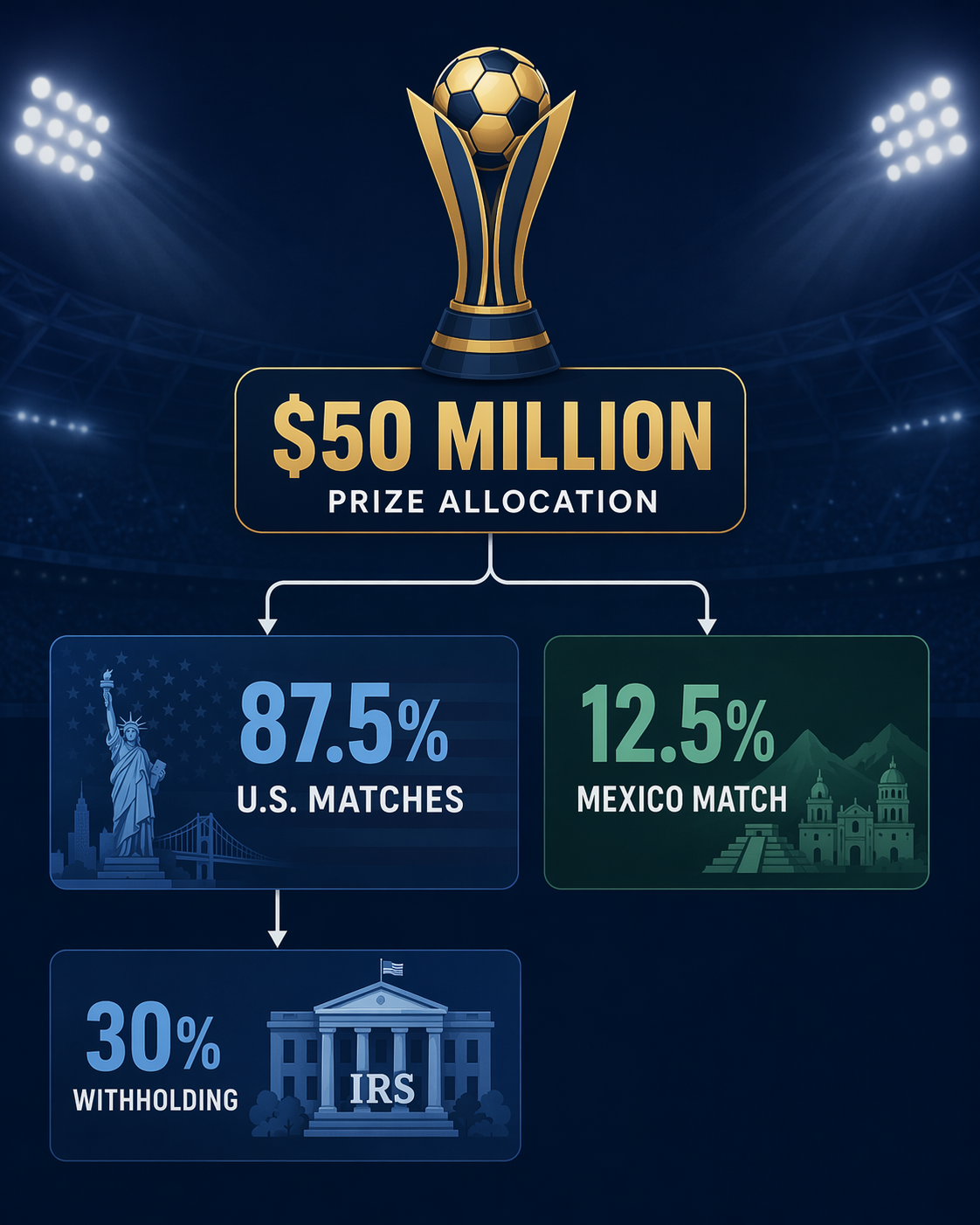
That number is the answer most people are looking for when they ask how much the IRS takes from Spain’s World Cup winnings and what legal tax rate applies. It is also only a withholding estimate. Withholding is the amount collected up front from gross U.S.-source income. It is not necessarily the final tax cost after a federation asserts exemption, files treaty paperwork, allocates payments to players and staff, or deals with state tax authorities.
The public reaction is easy to understand. Spain is a foreign team, the prize is awarded by FIFA, and the tournament is global. But the U.S. tax question does not start with nationality or fan intuition. It starts with source: where the income-producing performance took place, who received the income, and which withholding rule applies to that recipient.
The Calculation Behind the $13.1 Million Figure
| Step | Amount or Rate | Why It Matters |
|---|---|---|
| Winner’s prize | $50 million | The starting amount reported for Spain’s World Cup title prize |
| U.S. match allocation | 7 of 8 matches, or 87.5% | The allocation method looks to matches played in each host country |
| U.S.-source portion | $43.75 million | $50 million multiplied by 87.5% |
| Default federal withholding | 30% | The default gross withholding rate for U.S.-source income paid to foreign persons |
| Estimated federal withholding | $13.125 million | $43.75 million multiplied by 30% |
The prize figure comes from July 2026 reporting that put the winner’s award at $50 million, within a $655 million FIFA prize pool and $727 million when preparation funding is included.[1] The legal hinge is the tri-country allocation approach for the 2026 tournament, which Canada’s tax authority described as allocating prize money and other compensation among the United States, Canada, and Mexico by reference to matches played in each jurisdiction.[2]
Spain’s reported tournament path supplies the numerator. Reconstructing the schedule from published match and venue information gives Spain 8 total matches because it won the final and did not play a third-place match. Seven were in the United States, one was in Mexico, and none were in Canada.[3][4] That produces the 87.5% U.S. share.
From there the arithmetic is ordinary, which is why it is useful. $50 million multiplied by 87.5% equals $43.75 million. A 30% withholding rate applied to $43.75 million equals $13.125 million. Rounded, the federal withholding estimate is about $13.1 million. CryptoBriefing’s July 21 report that up to roughly $44 million of the prize could be taxable is consistent with that same allocation math, rounded from $43.75 million.[6]
There is one important caveat in the match count. The Canada Revenue Agency notice confirms the allocation method, but it does not publish Spain’s team-specific breakdown. The 7-of-8 calculation is a schedule-based reconstruction, not a bespoke IRS ruling on Spain’s prize.
Why the IRS Can Reach the U.S.-Source Slice
For federal withholding purposes, the U.S. does not need to tax the whole prize to have a claim. It needs U.S.-source income paid to a foreign person or foreign entity. IRS Taxpayer Advocate guidance and practitioner coverage of the 2026 tournament both describe the default 30% withholding framework for foreign athletes and other nonresident recipients of U.S.-source income.[5][7]
That is where Internal Revenue Code sections 1441 and 1442 matter. Section 1441 is the withholding rule generally associated with nonresident alien individuals. Section 1442 is the parallel rule for foreign corporations. In both settings, the collection mechanism is withholding at source on certain U.S.-source payments, commonly at 30% unless a treaty or statutory exception changes the result.[5][7]
The allocation agreement changes the question from “Did Spain win a $50 million prize?” to “How much of the compensation is assigned to U.S. matches?” That distinction is not a technicality. If all $50 million were treated as U.S.-source, the default 30% figure would be $15 million. If only the U.S. match share is used, the default figure falls to about $13.1 million. The difference is the legal significance of the allocation formula.
The Entity Question: Federation, Players, Coaches, and Staff
The headline usually says the IRS is taxing Spain. Tax paperwork is less tidy. The recipient could be Spain’s national federation, individual players, coaches, staff members, or some combination depending on how FIFA pays the prize and how the federation distributes it. The withholding answer can change when the payee changes.
The most important federal modifier is the tax-exemption route made available to national associations. KPMG reported in June 2026 that FIFA had secured a U.S. Treasury agreement allowing national soccer associations to apply for tax-exempt status in connection with the 2026 tournament, and The Global Treasurer reported the April 2026 agreement as a breakthrough for participating federations.[8][9]
That does not mean the Real Federación Española de Fútbol has already received U.S. tax-exempt treatment. The available material supports a narrower statement: the mechanism exists, and national associations may seek it. It does not confirm that Spain’s federation has applied, qualified, or obtained recognition for the prize at issue.[8][9]
Even if the federation-level exposure is reduced or eliminated, that does not automatically answer the player-level question. Forbes, citing Diario AS, reported an estimate that 45% of the prize, or $22.5 million, could go into a player bonus pool, producing roughly $865,000 gross per player across a 26-player squad.[1] Those are reported estimates of an internal distribution, not confirmed RFEF payroll records.
The practical consequence is that the “IRS takes $13.1 million” line is most precise as a default federal withholding estimate on the U.S.-sourced prize amount. It is less precise if used as a final bill for the federation, and less precise still if used to describe every player’s ultimate U.S. tax position.
Treaty Relief Can Lower Withholding, But It Does Not Erase Source
The U.S.-Spain tax treaty is another reason the default 30% rate should not be confused with the final burden. Current reports describe treaty relief as potentially available, including under the treaty article dealing with entertainers and sportspersons, while still recognizing that the United States may tax performance income earned in the country.[5][7]
The record available here does not support a confirmed treaty-adjusted dollar figure. The better reading is conditional: a valid treaty claim may reduce withholding for eligible recipients, but the applicable result depends on the recipient, documentation, payment characterization, and whether the treaty position is accepted. It is not enough to say “Spain has a treaty,” just as it is not enough to say “30% applies” without asking whether a treaty claim has been made.
State Jock Taxes Are a Separate Layer
The federal computation is only the first layer. State income taxes can apply to athlete and entertainer income sourced to games played in that state, and they do not necessarily follow federal treaty outcomes. Practitioner coverage of the 2026 tournament highlighted state jock taxes as a separate exposure for foreign athletes.[5]
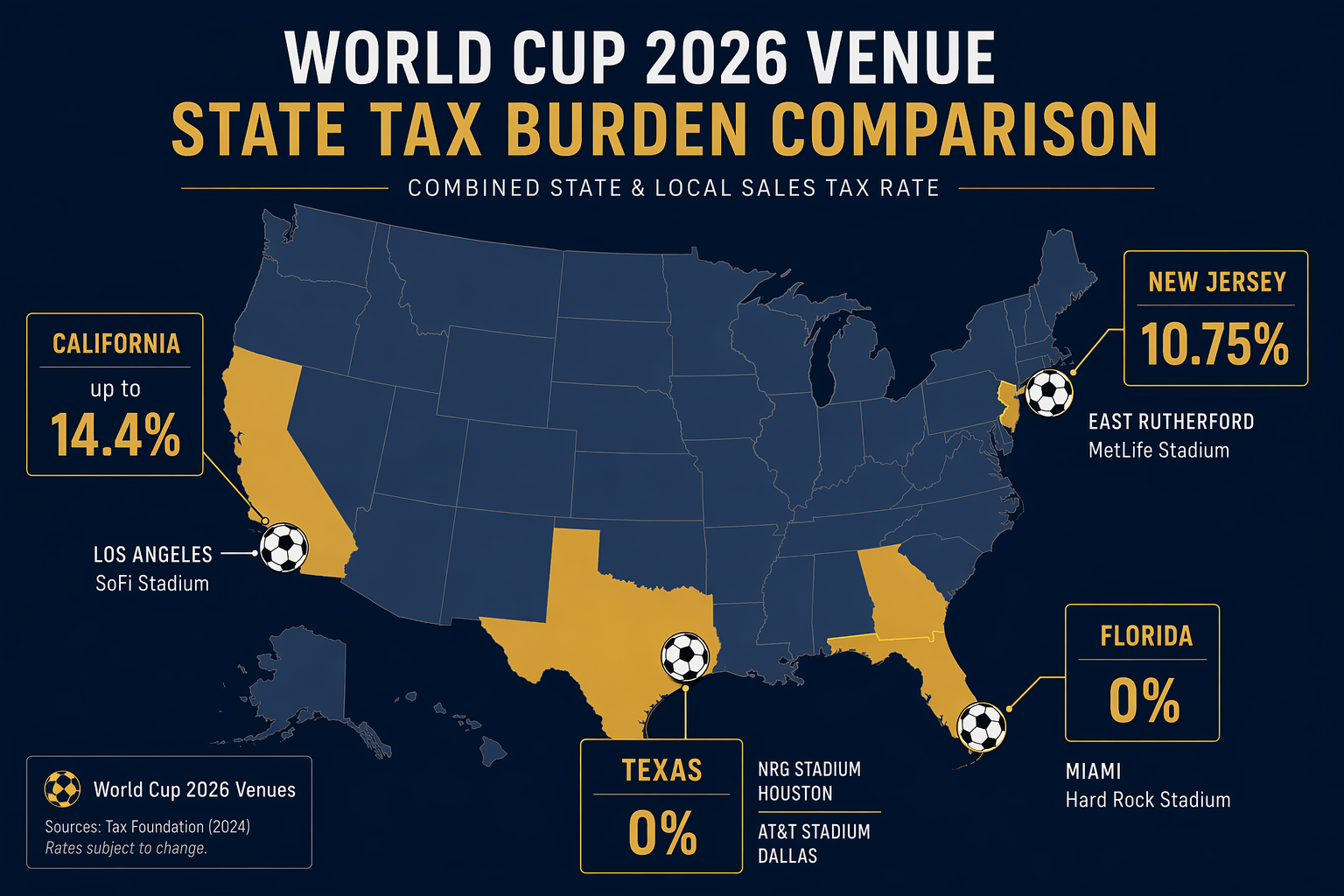
The state map is uneven. New Jersey matters because the final at MetLife Stadium creates exposure to a state with a top rate reported at 10.75% and no recognition of international tax treaties for this purpose.[5] California matters because Los Angeles games can bring a top-rate exposure reported in the 13.3% to 14.4% range, depending on how local surcharges are counted.[5][10] Texas and Florida matter for the opposite reason: reported state income tax exposure there is 0%.[5][10]
That does not justify adding one national “state tax” percentage to the $50 million prize. State exposure depends on which games were played where, which payments are attributed to which individuals or entity, and how each state sources the income. New Jersey’s final is not the same tax event as a Texas group-stage match.
The Politics Are Loud, but the Math Does the Work
The story became political almost immediately. Fox News reported on July 21, 2026, that Rep. Tim Burchett, a Tennessee Republican, and Rep. Jonathan Jackson, an Illinois Democrat, both called the tax a “rip-off.”[10] That quote captures the public mood better than it explains the withholding mechanics.
There is a fair emotional objection buried in the reaction: a foreign team wins a global tournament, and U.S. authorities appear to take a large cut. The legal answer is less theatrical. The United States hosted most of Spain’s income-producing matches, the tournament tax authorities agreed to a jurisdictional allocation approach, and the federal withholding rules collect from the U.S.-source slice first.
So How Much Does the IRS Take?
The best single answer is: about $13.1 million in default federal withholding, calculated as 30% of the $43.75 million U.S.-source portion of Spain’s $50 million prize. That figure is directionally grounded because it follows the match-allocation method and uses the default federal withholding rate.
The final burden could be lower if the federation successfully qualifies for the available U.S. tax-exempt treatment or if eligible recipients make valid treaty claims. It could be higher on an all-in basis when state jock taxes are added for games in states such as New Jersey or California. Texas and Florida games do not create the same state income tax layer.
The viral version is therefore both useful and incomplete. The useful part is the federal baseline: $43.75 million of U.S.-source prize income times 30%. The incomplete part is everything that happens after that baseline: who is treated as the recipient, whether exemption has actually been granted, whether treaty relief is claimed and accepted, and which states get to tax the people who played there.
References
- Spain World Cup prize money reporting, Forbes, July 20, 2026
- Allocation of prize money and other compensation for FIFA 2026, Canada Revenue Agency
- Spain match schedule, Yahoo Sports
- 2026 World Cup venue guide, Al Jazeera, June 3, 2026
- Default 30% withholding and state jock taxes for foreign athletes, CPA Practice Advisor, July 6, 2026
- IRS tax Spain World Cup prize estimate, CryptoBriefing, July 21, 2026
- Tax tips for foreign athletes, IRS Taxpayer Advocate Service, June 2026
- FIFA 2026 tax-exempt status agreement coverage, KPMG Tax Newsflash, June 2026
- Treasury agreement details for FIFA national associations, The Global Treasurer, April 30, 2026
- Congressional reaction to IRS taxation of Spain World Cup prize, Fox News, July 21, 2026
Comments
Join the discussion with an anonymous comment.