
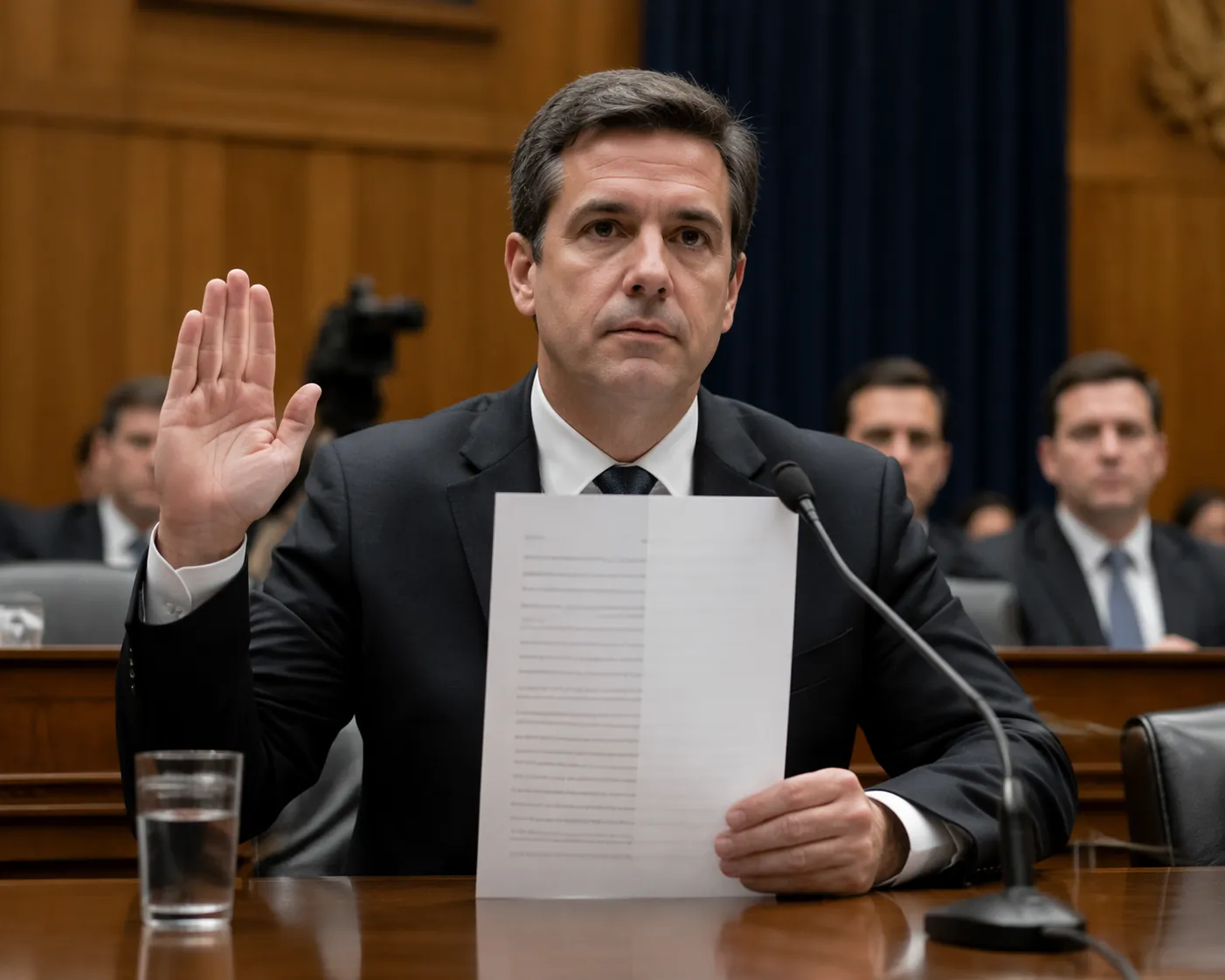
The disputed answer is narrower than the headline. In a Dec. 17, 2025 deposition, former Special Counsel Jack Smith reportedly said he did not “subpoena” lawmakers’ text messages. The records at issue were reportedly obtained through National Archives and Records Administration requests under the Presidential Records Act, not through telecommunications subpoenas. House Judiciary Chair Jim Jordan’s July 22, 2026 criminal referral faults Smith for not volunteering that distinction; Smith’s lawyers, Lanny Breuer and Peter Koski, responded that the referral “concedes [Smith] did not” make the allegedly false statement.[1][2]
That is the useful entry point for assessing the legal implications of the DOJ referral. The issue is not whether congressional Republicans dislike Smith’s investigative choices, or whether Smith’s answer was artful, or whether a referral generates a day of cable coverage. The legal question is whether a literally true answer can become a criminal false statement because it omitted information that would have made the answer less misleading.
That question is not frivolous. It is also not clean. False-statements law has room for intentionally misleading half-truths in some settings, but § 1001 is not a general duty-of-candor statute for every witness who answers a poorly framed question with painful precision.
The statute starts with falsity, not annoyance
Section 1001 covers several related but distinct forms of misconduct. As relevant here, it prohibits anyone, in a matter within federal jurisdiction, from “knowingly and willfully” making a “materially false, fictitious, or fraudulent statement or representation.” It also reaches the use of a false writing or document, and separately prohibits concealing a material fact by “trick, scheme, or device.”[3]
Those words matter because they point in different directions. A false statement charge asks whether the statement itself was false, fictitious, or fraudulent. A concealment charge asks whether the defendant concealed a material fact through an affirmative trick, scheme, or device. A half-truth theory sits uneasily between them: the words uttered may be literally accurate, but the government argues that the answer, in context, was designed to mislead.
The Smith referral appears to live in that uneasy space. If the reported answer was “I did not subpoena lawmakers’ text messages,” and if the records were obtained through NARA requests rather than subpoenas, then the ordinary falsehood is missing. The accusation becomes that Smith should have added something like: “No, we did not subpoena them, but we did obtain records through NARA.” That may have been the fuller answer. The criminal-law question is whether § 1001 required it.
Materiality would not be the referral’s hardest element. If Congress was investigating how Smith’s office obtained communications records from lawmakers, the source and legal mechanism for those records could plainly have a natural tendency to influence the inquiry. The more difficult elements are falsity, knowledge, and willfulness: whether Smith’s answer was criminally false or fraudulent in context, whether he understood the answer that way, and whether the government could prove beyond a reasonable doubt that he chose the wording to mislead rather than to answer the term actually used.
Why the half-truth problem is real
Lawyers sometimes talk about § 1001 as though the rule were administratively simple: do not lie to federal investigators or Congress. That is useful advice and incomplete doctrine. Courts have had to decide what to do with answers that are technically true, evasive, and allegedly crafted to create a false impression.
Available analysis describes a split in approach. Some courts, including the D.C. Circuit according to that analysis, have recognized that a literally true statement may violate § 1001 when it is intentionally misleading in context and omits information necessary to prevent the statement from being deceptive. Other courts have been more demanding, requiring an affirmative falsehood rather than treating a misleading but true answer as enough.[4]
That uncertainty cannot be waved away just because the referral comes from a political antagonist. Congressional testimony is full of bounded answers. Witnesses are instructed to answer the question asked, to avoid volunteering, and to request clarification when necessary. At the same time, a witness cannot safely convert precision into a device for deception. The hard cases arise when both propositions are plausible.
Consider a hypothetical deposition question: “Did you email the report to Agency X?” If the witness says “No,” knowing that she sent the same report through an encrypted file-transfer portal, the answer may be literally true in a narrow technical sense and misleading in the practical sense that prompted the question. A prosecutor looking at that exchange would care about the exact wording, the surrounding questions, the witness’s role, prior warnings, follow-up opportunities, and whether the witness’s chosen phrasing defeated the inquiry.
The subpoena-versus-NARA distinction works the same way, but with an additional complication. “Subpoena” is not a casual synonym for “obtain.” It is a legal instrument. A lawyer answering under oath may treat that word as limiting. If the questioner wanted to know whether the office obtained lawmakers’ communications records by any route, the question could have been asked that way.
Applying § 1001 to the reported exchange
On the currently reported facts, the referral’s strongest argument is contextual. It can say that Congress was asking about the acquisition of lawmakers’ text messages, that Smith knew the subject was the records themselves rather than the procedural label, and that his answer used “subpoena” as a shield while withholding the NARA route. If the record shows that Smith understood the inquiry more broadly and deliberately allowed a false impression to stand, a half-truth theory has doctrinal footing in at least some courts.
But that is not the same as saying the referral presents a strong criminal case. The reported accusation depends on a failure to volunteer a distinction that the question itself may have made legally salient. A government charge would have to do more than prove that the answer was incomplete or unhelpful. It would have to prove a materially false, fictitious, or fraudulent statement, or a concealment accomplished by trick, scheme, or device, and it would have to prove that Smith acted knowingly and willfully.[3]
| Issue | Why it matters for the referral |
|---|---|
| Literal truth | If Smith was asked about subpoenas and no subpoenas were used, the ordinary false-statement theory starts with a serious weakness. |
| Context | A half-truth theory depends on showing that the answer was intentionally misleading in the deposition setting, not merely narrow. |
| Materiality | The method used to obtain lawmakers’ records could matter to a congressional inquiry, but materiality does not solve falsity. |
| Knowledge and willfulness | The government would need evidence that Smith understood the answer as deceptive and chose it for that reason. |
| Charging theory | A false-statement count and a concealment-by-scheme theory would require different proof and different jury instructions. |
The missing transcript matters. So does the missing full referral. Public reporting gives the central exchange, the NARA distinction, and the lawyers’ response, but not the full sequence of questions, objections, clarifications, and surrounding testimony. A § 1001 analysis built from a single reported answer is necessarily provisional.
That limitation cuts both ways. A fuller transcript could show that Smith was repeatedly asked about all methods of obtaining records and then retreated into “subpoena” language to avoid disclosure. It could also show that the questioner chose a legally specific word, received a legally specific answer, and failed to ask the obvious follow-up. The difference is not etiquette. It is the difference between proof of criminal deception and proof that a witness did not rescue the examiner from an imprecise question.
A referral is not a prosecution
The procedural posture lowers the temperature. Congressional criminal referrals usually do not bind DOJ. The Congressional Research Service has explained that most referrals carry only the persuasive force of the evidence they contain, with limited exceptions for ethics committee referrals and criminal contempt certifications.[5]
That point is often treated as a civics footnote, but it is central here. The referral does not create a prosecutorial obligation. It does not resolve the half-truth split. It does not substitute for admissible evidence. It asks DOJ to evaluate whether the facts and law support a charge that DOJ itself would be willing to bring and defend.
The form of this referral also matters. The available research describes it as a referral from a committee chair, not as a full House resolution or a mechanism that triggers a mandatory executive-branch response. That does not make the evidence irrelevant. It means the document’s legal force depends almost entirely on the quality of its theory and record.
What DOJ would have to believe before charging
The Principles of Federal Prosecution direct prosecutors to consider whether admissible evidence is sufficient to obtain and sustain a conviction, as well as the strength of the case, the defendant’s culpability, and the federal interest in prosecution.[6] Those standards are a poor fit for a symbolic referral resting on a contested half-truth theory and a reported exchange that appears, at least in its most compressed form, to concede literal truth.
To indict Smith on the available theory, DOJ would need to be comfortable with several propositions at once: that the governing law permits half-truth liability in the relevant forum; that the deposition context made the answer misleading enough to qualify as false or fraudulent; that Smith knowingly and willfully intended that misleading effect; and that a conviction could survive trial and appeal despite the legal specificity of the word “subpoena.”
That is a long chain for a case whose public theory begins with a true answer. Prosecutors do bring difficult § 1001 cases, and they do not need to wait for a cartoonish lie. But an indictment is supposed to be more than a vehicle for testing how far one circuit’s half-truth doctrine can be pushed against a former prosecutor who gave a narrow deposition answer to hostile congressional questioners.
The political context does not immunize Smith, but it aggravates the institutional problem. The referral was reportedly sent to Acting Attorney General Todd Blanche, who previously served as Donald Trump’s lead defense counsel in cases Smith prosecuted.[7] That history creates an obvious appearance issue if Blanche were personally involved in assessing whether Smith should be prosecuted for testimony about those investigative activities.
Recusal questions do not answer the elements of § 1001. They do, however, affect whether a prosecution would look like the product of ordinary criminal enforcement or an extension of the political dispute that produced the referral. For DOJ, that distinction is not cosmetic. It bears on public confidence, internal process, and the credibility of any charging decision.
The practical legal lesson is uncomfortable
For lawyers who prepare witnesses, the episode is not safely dismissed as congressional theater. The half-truth problem is real. A witness who gives a technically correct answer while deliberately creating a false impression may face exposure under some readings of § 1001, especially where the context shows that the examiner was asking about the practical fact and the witness used precision as a tool of concealment.
The opposite lesson is just as important. A witness is not automatically criminally liable for failing to answer the question that could have been asked but was not. The law distinguishes an affirmative falsehood from an incomplete answer, and it distinguishes concealment by scheme from a narrow response to a narrow term. Compliance training often blurs those lines for good prophylactic reasons. Criminal charging cannot.
The safest witness-preparation advice remains practical rather than theatrical: listen to the exact wording, ask for clarification when a term is ambiguous, avoid exploiting technical wording to create a false impression, and correct an answer when the context shows the examiner and witness are using the same word differently. That advice does not depend on liking the referral. It follows from the fact that § 1001 doctrine is less tidy than the warning slide in most deposition-prep binders.
As a charging vehicle, though, this referral is weak on the presently reported facts. It raises a genuine unsettled issue in false-statements law, then packages that issue in a politically saturated referral, based on an answer reportedly true as phrased, with an evidentiary record not yet publicly developed enough to satisfy ordinary prosecutorial judgment. The referral exposes a real doctrinal fault line. It is a poor case for asking DOJ to cross it.
References
- Jordan recommends Jack Smith charges, The Hill, July 2026
- Jim Jordan Jack Smith DOJ referral, Axios, July 23, 2026
- 18 U.S. Code § 1001 - Statements or entries generally, Legal Information Institute
- Submitting a False Statement to Congress, Holland & Knight, November 2018
- Congressional Referrals to the Department of Justice, Congressional Research Service
- 9-27.000 - Principles of Federal Prosecution, U.S. Department of Justice
- Jack Smith hit with criminal referral as GOP moves testimony fight toward prosecution, Fox News, July 2026
Comments
Join the discussion with an anonymous comment.