
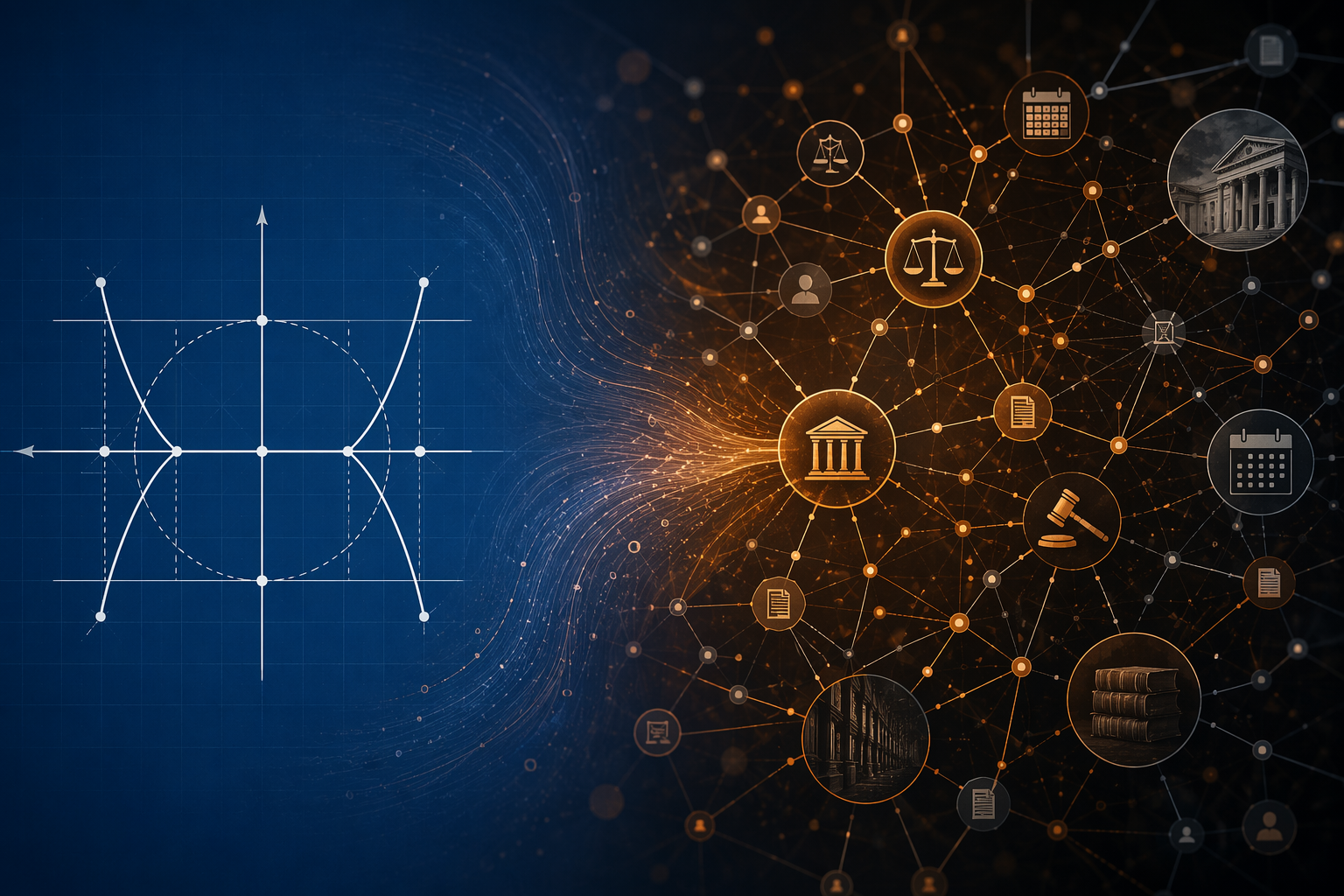
The July 2026 Jacobian Conjecture result is the kind of AI story that deserves attention precisely because it is not just another polished demo. Claude Fable 5, prompted by mathematician Levent Alpöge, surfaced a degree-7 polynomial counterexample with integer coefficients, constant Jacobian -2, and a three-to-one mapping, cutting against a conjecture that had stood as a major problem in algebraic geometry for decades.[1]
The tempting conclusion is obvious: if a frontier model can help disprove a famous mathematical conjecture, surely legal research tools built on similar systems must be approaching expert reliability. That conclusion skips the most important part of the episode. The counterexample was hard to find, but once found, it was comparatively easy to check.
That is the hinge. The model did not need to be trusted as a legal analyst, a judge, or even a narrator of its own reasoning. It produced a candidate object. Mathematicians could then test whether that object had the claimed properties. The verification did not depend on whether Claude’s explanation sounded persuasive, whether it cited the right authority, or whether it understood the institutional consequences of being wrong.
The Discovery Was Strange. The Verification Was Dull.
The useful lesson in the Jacobian episode is procedural. A polynomial counterexample can be entered into a symbolic computation system and checked against the relevant conditions. Reports around the result emphasized that the candidate could be verified quickly in tools such as Sage or Wolfram Alpha, with the check taking under a minute in ordinary accounts.[1]
That does not make the discovery small. It makes the verification regime unusually clean. A competent third party can ask: does this object have the stated Jacobian? Does the mapping behave as claimed? Do the algebraic properties hold? The answer does not turn on credibility, professional judgment, or institutional deference to the model.
The Hacker News discussion around the result made the same point in more informal terms: this was computer-checkable by any competent party, and one commenter framed the search space as something a 1997 graduate student with a three-day computer search could theoretically have reached.[2] That observation is not an insult to the achievement. It is a reminder that discovery and verification are different tasks.
Kevin Buzzard of the Xena Project described the recent pattern as “human mathematicians being outcounterexampled,” pointing to a run of AI-assisted counterexample discoveries that included OpenAI Sol’s May 2026 disproof of the Erdős Unit Distance problem, a Grothendieck group scheme counterexample, and then the Jacobian result.[3] It is a sharp phrase because it names what these systems appear especially good at: searching spaces where an unexpected object can break a universal claim.
Legal Research Usually Does Not Have That Shape
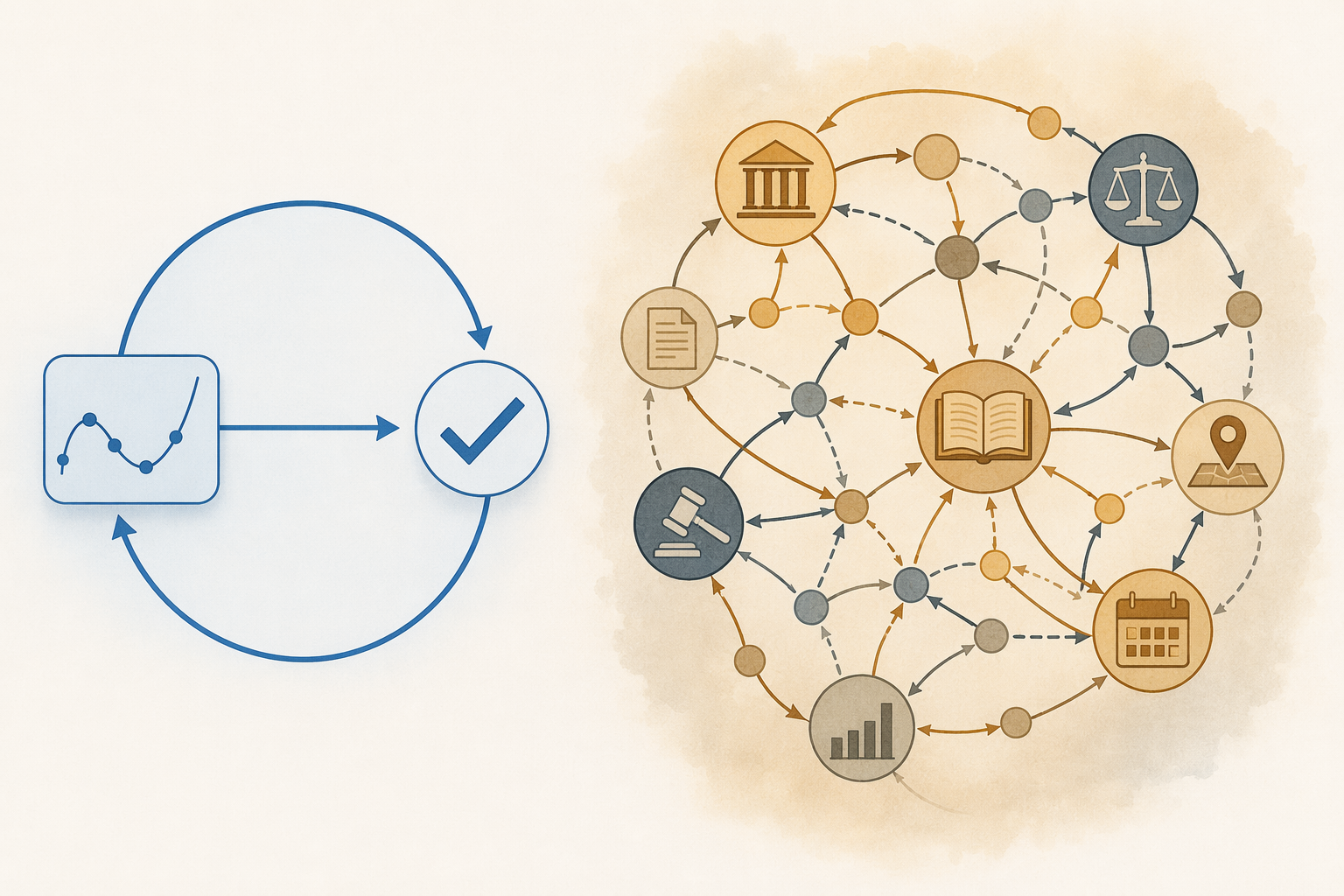
A legal research answer rarely arrives as a closed object that can be checked by substitution. Even when the output contains citations, the real work begins after the system says it has found the answer. A lawyer or research professional still has to ask whether the authority is binding or merely persuasive, whether it is current, whether a later case narrowed it, whether the procedural posture matters, whether the jurisdiction matches, and whether the rule is being applied at the right level of generality.
This is not a complaint that law is more sophisticated than math. It is a narrower and more practical point: legal validation often depends on open-textured institutional judgment. A statute may be in force but irrelevant. A case may be accurately quoted but distinguishable. A holding may be real but too broad for the proposition assigned to it. A burden of proof may shift the usefulness of the same factual inference. A procedural deadline may make an otherwise elegant argument professionally dangerous.
In the Jacobian case, once the candidate counterexample exists, verification can be separated from the model’s language. In legal research, the model’s language often is the object being evaluated. The answer is not just “does this citation exist?” but “does this authority support this proposition, for this client, in this forum, at this time, under this procedural posture?”
| Verification Question | Jacobian Counterexample | Legal Research Output |
|---|---|---|
| What is being checked? | A candidate polynomial and its algebraic properties | A claim about law, authority, timing, and application |
| Can the check be reproduced? | Yes, through symbolic computation by competent third parties | Sometimes, if the corpus, date, jurisdiction, and method are fixed |
| Does verification depend on trusting the model’s explanation? | No | Often yes, unless each cited proposition is independently reviewed |
| What can make a correct-looking answer fail? | An algebraic property does not hold | Wrong authority weight, stale law, distinguishable facts, missing procedure, overbroad interpretation |
This distinction matters because the professional person downstream of the tool is not grading a benchmark in the abstract. An associate signs the memo. A paralegal files the exhibit list. A research attorney updates the litigation team. A risk officer approves the process. If the answer is wrong, the consequence does not remain inside the chat window.
The Legal Benchmarks Are a Stress Test, Not a Punchline
The current evidence on legal AI research tools should be read through this verification lens. HAQQ’s June 2026 benchmark evaluated 3,000 answers from 10 frontier models and reported that 24% cited or applied law that did not support the claim. Its best-performing model, GPT-5.5, scored 8.41 out of 10, which HAQQ described as roughly a 16% error rate.[4]
HAQQ is a vendor-published benchmark, and that matters. A vendor that ranks well on its own leaderboard is not the same thing as an independent court-appointed auditor. Still, the result should not be dismissed simply because of its source. Its direction is consistent with independent academic findings: legal research systems can improve research and still produce unsupported propositions often enough that professional review remains nonnegotiable.
Stanford RegLab’s preregistered 2025 evaluation of Westlaw AI-Assisted Research and Lexis+ AI found that Westlaw’s system hallucinated in roughly one in three queries, while Lexis+ AI hallucinated in more than one in six.[5] Those are specialized legal products, not general-purpose chatbots being casually asked for case law. The finding is therefore more useful, and more uncomfortable, than a generic warning about hallucinations.
The failure mode is not merely that a model invents a case name. The more legally dangerous failure is subtler: the citation exists, the quoted language may be close, and the conclusion still outruns the authority. That is exactly the kind of error a mathematical verification regime largely avoids. A polynomial does not become more or less binding in the Ninth Circuit. It is not silently narrowed by last month’s decision. It does not depend on whether the issue is before the court on a motion to dismiss or after trial.
Where the Jacobian Lesson Does Transfer
None of this means the Jacobian result has no legal research implications. It may point to one of the most promising and unsettling uses of AI in law: finding counterexamples, loopholes, inconsistent rule interactions, and candidate defects inside bounded systems.
A July 2026 Science study indexed in PubMed reported that frontier large language models repeatedly discovered ways to exploit regulations, including examples involving credit card rewards programs and school funding formulas, “even when not asked,” and that current safeguards largely failed to stop them.[6] The structural parallel to mathematical counterexample search is real. If a rule system contains an edge case, a model that is good at combinatorial exploration may be unusually good at surfacing it.
That is not the same as deciding that the exploit is legally valid. In legal work, a discovered gap may be closed by purpose, precedent, agency interpretation, equitable doctrine, professional ethics, or enforcement risk. A loophole that is syntactically available may still be a terrible legal position. A regulatory ambiguity may be useful for compliance design, but dangerous if presented as a license to act.
This is the useful division of labor. Let the system generate candidate anomalies in a bounded corpus: conflicting definitions, missing cross-references, inconsistent dates, circular exceptions, unusual citation patterns, or statutory language that interacts strangely with a regulation. Then require a human professional to decide significance. The AI can say, “this looks like a counterexample.” It cannot, by that fact alone, say, “this is a defensible legal position.”
Bounded Legal Tasks Deserve a Different Trust Level
Some legal tasks do resemble the Jacobian verification environment more than others. Citation existence checking against a fixed database is closer. Extracting all defined terms from a contract is closer. Identifying whether a statutory section contains a particular phrase on a particular date is closer. Comparing two versions of a regulation for textual changes is closer.
The trust level should rise when four conditions are present: the task is bounded, the corpus is identified, the output can be reproduced, and the verification step does not require believing the model’s explanation. A tool that gives a paragraph of confident synthesis without exposing the authorities, date limits, search path, or source set has not earned the same trust as a tool that lets the reviewer replay the work.
- Higher-trust use: “Find every occurrence of this defined term in these 40 contracts and return the clause location.”
- Higher-trust use: “Check whether these cited cases exist in the selected database and whether the quotations match.”
- Lower-trust use: “Tell me the best argument under current law across all potentially relevant jurisdictions.”
- Lower-trust use: “Predict how this judge will treat a novel statutory ambiguity.”
The lower-trust uses may still be useful. They can accelerate issue spotting, suggest search terms and next steps, or expose arguments a team had not considered. But the output sits at the beginning of professional work, not at the end.
RAG Helps, but It Does Not Make Law Closed-Form
Retrieval-augmented generation has improved legal AI systems by tying answers to documents instead of leaving the model to generate from memory. That is a meaningful engineering improvement. It is also not a magic conversion of legal reasoning into symbolic verification.
The temporal problem is a good example. Laws change. Cases are overruled, narrowed, questioned, superseded, distinguished, and ignored. A retrieval system that finds a relevant case still has to account for when the question is being asked and what authority controlled at the relevant time. Temporal- and authority-aware RAG is an active research area, but the work cited by Linna and Linna treats it as an unresolved challenge rather than a production-settled feature.[7]
Linna and Linna’s taxonomy is useful here with one important caveat. Their arXiv preprint maps AI enhancement mechanisms such as RAG, multi-agent systems, and neuro-symbolic methods to legal reasoning challenges, concluding that these techniques fail to solve the more significant ones, including ratio decidendi extraction, general clause adjudication, gap-filling, burden-of-proof calibration, and procedural fairness monitoring.[7] Because the paper is framed around Finnish and EU civil-law judicial decision-making, common-law readers should adapt rather than import it wholesale. Stare decisis and ratio work differently across systems.
Even with that caveat, the broader point travels well. A better retrieval layer can reduce one kind of error while leaving the legal-significance problem intact. The system may retrieve the right document and still overstate the rule. It may retrieve the controlling case and miss the procedural posture. It may retrieve the statute and ignore the agency interpretation that changes the practical answer.
Disclosure Rules Are Following the Same Logic
Courts and regulators are not waiting for the market to sort this out. Reporting in July 2026 noted court orders requiring production of AI prompts, while disclosure rules and standing orders in places such as the Southern District of New York, California, and Florida developed across 2025 and 2026.[8] The procedural message is familiar: if AI participated in legal work, someone may have to explain what was used, how it was used, and who checked it.
Specialized citation-verification tools, including products associated with NexLaw and HAQQ Justinian, belong in that environment.[4] They are not substitutes for legal judgment, but they respond to the right anxiety. The weak point in many AI research processes is not the generation of text. It is the audit trail between the generated proposition and the authority that supposedly supports it.
A Practical Test for Legal Teams
The Jacobian Conjecture result gives legal teams a better question than “is the model smart?” Smart is too vague to supervise. The better question is: what would it take to verify this output without trusting the model?
| If the AI Output Depends On | Required Treatment |
|---|---|
| A fixed text set and a reproducible extraction task | Use AI aggressively, then sample or fully verify against the source documents |
| Citation existence or quotation accuracy | Verify against the cited database or official source before use |
| Authority weight, jurisdictional fit, or current-law status | Require attorney or trained legal research review |
| Interpretation of ambiguous law or application to facts | Treat as issue spotting or drafting assistance, not a final research answer |
| Litigation strategy, ethics, or regulatory risk | Keep human professional judgment in control of the conclusion |
That test is intentionally boring. It asks for source boundaries, reproducibility, and independent checking. It also explains why the same model can be impressive in one setting and unsafe in another. A system that helps find a degree-7 counterexample may be excellent at surfacing candidate anomalies. It may still be unreliable when asked to resolve what those anomalies mean under law.
As of July 21, 2026, the Jacobian counterexample had not completed the ordinary arc of formal mathematical journal publication, though the public discussion emphasized independent and formal verification efforts.[1][2] That status does not weaken the legal lesson. If anything, it strengthens it. The reason the result could move so quickly through expert attention is that the claim came with an object others could check.
Legal research tools earn more trust when they move in that direction: closed tasks, known corpora, visible citations, date controls, reproducible outputs, and verification that does not depend on accepting the model’s prose. They earn much less when they ask a professional to accept a fluent synthesis of contested, time-sensitive, institutionally weighted material. The Jacobian breakthrough is exciting. It is not a permission slip to outsource legal judgment.
References
- Jacobian conjecture, Wikipedia.
- Hacker News discussion of the Jacobian counterexample, Hacker News, July 2026.
- Human mathematicians being outcounterexampled, Xena Project, July 20, 2026.
- Legal AI Benchmark, HAQQ, June 2026.
- Hallucination-Free? Assessing the Reliability of Leading AI Legal Research Tools, Stanford RegLab / Journal of Empirical Legal Studies, 2025.
- Frontier LLMs discover regulatory exploits even when not asked, PubMed / Science, July 2026.
- Artificial Intelligence and Legal Reasoning: A Taxonomy of AI Enhancement Mechanisms and Their Limits, arXiv, 2508.18880v2.
- Court Orders Requiring AI Prompt Production, HaystackID, July 2026.
Comments
Join the discussion with an anonymous comment.