
The legal problem in the Jacobian counterexample attributed to Claude does not start with artificial intelligence deserving credit. It starts with a narrower and more troublesome fact: a claimed mathematical counterexample first appeared as a social-media disclosure, not as a journal article, patent application, corporate release, or signed preprint.
On July 19–20, 2026, mathematician Alpöge posted on X that Anthropic’s Fable model had produced a counterexample to the Jacobian conjecture, a problem described in the source materials as open since 1939. Public reporting and discussion identify the model as Claude Fable or Claude Fable 5, but Anthropic has not confirmed the exact version, and the original public account reportedly used only “Fable.” The explicit polynomial has been publicly checked by multiple mathematicians using computer algebra systems, according to the technical and news materials now circulating, but as of July 21, 2026 there is no formal peer-reviewed paper or arXiv preprint in the materials reviewed here.[1][2][3][4]
That combination matters. A checkable polynomial is not a press-release claim about future AI capability. It is an artifact other people can test. But the prompt transcript, session log, intermediate exchanges, and any internal Anthropic records have not been released. Those missing records are not trivia. They are the documents one would need to separate human mathematical direction from machine generation, and that separation is doing almost all of the legal work.
This is source-cited legal analysis for news and commentary purposes, not legal advice. The facts are still incomplete, and several of the legal questions below would be questions of first impression if litigated on these facts.
The artifact exists before the ownership record does
Mathematics has its own attribution customs, but law asks different questions. Who authored the expression? Who conceived the invention, if there is one? Who disclosed it first? Who employed the human operator? What contract governed the model and the output? A polished discovery narrative can skip those questions. A chain-of-title review cannot.
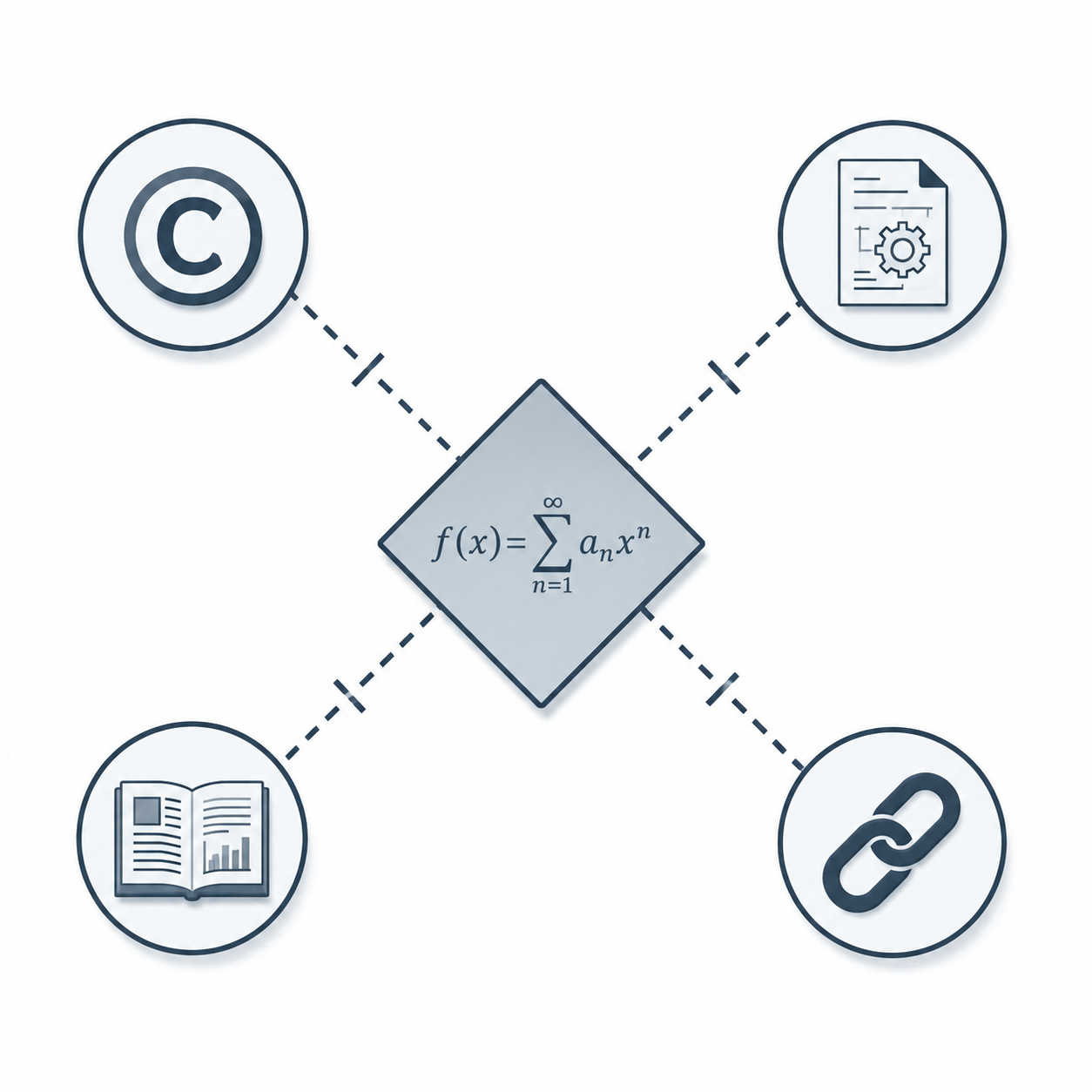
The Jacobian counterexample forces four bodies of law and practice to touch the same object at once:
| Issue | Why this counterexample strains it |
|---|---|
| Copyright authorship | If the polynomial and explanation are purely AI-generated, U.S. copyright protection is doubtful; if Alpöge selected, arranged, or steered the result creatively, the analysis may change. |
| Patent inventorship | An AI system cannot be named as an inventor under current U.S. law, but AI-assisted inventions are not automatically unpatentable if a natural person made a significant contribution. |
| Prior art | The disclosure appeared on X before a formal paper or patent filing, raising the practical question whether the post can block later patent claims even if nobody clearly owns the output. |
| Employee IP chain | Alpöge’s reported role as an Anthropic employee using Anthropic’s model makes employment agreements, model-use terms, and internal policies central, but those documents are not in the public record. |
The tempting move is to ask whether Claude “owns” the disproof. That is the wrong doorway. The more immediate question is what follows when the law recognizes neither the model as a legal author nor, on the present public record, a clearly documented human author or inventor for the operative contribution.
Copyright has a human-authorship gate, and the prompt record is missing
The U.S. Copyright Office’s AI materials, including its March 2023 policy statement and subsequent reports, maintain the familiar rule that copyright protects human authorship and does not protect material generated by AI without sufficient human creative contribution.[5] The Congressional Research Service has summarized the same unresolved legislative setting: generative AI has exposed difficult authorship questions, but the statutory framework has not been rewritten to make an AI system an author.[6]
For this counterexample, copyright is already a somewhat awkward fit. A mathematical fact, theorem, disproof, or polynomial as such is not protected merely because it is important. Copyright would attach, if at all, to protectable expression: a written explanation, diagrams, code-like presentation, or other original human-authored material. Even there, the Office’s human-authorship requirement matters.
If Fable generated the polynomial and explanatory text with no meaningful human control beyond a high-level request, the copyright answer is likely thin: the AI-generated expression would not receive U.S. copyright protection under the Copyright Office’s current approach. But that is not the only possible factual pattern. Alpöge may have framed the problem, constrained the search, rejected failed outputs, supplied mathematical lemmas, edited the final expression, or selected one candidate from many. Some of those acts may be mere use of a tool; some may begin to look like human creative control over protectable expression.
The public materials do not allow that line to be drawn. A final X post cannot show whether the human contribution was equivalent to commissioning an answer, collaborating through a sequence of mathematical choices, or independently recognizing and formulating the legally relevant expression. That is why the undisclosed prompt and session record are not just evidentiary decoration. They are the difference between “unprotectable AI output,” “human-authored expression using AI assistance,” and “a mixed work with only the human-authored portions protectable.”
This matters less because someone needs to stop others from reciting the polynomial and more because copyright ownership often becomes the first proxy for control when no better legal category is ready. Here, that proxy is weak. The mathematical discovery may be usable by everyone as a fact, while the surrounding explanatory expression may or may not have protectable human authorship depending on records that are not public.
Patent law separates AI inventorship from AI-assisted invention
Patent law supplies a cleaner negative rule and a messier affirmative one. Following Thaler v. Vidal and the USPTO’s 2024 Revised Inventorship Guidance for AI-assisted inventions, only natural persons can be inventors. AI cannot be listed as the inventor on a U.S. patent application. At the same time, the USPTO guidance does not bar patent protection merely because AI was used; an AI-assisted invention may still be patentable if a natural person made a significant contribution.[7]
Popular accounts tend to collapse those propositions into one sentence: AI cannot invent, so AI inventions cannot be patented. That is not the current U.S. posture. The harder question is whether a human being contributed enough to be an inventor of the claimed subject matter. The answer depends on claim scope and facts of conception, not on whether the machine’s role feels impressive.
The Jacobian counterexample is a poor candidate for easy patent analysis for another reason: it is a mathematical object. U.S. patent law does not grant patents on abstract mathematical truths just because they are newly found. A future applicant might instead try to claim a computational method, software technique, cryptographic application, verification workflow, or some downstream technical implementation informed by the disproof. At that point, the question would not be “Who owns the theorem?” but “Who conceived the claimed invention?”
On the present public facts, one cannot responsibly assign inventorship. If Alpöge merely asked Fable to find a counterexample and the system produced the decisive polynomial unaided, naming the AI is unavailable and naming the human may be vulnerable. If Alpöge contributed the specific approach, constraints, transformations, or verification path that led to the result, the analysis becomes different. If another Anthropic researcher or internal system architecture materially contributed, the record becomes more complicated still.
The law is therefore doing something more uncomfortable than refusing to reward AI. It is demanding a human conception story at the exact moment the public discovery story is most proud of machine autonomy. Without the session history, a patent lawyer cannot tell whether the human contribution was significant, administrative, or somewhere in between.
The disclosure may matter even if nobody owns it
Ownership uncertainty is not the end of the problem. It may be less disruptive than the disclosure itself. Once the counterexample was posted on X, the question shifted from “Who can claim this?” to “Has this already become public enough to prevent someone else from claiming related subject matter later?”
Under 35 U.S.C. § 102, prior art can bar later patent claims when the relevant information has been made available to the public in a legally sufficient way. The hard part here is not whether a tweet is modern communication. It plainly is. The hard part is whether an AI-generated mathematical disclosure, posted through a social-media account and reportedly subject to X’s seven-day deletion window, satisfies the public-accessibility and enabling-disclosure concepts that patent law uses for printed publications and other disclosures.
Sterne Kessler’s November 2024 analysis of AI-generated prior art identifies the pressure points: AI systems can produce large volumes of technical disclosures, and patent law must confront whether those disclosures are publicly accessible, whether they can anticipate claims, and how examination should treat them.[8] That analysis is useful because it frames the question. It does not answer this case.
A future patent applicant might argue that an X post containing or linking to the operative polynomial was publicly accessible, indexed or disseminated enough through public discussion, and enabling because mathematicians could and did verify the algebra using computer algebra systems. A contrary argument would press on ephemerality, context, completeness, authentication, and whether the disclosure taught the later-claimed invention with enough specificity. If the post was deleted within a platform window, archived by third parties, screenshotted, quoted, or reproduced elsewhere, the evidentiary record would matter.
This is the most operationally dangerous gap. A disclosure can damage patentability even when no one has secured ownership. The future filer may not care whether Claude, Alpöge, Anthropic, or no one owns the counterexample if an examiner or challenger can use the public record to defeat novelty or obviousness. The object can be ownerless and still legally consequential.
Employment ownership cannot be inferred from the model name
The employee-IP question is tempting to overstate because it has a familiar corporate shape: an Anthropic employee used an Anthropic model and posted a discovery. But the public materials do not include the relevant employment agreement, invention-assignment language, confidentiality rules, model-use terms, publication policy, or internal approval history. Without those documents, “Anthropic owns it” is a guess, not a conclusion.
Several different chains are plausible in the abstract. If the work was within the scope of employment or used company resources under an assignment agreement broad enough to capture resulting inventions or works of authorship, Anthropic may have a contractual claim to whatever human-owned rights exist. If Alpöge acted personally, outside assigned duties, and produced protectable human expression or patentable contribution, he may have a personal claim subject to whatever agreements he signed. If the operative output is not copyrightable and no patentable human invention exists, there may be no exclusive IP right for either of them to own.
Model-provider ownership is also not automatic. A company’s ownership of model weights, infrastructure, and service terms does not by itself answer who owns every output in every legal category. Contract can allocate rights between provider and user, but the public record here does not supply the contract terms that would be needed to apply that allocation. Nor does contract convert noncopyrightable material into copyrightable authorship or make an AI a patent inventor.
For in-house counsel, the uncomfortable lesson is procedural rather than philosophical. The missing documents are the documents. If the discovery is valuable, counsel would want the prompt logs, user account records, employment scope analysis, assignment agreements, publication approvals, internal communications, and verification timeline before making any assertion about ownership or filing strategy.
Academic attribution has no clean slot either
The journal problem is different but related. The research brief notes that no major mathematics journal allows AI as a co-author, while the discovery narrative credits AI. That leaves editors with a practical mismatch: a paper cannot honestly pretend the model was irrelevant if the model generated the decisive candidate, but conventional authorship rules are built around accountable human contributors.
A journal can require disclosure of AI use, human verification, code or computer-algebra files, and a statement of responsibility from human authors. It can refuse to list Fable as a co-author. What it cannot do, at least without distorting the provenance record, is make the AI disappear from the account of how the counterexample was found. That gap is not the same as copyright or patent ownership, but it will shape the evidentiary record those regimes later inspect.
What can be said as of July 21, 2026
A few conclusions are safe only if kept narrow. First, the public record describes a concrete polynomial counterexample that multiple mathematicians have reportedly verified with computer algebra systems; it does not yet contain the full prompt transcript, model session log, peer-reviewed publication, or arXiv preprint.[1][2][3][4] Second, current U.S. copyright practice requires human authorship, making purely AI-generated expression difficult or impossible to protect, while leaving room for fact-specific arguments about human selection, arrangement, and control.[5][6] Third, current U.S. patent practice does not allow an AI to be an inventor, but it does allow AI-assisted inventions where a natural person made a significant contribution.[7]
The remaining conclusions are intentionally unresolved. The X disclosure may become important prior art, but its exact status under patent doctrine would depend on public accessibility, content, enablement, persistence, and proof. The employment chain may point to Alpöge, Anthropic, both in different respects, or no exclusive owner at all, but the contracts and policies needed to decide that are not public. The academic record may eventually normalize the discovery through a human-authored paper, but that will not retroactively supply a clean invention or authorship story if the operative act occurred in an undocumented AI session.
That is the ownership vacuum. The counterexample may be mathematically usable and publicly discussed. U.S. law does not yet definitively say who owns it, whether anyone can exclude others from using it, whether the X disclosure bars later patent claims, or whether any relevant human contribution belongs personally to Alpöge, contractually to Anthropic, or legally to no one.
References
- Jacobian Conjecture Disproved? Claude Fable Evidence — Kingy.ai
- Hacker News discussion — Hacker News
- A Mathematician Used Claude Fable to Disprove the 87-Year-Old Jacobian Conjecture — Glitchwire
- Fable 5 Jacobian Conjecture Claim — July 2026 — explainx.ai
- Copyright and Artificial Intelligence — U.S. Copyright Office
- Generative Artificial Intelligence and Copyright Law — Congressional Research Service
- USPTO Issues Revised Inventorship Guidance for AI-Assisted Inventions — BHFS
- Top 5 Potential Implications of AI-Generated Prior Art on Patent Law — Sterne Kessler, November 2024
Comments
Join the discussion with an anonymous comment.