
The latest turn in Janel Grant’s lawsuit against WWE and Vince McMahon is not a ruling. It is a joint request. On June 11, 2026, after more than two years of resisting McMahon’s effort to send her claims out of federal court, Grant joined McMahon and WWE in asking Judge Sarah F. Russell to allow the dispute to proceed in private arbitration. The next day, the court canceled a hearing that had been set for June 16. [1][2]
That procedural reversal is easy to overread. It does not mean the court held the NDA valid. It does not mean Grant withdrew the factual account she had placed before the court. It does not even tell us, on its face, why Grant changed course. The joint motion is significant precisely because it arrives after a long fight over whether a court could compel arbitration when the arbitration clause sits inside the very agreement Grant says was procured through duress, coercion, and concealment.
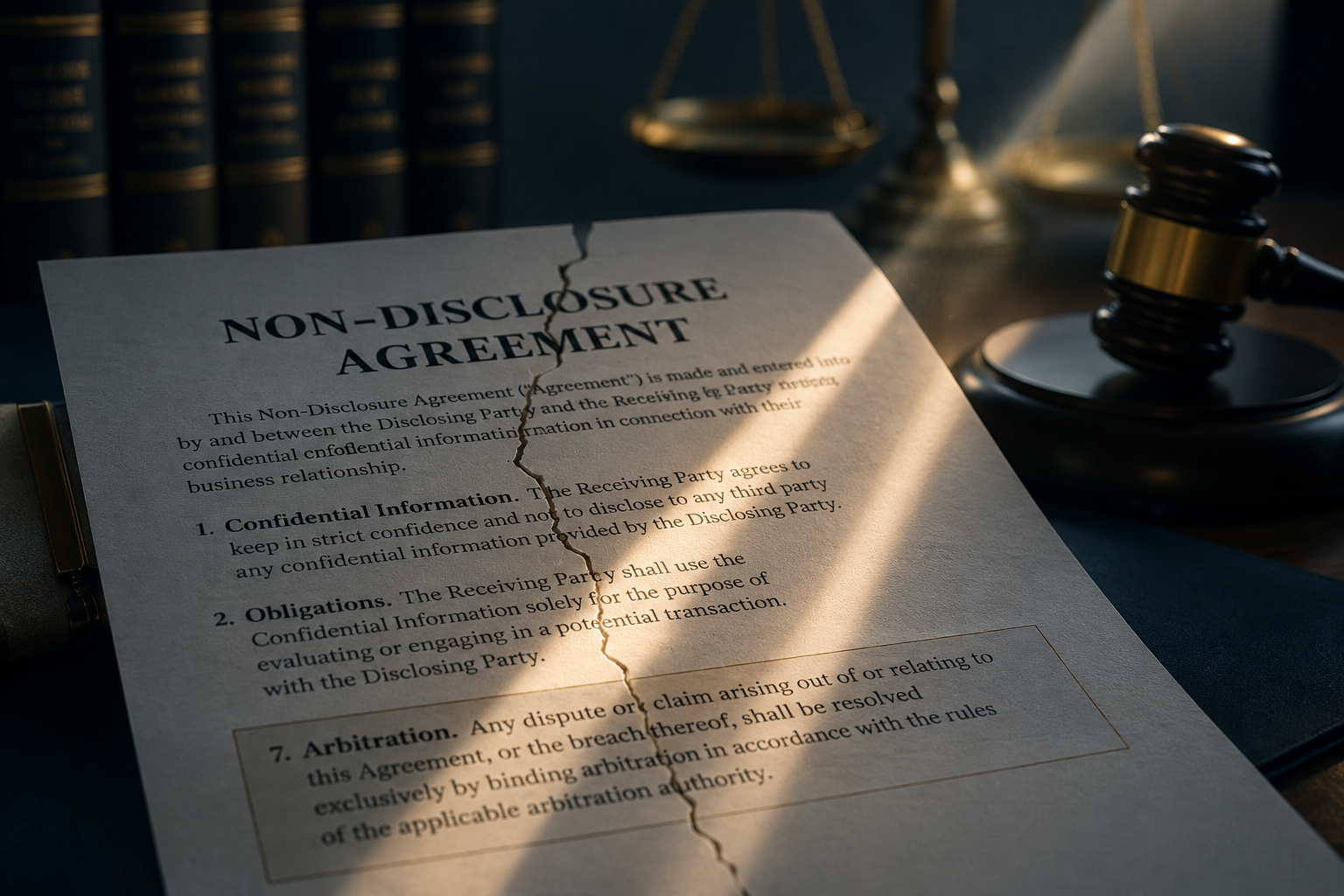
For lawyers who draft or litigate employment NDAs, that is the pressure point. Arbitration language is often treated as a durable enforcement asset. In this case, the fight became more basic: before a private forum can hear the dispute, what record does a federal court need when the plaintiff attacks the validity of the contract containing the arbitration promise?
The June 2026 pivot did not erase the earlier arbitration fight
The June 11 joint motion asked the court to allow the parties to arbitrate and to stay the federal action while arbitration proceeded. Post Wrestling reported that the filing followed Grant’s earlier opposition to arbitration and came after a period in which the court had been preparing to address the enforceability dispute. [1]
Judge Russell’s June 12 order canceling the scheduled hearing changed the immediate litigation posture, but not the analytical lesson of the docket. The court had already treated the motion to compel arbitration as a fact-sensitive dispute, not as an automatic consequence of finding an arbitration clause in the NDA. [2]
That distinction matters because the Federal Arbitration Act strongly favors enforcement of arbitration agreements. It also matters because arbitration doctrine commonly separates a challenge to an arbitration clause from a challenge to the broader contract. In ordinary cases, a party cannot avoid arbitration merely by saying the overall contract is disputed. But Grant’s argument was not an ordinary pricing dispute, nonperformance dispute, or after-the-fact regret claim. Her position was that the NDA itself, including the arbitration clause, arose from circumstances that made assent invalid.
The June motion therefore should be read as a strategic event, not as a retroactive merits ruling. It tells us the parties jointly chose a private forum at that point in the litigation. It does not tell us that the court resolved the duress challenge, rejected Grant’s declaration, or adopted McMahon’s view of contract formation.
Judge Russell treated arbitrability as a record problem
The most important order in the public arbitration record remains Judge Russell’s February 6, 2026 ruling denying Grant’s request for discovery in connection with the motion to compel arbitration. The order applied the summary-judgment-like framework drawn from Ligeri v. Amazon, a District of Connecticut decision addressing how courts evaluate disputed facts bearing on arbitration. [3]
Under that approach, the court does not simply accept the moving party’s invocation of the FAA and stop there. Nor does it automatically allow full merits discovery whenever a plaintiff contests arbitration. The court asks whether the materials before it reveal a genuine dispute of material fact about the existence or enforceability of the arbitration agreement. If the nonmovant identifies such a dispute with competent evidence, the court may need a trial or further proceedings on arbitrability before compelling arbitration.
That framing is why the February order is more revealing than the headline “discovery denied” might suggest. Grant sought discovery before the court ruled on McMahon’s motion to compel arbitration. Judge Russell denied that request, but did so while recognizing that Grant could renew her position if she identified the kind of factual conflict the governing standard required. [3]
For an employment lawyer, the order is a reminder that the presence of arbitration language does not end the court’s work when formation or validity is genuinely in dispute. For a litigator, the same order shows the constraint: a party challenging arbitration must build a record targeted to arbitrability, not merely repeat the underlying allegations in a different procedural key.
| Procedural question | Why it mattered in Grant |
|---|---|
| Is there an arbitration clause? | The NDA contained arbitration language, so McMahon and WWE had a textual basis to seek a private forum. |
| Is the challenge aimed only at the overall contract, or also at assent to the arbitration agreement? | Grant attacked the circumstances under which the NDA was allegedly procured, creating a formation and validity fight that could bear on the arbitration clause itself. |
| Has the nonmovant shown a genuine factual dispute? | Judge Russell used a summary-judgment-like standard rather than treating the clause as self-enforcing. |
| Is discovery necessary before deciding arbitrability? | The court denied discovery in February 2026, while leaving the procedural door open for renewed arguments tied to the required factual showing. |
Grant’s April declaration gave the NDA challenge its factual weight
Grant’s April 3, 2026 sworn declaration is the filing that prevents the arbitration dispute from being reduced to a sterile clause-versus-complaint exercise. The declaration ran 40 pages and set out the facts Grant relied on to argue that the NDA was not an ordinary negotiated bargain. It was accompanied by an expert declaration from Dr. Raghavan addressing coercion dynamics. [4]
The point is not that a declaration proves the allegations. It does not. A declaration is evidence offered by a party, subject to challenge, context, and credibility determinations. But at the arbitrability stage, the question is often narrower than ultimate truth. The question is whether the party resisting arbitration has put forward facts that, if credited and legally sufficient, create a genuine dispute about whether there was valid assent to the agreement that contains the arbitration clause.
That is why the scale and character of the April filing matter. A 40-page sworn account is different from a conclusory sentence saying “I was coerced.” The expert material also matters because Grant was not merely asking the court to infer pressure from unequal bargaining power. She was attempting to frame the NDA’s execution through a coercion lens, so that the arbitration clause would not be treated as severable boilerplate insulated from the circumstances of signature. [4]
McMahon and WWE, of course, did not have to accept that framing. The pro-arbitration structure of federal law gave them a powerful argument that disputes should be sent to the forum named in the parties’ written agreement. But once Grant attacked the NDA’s validity through sworn factual material, the case moved into the procedural zone Judge Russell’s February order had already identified: the court had to decide whether the arbitration issue could be resolved on the existing record or required further factual development.

How the docket arrived there
The public docket began in 2024, with Grant filing her civil action in the District of Connecticut. The docket then developed along overlapping tracks: civil claims, arbitration briefing, amended pleading practice, and outside proceedings involving McMahon and WWE-related disclosures. [2]
The amended complaint later incorporated developments from the SEC enforcement matter. In January 2025, the SEC announced that McMahon had agreed to pay a $400,000 civil penalty and reimburse WWE $1.33 million after findings that he failed to disclose two settlement agreements totaling $10.5 million. Reuters reported that the nondisclosure caused WWE to overstate 2018 net income by about 8% and 2021 net income by about 1.7%. [5]
Those SEC findings are not findings that Grant’s civil claims are true. They are not criminal charges. They are relevant in a more limited way: they show that the NDA-validity attack was being argued against a public regulatory backdrop involving settlement concealment and corporate disclosure obligations, rather than in isolation from any institutional record.
A separate public development came from the Second Circuit’s crime-fraud ruling. The court found probable cause that McMahon’s communications with attorneys about settlement agreements furthered a scheme to conceal information from WWE and its auditors, permitting use of the crime-fraud exception in that context. [6]
Again, the careful lawyer’s caveat is essential. A crime-fraud exception ruling is not a conviction, and no criminal charges have been publicly filed against McMahon. Its significance for the arbitration fight is narrower: it helped explain why Grant’s side could argue that the NDA’s formation and purpose deserved factual scrutiny rather than routine enforcement.
By early 2026, then, the court had before it a motion to compel arbitration, a plaintiff attacking the NDA’s validity, and a public record that included regulatory and appellate developments concerning settlement concealment. Judge Russell’s February order supplied the procedural lens. Grant’s April declaration then supplied the detailed factual proffer. The June joint motion changed the immediate path, but it did not make that sequence irrelevant.
The Speak Out Act adds pressure, but not a clean answer
Sexual misconduct NDA cases now sit in the shadow of the Speak Out Act, signed in December 2022, which limits enforcement of certain predispute nondisclosure and nondisparagement clauses involving sexual assault and sexual harassment disputes. [7]
That statute is important to the practical posture of disputes like Grant’s. It reflects congressional skepticism toward using confidentiality promises to suppress sexual assault and harassment allegations before a dispute has arisen. But the statute does not, at least on the materials available here, supply a circuit-level rule that cleanly resolves every interaction between sexual misconduct NDAs and the FAA.
That is the danger of treating this case as if one public-policy statute automatically answers the arbitration question. The better reading is narrower. The Speak Out Act gives parties resisting enforcement of sexual misconduct-related NDAs another statutory pressure point. The FAA still supplies a strong federal policy favoring arbitration. When the arbitration clause is embedded in the disputed NDA, the court still has to work through contract formation, validity, separability, and the factual record.
Why Grant might have agreed to arbitrate
The joint motion does not explain Grant’s change in position. That omission should discipline the analysis. The public record supports plausible inferences, not certainty.
One possible driver is discovery. Judge Russell’s February order denied arbitration-related discovery at that stage, while applying a standard that required a targeted factual showing. If Grant’s team concluded that the court was unlikely to allow the discovery they wanted before ruling on arbitrability, the practical value of continuing to resist arbitration may have changed. [3]
Another possible driver is John Laurinaitis. Public reporting and docket activity indicated a cooperation development involving Laurinaitis, but the specific terms of any cooperation agreement are confidential. That means the public record can support the observation that cooperation may have altered litigation terrain; it cannot support a confident account of what testimony, documents, or strategy the cooperation produced.
A third possible driver is the status of parallel government activity. The DOJ investigation and the Second Circuit crime-fraud ruling gave the case a broader enforcement backdrop, but no criminal charges have been publicly filed. A party’s appetite for public litigation, private arbitration, stays, timing, and sequencing can change when parallel proceedings are moving or unresolved. The record permits that general inference. It does not reveal privileged client strategy. [6]
The result is a procedural shift that is meaningful because of when it happened. Grant did not agree to arbitration at the outset. She did so after an arbitration discovery ruling, after submitting a detailed sworn declaration, after SEC and appellate developments had entered the public record, and after the parties had litigated the enforceability issue for a substantial period.
The July status reports show the case was still active
The docket did not go dormant after the June pivot. CourtListener metadata reflects a July 10, 2026 status report and a July 20, 2026 joint status report. The July 20 filing appears as document 152, but its contents are not publicly available through the docket metadata. [2]
That is a modest but useful freshness signal. As of July 21, 2026, the public docket indicates continuing activity, ongoing negotiations, and possible August hearing activity. It does not provide the substance of the July 20 report, so any account of what the parties told the court in that document would be speculation. [2]
The lesson for NDA arbitration clauses
The Grant case has not produced a final ruling that the NDA is invalid. It has not produced a final ruling that the arbitration clause is unenforceable. And the June 2026 joint motion means the court may never issue the kind of public arbitrability opinion lawyers were watching for.
Even so, the case is already useful. Judge Russell’s February order shows that, at least under the Ligeri-style approach used in this District of Connecticut proceeding, a motion to compel arbitration can be tested through a summary-judgment-like lens when the facts bearing on contract validity are genuinely disputed. Grant’s April declaration shows what a party resisting arbitration may try to do with that opening: build a sworn factual record aimed not merely at the merits, but at the circumstances of assent to the NDA itself. [3][4]
That is a narrower lesson than either side of the public debate may want. The FAA remains powerful. Arbitration clauses remain enforceable in many employment and settlement contexts. But where the arbitration promise is housed inside an NDA alleged to have been procured by duress, coercion, or concealment, the path to arbitration may require more than pointing to the clause. It may require a record showing what can be proved, when, and by whom.
References
- Janel Grant agrees to enter private arbitration with Vince McMahon, WWE — POST Wrestling, June 11, 2026
- Grant v. World Wrestling Entertainment, Inc., No. 3:24-cv-00090 — CourtListener
- Judge denies Janel Grant’s request for discovery in arbitration dispute — POST Wrestling, February 6, 2026
- Janel Grant sworn declaration — PWTorch, April 3, 2026
- SEC charges Vince McMahon with failing to disclose settlement agreements — Reuters, January 10, 2025
- Appeals court says McMahon settlement communications fall under crime-fraud exception — AP News
- Speak Out Act — Congress.gov, December 2022
Comments
Join the discussion with an anonymous comment.