
The hard question in the Jason Alexander story is not whether the conduct described by Courtney Stodden was acceptable. It is why the phrase “inappropriate behavior with a minor” did not translate into a California criminal case.
The public fact pattern is compact but legally awkward. In 2012, Alexander was 52 and Stodden was 17 when they appeared in a Funny or Die sketch; Stodden was then legally married to 51-year-old actor Doug Hutchison. Alexander was credited as a writer and performer. Stodden later said Alexander touched her breasts and made inappropriate jokes, and on July 21, 2026, Alexander publicly apologized, acknowledging that the conduct was “inappropriate” while not admitting a crime.[1][2][3]
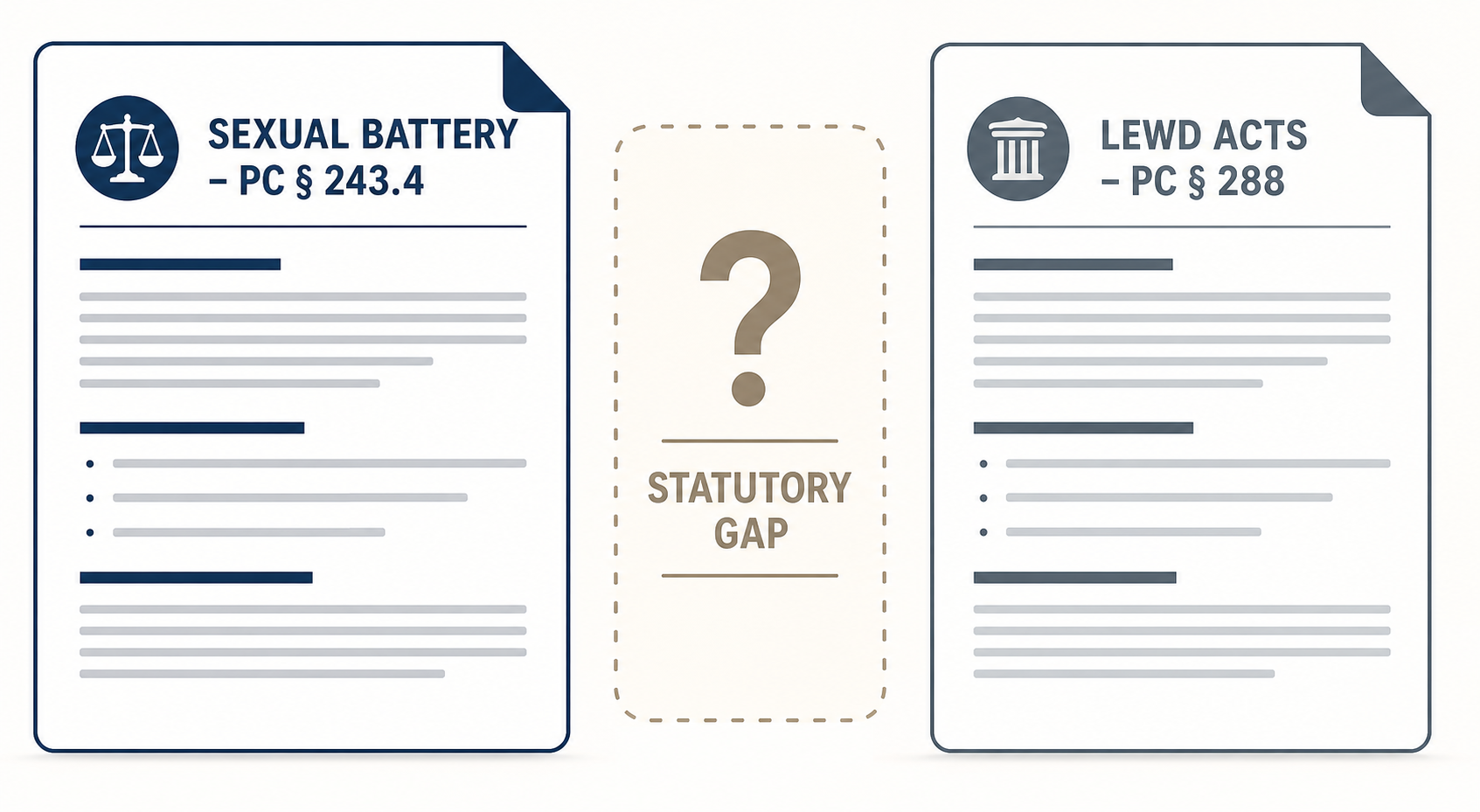
That distinction matters. “Inappropriate” is a moral word, a reputational word, and sometimes a workplace word. It is not, by itself, a Penal Code element. California prosecutors would have needed a charge that fit the age, the touching, the setting, the available proof of intent, and the filing deadline. On the public record, the two statutes that most naturally come to mind do not line up cleanly.

The first problem is sexual battery
California Penal Code § 243.4 is the obvious place to start because Stodden’s allegation concerns intimate touching. But sexual battery is not charged merely because contact involved a breast or because the person touched was under 18. The statute requires proof that the touching was against the victim’s will and done for sexual arousal, sexual gratification, or sexual abuse.[4]
Those requirements create the first gap. A comedy sketch is not a legal waiver for off-script sexual contact. Still, a public performance setting can complicate proof. Prosecutors would need to separate what was scripted from what was improvised, what Stodden understood would happen on camera, whether she objected or was overborne, and whether Alexander’s purpose was sexual rather than comic, humiliating, or performative. The latter categories are not admirable. They are just not identical to the intent language in § 243.4.
The “against the will” element is also more demanding than public commentary often assumes. A 17-year-old can be pressured, exploited, or placed in an adult-controlled environment that makes objection difficult. But a criminal case still has to prove the statutory absence of consent, not merely the broader unfairness of the situation. That proof may exist in some cases. Here, no public complaint, charging record, discovery record, or trial record has tested it.
| Potential theory | What prosecutors would need | Why the public facts are difficult |
|---|---|---|
| Sexual battery under PC § 243.4 | Touching against the victim’s will and for sexual arousal, gratification, or abuse | The public sketch context raises unresolved questions about consent, script, improvisation, and intent.[4] |
| Lewd act under PC § 288 | A lewd or lascivious act on a child within the statute’s age and limitations framework | Stodden was 17, not under 14, so the most severe limitations rules do not apply in the same way.[4][5] |
The lewd-act statute is harsher, but age changes the analysis
California Penal Code § 288 is the statute people often have in mind when they hear “adult,” “minor,” and “sexual touching.” It covers lewd or lascivious acts involving children, and in the most serious child-victim scenarios it carries far more severe consequences than a simple unwanted-touching theory. But the statute is not a general “any sexualized misconduct with anyone under 18” provision.
The age line matters. The no-limitations framework for the most serious child molestation offenses applies to victims who were under 14 at the time of the offense. Stodden was 17. That does not make the alleged conduct acceptable, and it does not make a teenager indistinguishable from an adult in any practical sense. It does mean that the case would fall outside the cleanest version of the § 288 charging pathway described in California limitations summaries.[4][5]
There is another statutory-fit problem. Lewd-act liability would still require the government to prove the act was committed with the required lewd intent. Touching that is ugly, exploitative, and sexualized in the ordinary sense may still generate litigation over whether the specific criminal intent can be proved beyond a reasonable doubt. Alexander’s apology helps establish that he now characterizes the conduct as inappropriate. It does not, standing alone, establish every element of a lewd-act offense.
Marriage and emancipation explain the normalization, not a defense
Stodden’s marriage to Hutchison is legally and socially important for a different reason. They married when Stodden was 16, and contemporaneous coverage treated the marriage itself as part of the spectacle surrounding the couple’s public appearances.[6] A legally married teenager can appear administratively adult to gatekeepers: able to appear with a spouse, participate in publicity, and be framed by media as part of an adult entertainment story.
That framing can distort judgment on a set. It may help explain how adult professionals treated Stodden as someone available for sexualized jokes and physical bits. It would not give Alexander a legal defense if the elements of a crime were otherwise satisfied. Emancipation by marriage is not a permission slip for another adult to commit sexual battery or a lewd act.
The broader child-marriage context makes the point without deciding this case. Unchained At Last has documented approximately 315,000 U.S. child marriages involving ages 10 to 17 between 2000 and 2021, and McGill University reported in 2022 that child marriages violated statutory rape laws in 14 states.[7][8] Those figures do not prove anything about Alexander’s intent. They show why legal adulthood markers can coexist with adolescent vulnerability.
The timing problem may be decisive
Even if a prosecutor could identify a viable offense, timing would be a separate obstacle. The sketch occurred in 2012. The apology arrived in July 2026. By then, the public record was dealing with a 14-year-old incident, not a fresh report.
California’s limitations rules are unusually offense-specific. For certain child sexual abuse offenses, summaries describe extended filing periods, including frameworks that can run until the victim’s 40th birthday, but those rules depend on the offense, the victim’s age, and notice or reporting requirements.[5] The no-limitations rule discussed for the most serious child molestation offenses is tied to victims under 14, which again does not match Stodden’s age at the time.[4]
That leaves a narrow and fact-dependent question rather than a headline answer. A limitations analysis would require identifying the exact charge, the applicable version of California law, any delayed-reporting provisions, and whether the known facts satisfy the statutory preconditions. Nothing in Alexander’s 2026 apology resets the clock. A public apology can create new attention, but it does not revive an expired criminal limitations period.
Civil remedies are a separate question
The absence of criminal charges does not answer whether civil claims were or are available. California eliminated the civil statute of limitations for childhood sexual assault in 2024, but that change is not retroactive under the limitations summary provided in the research materials.[5] For an alleged 2012 incident, civil viability would likely turn on the pre-2024 rules, including the age-40 framework for certain claims and any statutory conditions attached to it.[5]
Civil litigation also uses different burdens and remedies. A civil plaintiff need not prove guilt beyond a reasonable doubt, and a civil claim can focus on damages, institutional conduct, or responsibility beyond a single actor. But the nonretroactivity issue matters. The 2024 change cannot simply be dropped onto a 2012 fact pattern as though the filing window had always been open.
What the apology does and does not do
Alexander’s apology is newsworthy because it confirms that the conduct was not merely invented by later commentary. It also has limits. The words reported publicly acknowledge inappropriate behavior; they do not admit that the touching was against Stodden’s will, that it was committed for sexual arousal or gratification, that it satisfied § 288’s lewd-intent requirement, or that any limitations period remained open.[1][2][3]
That is the uncomfortable center of the legal analysis. A reader can be right that a 52-year-old man touching a 17-year-old’s breasts in a comedy sketch was wrong, and still be wrong that the criminal-law outcome was obvious. California law asks narrower questions than public outrage asks. Who touched whom is only the start. The statute then asks why, under what circumstances, against whose will, at what age, under which limitations rule, and with what proof still available years later.
No public charging memo explains why prosecutors did not proceed, and this analysis should not be mistaken for legal advice or for a finding that no crime occurred. The safer conclusion is narrower: on the known public facts, the case lands in a charging gap between sexual battery and lewd-act theories, with limitations rules likely doing additional work. The absence of charges does not make the conduct acceptable. The apology does not make it newly chargeable.
References
- Jason Alexander Apologizes to Courtney Stodden, TMZ, July 21, 2026.
- Courtney Stodden slams Jason Alexander for inappropriate behaviour when she was a minor, News.com.au.
- Jason Alexander Apologizes to Courtney Stodden Over Controversial Comedy Sketch, The Daily Beast.
- Statute of Limitations on Child Molestation, Shouse Law Group.
- Time Limits to File Lawsuits, Taylor & Ring.
- Teen Bride Courtney Stodden and Doug Hutchison on Funny or Die: Were They Offended?, E! News.
- Child Marriage in the U.S., Unchained At Last.
- Child marriages violating statutory rape laws in many US states, McGill University, 2022.
Comments
Join the discussion with an anonymous comment.