
Solomon's reported task-force role begins with a fairly dry classification question: if a person is brought into federal service as an unpaid Special Government Employee, what limits actually travel with that title? Solomon was reportedly appointed in June 2026 as an unpaid SGE to help lead declassification work for a White House election task force while remaining CEO and editor-in-chief of Just the News.[1][2] The word “unpaid” answers a payroll question. It does not answer the ethics question.
The SGE category exists because government sometimes needs outside expertise for short assignments. It is not supposed to operate as a low-friction doorway through which a private actor can keep a public-facing business role, receive governmental authority, review sensitive records, and then return to a platform that may benefit from the experience. That does not make Solomon's appointment unlawful on the present public record. It does make the missing paperwork unusually important.

What is publicly known, and what is not
Under 18 U.S.C. § 202(a), an SGE is an officer or employee retained, designated, appointed, or employed to perform temporary duties, with or without compensation, for not more than 130 days during any period of 365 consecutive days.[1] DOJ's ethics summary likewise treats SGEs as government employees for important ethics purposes, though subject to modified rules in some areas because of their short-term status.[3]
NBC reported that Solomon was named to an unpaid SGE role connected to a White House task force reviewing election-related intelligence documents for possible declassification.[2] The publicly available account does not supply the appointment instrument, the scope-of-work language, the anticipated number of service days, the supervising official, any recusal terms, or any conflict waiver. Those are not clerical details. They are the documents that determine whether this arrangement is a bounded SGE assignment or a loosely governed hybrid role.
| Question | Why it matters |
|---|---|
| Who appointed Solomon and under what authority? | The appointing authority determines supervision, ethics review, and responsibility for any waiver. |
| How many days of service were expected or tracked? | The SGE definition turns on service of not more than 130 days in a 365-day period. |
| What work was assigned? | A narrow declassification-review role creates different risks than broader task-force strategy, messaging, or investigative work. |
| Was a § 208 waiver issued? | A waiver would show how the government weighed Solomon's private interests against the need for his services. |
| What recusal or use restrictions applied? | These terms would determine whether private editorial, litigation, or advocacy interests were separated from government work. |
The public record is therefore strong enough to identify legal stress points, but not strong enough to render a clean compliance verdict. That distinction matters. Ethics analysis becomes less useful when it treats every unanswered question as proof of misconduct. It also becomes less useful when officials invoke the incompleteness of the record as if that ends the inquiry.
The 130-day cap is administrable only if the mission is administrable
The 130-day limit is the most concrete feature of the SGE framework. It is also the feature most likely to be strained by an open-ended intelligence-document review. The statute does not say that an SGE may serve indefinitely so long as the project remains politically salient or administratively unfinished. It ties the status to temporary duties of not more than 130 days during a 365-day period.[1]

That does not mean Solomon has exceeded the cap. The reported appointment was in June 2026, and the current public materials do not establish his actual service days. The better point is more operational: an appointment tied to a mission with no public end date should have a day-counting mechanism before the work starts, not after the controversy matures.
The declassification context makes the day-count problem harder. A document-review assignment can begin as technical assistance, expand into interagency coordination, become public messaging support, and then require follow-up after release decisions. If all of that is treated as the same short-term SGE assignment, ethics counsel need to know who is counting days, which activities count as service, and what happens when the work requires continuity beyond the statutory expectation.
This is where “temporary” can become more of a label than a control. A fixed cap works only if the government identifies the work package, the supervising office, and the exit point. Otherwise, a supposedly temporary appointment can acquire the practical qualities of an advisory office without the governance structure that normally accompanies one.
Section 208 is the waiver problem, not just the conflict problem
The main financial-conflict statute is 18 U.S.C. § 208. In broad terms, it bars a government employee from participating personally and substantially in a particular matter in which the employee, certain close affiliates, or covered organizations have a financial interest.[4] DOJ's SGE guidance makes clear that SGEs remain subject to conflict-of-interest rules, even though some ethics restrictions apply differently because of their temporary status.[3]
For Solomon, the issue is not merely that he has a private job. SGEs often do. The issue is that the private job is CEO and editor-in-chief of a news outlet that covers the same political and governmental ecosystem implicated by the task-force assignment. Editorial control is not a passive asset. It is an operating role with consequences for audience attention, institutional reputation, source relationships, and business value.
Section 208 contains an SGE-specific waiver path. Under § 208(b)(3), the appointing official may waive the restriction for an SGE serving on an advisory committee or similar body if the official certifies in writing that the need for the individual's services outweighs the potential for a conflict of interest created by the financial interest involved.[4] Public Citizen has criticized this waiver structure, in the context of other high-profile SGEs, as a weak control because it depends heavily on agency judgment and public documentation may be limited.[5]
That criticism should be treated as pressure testing, not as legal authority. The statute permits waivers. But a waiver in this setting would need to do real work. It would need to identify the relevant financial interest, explain why Solomon's services were necessary despite it, and define the matters from which he was excluded. A generic statement that he was unpaid or temporary would not answer the statutory question.
The harder question is what counts as the financial-interest conflict. If a government declassification project produces information that a news outlet can cover, package, promote, or use to enhance credibility with a politically aligned audience, the financial interest may not look like a classic contract, grant, or enforcement matter. It may look like editorial advantage. Federal ethics law is more comfortable with direct financial stakes than with reputation-driven media economics. That is one reason this appointment is a poor fit for ordinary consultant-SGE assumptions.
The journalist-SGE gap is not solved by ordinary outside-employment analysis
A consultant who keeps a private-sector job while advising the government presents familiar questions: clients, contracts, investments, confidential information, representational contacts, and recusals. A journalist-CEO serving in government while retaining editorial control presents those questions, plus another set that the SGE framework does not clearly name.
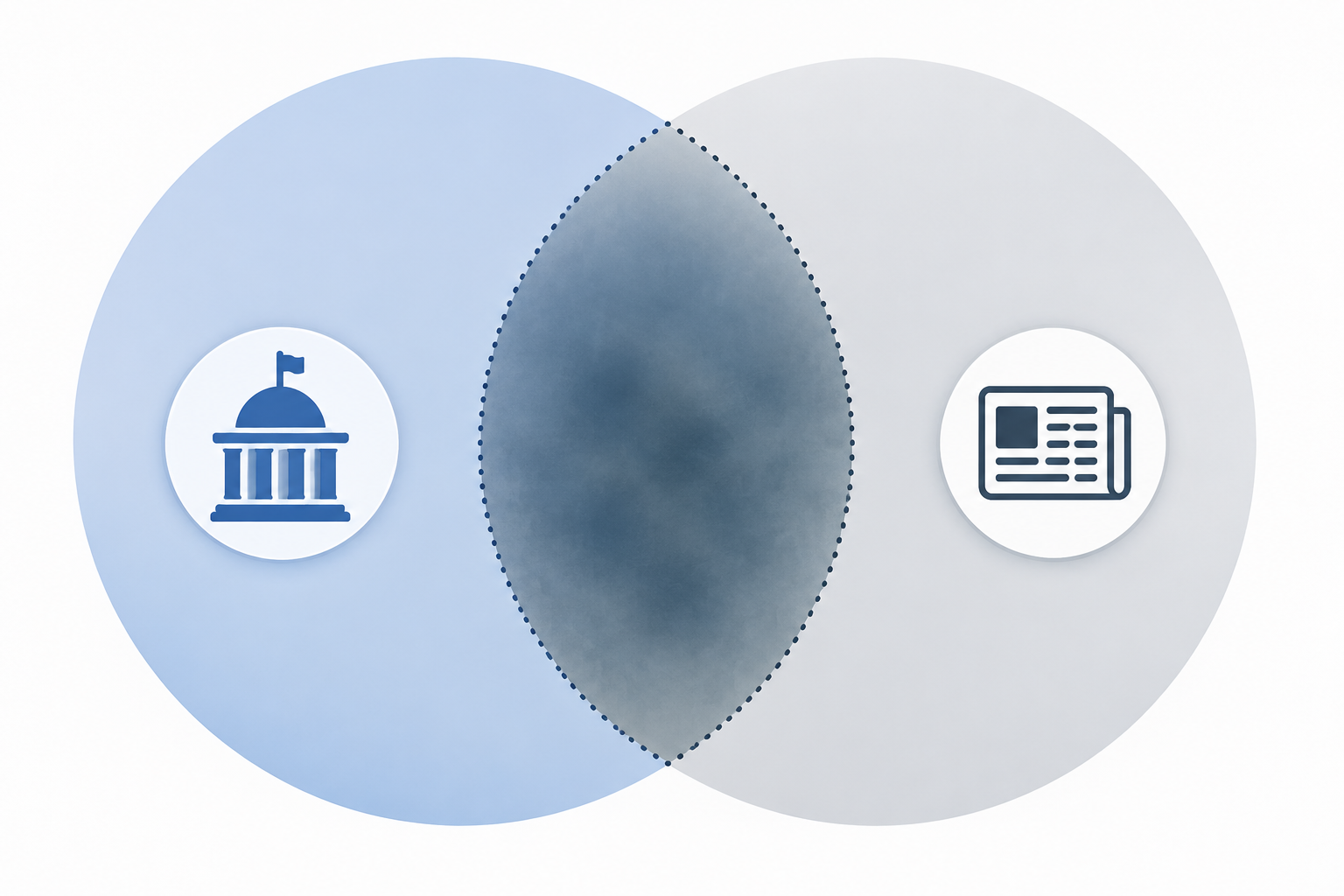
The unresolved issue is not whether Solomon may hold opinions, publish journalism, or request records. The issue is whether he can exercise public authority over a body of government information while simultaneously controlling a private platform that may later report on, interpret, promote, or litigate around that information. Ordinary recusal language may not capture the sequence: government access first, editorial treatment later.
No public material identified in the current coverage supplies a directly applicable OGE precedent for a journalist who is also a news-outlet chief executive serving at the White House as an SGE. That absence should not be exaggerated into a categorical prohibition. It should, however, make legal professionals suspicious of any analysis that treats the arrangement as a routine temporary appointment. A structural gap is not a violation by itself, but it is exactly where written controls matter most.
Useful controls would be concrete rather than atmospheric: no involvement in decisions that uniquely advantage Just the News; no use of nonpublic information for editorial planning; no participation in release-timing decisions that coordinate with private publication interests; no private representations back to the government on the same matters; and documented supervision by an official who is not relying on Solomon for the only account of the work. Whether any such terms exist is not publicly settled.
The election-records context sharpens the ethics question without deciding it
Reuters reported on July 15, 2026, that the White House was weighing release of disputed intelligence concerning China and U.S. elections. The reporting said the underlying intelligence “did not show Beijing had manipulated or changed votes,” and that a Christopher Porter dissent paper concerning China's ability to interfere drew from a small subset of raw intelligence and did not necessarily represent Beijing's official viewpoint.[6] Those descriptions come through Reuters' sourcing; the underlying paper has not been publicly released.
Two days later, Solomon said in an MS NOW interview, as reported by The New Republic, that the task force had found “zero evidence” of the election-fraud claims Trump has alleged.[7] That statement does not eliminate the possibility of a legitimate declassification review. Agencies can review, declassify, and release records that do not validate the premise that prompted public interest. But it does make the purpose and supervision questions harder to avoid.
If the assignment is a records-review function, the appointment documents should say so. If it is a broader task-force role involving strategy, public claims, or advocacy about election integrity, the ethics analysis changes. The same person can move from technical reviewer to public narrator quickly when the private platform remains active. The law has tools for conflicts and misuse of office, but those tools depend on identifying the governmental matter with some precision.
There is also an entity-mapping problem. Executive Order 14395, issued on March 16, 2026, established a “Task Force to Eliminate Fraud” focused on federal benefits programs.[8] NBC and related reporting describe a White House election task force involving Solomon.[2] The public record does not clearly establish the relationship, if any, between the benefits-fraud task force created by the executive order and the election-intelligence effort described in news accounts. Treating them as the same entity without documentation would overstate what is known.
Records-access litigation makes the boundary problem less theoretical
Solomon's prior records-access litigation is relevant for a narrow reason. In March 2023, ABC News reported that Solomon, represented by America First Legal, sued the National Archives and Records Administration and DOJ over records connected to the Crossfire Hurricane binder.[9] America First Legal's own release described the suit as an effort on Solomon's behalf to force public access to government records concerning the origins of the Russia investigation.[10]
That history does not prove anything improper about the 2026 appointment. It does show that Solomon's public work, private journalism, and records-access strategy have previously converged around the release of politically significant intelligence-related documents. When the same person later receives a government role connected to declassification, ethics counsel should ask whether pending, past, or reasonably anticipated records matters require recusals or other written restrictions.
The key distinction is between general subject-matter interest and a particular matter involving specific parties or records. Section 208 is not a general taste-and-opinion statute. But if the government work intersects with litigation positions, access requests, publication plans, or organizational interests of the outlet Solomon controls, the analysis becomes more concrete. That is why the scope language matters more than the public label attached to the task force.
Post-employment and Hatch Act rules become awkward when the private platform never stops
SGE status does not make post-government restrictions disappear. DOJ's SGE guidance explains that SGEs remain subject to post-employment limits, including restrictions tied to particular matters in which the employee participated personally and substantially.[3] Section 207 supplies the main post-employment framework, including lifetime and two-year restrictions in covered circumstances on representational contacts back to the government.[11]
For a journalist-SGE, the representational line may be less intuitive than it is for a lobbyist or contractor. Publishing commentary is not the same thing as representing another person before an agency. Asking questions as a reporter is not automatically a barred communication. But if the SGE later contacts the White House, DOJ, NARA, or another agency seeking action on the same particular matter in which he participated, the post-employment analysis becomes more serious.
The Hatch Act adds a different boundary. DOJ's SGE summary identifies Hatch Act limits as part of the ethics landscape for SGEs.[3] The practical concern is not that a media figure can never speak about politics. It is that an SGE cannot treat government duty time, government title, or nonpublic governmental access as campaign or partisan material. When the private role is a political media operation, the agency needs more than a reminder to “follow the Hatch Act.” It needs a usable separation rule.
A workable rule would distinguish at least three activities: government service on the assigned declassification matter, private editorial activity unrelated to government access, and communications that invoke or exploit the government role. The public record does not show whether that line was drawn for Solomon. If it was not, the problem is not simply personal discretion. It is institutional design.
What legal professionals should watch
The most important future document is the appointment package. If it becomes public, the first review should not be for political language. It should be for service duration, supervisory authority, assigned duties, waiver language, recusals, records-use restrictions, and post-service contact limits. Those terms will determine whether the ethics framework was applied as a control system or treated as a credentialing formality.
- A day-count record showing how the 130-day limit is monitored across the 365-day period.
- A written § 208 analysis identifying the financial interests attached to Just the News and any waiver rationale.
- Recusal terms for matters involving records requests, litigation positions, publication timing, or private editorial advantage.
- A clear statement of whether Solomon's role is limited to document review or extends to task-force strategy and public messaging.
- Post-employment instructions addressing future contacts with agencies on the same declassification or records matters.
This appointment also belongs beside other recent ethics-boundary disputes involving senior officials, contractors, and politically connected private enterprises. The better comparison is not personal notoriety; it is structural overlap. The same site has examined related boundary problems in Brendan Carr's Paramount Gifts and the Federal Ethics Rules and SpaceX Pentagon AI Deal Exposes Federal Ethics Gaps. Solomon's role is different because the private enterprise is not a defense contractor or regulated company. It is a news organization controlled by the same person serving in government.
Based on current public materials, the federal ethics framework may permit more than it clearly governs. The SGE category can handle short-term expertise. It is less well equipped for a journalist-turned-official who keeps control of a political media platform while assisting a White House declassification project with uncertain duration, uncertain waiver terms, and uncertain post-service boundaries. That is the legal significance of the Solomon appointment. It is a stress test, not merely a personnel story.
References
- 18 U.S. Code § 202 - Definitions, Cornell Legal Information Institute.
- White House task force gathers intelligence documents seeking to amplify, NBC News.
- Summary of Government Ethics Rules for Special Government Employees, U.S. Department of Justice.
- 18 U.S. Code § 208 - Acts affecting a personal financial interest, Cornell Legal Information Institute.
- Ethics Rules—or Lack Thereof—that Apply to Special Government Employees (SGE), and Elon Musk in Particular, Public Citizen.
- White House weighs releasing controversial intel on China, US elections, sources say, Reuters, July 15, 2026.
- Trump Election Fraud Guy John Solomon Found No Proof, The New Republic.
- Establishing the Task Force to Eliminate Fraud, The White House, March 16, 2026.
- Amid classified documents probe, Trump's records representative sues National Archives, DOJ, ABC News.
- America First Legal Sues the National Archives and DOJ on Behalf of John Solomon for Illegally Refusing to Make Public Gov't Records on the Fabrication of the Russian Collusion Lie That Were Declassified by President Trump, America First Legal.
- 18 U.S. Code § 207 - Restrictions on former officers, employees, and elected officials of the executive and legislative branches, Cornell Legal Information Institute.
Comments
Join the discussion with an anonymous comment.