
The legal implications of the Jordan attack that killed US soldiers start with a distinction that ordinary coverage tends to flatten. The January 28, 2024 attack on Tower 22 in Jordan was a drone strike by Iran-backed Iraqi militia forces on a small US logistics outpost near the Syrian border; it killed three US service members and injured 47 others.[1] The later July 2026 incident, in which Iranian missiles or drones killed two US service members in Jordan, arose in a different legal setting: by then, the United States and Iran were already operating inside a much more direct state-to-state escalation, with Article 51 self-defense claims already in circulation.
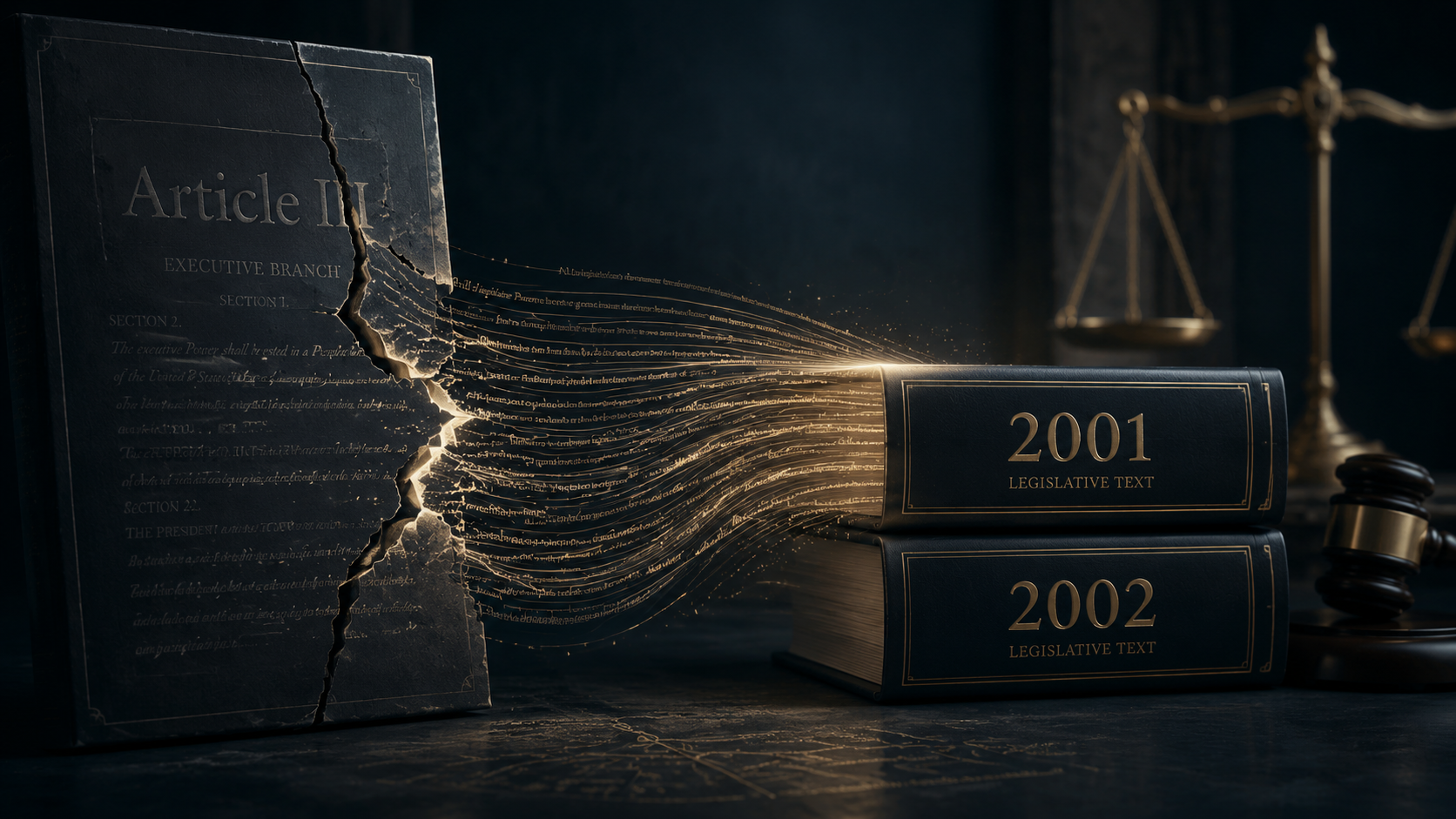
That distinction matters because the 2024 Tower 22 response did not merely ask whether a president may protect US forces after a deadly attack. It became the point at which the executive branch moved back toward a more durable domestic legal theory: “ancillary self-defense” under the 2001 and 2002 Authorizations for Use of Military Force, tied to the US counter-ISIS mission at al-Tanf. Lawfare’s account of the relevant War Powers reports is the crucial documentary trail here: after relying heavily on Article II authority in the immediate post-October 7 period, the administration began placing some strikes against Iran-backed groups back inside an AUMF-linked frame.[2]
| Incident | Relevant legal setting | Why the distinction matters |
|---|---|---|
| January 2024 Tower 22 attack | Drone attack by Iran-backed Iraqi militia forces on US forces in Jordan; subsequent US strikes justified through Article II and then AUMF-linked ancillary self-defense arguments | Raised the domestic-law question whether force against Iran-backed militias could be connected to the 2001 and 2002 AUMFs through protection of the counter-ISIS mission |
| July 2026 Jordan deaths | Iranian missiles or drones killed US service members during a broader US-Iran escalation | Occurred after Article 51 and broader self-defense claims had already been asserted in the Iran context |
Tower 22 Was a Force-Protection Failure Before It Became a Legal Test
The Tower 22 facts should not be made antiseptic. Three service members were killed: Sgt. William Jerome Rivers, Spc. Kennedy Ladon Sanders, and Spc. Breonna Alexsondria Moffett. Forty-seven others were injured.[1] The outpost sat near the Jordan-Syria border and supported US operations connected to the regional campaign against the Islamic State. The administration’s lawyers were therefore not writing in a seminar-room vacuum; they were responding after US personnel had been killed at a forward site tied to an ongoing military mission.
The tactical detail reported by AP is legally relevant because it explains why the event registered inside the military system as more than another militia harassment attack. The hostile drone was reportedly flown near a returning US drone, helping it evade detection and reach the base.[3] For commanders and force-protection lawyers, that is the sort of operational fact that narrows the distance between “regional proxy activity” and an immediate obligation to prevent the next strike.
But force-protection urgency does not answer the authorization question by itself. A president can have compelling reasons to act quickly and still have to explain which legal authority carries the operation. After Tower 22, the important development was not simply that the United States struck back. It was how the executive branch described the legal box into which those strikes fit.
In early February 2024, the United States launched retaliatory strikes using more than 125 precision munitions against more than 85 targets in Iraq and Syria associated with Iran’s Islamic Revolutionary Guard Corps and affiliated militia groups.[1] That scale matters, but the list of targets is less important than the legal move that followed: the administration’s War Powers reporting began to connect certain actions against Iran-backed groups to the protection of US forces engaged in AUMF-authorized missions.
The Pivot Back to the AUMFs
The post-October 7 posture had leaned on Article II. That was not surprising. Article II is the executive branch’s familiar first tool when officials want to frame a limited strike as protection of US forces, deterrence of further attacks, or defense of national interests. It is flexible, fast, and does not require proving that the target falls within the enemy organizations Congress named or contemplated in an old authorization.
Lawfare’s documentation shows why the Tower 22 sequence deserves closer attention. Beginning with War Powers reports in November 2023 and continuing through the response to the Jordan attack, the administration’s language moved back toward the 2001 and 2002 AUMFs, not as the direct enemy-authorizing provisions for Iran-backed militias, but as the basis for protecting US forces engaged in missions those AUMFs still purportedly authorized.[2] This is the “ancillary self-defense” theory: if US forces are lawfully deployed for an AUMF-covered mission, the president may use force to defend them from attacks that threaten their ability to carry out that mission.
That theory is not frivolous. Military lawyers have long treated unit self-defense and mission defense as real authorities, and they do not vanish merely because the attacker is not the original statutory enemy. If US troops are deployed under lawful authority and come under attack, lawyers are not required to pretend the only available responses are evacuation or passive defense.
The difficulty is load-bearing capacity. A theory that looks narrow when used to stop an imminent threat to a discrete US position looks different when it becomes the domestic-law bridge for repeated strikes against a network of Iran-backed groups. Once the executive branch routes those strikes through the 2001 and 2002 AUMFs, the question is no longer only whether US personnel may be defended. It is whether Congress’s authorizations for force connected to al-Qaeda, the Taliban, associated forces, Iraq, and later the counter-ISIS campaign can plausibly support an expanding confrontation with militias whose strategic relationship to Iran is the reason they matter.
Why al-Tanf Carries So Much Weight
The al-Tanf garrison is the hinge. Without it, the AUMF argument is much harder to sustain. With it, the executive branch can say US forces in the area are not simply sitting in Jordan, Iraq, or Syria as a tripwire against Iran. They are supporting a counter-ISIS mission that the United States has long treated as connected to the 2001 and 2002 AUMFs. Attacks on those forces, in this account, threaten an AUMF-authorized mission and can be met with force ancillary to that mission.
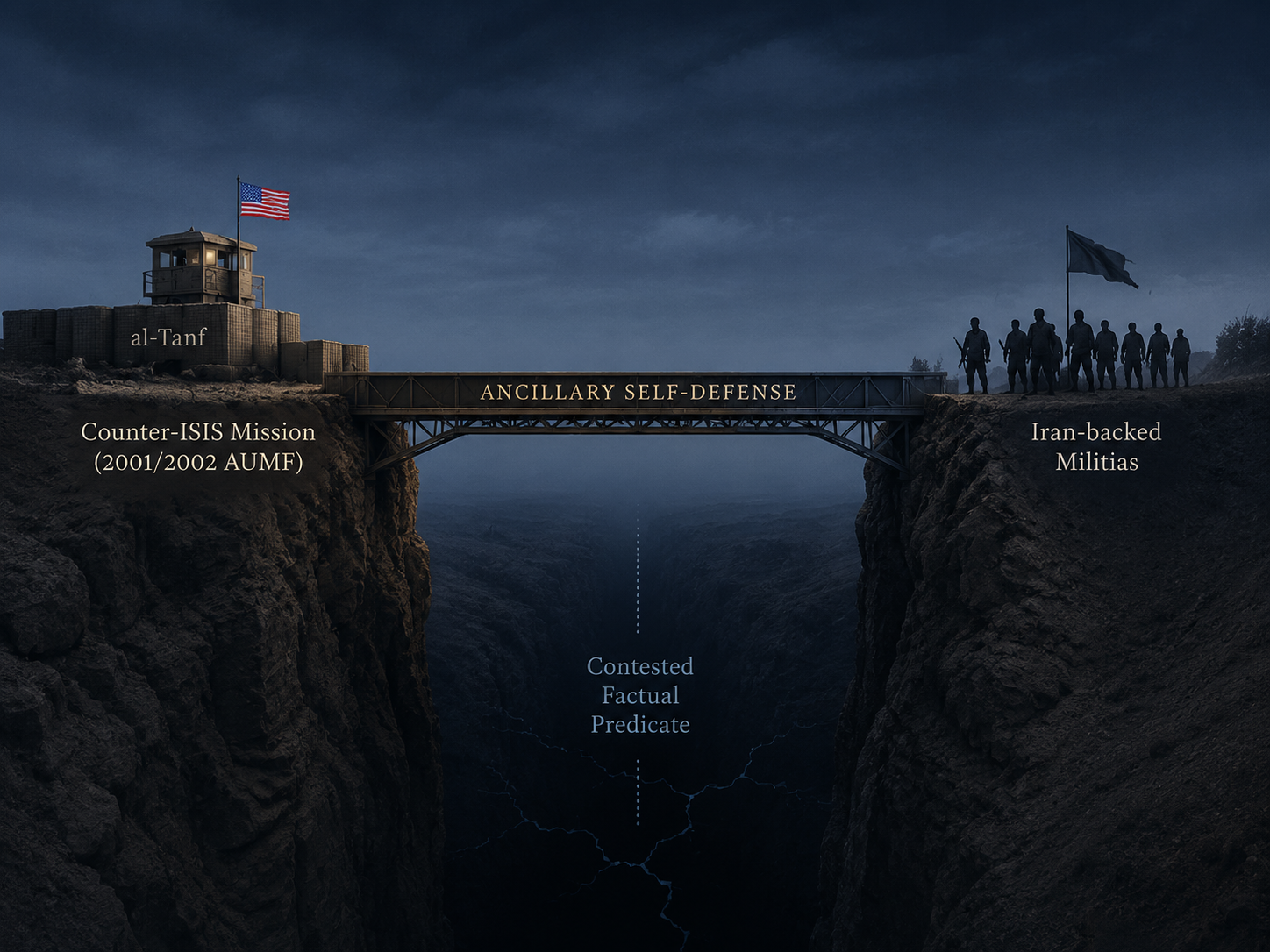
That is a lawyerly bridge, and like most bridges in war-powers practice, it depends on the footing. The contested predicate is factual as much as doctrinal: what exactly were the relevant US forces doing, how directly did the militia attacks threaten the counter-ISIS mission, and when does defending that mission become a more general campaign against Iran-backed armed groups? If al-Tanf is doing the work of connecting the militia strikes to the AUMFs, then the nature and continuing necessity of the al-Tanf mission cannot be treated as a settled background fact.
This is where broad slogans about “war with Iran” obscure more than they reveal. The domestic legal question after Tower 22 was not whether the United States had declared war on Iran. It was whether force against militia targets in Iraq and Syria could be characterized as defensive force in support of an AUMF-authorized counter-ISIS deployment. The answer turns on mission connection, target selection, threat characterization, and the executive branch’s willingness to describe those elements with enough specificity for Congress to evaluate them.
The administration’s strongest version of the argument is straightforward: US forces remained in the theater for counter-ISIS purposes; Iran-backed militias attacked those forces; defending them was necessary to preserve the mission. The weaker version is also apparent: a decades-old authorization becomes a platform for military action against groups not themselves the statutory object of the authorization, because those groups endanger US troops whose continued deployment is itself defended by reference to that old authorization.
The gap between those versions is not a technicality. It is where a one-off response can become an architecture.
Intermittent Strikes and the War Powers Clock
The War Powers Resolution is often discussed as if it contains a clean timer: introduce US forces into hostilities, report within 48 hours, and terminate within 60 to 90 days absent congressional authorization. In practice, the clock is much less tidy when the executive branch uses episodic strikes rather than a continuous campaign openly described as hostilities.
CRS has described the difficulty presented by intermittent uses of force: discrete operations may trigger reporting obligations without necessarily being treated by the executive branch as the kind of sustained “hostilities” that start the termination clock in a way Congress can easily enforce.[4] That matters for the Tower 22 aftermath because the United States could file 48-hour reports, describe particular strikes as limited and defensive, and still participate in a recurring cycle of militia attack and US response.
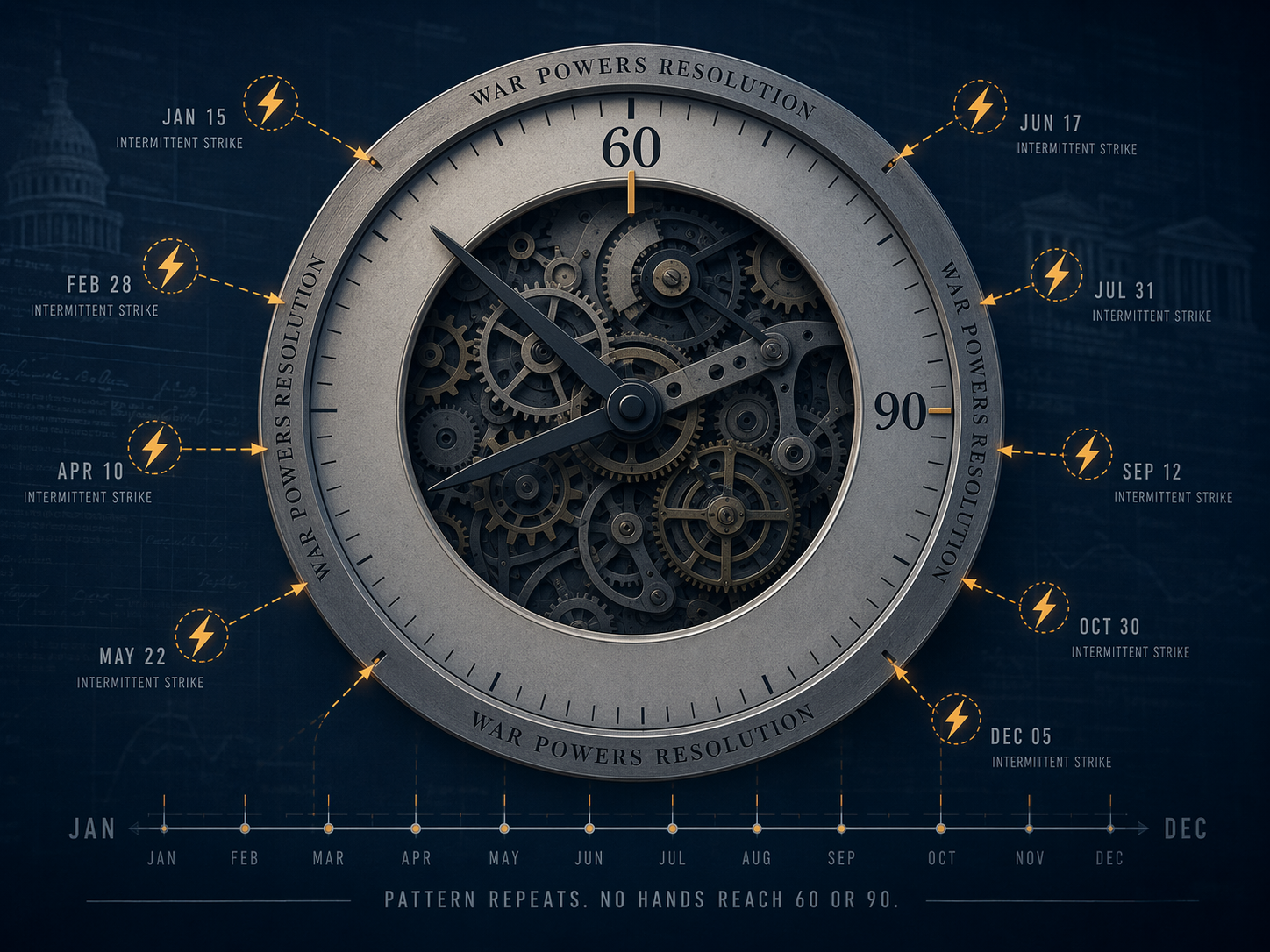
There is a serious institutional asymmetry here. The executive branch can disaggregate force into individual episodes. Congress experiences the aggregate pattern: repeated deployments, repeated reports, repeated assertions of defensive necessity, and no single moment at which the statutory clock obviously forces a vote. The legal consequence is not that the War Powers Resolution becomes irrelevant. It is that its pressure points are easiest to avoid when force is intermittent, geographically distributed, and framed as protection of forces already present under some other authority.
The AUMF pivot intensifies that problem. If each strike can be described as ancillary to an already-authorized mission, the executive branch does not need to ask Congress for a new authorization directed at Iran-backed militias. If each strike is also episodic enough to avoid a conceded 60-day clock, Congress receives notice without necessarily receiving a forcing mechanism. That is not the same thing as no oversight. It is oversight conducted after the executive has already selected the legal category most favorable to operational continuity.
The International-Law Debate Was Moving on a Parallel Track
Domestic authority and international legality should not be collapsed. A strike can be authorized as a matter of US domestic law and still raise separate questions under the UN Charter. Conversely, an Article 51 self-defense letter does not supply domestic statutory authority. By 2025 and 2026, both conversations were under strain in the Iran context.
Brian Finucane’s Just Security critique of the US Article 51 letter justifying June 2025 strikes on Iran’s nuclear facilities described the US self-defense claim as “unconvincing.”[5] That critique did not depend on the Tower 22 AUMF theory, but the two debates rhymed: both involved the legal system being asked to accept a chain of necessity that grew longer as the confrontation widened.
Stanford Law’s Allen Weiner was more direct in assessing the February 2026 US-Israel attack on Iran, calling it “quite clearly illegal” under international law.[6] Le Monde’s March 2026 analysis likewise treated the US-Israel attack on Iran as presenting serious international-law problems.[7] These critiques are not interchangeable, and they should not be treated as a single academic chorus. Their importance for the Jordan analysis is narrower: by the time US personnel were again killed in Jordan in July 2026, the legal environment had moved beyond militia attribution and mission defense. The United States was operating amid a direct Iran-centered conflict in which the international self-defense rationale was already heavily contested.
That is why the two Jordan incidents cannot be merged into one storyline. The Tower 22 attack tested whether old AUMFs could support force against Iran-backed militias through the al-Tanf counter-ISIS mission. The July 2026 deaths occurred after the legal frame had expanded into direct confrontation with Iran. The casualties were both real; the legal predicates were not the same.
From Legal Notice to Congressional Confrontation
The June 2026 war powers resolution should not be described as inevitable. Congress does not act just because legal theories become strained. It often tolerates strain for years, especially when US forces are under threat and members would rather criticize tactics than own a vote on authorization. Still, the earlier Jordan response helped normalize a structure that Congress eventually had to confront: Article II for immediacy, AUMF-linked ancillary self-defense for continuity, and episodic strike reporting for War Powers compliance.
Al Jazeera reported that in June 2026, both chambers passed a war powers resolution concerning the conflict, describing it as the first congressional war powers resolution in history.[8] The significance is institutional, not curative. A resolution can mark congressional resistance without resolving every underlying question about the 2001 AUMF, the 2002 AUMF, Article II, Article 51, state responsibility for proxy forces, or the legality of prior strikes.
What it does show is that the executive branch’s earlier legal architecture had consequences across time. The response to Tower 22 began with a concrete and grave force-protection problem. It then supplied a usable theory for hitting Iran-backed militias without seeking a new authorization. Repeated use of that theory interacted with the War Powers Resolution’s weakest feature: its difficulty handling intermittent force that produces sustained strategic effects. By the time the conflict moved into direct US-Iran escalation, the question was no longer whether a single retaliatory strike after a deadly attack could be defended. It was whether the accumulated legal framework had allowed the United States to approach a much larger conflict without the kind of congressional authorization the Constitution’s war-allocation structure is supposed to force into view.
References
- Tower 22 drone attack, Wikipedia.
- Law and the Biden Administration's Response to the Attack in Jordan, Lawfare.
- Drone that killed US troops in Jordan followed American drone onto base, causing confusion, AP News.
- The War Powers Resolution: Concepts and Practice, Congressional Research Service.
- US Article 51 Letter on Strikes Against Iran's Nuclear Facilities Is Unconvincing, Just Security, June 2025.
- The U.S.-Israel Attack on Iran Is Quite Clearly Illegal Under International Law, Stanford Law School, March 3, 2026.
- Analysis of the US-Israel attack on Iran under international law, Le Monde, March 2026.
- US Congress passes war powers resolution on Iran conflict, Al Jazeera, June 28, 2026.
Comments
Join the discussion with an anonymous comment.