
The disputed answer is small enough to fit on one transcript page. In a Dec. 17, 2025 deposition before the House Judiciary Committee, former Special Counsel Jack Smith was asked whether his investigators had subpoenaed members of Congress for their text messages. He answered no, and confirmed that the team had sought toll records rather than message content from members themselves.[1]
That answer is the starting point for any serious legal analysis of Jim Jordan’s criminal referral against Jack Smith, because the legal problem is not whether the phrase “lying to Congress” sounds forceful. It is whether a narrowly true answer to a subpoena question became a false statement under 18 U.S.C. § 1001 because Smith did not volunteer a different route by which his team allegedly obtained text message content.
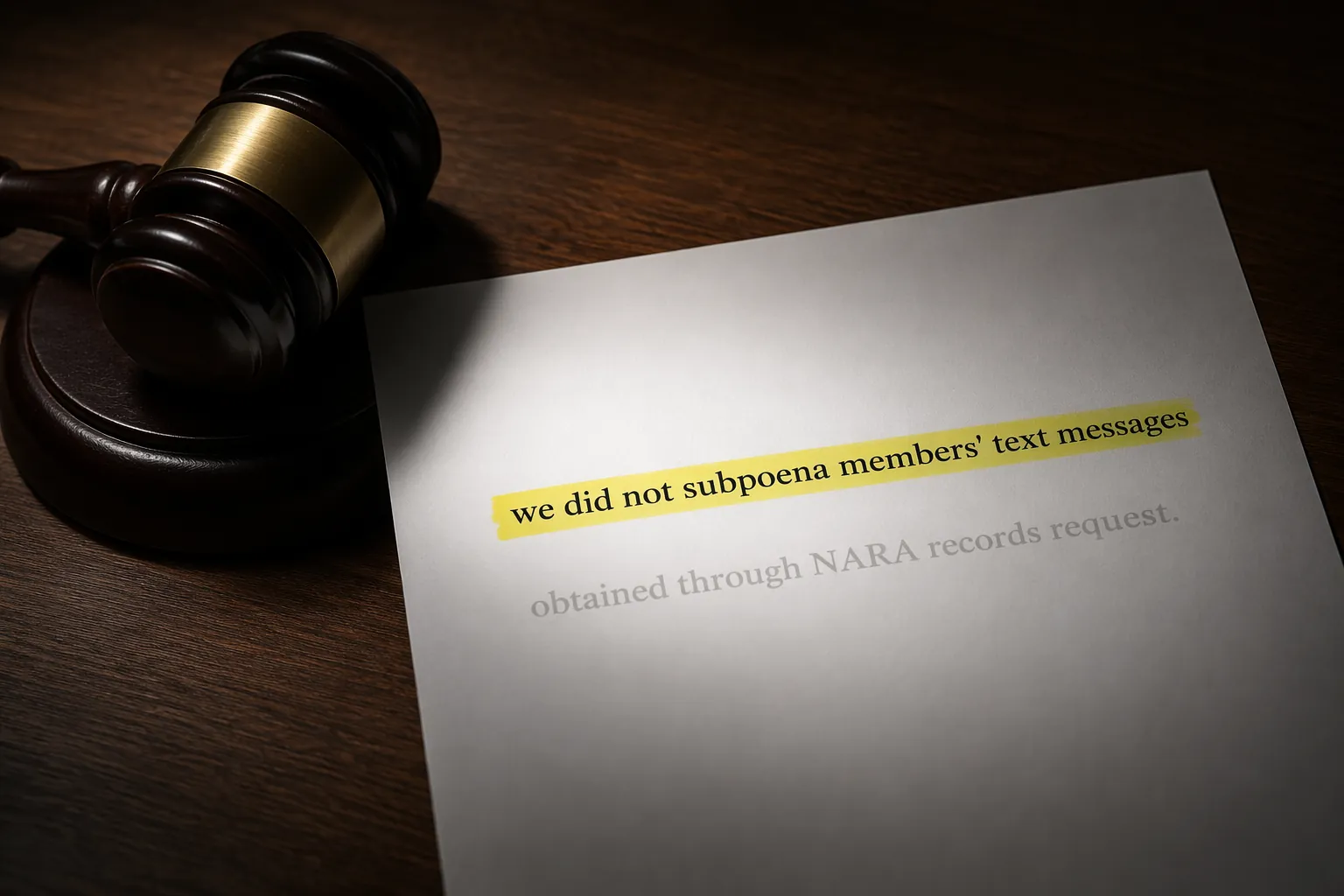
The different route matters. On July 14, 2026, Sens. Chuck Grassley and Ron Johnson said DOJ records showed Smith’s investigative team obtained text message content from 44 members of Congress through the National Archives and Records Administration, accessed the material within hours of receipt, and bypassed the expected filter-team protocol.[2] If those disclosed records are accurately characterized, the answer “we did not subpoena members’ text messages” was not the whole practical story.
It still may have been the whole answer to the question asked.
The Literal Truth Problem
Section 1001 punishes materially false, fictitious, or fraudulent statements and concealments made knowingly and willfully in matters within federal jurisdiction. Congressional testimony can fall within that statute, but the statute does not erase the transcript. The words used by the questioner still matter.
On the reported record, the question concerned subpoenas to members for their text messages. A NARA records request is not that. It is a different legal mechanism, directed at a different custodian, even if it produced some of the same category of content. That distinction is not a technicality in false-statements practice. It is often the case.
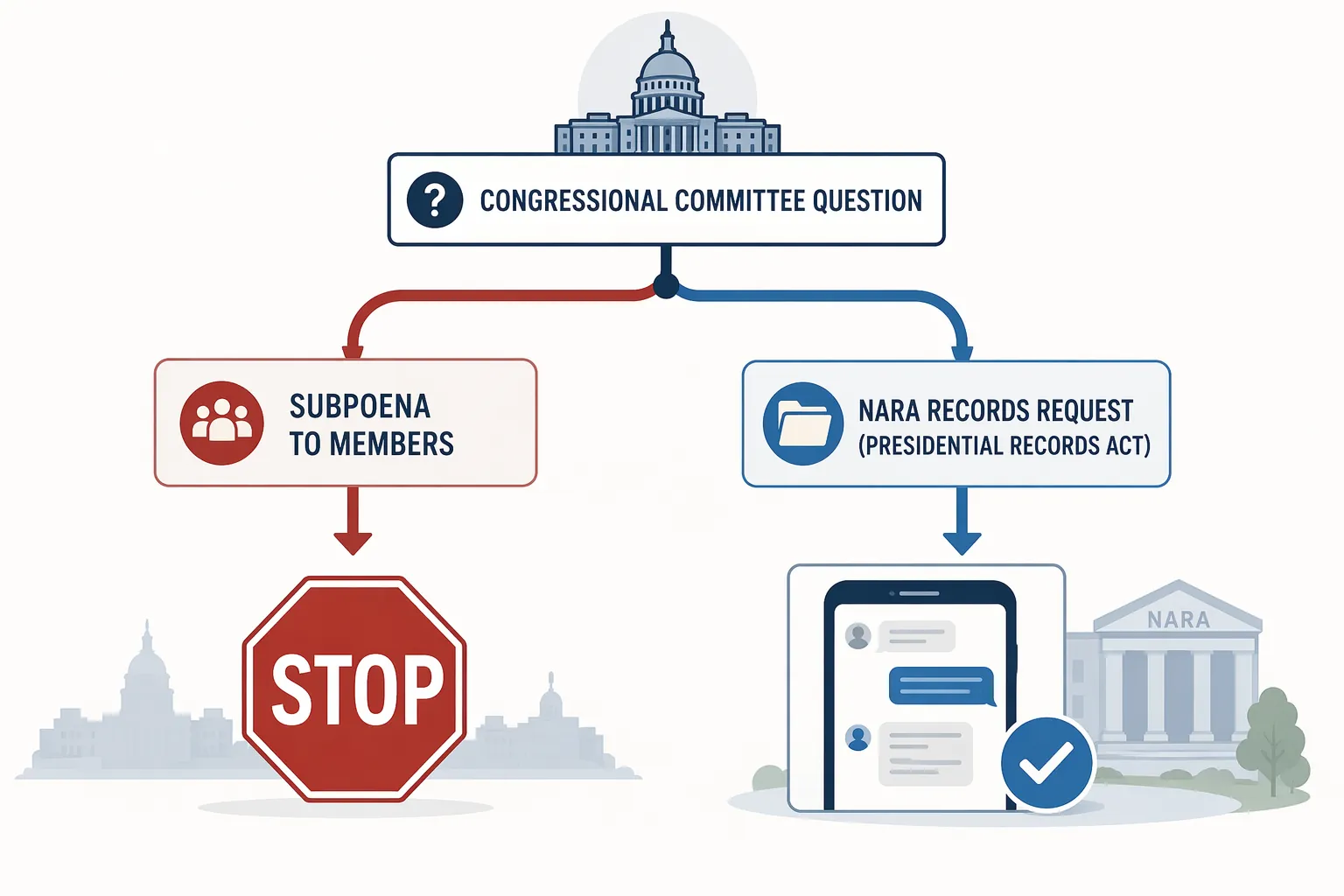
Jordan’s referral tries to move the case out of literal-truth territory by calling Smith’s answer a “half truth.” The House Judiciary Committee’s July 22, 2026 referral to Acting Attorney General Todd Blanche alleges that Smith misled Congress by denying subpoenas for members’ texts while omitting the NARA-derived text contents.[3] That is the right legal category for Jordan to invoke if he wants the referral to survive the first objection. It is also the category where the prosecution theory becomes hardest to prove.
When an Omission Becomes a False Statement
A half-truth theory is not simply a rule that a witness must provide all adjacent facts that would interest the committee. The government normally has to show that the statement, though perhaps literally accurate in isolation, was misleading because the speaker had a duty to disclose the omitted fact or because the chosen answer created a materially false impression within the context of the question.
That is why the transcript does so much work here. If staff asked, in substance, “Did your team obtain the contents of members’ text messages by any means?” a denial limited to subpoenas would look evasive. If staff asked only, “Did you subpoena members’ text messages?” a witness can answer that question without turning the deposition into a voluntary tutorial on every investigative mechanism that touched congressional communications.
The publicly reported summaries place the exchange closer to the second version. Smith’s lawyers, Lanny Breuer and Peter Koski of Covington & Burling, reportedly argued that the referral “concedes he did not” make a false statement and instead seeks to punish him for not answering questions that were never asked.[1] That is a defense lawyer’s framing, but it identifies the necessary pressure point: silence is not automatically falsity.
Rep. Jamie Raskin’s response presses the same transcript point from the committee side. House Judiciary Democrats said staff did not ask about presidential records or whether members’ messages appeared on executive branch phones, and Raskin described the referral as treating the witness as if he had to be “telepathic.”[4] That argument would be weaker if the committee had laid a broader foundation and Smith steered the answer back to subpoenas anyway. On the materials now public, that broader foundation is uncertain.
The NARA Route Makes the Answer Uncomfortable
The NARA facts are not legally irrelevant just because they are not subpoenas. They explain why the answer feels too clean. A committee asking about subpoenas for congressional text messages is not usually making an abstract taxonomy inquiry. It is trying to learn whether investigators obtained lawmakers’ communications. If the investigative team had obtained text content through NARA, and especially if it reviewed that content within hours while bypassing an expected filter-team process, the practical answer to the committee’s apparent concern was more complicated than “no.”[2]
But § 1001 does not punish discomfort. It punishes materially false statements or concealments made with the required mental state. The gap between those two propositions is where the referral has to do its work.
| Issue | Why it matters for § 1001 |
|---|---|
| Literal wording | A subpoena to a member is not the same mechanism as a NARA records request. |
| Omitted fact | The team allegedly obtained text message content from 44 members through NARA. |
| Duty to disclose | The referral needs a reason Smith had to volunteer the NARA route in response to a subpoena question. |
| Materiality | The omission must have had a natural tendency to influence the committee’s work. |
| Mens rea | The government would need proof Smith knowingly and willfully misled Congress, not merely answered narrowly. |
The bypass allegation adds force to the political and oversight complaint. It may also matter to intent if there is evidence Smith understood the question as covering all means of obtaining text content and chose the narrower answer to avoid disclosing the NARA request. But without that kind of evidence, the bypass fact proves a separate concern more readily than it proves a false statement.
Duty to Disclose Is the Referral’s Gate
The cleanest prosecution theory would not be that Smith had a general civic obligation to be more forthcoming. It would be that, in context, his answer affirmatively implied his team had not obtained member text contents when he knew it had. That theory depends on the question’s framing, the surrounding colloquy, any preparation materials, and whether the committee’s use of “subpoena” was obviously shorthand for “obtain.”
A prosecutor would want the transcript to show more than one narrow question. Follow-ups matter: “Through any other process?” “From any third-party custodian?” “From NARA?” “From executive branch devices?” “Did your team review the contents of messages involving members?” Each missed off-ramp would make the half-truth theory stronger. Each absent follow-up leaves the referral leaning on inference.
This is where congressional questioning often creates its own evidentiary problem. Staff may know the subject they want to reach but use the wrong procedural noun. Later, after documents surface, everyone understands what should have been asked. Section 1001 is not usually satisfied by proving that a sharper question would have produced a more damaging answer.
There is a fair counterpoint. Sophisticated DOJ witnesses understand that oversight questions are not bar-exam hypotheticals. If the witness knows the committee is asking whether congressional communications were obtained, a mechanistic “no subpoenas” answer can be a way to mislead while preserving a literal escape hatch. That is why this is not an easy dismissal. It is a contested half-truth theory, not a fake legal theory.
Materiality Is Plausible but Not Automatic
Materiality under § 1001 is not measured by whether the omitted fact later became embarrassing. The question is whether the statement or concealment had a natural tendency to influence, or was capable of influencing, the decision-making body. In a congressional oversight deposition, learning that a special counsel team had obtained text message content from 44 members through NARA could plainly influence follow-up questions, document demands, witness selection, and public oversight strategy.[2]
That gives Jordan’s referral a real materiality argument. The committee was investigating Smith’s investigative methods. Information about congressional text contents, filter-team handling, and NARA access would have mattered to that inquiry. A committee does not need to show it would have changed a final report or enacted legislation the next day.
The defense response is that materiality cannot rescue a non-false answer. If the only question was about subpoenas, the fact that another unasked topic was important does not make the subpoena answer false. That is a sequencing point, and it is a good one. Materiality answers whether the lie mattered; it does not by itself create the lie.
Mens Rea Is the Hardest Charging Problem
Even if a prosecutor could get past literal truth, duty, and materiality, the case still has to prove Smith acted knowingly and willfully. That is not the same as proving he knew about the NARA request. The government would need to prove he knew his answer was misleading in the setting of the question and intended to give Congress a materially false impression.
That proof could theoretically come from preparation notes, prep memos, internal emails, testimony prep discussions, or prior warnings about congressional-text issues. If Smith had been prepped on the exact distinction — “they may ask about subpoenas, but we got content through NARA” — the narrow answer would look different. If instead the deposition question came and went as a subpoena-specific exchange, the intent case becomes much thinner.
The alleged filter-team bypass may sharpen suspicion, but suspicion is not mens rea. A charging memo would have to explain who made the bypass decision, what Smith knew about it, when he knew it, and how that knowledge connected to the wording of his deposition answer. Without that chain, the case risks treating institutional knowledge as personal criminal intent.
The Referral Lands in a Contaminated Institutional Setting
The referral was sent to Acting Attorney General Todd Blanche, who previously represented Donald Trump in the cases Smith prosecuted; Axios and The Hill also reported that Smith was already under DOJ investigation before this referral arrived.[1][5] That context does not decide the elements of § 1001. It does affect how any charging decision would be read, and it raises an obvious recusal and legitimacy problem if the department were to move forward without visible insulation.
Criminal referrals from Congress are not indictments with letterhead. Co-Equal Foundation research found that about 37% of 183 congressional criminal referrals since the 1920s resulted in indictment, with outcomes varying significantly by era and political context.[6] That figure is useful only as a brake on overconfidence. It does not predict what DOJ will do here, and it does not answer the half-truth problem.
What Would Change the Analysis
The analysis is necessarily bounded by the publicly reported transcript summaries. If the full deposition transcript contains broader questioning than has been reported, the referral becomes stronger. In particular, the legal posture changes if Smith was asked about obtaining member messages by any means, reviewing member message content, using NARA to collect communications, or receiving records from executive branch devices.
- A stronger referral would quote the exact question-and-answer sequence, not only the damaging contrast between subpoenas and NARA access.
- A stronger prosecution theory would identify the source of Smith’s duty to disclose the NARA mechanism in response to the subpoena question.
- A stronger intent theory would connect Smith personally to knowledge of the NARA text-content review before the deposition.
- A stronger materiality showing would explain what committee action the omission was capable of affecting at the time of the testimony.
Those are not decorative details. They are the difference between a referral that describes an evasive-looking answer and a chargeable false statement.
The Likely DOJ View
Under ordinary DOJ practice, this is a difficult § 1001 case. The NARA disclosure makes Smith’s testimony uncomfortable and politically usable. It gives Jordan a plausible reason to ask whether Congress was misled. It does not, on the public record, eliminate the core defense: Smith was asked about subpoenas to members and answered about subpoenas to members.
A half-truth prosecution would need the transcript to create a duty to disclose the NARA route, the omission to be material to the committee’s inquiry, and the evidence to show Smith knowingly and willfully chose a narrow answer to mislead rather than to respond to the question as phrased. Unless the transcript contains broader questioning than has been publicly reported, those are serious obstacles. Prosecution is not impossible as an abstract matter, but it is unlikely under the usual charging discipline for false-statement cases.
References
- Jim Jordan accuses Jack Smith of lying to Congress in DOJ referral, Axios, July 23, 2026
- NEWS: Jack Smith’s Investigative Team Secretly Obtained Text Messages From 44 Members of Congress Amid Trump Probe, U.S. Senator Chuck Grassley, July 14, 2026
- House Judiciary Committee Refers Jack Smith to DOJ for Criminal Prosecution, House Judiciary Committee, July 22, 2026
- Ranking Member Raskin Slams Republicans’ Baseless and Vindictive Criminal Referral of Jack Smith, Former Special Counsel Who Prosecuted Trump’s Crimes, House Judiciary Democrats, July 22, 2026
- Jordan accuses Smith of lying to Congress in criminal referral to DOJ, The Hill, July 22, 2026
- Congressional Criminal Referrals Precedents, Co-Equal Foundation
Comments
Join the discussion with an anonymous comment.