
Kamar Williams was found safe. That is the fact that should come before the technology, the speculation, and the frustration that often follows a high-visibility missing-persons search. Williams, known with his twin brother Kiyel as part of the 80KTwins, reportedly left his Fairburn, Georgia, home voluntarily in mid-July 2026. Kiyel then posted a public appeal on Instagram, and the missing-person post was shared more than 80,000 times within 48 hours, according to People’s reporting on the family’s account of events.[1] E! Online later reported that Williams resurfaced after several days and contacted family asking for more time away, with representatives describing the episode as a voluntary mental-health break rather than foul play.[2]
That resolution matters because it keeps the legal question in its proper lane. The available public record does not show that Williams was abducted. It does not show that artificial intelligence tracking was deployed. It does not show that police ignored a specific AI lead. And in the sources reviewed here, there was no independently verified law-enforcement resolution record confirming the family and representative statements. The useful question is therefore narrower than the one social media tends to ask. In a metropolitan area associated with dense camera networks, automated license plate readers, and real-time crime-center infrastructure, what determines whether those tools are used in a missing-persons matter, and what record exists if they are?

The Public Search Moved Faster Than the Public Record
The Williams update begins with an asymmetry. The family-facing search became visible almost immediately: Kiyel posted, followers shared, and entertainment outlets picked up the story while uncertainty was still live. In the first two days, attention traveled faster than any public explanation of whether a formal missing-persons report had been filed, what agency had jurisdiction, whether any camera review had been requested, or whether the facts met the threshold for a formal alert.
That is not unusual. The first hours of a missing-persons matter are often crowded with partial facts. Families are trying to locate someone, agencies are deciding whether the matter is criminal, medical, voluntary, endangered, or some combination, and the person at the center may have privacy interests that do not disappear simply because the public is worried. The Williams case is unusually useful for legal professionals because it ended safely while still exposing the machinery that people now assume should be available on demand.
The regional context makes that assumption understandable. Atlanta’s ConnectAtlanta program has been reported to include more than 46,000 integrated or registered cameras, and SaportaReport described the city as having 124.15 cameras per 1,000 people, the highest figure among U.S. cities in the report it cited.[3] The same reporting describes an AI-enabled public-safety platform connected to Fusus, now part of Axon, and credits the Buckhead area with a 27% crime reduction over five years in connection with the surveillance system.[3] Those figures do not prove that any tool was used, or should have been used, in Williams’ case. They explain why the public sees a dense surveillance map and expects a clean answer.
Availability Is Not Authorization
A city can have cameras without having legal authority to search them for every disappearance. An agency can have access to automated license plate reader data without having a settled policy for a voluntary adult absence. A real-time crime center can be technically capable of correlating feeds without creating an admissible trail that later explains who queried what, under which legal standard, using which inputs, and with what confidence level.
That distinction is easy to lose during a family emergency. When a person is missing, the humane impulse is to use whatever system might shorten the search. But legal categories still control the first gate. The federal AMBER Alert guidance requires law enforcement to confirm that an abduction has occurred before issuing an alert, among other criteria.[4] That threshold is intentionally narrow. It helps protect the alert system from overuse, but it also means that runaways, voluntary departures, adults taking space, and many ambiguous disappearances may not qualify even when families are terrified.
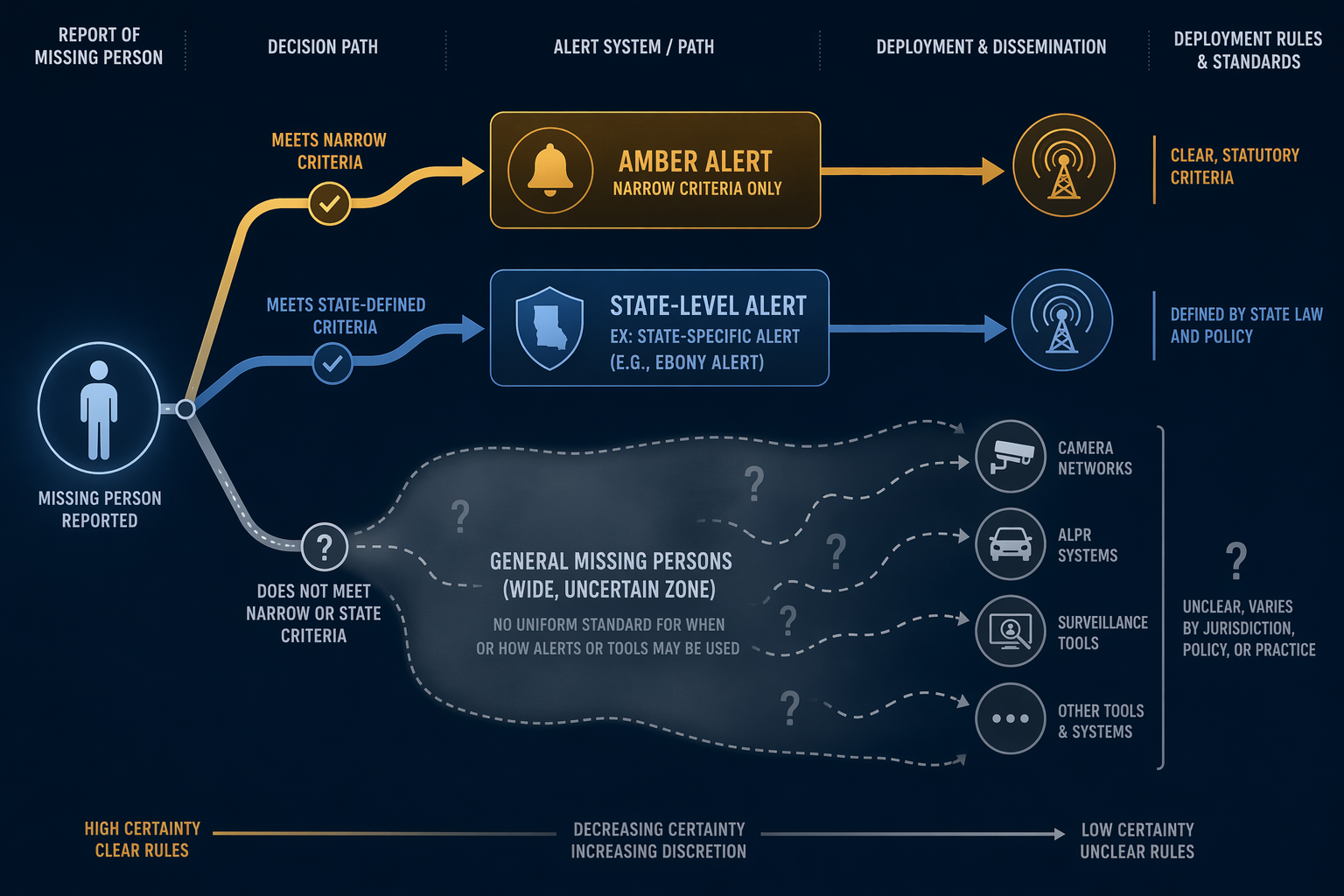
The Williams facts, as publicly reported, sit in precisely the zone where public urgency and formal eligibility can diverge. The reports describe a voluntary departure and later contact with family. They do not establish an abduction. If the person is an adult who is not shown to be abducted or endangered under a specific statutory standard, the legal basis for escalating into broad surveillance searches may be less obvious than the public assumes.
California’s Ebony Alert shows a different gate. The alert, effective January 2024, created a designated system for missing Black youth and young adults ages 12 to 25.[5] It responds to a real equity problem: some missing-persons cases receive dedicated alert infrastructure, while others rely heavily on family mobilization, media luck, or local discretion. But the comparison also shows how much depends on statutory design. A state-level alert category can authorize attention that a general missing-persons classification might not. Most jurisdictions do not yet have a comparable framework for deciding when AI-assisted camera or ALPR searches should be triggered in non-AMBER cases.
The Tool Claims Are Directional, Not Proof
Vendors can point to legitimate public-safety use cases. Flock Safety says its automated license plate reader technology has helped reunite more than 1,000 missing persons as of May 2025.[6] That is a material claim, especially for lawyers advising agencies that already use ALPR networks or reviewing discovery in cases where a vehicle sighting becomes the first investigative lead. It is also a self-published aggregate figure, not an independently audited effectiveness study. It should be treated as evidence that agencies are using ALPR systems in missing-persons contexts, not as proof of a general recovery rate or a guarantee that a similar tool would have changed any particular case.
The same caution applies to evidence-processing claims. Veritone says officers may spend 4 to 6 hours per case on repetitive evidence-gathering tasks that AI can compress, and it describes AI-assisted review reducing some evidence review from weeks to hours.[7] Those statements matter because they identify the operational temptation: when video, phone data, social media, and camera feeds pile up, a tool that can triage evidence quickly looks less like a luxury and more like a staffing workaround. But time savings are not the same as legal reliability. A faster review still has to produce a record that a defense lawyer, judge, prosecutor, records custodian, and family can understand.
Innefu frames the first 24 to 72 hours as a critical recovery window and argues that AI tools can improve outcomes by compressing the time needed to correlate leads.[8] That is plausible as an operational proposition, and it matches the lived pressure of early missing-persons work. It does not answer the harder legal question: what level of concern justifies searching a broad surveillance network, especially when the person may be voluntarily absent and has not been shown to be in danger?
Where the Evidentiary Problems Start
A missing-persons AI lead can look clean in a press release and become complicated in a case file. Suppose, hypothetically, an agency receives a family report, queries an ALPR system for a vehicle associated with the person, finds a possible plate match, and then reviews nearby camera feeds. If the person is found safe, the public may remember only that the system worked. If a criminal case later develops, or if the search is challenged, every step becomes a question.
- Who authorized the query, and under what policy?
- Was the search based on consent, exigency, a warrant, agency policy, or informal practice?
- Which databases were searched, and were privately owned cameras included?
- Did AI merely filter footage, or did it generate a match, route, identity suggestion, or risk score?
- Were false positives preserved, suppressed, overwritten, or never visible to the human reviewer?
- Can the agency reproduce the search later using the same inputs and software version?
Those questions are not paperwork trivia. They determine whether a data point is a lead, a business record, demonstrative support, testimonial evidence, or something that should not be used at all. They also determine whether an agency can satisfy disclosure obligations. If AI filtered 500 hours of footage down to 20 clips, the defense may need to know what was excluded and why. If a camera owner shared access through a city platform, counsel may need to know whether the agency possessed the footage, controlled it, or merely viewed it.

The volume problem is real. Digital Evidence AI states that digital evidence is now involved in about 90% of criminal cases.[9] Veritone, citing a Colorado district attorney’s office, reports a 600% increase in video and audio evidence volume from 2022 to 2025.[7] Even allowing for the limitations of vendor-linked evidence-market reporting, the direction is hard to dispute: legal teams are being asked to review more machine-readable material, from more systems, with more automated filtering in the middle.
The Fourth Amendment Question Does Not Wait for a Trial
For legal professionals, the constitutional issue is not limited to whether a final prosecution exists. The search decision itself can create later exposure. ALPR data, camera networks, and integrated public-private feeds can reveal patterns of movement. A single plate hit may be modest; a historical query across a dense network can be much more revealing. The more comprehensive the infrastructure becomes, the harder it is to treat each query as a small administrative act.
Atlanta’s surveillance debate illustrates the governance gap. SaportaReport describes the ACLU of Georgia’s campaign for a Community Control Over Police Surveillance ordinance in Atlanta and notes concern over ConnectAtlanta’s scale and oversight.[3] That advocacy position is not settled law. But the absence of a public-facing ordinance governing how a large surveillance network is approved, audited, and constrained is exactly the kind of gap that later becomes litigation fuel.
Missing-persons cases make the issue harder because urgency is genuine. A rigid warrant-first model may be too slow for an abducted child, an endangered elder, or a person at acute risk of self-harm. A no-standard model is also untenable. It invites retroactive justification: the search was reasonable because the outcome was good, or because everyone wanted the person found. That is emotionally powerful and legally thin.
The better distinction is between emergency lead generation and durable evidentiary use. Agencies may need a fast path for time-sensitive location work. Legal systems still need logs showing the trigger, scope, duration, data sources, reviewer, retention decision, and any handoff from AI-filtered lead to human-verified evidence. Without that record, the system asks courts and affected people to trust a black box after the fact.
Social Media Can Fill a Vacuum, But It Cannot Cure It
The Williams search also shows the role of family-led distribution. A viral post can reach more eyes than an agency bulletin. It can surface sightings, pressure officials, and keep a case from vanishing into an intake queue. It can also spread stale facts after the person has been found, intensify attention around someone who may be in crisis, and create a public archive that is difficult to correct.
That creates a second evidentiary track. Tips from Instagram are not the same as authenticated footage. A repost count is not a reliability measure. A family statement may be the best available update and still not be a law-enforcement finding. Lawyers handling matters downstream should separate the public chronology from the official investigative chronology and then ask where they overlap.
| Record Type | Useful For | Legal Caution |
|---|---|---|
| Family or representative statement | Understanding public timeline and reported resolution | May not establish agency action or formal findings |
| Social media appeal | Showing when public attention began and what information circulated | May include incomplete, outdated, or privacy-sensitive claims |
| Camera or ALPR hit | Generating a location lead | Requires authorization, source, retention, and reliability review |
| AI-filtered evidence set | Reducing review burden across large data volumes | Requires explanation of inputs, exclusions, model role, and human review |
| Formal agency report | Establishing official chronology and investigative steps | May omit vendor-side logs or privately held source data |
What Legal Teams Should Track as AI Case Tracking Spreads
The Williams case does not prove an AI failure. There is no public basis for saying that an AI camera network should have found him sooner, or that an agency declined to use a lawful tool that would have changed the outcome. The case instead exposes a documentation problem that is becoming harder to ignore. Surveillance capacity is increasingly visible; deployment rules are often not.
For attorneys and legal operations teams, the practical work is to ask for the operational record before accepting the technology narrative. In procurement, that means reading beyond accuracy claims and asking whether the product creates exportable audit logs, preserves negative results, identifies software versions, records human overrides, and distinguishes a lead from evidence. In litigation, it means requesting the query history, not only the clip that survived review. In compliance, it means mapping which categories of missing-persons matters trigger which systems and who can approve each escalation.
The hardest cases will not be the obvious abductions. They will be the ambiguous ones: a young adult who leaves voluntarily but may be in distress, a teenager treated as a runaway until facts change, a person whose family wants urgent help but whose own privacy interest is substantial, or a case that begins as welfare concern and becomes criminal investigation after surveillance has already been searched. Those are the cases where a clean policy matters most, because the moral urgency will be real and the legal basis may still be forming.
A credible AI tracking regime for missing persons would leave behind more than a success story. It would show when the tool was activated, why the case qualified, what data was searched, who reviewed the output, what was retained, what was discarded, and how affected people can later challenge or correct the record. Until those details are as visible as the camera counts and vendor milestones, legal professionals should treat each AI-assisted missing-persons claim as a starting point for inquiry rather than a finished explanation.
References
- Influencer Kamar Williams Has Been Missing for Over 2 Days, Says Brother Kiyel, People
- Kamar Williams of 80KTwins Missing, Says Brother Kiyel Williams, E! Online
- Atlanta and AI-powered surveillance, SaportaReport
- Guidelines for Issuing AMBER Alerts, U.S. Department of Justice
- Ebony Alert, California Highway Patrol, January 2024
- 1,000+ Missing Persons Reunited with Flock Safety, Flock Safety, May 2025
- AI for Public Safety: Missing Persons, Veritone
- AI for Missing Persons Tracking: A Law Enforcement Use Case, Innefu
- How Technology Helps in Solving Missing Person Cases, Digital Evidence AI
Comments
Join the discussion with an anonymous comment.