
Keytruda’s patent cliff is no longer just Merck’s revenue problem. It has become the place where several U.S. drug-pricing rules are being forced to decide whether they can operate side by side without leaving a reformulation-sized gap between them. IV Keytruda is moving toward core patent expiry in 2028; Merck’s subcutaneous successor, Keytruda Qlex, is already positioned as the next version; the IRA negotiation calendar has been altered by the OBBBA orphan-drug exclusion; and CMS has proposed treating IV and subcutaneous versions as one unit for Medicare negotiation in the 2029 cycle.[1]
That is the practical impact of Keytruda’s patent cliff on drug pricing law: the law is not merely waiting for exclusivity to end and then negotiating price. CMS is now asking when a new delivery format should be treated as part of the same economic product before the switch has fully done its work.

The 2028 Cliff Is Already a 2029 Pricing Fight
Keytruda’s scale explains why the legal details matter. The product reached $32.7 billion in annual revenue, and the subcutaneous version launched in October 2025 with 38 approved solid tumor indications. Evaluate forecasts cited by BioPharma Dive put Qlex at $7.1 billion in 2032, while IV Keytruda is projected to fall to $7.2 billion over the same period.[2]
Those figures do not prove an unlawful product hop. A manufacturer may have clinical, commercial, and administrative reasons to develop a more convenient route of administration. But timing matters in law because timing changes consequences. A subcutaneous launch before the IV cliff can let a company move prescribing habits, contracting expectations, and payer coverage before biosimilar competition has a clean chance to discipline the older formulation.
| Pressure point | Current status as of Q3 2026 | Why it matters legally |
|---|---|---|
| IV Keytruda patent cliff | Core expiry pressure begins in 2028 | Creates the opening for biosimilar competition, subject to approval, litigation, and settlement outcomes |
| Estimated biosimilar timing | Leerink analyst estimate points to around December 2028 | Competition is plausible but not guaranteed; the date is not itself a regulatory approval |
| IRA negotiation | OBBBA orphan-drug change removed Keytruda from the expected 2028 selected-drug list | CMS interpretation now matters for whether Keytruda is selected for the 2029 round |
| Subcutaneous Qlex | Launched before the IV cliff with broad solid tumor indications | Tests whether a new formulation can be priced separately after prescriptions migrate |
| CMS proposed rule | June 12, 2026 proposal would treat IV and subcutaneous versions as one negotiation unit | Would blunt the pricing value of switching patients from IV to subcutaneous before negotiation |
The timeline is uneven. The patent cliff does not automatically produce biosimilar sales. The IRA does not automatically select every expensive drug as soon as observers expect it. And CMS’s June 2026 position is not yet final law. The squeeze is real, but it is staggered.
CMS Moves at the Point Where Formulation Strategy Becomes Pricing Strategy
CMS’s June 12, 2026 proposed rule is the load-bearing event. For the 2029 negotiation cycle, the agency proposed treating subcutaneous and IV formulations as a single negotiation unit, a change reported as directly relevant to under-the-skin versions of drugs such as Keytruda and Opdivo.[1]
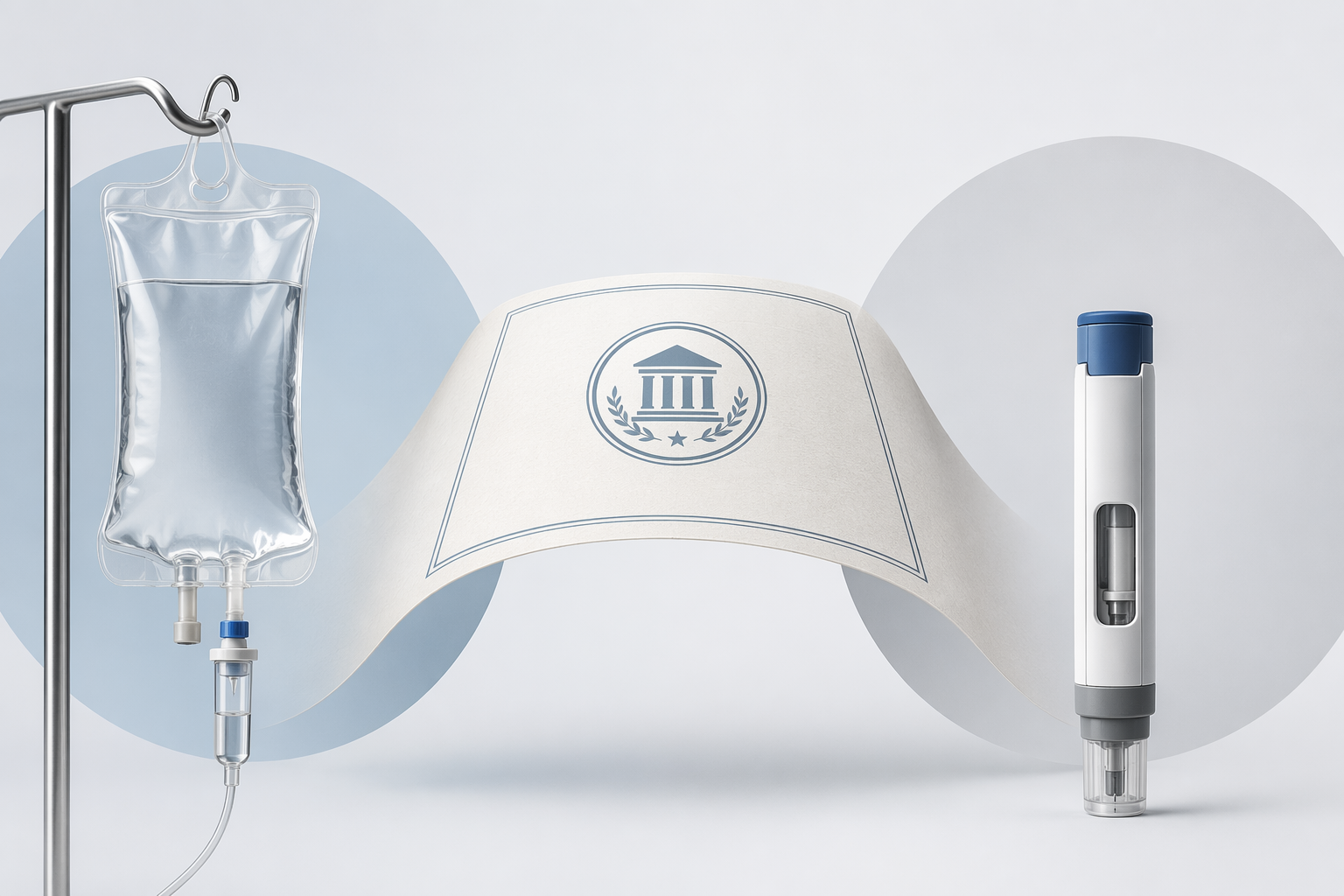
That proposal matters because it changes the unit of analysis. If IV Keytruda and Qlex are treated separately, then the older product can face negotiation or competition while the newer product preserves a different pricing pathway. If they are treated together, the manufacturer cannot as easily turn a delivery change into a clean escape from the negotiated price.
The legal move is not a ban on reformulation. It is a refusal, at least in proposed form, to let reformulation alone decide the boundary of Medicare negotiation. That distinction is important. CMS is not saying that subcutaneous administration has no value; it is saying that value does not necessarily create a separate economic identity for purposes of the maximum fair price process.
There is still a procedural brake on any confident conclusion. CMS will not release the 2029 selected-drug list until February 1, 2027, and the proposed rule may change before finalization.[1] Counsel advising on launch, contracting, or litigation strategy cannot treat the proposal as settled law. They also cannot ignore it as a stray policy signal.
The Orphan Exclusion Changed the IRA Clock
The IRA negotiation story became more complicated after the One Big Beautiful Bill Act was signed on July 4, 2025. The law broadened the IRA’s orphan-drug exclusion, changing the treatment of certain drugs with orphan designations and approved indications.[3]
That change had an immediate practical effect for Keytruda. KFF reported in March 2026 that Keytruda, with $5.6 billion in Medicare Part B spending in 2023, and Opdivo, with $2.0 billion, had been expected for selection but were removed because of the expanded exclusion.[4]
The budgetary consequence is not incidental. CBO estimated the expanded exclusion would cost $8.8 billion over a decade, and KFF noted that the estimate did not originally include the effect of adding Keytruda, Opdivo, and Darzalex to the set of affected drugs.[4]
This is where ordinary shorthand does damage. Keytruda did not simply “lose” IRA negotiation status in a permanent sense. The better description is narrower: the OBBBA orphan-drug change removed Keytruda from the expected 2028 selected-drug list, while its precise eligibility for later rounds depends on CMS interpretation of the statutory language and the agency’s implementation choices.
Merck had already anticipated IRA exposure. Fierce Pharma reported that the company expected Keytruda to face the IRA price-setting process starting in 2026, with price cuts taking effect in 2028.[5] The OBBBA change disrupted that expectation, but CMS’s subcutaneous-formulation proposal then pulled the pricing issue back into the 2029 frame.
Biosimilars Are the Other Half of the Squeeze, Not a Guaranteed Ending
Patent cliffs are often discussed as if they mechanically convert exclusivity into competition. Biologics rarely make it that tidy. Even when core patents expire, biosimilar entry depends on FDA approvals, patent litigation outcomes, and settlements that may not be public when forecasts are made.
BioPharma Dive’s broader patent-cliff reporting places Keytruda among the large biologic products facing major loss-of-exclusivity pressure, and the current analyst estimate points to possible biosimilar entry around December 2028.[6] That estimate is useful for sequencing the risk; it is not a court judgment, an FDA approval, or a launch commitment.

This uncertainty is exactly why the CMS proposal matters. If biosimilar challengers arrive late, settle narrowly, or spend years litigating around secondary patents, a successful formulation migration can preserve substantial pricing leverage during the very period when Medicare negotiation is trying to capture savings.
The Patent-Thicket Evidence Is Relevant, but It Needs Sorting
The patent record around Keytruda is large enough to matter, but the counts are not interchangeable. CSRxP, discussing an ICIJ and USA Today investigation, described more than 1,200 Keytruda-related patent applications across 53 countries.[7] That figure should not be read as 1,200 Merck-owned U.S. patents blocking a domestic biosimilar tomorrow; the broader count includes applications by Merck and other cancer research businesses across multiple jurisdictions.
I-MAK’s narrower Keytruda analysis makes a different claim: about 300 Merck-specific U.S. patent filings, with more than 50 active patents that the group says could extend exclusivity 14 years beyond 2028.[8] That is advocacy-source framing, but it is still useful because it identifies the legal theory regulators and reformers are reacting to: not one patent, but a stack of later-filed claims that can make entry expensive and uncertain even after the headline cliff arrives.
The Commonwealth Fund’s explanation of drug patenting describes the broader mechanism: manufacturers can use patents on formulations, delivery devices, dosing methods, and other follow-on features to preserve market protection after the original compound patent loses force.[9] Keytruda is not important because that tactic is new. It is important because the product is large enough, and the Medicare spend visible enough, that the tactic is now colliding with an active federal negotiation program.
The Courts Have Stabilized the IRA, but They Have Not Answered This Question
The constitutional challenge to IRA negotiation is no longer the only legal story. The 3rd Circuit’s May 2025 decision upholding the program gave CMS a more stable platform to administer negotiation, reducing the chance that the entire structure disappears before Keytruda reaches the relevant cycle.
But stability is not the same as doctrinal completeness. The harder Keytruda question is administrative and statutory: when Congress authorizes negotiation for a selected drug, how far may CMS go in defining the selected unit where a manufacturer has moved from IV infusion to subcutaneous injection?
That question matters for more than Merck. If CMS finalizes the simultaneous-negotiation approach, future biologic manufacturers will have to account for the possibility that a delivery-format successor does not create a separate Medicare pricing island. If CMS retreats, the signal will run the other way: reformulation may remain a more powerful defense against negotiation than the IRA’s savings estimates assumed.
Other Pricing Levers Add Pressure Without Solving the Core Problem
The TrumpRx most-favored-nation pledge sits beside this structure rather than inside it. Merck was among nine signatories, creating a separate pricing-floor dynamic alongside IRA negotiation. The pledge may affect political and commercial expectations, but it does not decide whether IV Keytruda and Qlex are the same drug for Medicare negotiation purposes.
The same is true of corporate restructuring. Reuters reported in February 2026 that Merck would create a separate cancer division as Keytruda patent loss loomed.[10] That kind of reorganization may make business sense when a company is facing a franchise reset, but it does not answer the statutory question now sitting with CMS.
For readers tracking the broader health-policy environment, the companion issue is not only drug negotiation. Congress is also moving through a period of heavier health transparency and oversight activity, a context covered in Congress Weighs Health Transparency Laws Amid Regulatory Ramp-Up. Keytruda belongs in that larger regulatory moment, but its immediate test is narrower and more technical.
Congress Is Also Testing Patent-Stack Limits
The legislative response is moving on a parallel track. Bipartisan patent reform bills, including S. 1041, S. 2276, and the ETHIC Act, would limit the number of patents a biologic manufacturer can assert against biosimilar competitors. The shared premise is that patent quantity can become a litigation weapon even when individual patents may be valid.
Those bills should not be treated as if enactment is inevitable, or as if they would instantly clear every biosimilar path. Their importance is more modest: Congress is now examining the same pressure point from the patent side that CMS is examining from the pricing side. One branch is asking how many patents can be used to slow a biosimilar; the agency is asking whether a formulation successor should inherit separate negotiation treatment.
What Keytruda Will Actually Test
The cleanest version of the test is this: can U.S. pricing law prevent a biologic patent cliff from being converted into a formulation-based delay strategy? Keytruda is the first product large enough to make that question unavoidable across the IRA, Medicare Part B spending, biosimilar litigation, orphan-drug exclusions, and patent-stack reform.
The answer is not available yet. It depends on whether CMS finalizes its proposed treatment of IV and subcutaneous formulations, whether Keytruda appears on the February 1, 2027 selected-drug list for the 2029 negotiation cycle, and whether biosimilar challengers can move through approvals, litigation, and settlements quickly enough to matter during the 2028–2029 squeeze.[1]
What can be said now is narrower and more consequential than a victory lap or a doom chart. Keytruda has forced a boundary question that U.S. drug-pricing law previously managed to postpone: when a biologic’s commercial life is extended through a new route of administration, should Medicare price the successor as a new product, or as part of the same franchise whose exclusivity is already ending?
References
- Medicare drug price rule may target under-the-skin Keytruda and Opdivo, BioPharma Dive
- Half of Merck's sales are in jeopardy. Can Keytruda's sequel save the day?, BioPharma Dive
- Key Inflation Reduction Act Amendment Broadens U.S. Protection for Orphan Drugs, Sidley
- Key Facts About Medicare Drug Price Negotiation, KFF
- Merck expects oncology king Keytruda to face IRA 'price setting' process starting in 2026, Fierce Pharma
- Big pharma's looming threat: a patent cliff of 'tectonic magnitude', BioPharma Dive
- NEW REPORT OUTLINES MERCK'S STRATEGY TO BLOCK COMPETITION, KEEP PRICES HIGH ON BLOCKBUSTER CANCER DRUG KEYTRUDA, CSRxP
- Merck's Scheme to Product Hop Keytruda, I-MAK
- How Drugmakers Use the Patent Process to Keep Prices High, Commonwealth Fund
- Merck to create separate cancer division as Keytruda patent loss looms, Reuters
Comments
Join the discussion with an anonymous comment.