
A Legionnaires' outbreak wrongful death file rarely begins as a clean case list. It begins as a stack of outbreak notices, press conferences, law-firm announcements, death certificates, hospital timelines, cooling-tower records, municipal notices of claim, and docket entries that do not use the same vocabulary. News coverage may tell a lawyer that people died. It usually does not answer the next questions: which defendant was sued, where the claim was filed, whether the defendant has seen similar claims before, what damages figures have surfaced in comparable cases, and whether a reported death count is official, alleged, or still being investigated.
That is the practical value of legal analytics in this corner of mass-tort and premises-liability work. The tools do not prove causation. They do not make a confidential settlement public. They do not turn an outbreak investigation into admissible expert proof. What they can do is make the litigation map visible sooner: outbreak by outbreak, venue by venue, defendant by defendant, and damages tag by damages tag.

Harlem Shows Why the Case Universe Has to Be Built Carefully
The 2025 Harlem outbreak is the kind of cluster that punishes loose counting. ABC7NY reported more than 114 confirmed cases, 90 hospitalizations, and 7 deaths in connection with new lawsuits against New York City and Skanska construction entities after the outbreak.[1] The New York Post later reported that lawyers alleged the outbreak may have killed up to 20 people, while the official death count remained 7.[2] Those two figures cannot be blended into one damages assumption. One is an official count. The other is a litigation allegation.
The filing record adds another layer. A PRNewswire announcement for the first Harlem lawsuit said more than 50 people had retained counsel and that notices of claim exceeded $210 million against the City of New York.[3] The same announcement framed the case around alleged failures tied to an unregistered cooling tower at a Skanska construction site.[3] ABC7NY likewise reported allegations that the tower had not been registered and therefore had not been inspected.[1]
For analytics work, each of those details belongs in a different field. Confirmed cases and hospitalizations belong with outbreak scale. Official deaths belong with public-health findings. Alleged additional deaths belong with pleading and damages allegations. Notices of claim belong with municipal exposure and procedural timing. The unregistered-cooling-tower allegation belongs with defendant conduct and public compliance records. If they are collapsed into one narrative, the file becomes dramatic but less useful.
Harlem also matters because it is not just a private premises case. The involvement of New York City, reported links to NYC Health + Hospitals across Harlem outbreaks, and construction entities creates a mixed defendant set. Municipal claims bring notice requirements and immunity questions. Construction defendants bring contractor-history and site-control questions. Public-health facts sit next to docket facts, but they do not become docket facts until they appear in a filing, motion, order, verdict, or settlement record.
The Upper East Side Filing Is a Signal, Not Yet a Dataset
The litigation wave did not stop with Harlem. On July 15, 2026, a PRNewswire announcement reported a new Legionnaires' disease lawsuit against the City of New York tied to an Upper East Side outbreak that allegedly sickened 64 people.[4] As of the current writing date, that filing is only days old. It is useful for party tracking, counsel tracking, and early venue monitoring. It is not yet a reliable source for settlement behavior, motion practice, judicial treatment, or damages outcomes.
That distinction is where a litigation analytics platform earns its keep. A new filing can be logged immediately without being overread. Counsel can flag the defendant, the filing date, the court, the cause-of-action language, and any related notices or public-health materials, then wait for the record to mature. The temptation is to treat every new outbreak complaint as confirmation of a trend. The better use is narrower: add it to the map, label its stage, and do not give it the weight of a resolved case.
What Legal Analytics Actually Adds
Lex Machina is the obvious example because its value is not just docket search. Its Litigation Footprint feature was described in 2024 as adding 18 million cases to help map party litigation history across state and federal dockets.[5] Separate product-coverage materials have described a platform with broad federal coverage and product-liability analytics, while Lex Machina's 2023 Torts Litigation Report was released as a torts baseline resource.[6][7] Practitioners should still verify current 2026 coverage, tags, and filters in the live platform, especially where older materials describe specific damages tags or practice-area coverage.
The core workflow is less glamorous than the sales language around analytics, but it is where the work happens. A lawyer starts by building a Legionnaires-related search set, then narrows it by claim type, defendant category, court, date range, and damages indicators. If the platform supports a wrongful-death or disfigurement-type damages tag, that tag helps separate fatality claims from exposure, nuisance, or nonfatal illness cases. The resulting universe is then checked against outbreak timelines so that a hotel case from Napa, a hospital-associated case, and a municipal New York claim are not treated as interchangeable merely because the disease label matches.
| Analytics Task | What It Helps Separate | Why It Matters |
|---|---|---|
| Search Legionnaires-related filings | Disease references, outbreak names, defendant names, and claim language | Builds the first case universe without relying only on news or law-firm pages |
| Filter for wrongful death and damages indicators | Fatality claims from nonfatal illness or exposure claims | Keeps valuation work tied to comparable injury severity |
| Compare venues | Federal, state, municipal, and outbreak-specific filing patterns | Shows where similar claims have been filed and how quickly they moved |
| Inspect party litigation histories | Repeat defendants, related entities, insurers, contractors, and public bodies | Surfaces prior defense behavior and related disputes before mediation |
| Place outcomes beside epidemiology | Settlement and verdict figures versus fatality-rate baselines and outbreak facts | Prevents damages benchmarks from being read as automatic prediction ranges |
The party-history step is especially important in Legionnaires' cases because the nominal defendant is often not the only meaningful actor. A hotel brand may differ from the property owner or management entity. A hospital case may involve facility operations, water-management vendors, or public healthcare systems. A construction-site allegation may require contractor, owner, and municipal records to be read together. Analytics can show which names have appeared in prior litigation; it cannot decide whether the entity in the caption controlled the water system that allegedly caused the infection.
Fatality Rates Belong Beside Damages Data, Not Inside It
The CDC states that Legionnaires' disease has a case-fatality rate of about 10%, rising to about 25% for healthcare-associated cases, and that reported incidence has increased eightfold since 2000.[8] Those numbers are not damages numbers. They are epidemiological baselines. They help a lawyer understand why fatality claims appear predictably within larger outbreaks and why hospital-associated clusters may carry a different mortality profile. They do not tell a mediator what a particular decedent's case is worth.
The useful move is to place CDC baselines next to outbreak-specific facts. A cluster with 114 confirmed cases, 90 hospitalizations, and 7 official deaths presents one mortality picture.[1] A case in which lawyers allege additional deaths presents a litigation theory that may or may not be accepted as the record develops.[2] A healthcare-associated claim should not be benchmarked casually against a hotel guest's case without checking the different fatality-rate context, defendant duties, medical causation record, and available compliance evidence.
Reading the $1.75 Million to $4.5 Million Damages Signals
Reported Legionnaires' wrongful death outcomes are commercially useful and easy to misuse. Pritzker Hageman reports wrongful death resolutions of $3 million, $2.25 million, and $1.75 million on its Legionnaires' disease wrongful death page.[9] Those figures are important benchmark signals. They are also self-reported law-firm outcomes, which means they may overrepresent favorable plaintiff results and omit confidential settlements that never appear in public.
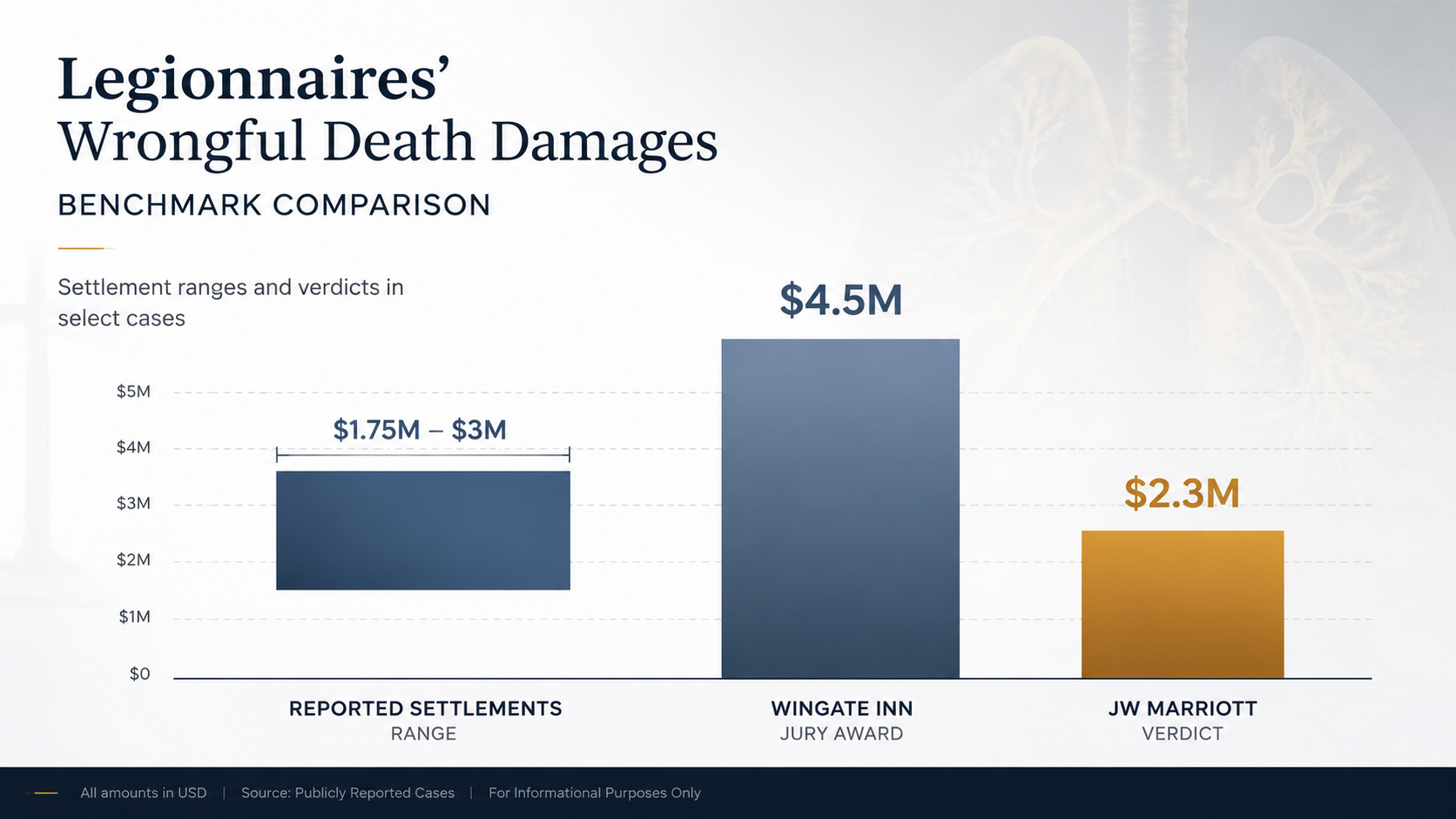
Jury outcomes provide a different kind of signal. McEldrew Purtell's outbreak and lawsuit catalog identifies a $4.5 million Wingate Inn jury award and a $2.3 million JW Marriott federal verdict.[10] EAI Water's case-law review discusses Legionella legal precedents, including the Wingate Inn matter and evidence-destruction issues attributed to the hotel.[11] The presence of an evidence-destruction fact matters. A verdict influenced by spoliation or unusually bad conduct should not be treated as a clean disease-severity comparator.
A sober benchmark table for a mediation deck would therefore separate at least three categories: confidential or self-reported settlements, plaintiff verdicts with aggravating facts, and federal verdicts from hotel-related outbreaks. It would also note what the number measures. A $3 million reported settlement is not the same kind of evidence as a $4.5 million jury award. One may reflect negotiated risk, insurance limits, confidential causation disputes, or business judgment. The other reflects what a jury did on a developed record in a particular venue.
| Benchmark | Reported Amount | How to Read It |
|---|---|---|
| Wrongful death settlements reported by plaintiff counsel | $1.75 million, $2.25 million, and $3 million | Useful settlement signals, but self-reported and affected by selection bias |
| Wingate Inn jury award | $4.5 million | A verdict signal that should be read with the reported evidence-destruction context |
| JW Marriott federal verdict | $2.3 million | A hotel-related verdict signal, not a universal valuation floor or ceiling |
This is where analytics should discipline the damages conversation rather than inflate it. The question is not whether a Legionnaires' death case is “worth” the highest number on the slide. The question is which cases in the searchable universe share enough features to sit near each other: death versus severe illness, healthcare-associated versus hotel-associated exposure, proof of source, compliance record, defendant notice, venue, judge, spoliation allegations, age and earning profile of the decedent, and the procedural posture at resolution.
Repeat Defendants Change the Pre-Filing Questions
The most practical repeat-party work happens before a complaint is drafted or before a defendant evaluates early resolution. If NYC Health + Hospitals Corp., Hilton-related entities, Skanska USA, or municipal New York entities appear in more than one outbreak-adjacent context, a lawyer wants to know more than the name. The useful questions are procedural: where have these entities been sued, which related entities were named, how often did cases stay in state court or move to federal court, which firms appeared, what motions were filed, and whether damages tags or wrongful-death indicators appear in comparable matters.
Napa illustrates the point from the hotel side. The Press Democrat reported that a wrongful death lawsuit tied to a 2022 Legionnaires' outbreak in Napa was headed to trial, with jury selection set for April 20, 2026; the report described 1 death, 16 hospitalizations, and allegations involving a Hilton hotel decorative pond and cooling tower.[12] That case belongs in the same broad litigation map as Harlem because it involves Legionnaires' disease and wrongful death. It does not belong in the same valuation bucket without adjustment. A hotel decorative-water feature, a construction-site cooling tower, and a municipal public-health response create different proof problems.
For defense counsel, Litigation Footprint-style party mapping can also reveal whether a defendant is facing isolated exposure or a developing pattern. For plaintiff counsel, it can show whether a nominally local defendant sits inside a larger litigation history. For legal operations teams, it can support reserve discussions and outside-counsel selection. The point is not to label a repeat defendant as liable. The point is to avoid pretending each outbreak starts with a blank caption.
Venue and Judge Patterns Are Strategy Inputs, Not Answers
Venue analysis in Legionnaires' wrongful death litigation has to do several jobs at once. It tracks where outbreak defendants can be sued. It shows whether cases concentrate in federal courts such as the Southern District of New York or California federal courts when hotel, municipal, or multi-state defendants are involved. It identifies judge assignment patterns, motion timing, and the kinds of orders that appear before settlement pressure changes. None of that replaces local procedural analysis, but it keeps lawyers from making venue judgments from memory.
Municipal defendants add another layer. New York City cases can involve notice-of-claim timing and sovereign-immunity limitations that do not operate the same way in a private hotel case. A platform can help identify prior municipal Legionnaires' filings, related tort cases, and timing between notice, filing, removal, motion practice, and disposition. It cannot tell counsel whether a specific public-health act will be treated as discretionary, ministerial, immune, or actionable on a given record.
Judge-level analytics should be handled with the same restraint. Assignment history, motion grant rates, time-to-resolution data, and prior exposure to complex torts can shape expectations. They should not be converted into a promise that a judge will respond to a Legionnaires' causation fight, discovery dispute, or Daubert-style challenge in a predetermined way. The human record still matters: the decedent's medical history, the outbreak investigation, the defendant's documents, and the credibility of experts.
A Usable Analytics File Looks Different From an Outbreak Timeline
An outbreak timeline is chronological. A litigation analytics file is relational. The Harlem file should connect official health counts, alleged death counts, notices of claim, registered or unregistered tower allegations, defendants, counsel, venues, and filing dates. The Upper East Side filing should be labeled as new and immature. Napa should be tagged as a hotel case with trial activity. Wingate Inn and JW Marriott should be tagged as verdict benchmarks, with their factual qualifiers preserved. Settlement figures should be marked by source type and confidentiality limits.
- Start with the outbreak name, date window, jurisdiction, and public-health source.
- Link each complaint to defendants, related entities, counsel, court, judge, and filing date.
- Separate official deaths, alleged deaths, hospitalizations, and represented claimant counts.
- Tag defendant type: hotel, hospital, contractor, municipal entity, owner, manager, or vendor.
- Keep damages outcomes in source-aware buckets: public verdict, reported settlement, confidential settlement, or unresolved claim.
Once built that way, the file can answer better questions. It can show whether a new complaint resembles prior hotel verdicts or sits closer to municipal outbreak litigation. It can flag repeat counsel and defendants. It can expose gaps where the public story is louder than the docket record. It can also warn a lawyer when a promising benchmark is too fact-specific to carry much weight.
The limitation should stay visible. Structured litigation data sees filings, parties, tags, courts, judges, timing, motions, and disclosed outcomes. It only partially sees causation proof, expert vulnerability, public-health uncertainty, insurer behavior, grief evidence, and the private reasons a case settles. In Legionnaires' wrongful death litigation, that still leaves a great deal outside the dashboard.
Even so, the working conditions have changed. A lawyer no longer has to walk into a valuation meeting with only outbreak clips and a few remembered verdicts. Lex Machina-style analytics can now give litigators a sharper map of where similar claims have been filed, which defendants have appeared before, how venues and judges entered the record, and which damages figures are public enough to discuss. It does not decide liability. It does reduce the amount of blindness.
References
- New lawsuits filed against NYC, Skanska construction on behalf of victims of Harlem Legionnaires' outbreak, ABC7NY
- NYC Legionnaires outbreak may have killed up to 20..., New York Post, 2025
- First Lawsuit Filed Against the City of New York in Harlem Legionnaires' Disease Outbreak, PRNewswire
- Legionnaires' Disease Lawsuit Filed Against the City of New York... (Upper East Side), PRNewswire, July 2026
- Powered By An Added 18M Cases, Lex Machina's New 'Litigation Footprint'..., LawNext, 2024
- Lex Machina's Legal Analytics Platform Handles Federal Product Liability Litigation, Legal Reader
- Lex Machina Releases 2023 Torts Litigation Report, PRNewswire, 2023
- Clinical Features of Legionnaires' Disease and Pontiac Fever, CDC
- Legionnaires' Disease Wrongful Death Lawsuits, Pritzker Hageman
- Legionnaires' Disease Outbreaks and Lawsuits, McEldrew Purtell
- Legionella Lawsuits: Case Law Review and Legal Precedents, EAI Water
- Wrongful death lawsuit tied to 2022 Legionnaires' outbreak in Napa heads to trial, The Press Democrat, April 2026
Comments
Join the discussion with an anonymous comment.