
The public face of FBI World Cup security is unusually visible: background checks, intelligence coordination, foreign police liaison work, and a joint operations center built for an event spread across borders and jurisdictions. Director Kash Patel said the Bureau had conducted 300,000 background checks on players, coaches, and other personnel, and described a joint operations center involving police from 46 countries.[1] That is a meaningful security record. It is not, by itself, a single legal regime.
For a legal review of FBI World Cup security in 2026, the first distinction is venue classification. The MetLife Stadium final has been treated as a National Special Security Event, while the other 77 U.S. matches fall under Special Event Assessment Rating 1 or 2 designations.[4] That difference matters because NSSE and SEAR frameworks do not merely describe threat level. They affect who leads, who documents the decision chain, and which public entity may later need to explain why it relied on someone else’s operational judgment.

The known architecture has five layers. The event designation layer separates the NSSE final from SEAR-rated matches. The statutory layer includes newly extended counter-drone authority under the Safer Skies Act of 2025. The intelligence layer includes FBI domestic coordination, ODNI-backed interagency work, and international police participation. The funding layer includes a reported 76-day DHS shutdown that delayed $625 million in FEMA security grants. The local-liability layer rests on a decentralized host-committee model in which U.S. host cities did not operate under one national organizing committee contract.[4][5][6]
The FBI Is Central, But Not Uniformly the Legal Lead
The FBI’s public materials describe a broad domestic intelligence and coordination role. Patel’s June 2026 remarks emphasize vetting, information sharing, and coordination with foreign police agencies, not a wholesale displacement of state and local authority at every venue.[1] Reuters framed the tournament as a defining institutional test for Patel’s FBI, which is useful context for understanding why the Bureau’s posture has received national attention.[2] But institutional prominence and legal command are not the same thing.
At an NSSE, federal security planning is more centralized. The U.S. Secret Service generally has the lead role for the design and implementation of the operational security plan, while the FBI carries lead responsibility for crisis response, intelligence, and counterterrorism-related functions. At SEAR-rated events, federal agencies may be deeply involved, but state and local authorities retain more visible operational responsibility. The result is not a ladder with the FBI on top at every rung. It is a set of venue-specific records that should show which agency had which role at which time.
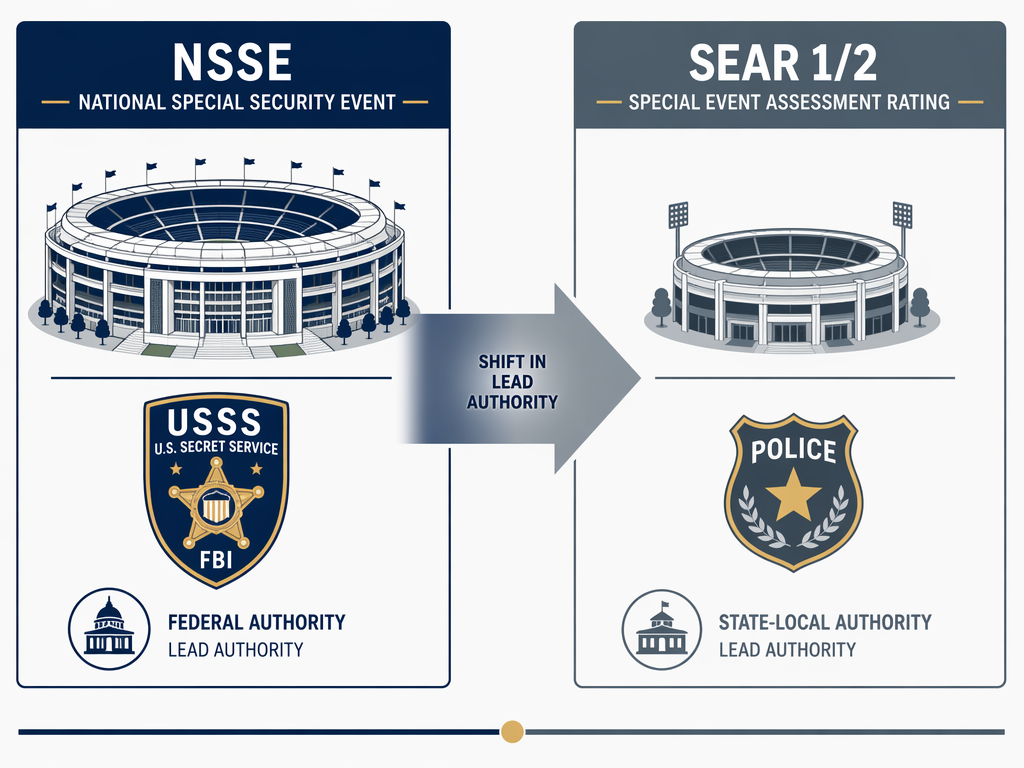
That distinction is easy to lose in ordinary coverage because a stadium security plan usually appears to the public as one coordinated operation. For counsel, the better question is narrower: which designation applied to the match, which agency had the lead for the relevant function, and which state or local entity accepted operational dependence on that lead? A crowd-control decision, a credentialing failure, a drone interdiction, and an evacuation order may all sit in different files even when they occur inside the same tournament footprint.
| Security Layer | Known Public Record | Legal Significance |
|---|---|---|
| Event designation | MetLife final treated as NSSE; other 77 U.S. matches treated as SEAR 1/2 events | Lead authority and documentation duties vary by venue rather than across one uniform federal regime |
| FBI role | Background checks, intelligence coordination, crisis-response functions, and foreign police liaison work | Central operational role does not automatically answer who had legal control over each venue decision |
| Counter-drone authority | Safer Skies Act extends authority to state and local law enforcement; FBI training program used before the tournament | New authority may produce post-event disputes over scope, delegation, and reasonableness |
| Funding capacity | Reported 76-day DHS shutdown delayed $625 million in FEMA security grants | Delayed funding becomes part of the foreseeable-risk and adequacy-of-planning record |
| Host-city responsibility | Decentralized host-committee structure; Foxborough dispute over $7.8 million in unfunded security costs | Local governments may bear residual costs or liability without full control over tournament design |
Designation Changes the Paper Trail
The MetLife final’s NSSE treatment is the cleanest place to see mature federal machinery. NSSE designation exists for events where national significance and risk justify federal planning at the highest level. That structure is familiar to lawyers who have reviewed presidential inaugurations, major political conventions, or other high-profile events. It produces a recognizable hierarchy, even if the underlying operational plan remains sensitive.
The other U.S. matches present a less centralized legal posture. USA Today reported that the 77 non-final U.S. matches are SEAR 1 or SEAR 2 events.[4] A SEAR designation can still draw substantial federal support, including FBI and DHS involvement, but it does not collapse state and local responsibility into a single federal command model. For after-action review, that matters more than the label’s public messaging value.
A municipal lawyer looking at a SEAR-rated match will want the record to answer basic questions before the event, not after litigation begins. Who approved the venue security perimeter? Which agency controlled intelligence thresholds for escalation? Who had authority to delay entry, close a gate, or suspend play? Which decisions were recommendations from federal partners, and which were binding instructions? If a local government relies on federal intelligence, the reliance should be documentable. If it departs from federal guidance, the reason should be documentable as well.
This is not a technicality. Legal responsibility often turns on the record that existed at the time of the decision. Security professionals need discretion; lawyers need to preserve why that discretion was exercised by one actor rather than another. A designation system that shifts lead authority by venue creates a foreseeable documentation burden. Treating the tournament as one federal security event may be administratively convenient, but it is not what the public-source record shows.
Threat Context Explains the Machinery, Not the Liability Allocation
The security apparatus did not arise in a vacuum. CSIS assessed terrorism risk around the 2026 World Cup in the context of a large, international, symbolically attractive event.[3] Private-sector security assessments have also emphasized the operational complexity of multi-city tournament protection, including stadium security, transit exposure, cyber concerns, and protest or disruption risks.[7][8] Those materials help explain why federal planning is extensive.
They do not answer the liability question. A heightened threat environment may support the reasonableness of stronger screening, more intrusive credentialing, broader intelligence sharing, or more aggressive drone restrictions. It does not identify which agency had legal authority for the contested act. The legal analysis still returns to source of authority, lead actor, delegated function, and record of reliance.
The same caution applies to corruption or financial investigations adjacent to the tournament. Public reporting has described an FBI investigation involving the Argentine Football Association, including alleged transactions totaling $300 million and $42 million allegedly diverted through Florida companies, but the research record describes the matter as preliminary and no charges have been filed. That kind of inquiry may matter to broader FIFA or financial-compliance coverage. It should not be converted into proof about venue security governance.
Counter-Drone Authority Is New Enough to Deserve Its Own File
Drone risk is one of the places where legal authority and operational urgency most visibly collide. The Safer Skies Act of 2025, embedded in the National Defense Authorization Act, extended counter-drone authority to state and local law enforcement.[4] That is a major change for World Cup planning because drone incidents near a stadium may require action faster than a traditional federal-only response model can provide.
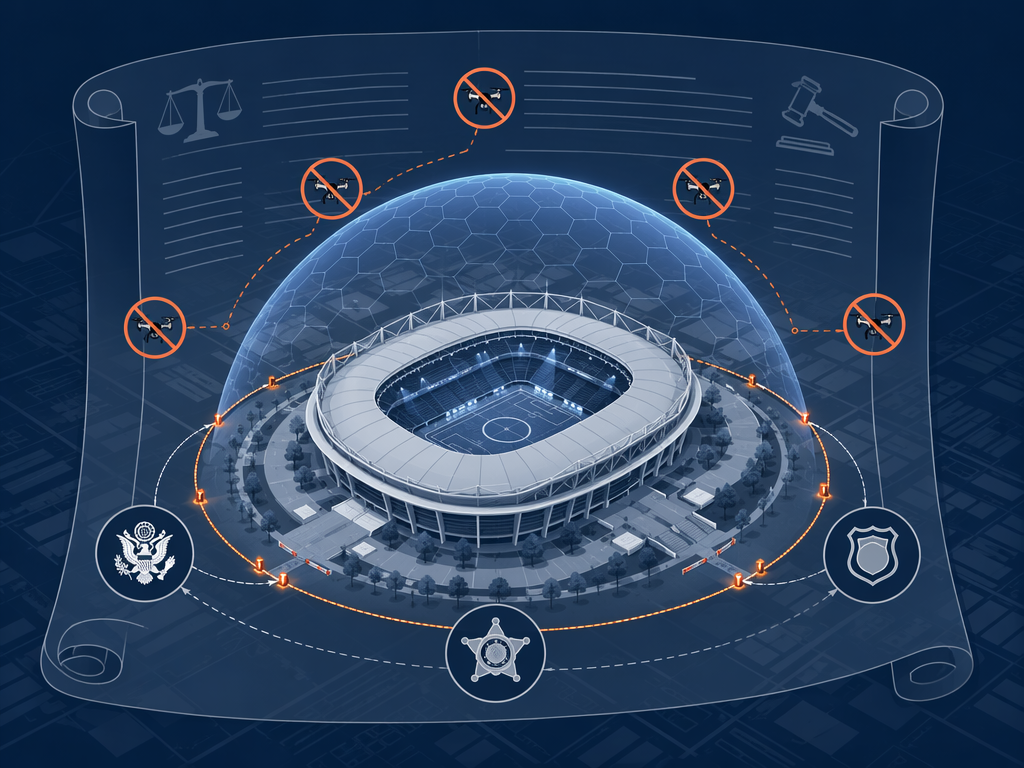
USA Today reported that the FBI’s Huntsville training program graduated 70 officers under this expanded framework.[4] The number is modest compared with the scale of the tournament, but legally significant because it marks the first large-scale test of state and local participation under the new counter-drone authority. The training record may become as important as the statute. If an interdiction is challenged later, the review will not stop at whether the law existed. It will ask who was trained, what authority was delegated, what airspace restrictions applied, what alternatives were available, and whether the response was proportionate to the information available at the time.
The public materials do not justify predicting a wave of litigation. They do justify treating counter-drone decisions as legally exposed. New statutory authority is often most vulnerable at the boundary: state versus federal power, public safety versus property interests, emergency action versus ordinary warrant or privacy expectations, and operational necessity versus overbreadth. The World Cup gives those boundaries a large and visible stage.
Interagency Coordination Is Stronger Evidence Than Reassurance
The ODNI record is important because it shows pre-event intelligence coordination rather than ad hoc crisis management. ODNI Press Release No. 09-26 describes an interagency symposium tied to World Cup security planning, placing the intelligence community’s work alongside the FBI’s domestic coordination role.[5] Patel’s account of a joint operations center with police from 46 countries points in the same direction.[1]
For legal professionals, this is reassuring in a specific way. It supports the view that agencies anticipated cross-border information flows, foreign liaison issues, credentialing concerns, and intelligence escalation before the tournament. It does not eliminate the need to identify which actor could lawfully receive, retain, act on, or share particular information. The more agencies in the room, the more important it becomes to know whether the room was a coordination forum, a command center, an intelligence hub, or some mixture of all three.
That distinction may sound narrow until a challenged decision depends on it. If a local police department acted on a federal intelligence bulletin, the record should show whether the bulletin was advisory, whether it was tied to a specific threat, and who translated it into a local operational order. If a host committee denied access based on credentialing information, the record should show whether the decision came from FIFA rules, federal vetting, local public-safety authority, or private venue policy.
The DHS Shutdown Turns Capacity Into a Legal Fact
Funding and staffing disruptions are not merely administrative background. USA Today reported that a 76-day DHS funding shutdown in spring 2026 delayed $625 million in FEMA security grants tied to the tournament.[4] The same reporting stated that CISA lost roughly one-third of its staff and TSA lost 8 percent, attributing those figures to security experts and Giuliani rather than to audited GAO, CISA, or TSA datasets.[4] That sourcing limitation matters. The figures should be treated as current public reporting, not as final agency accounting.
Even with that caveat, the shutdown belongs in the liability record. Delayed grants can affect procurement, overtime planning, mutual-aid agreements, training schedules, cybersecurity preparation, and physical-security contracting. If a city or host committee postponed a security measure because federal reimbursement was uncertain, that postponement should be traceable. If a local entity proceeded without funds, the source of replacement funding should be traceable. If a planned measure was abandoned, the reason should be traceable.
The open question is not whether the shutdown made the World Cup unsafe. The available materials do not support that conclusion. The better question is whether the shutdown made security adequacy easier to challenge after the fact. A plaintiff, auditor, inspector general, city council, insurer, or legislative committee will not need to prove that funding disruption caused every later problem. It may be enough for scrutiny that public actors knew money was delayed, knew staffing was strained, and still had to decide which protections would proceed.
That is where source quality becomes practical. If staffing-loss estimates remain media-reported and unaudited, counsel should not overstate them. But public reporting can still put officials on notice. Once notice exists, the contemporaneous file should explain how the risk was evaluated, who accepted the residual exposure, and whether the answer differed between an NSSE venue, a SEAR-rated match, a fan zone, a team hotel, or a transit corridor.
Host Committees Carry the Part the Federal Plan Does Not Absorb
The 2026 U.S. structure is decentralized. USA Today reported that each of the 11 U.S. host cities operates through its own independent FIFA deal rather than through one national organizing committee.[4] Public controversy materials likewise describe a host-city model that leaves local committees and municipalities with significant responsibility for infrastructure, services, and security-related costs.[6] The exact contracts between FIFA, host committees, venues, and local governments are not fully public, so the liability allocation cannot be mapped in full from current sources.
The structural risk is still clear enough. Federal agencies may coordinate threat intelligence and support law enforcement operations. They generally do not write blank checks for every local cost created by a global sports event. A host committee may make commitments that depend on city police, public works, emergency medical services, traffic control, and transportation agencies. When those commitments exceed available funding or political authorization, the legal issue is no longer abstract.
Foxborough made the point concrete. Public controversy reporting describes the town’s Select Board refusing an entertainment license for Gillette Stadium over $7.8 million in unfunded security costs.[6] That dispute is not proof that other host cities will face the same breakdown. It is proof that at least one local government treated residual security cost as significant enough to interrupt the licensing path.
For lawyers advising municipalities or host entities, the Foxborough dispute is useful less as a prediction than as a document model. It shows the questions that should be asked before a match week arrives: which costs are mandatory, which are reimbursable, which are politically discretionary, which are tied to a license or permit, and which entity can say no. A local board’s refusal may be inconvenient for tournament operations, but it can also create the clearest public record of a cost that others preferred to treat as absorbed.
The municipal-liability problem is familiar even outside major-event security. Government entities are often judged not only on whether a bad outcome occurred, but on whether their allocation of authority, training, supervision, and known risks was reasonable in context. That same habit of proof appears in other public-safety litigation settings, including police-use-of-force cases where the documentary record can become decisive. For a related discussion, see How Litigation Analytics Reshapes Police Shooting Cases.
What the Current Record Supports
The strongest conclusion is not that World Cup security is underprepared. The public record shows extensive pre-planning: FBI vetting, an international joint operations center, ODNI-backed intelligence coordination, federal event designation, counter-drone training, and visible attention to terrorism and disruption risks.[1][3][4][5] Those are mature features of a serious security architecture.
The weaker conclusion would be that those features settle legal responsibility. They do not. The MetLife final sits in a different governance category from the other U.S. matches. Counter-drone authority has been newly extended and is being tested at a scale that may expose unresolved statutory boundaries. Funding disruption created a public record of delayed grants and reported staffing strain. Host-city responsibility remains decentralized, and the Foxborough dispute shows that local governments may resist being left with costs they did not fully control.[4][6]
A disciplined FBI World Cup security legal review in 2026 should therefore resist the temptation to describe the tournament as operating under one federal security umbrella. The better description is layered authority: federal leadership for some functions and venues, federal support for others, state and local operational responsibility in many places, and private or quasi-public host entities carrying contractual and financial exposure that public sources only partly reveal.
The practical legal work is correspondingly plain. Identify the authority. Identify the lead actor. Identify the documentable duty. Identify the gap between formal responsibility and operational dependence. The most important files will show who had authority, who relied on whom, what funding was delayed, and which local entity accepted or resisted the residual responsibility.
References
- FBI Director Patel video transcript, FBI.gov, June 11, 2026.
- Reuters feature on Kash Patel, Reuters, June 11, 2026.
- CSIS analysis — Byman & McCabe, CSIS, May 27, 2026.
- USA Today security explainer, USA Today, June 11, 2026.
- ODNI Press Release No. 09-26, Office of the Director of National Intelligence.
- List of 2026 FIFA World Cup controversies, Wikipedia.
- Special Security Assessment, The Ackerman Group.
- Three security risks, Securitas.
Comments
Join the discussion with an anonymous comment.