
For food-safety lawyers watching the Taylor Farms Cyclospora retraction, the legally important event is not simply that the FDA corrected itself. It is that the correction came after the market, the plaintiffs' bar, customers, and the recall system had already acted on the earlier government signal.
On July 19, 2026, the FDA said its earlier Cyclospora finding connected to Taylor Farms lettuce was a false positive and apologized to Taylor Farms, while Reuters reported the retraction the following day.[1] The FDA's own outbreak page still described an active five-state investigation involving iceberg lettuce and cyclosporiasis, rather than a closed matter.[2] Taylor Fresh Foods then issued its own statement, emphasizing that the FDA had retracted the positive test and apologized.[3]
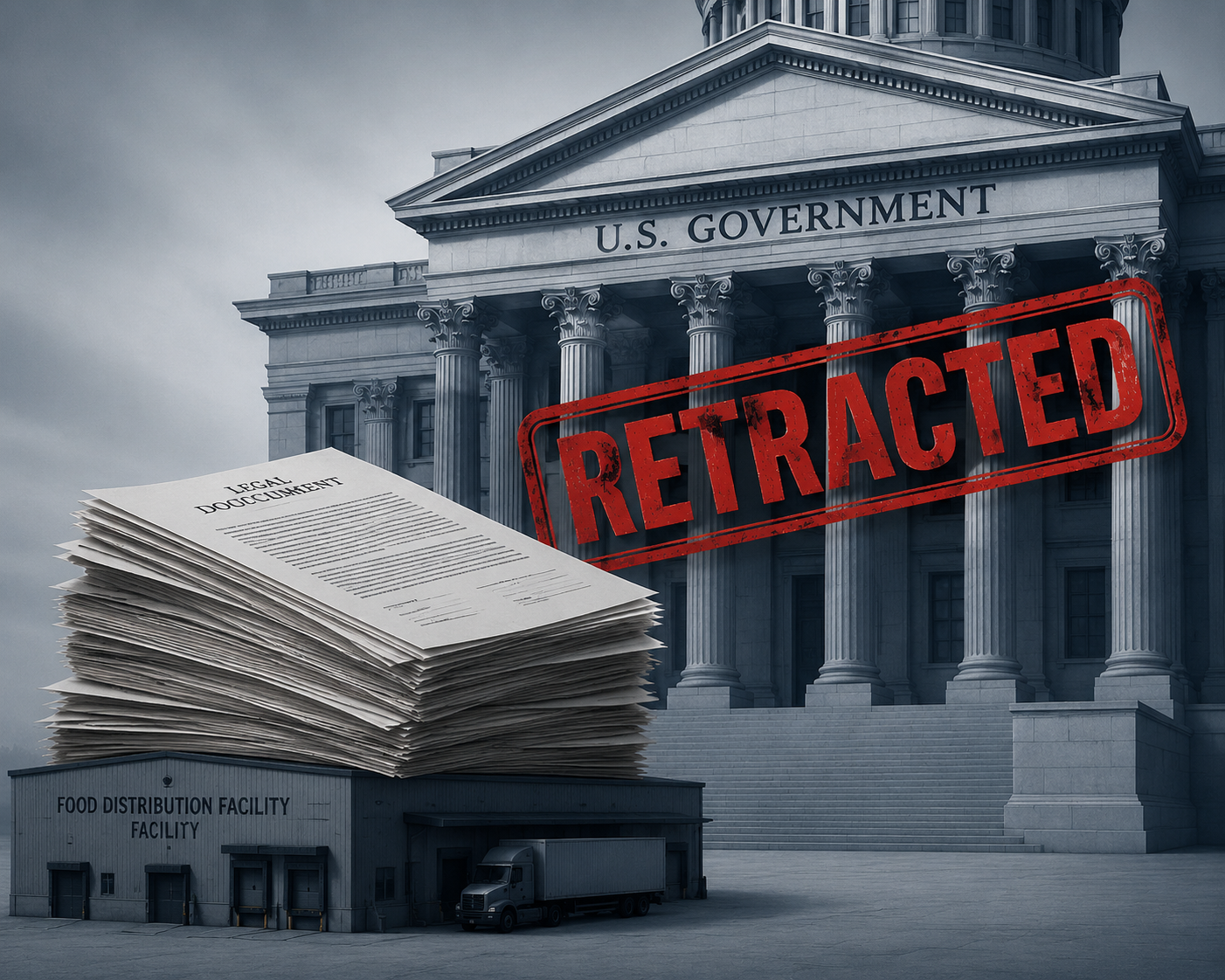
That sequence creates a legal problem with three separate tracks. The false positive matters to any claim Taylor Farms might consider against the government. It matters to the outbreak lawsuits already filed against Taco Bell and Taylor Farms. And it matters to the recall system, where a company can be pushed hard toward a voluntary recall before the evidentiary record is stable.
What the Retraction Changes
The retraction removes the most direct public evidence that Cyclospora was detected on Taylor Farms product. That is a real evidentiary loss for anyone trying to present the product test as a clean causal link. It also gives Taylor Farms a strong reputational and commercial point: the government result that helped put the company at the center of the story was withdrawn.
It does not, however, prove that Taylor Farms had no connection to the outbreak. The FDA's investigation page separately reported epidemiological information, including that approximately 90% of sick people who ate at Taco Bell reported eating iceberg lettuce, and identified iceberg lettuce as the vehicle under investigation.[2] That kind of evidence is not the same as a positive product test, but it does not disappear because one laboratory result was reclassified.
Nor does the apology automatically make the recall legally compensable. The harder question is whether a company that acts on FDA-generated information, recalls product, and then learns that the triggering test was wrong can recover from the federal government. The answer is likely no, or at least not without clearing obstacles that are much higher than the equities suggest.
The Timeline Matters More Than the Apology
Before the retraction, Taylor Farms had already expanded a lettuce recall after a sample tested positive for Cyclospora, according to Fox Business reporting on the recall expansion.[4] By then, the ordinary commercial consequences of a recall were already in motion: product removed from commerce, inventory isolated or destroyed, customer relationships strained, and search results rewritten around contamination headlines.
The lawsuits also arrived before the FDA's retraction. Forbes reported on July 17, 2026, that Taco Bell had been hit with federal lawsuits over cyclosporiasis infections, including Ayyad and Caruso-related filings.[5] A July 17 PRNewswire release from Marler Clark and Darr Law described claims against Taco Bell and Taylor Farms over an outbreak linked by plaintiffs to shredded iceberg lettuce.[6]
That order is why the false positive cannot be treated as a tidy correction. A recall is not a pleading that can be amended without residue. Once distributors, restaurants, insurers, plaintiffs' lawyers, and newsrooms receive the original signal, the later correction competes with what has already been internalized.
| Event | Legal Significance |
|---|---|
| FDA-linked positive Cyclospora result | Created the public evidentiary trigger that placed Taylor Farms product at the center of the recall narrative |
| Taylor Farms voluntary recall expansion | Shifted economic cost and operational burden to the company before final certainty existed |
| Ayyad and Caruso lawsuits filed | Put outbreak allegations into court before the FDA's correction |
| FDA retraction and apology | Removed the product-test evidence but did not close the outbreak investigation |
| Continuing FDA investigation | Left epidemiology and traceback as live issues |
Why an FTCA Claim Would Face a Steep Climb
Taylor Farms' instinctive damages theory is easy to understand. If a government test was wrong, and if that test helped trigger a costly recall, the company would want to ask who pays for the destroyed product, lost sales, crisis response, and reputational harm. In private litigation, that question would immediately sound in negligence, reliance, causation, and damages.
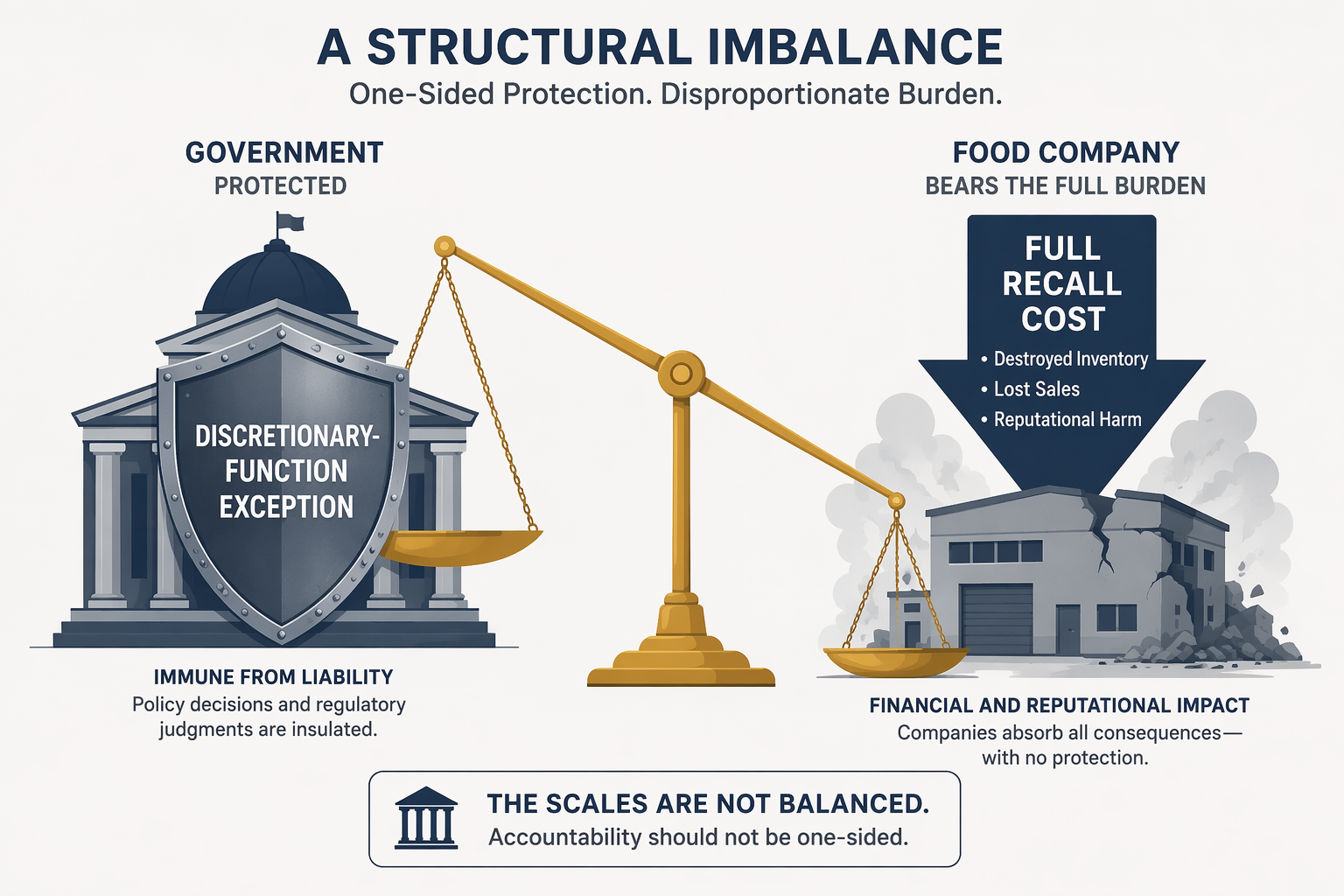
Against the federal government, the analysis changes. A claim would likely have to proceed, if at all, under the Federal Tort Claims Act. The central barrier would be the discretionary-function exception, which generally protects federal agencies from tort liability for conduct grounded in judgment or policy choices. In an active foodborne illness investigation, decisions about sampling, testing, public communication, recall pressure, and outbreak management are exactly the kinds of agency functions the government would characterize as discretionary.
That does not mean every laboratory mistake is automatically immune. A company would try to separate technical execution from protected judgment: mishandled samples, improper validation, chain-of-custody breakdowns, or departures from mandatory procedures look different from policy choices about how to manage public-health risk. The problem is that the currently available public record identifies a false positive and apology, not a fully developed account of a ministerial violation that caused the loss.
No directly analogous precedent in the available materials resolves FDA liability for a false-positive food-testing result that triggers a voluntary recall. That absence matters. It leaves Taylor Farms with sympathy, potential factual questions, and a commercially serious injury, but not with an obvious path around sovereign immunity.
The voluntary nature of the recall also complicates causation. FDA's mandatory recall framework under FSMA gives the agency authority to order a recall only after specified statutory procedures, including an opportunity for voluntary action, and FDA guidance describes mandatory recall authority as a tool used when responsible parties do not voluntarily remove violative food from the market.[8] FDA's Q&A materials likewise frame mandatory recall as a structured authority, not the first move in every outbreak response.[9]
That framework creates a familiar litigation tension. The company can say the recall was practically compelled by FDA information, customer pressure, and public-health risk. The government can say the recall was voluntary and that outbreak communications involved protected judgment. Both statements can be true enough to leave the injured company without a realistic damages remedy.
Why the Outbreak Lawsuits Do Not Automatically Collapse
The plaintiffs' cases have a different evidentiary problem. They do not need to prove that FDA can restore its own credibility after a false positive. They need to prove, under the applicable civil standard, that the defendants' food was the likely source of the plaintiffs' illnesses and that liability attaches under the relevant product-liability, negligence, warranty, or statutory theories pleaded.
The withdrawn product test would have been powerful evidence because it appeared to connect the pathogen to product in the supply chain. Losing it narrows the plaintiffs' proof. It gives defense counsel an obvious cross-examination theme: the government result that generated the most damaging headline was wrong. It also complicates any effort to portray the case as scientifically straightforward.
But the lawsuits were not described as resting only on that test. The FDA's outbreak page reported that approximately 90% of sick Taco Bell diners had eaten iceberg lettuce, and the investigation focused on iceberg lettuce as the vehicle.[2] Plaintiffs' public filings and releases also identified Taylor Farms as Taco Bell's shredded-iceberg supplier in the challenged supply chain.[6] Those are distinct evidentiary lanes: epidemiology asks what sick people commonly ate, while traceback asks where that food came from.
Defense counsel will attack both. Food histories can be incomplete. Restaurant meals involve multiple ingredients and possible exposures. Traceback can show supply relationships without proving contamination at a particular time, facility, or lot. A false positive adds force to those attacks because it shows that one government-generated link was unreliable.
Still, civil outbreak cases often proceed on combined circumstantial proof. The loss of a product isolate or positive sample may weaken the case without ending it. A judge assessing motions practice will not treat an FDA apology to Taylor Farms as a merits adjudication for every plaintiff. The question will be whether the remaining epidemiological, medical, and supply-chain evidence can support causation for the named plaintiffs.
The Prior-Outbreak Record Is Context, Not Causation
Plaintiffs' counsel will also use history. The Marler Blog framed the 2026 outbreak against prior Taylor Farms-associated matters, including a 2013 Cyclospora outbreak with 643 cases, a 2015 E. coli outbreak linked to Costco products, and a 2024 E. coli O157:H7 outbreak at McDonald's with one death; the post said Taylor Farms' safety claims "are belied by its record."[7]
That history has rhetorical force and may shape settlement posture, public perception, and plaintiffs' theory of notice or corporate practices. It is not proof that Taylor Farms caused this outbreak. Prior incidents do not substitute for evidence about this lettuce, this supply chain, these plaintiffs, and this exposure window. Treating them as causation evidence would overread the record.
The Recall Incentive Problem
The uncomfortable policy lesson is not that FDA should wait for perfect information before speaking. In an outbreak investigation, delay has its own victims. Cyclospora illnesses are not solved by agency caution alone, and companies in the food chain should not be rewarded for waiting until every uncertainty is eliminated.
The problem is asymmetry. FDA can act under public-health pressure, update its investigation, and later retract a result. The company that recalls based on the original signal bears the immediate economic consequences. If sovereign immunity and the discretionary-function exception block damages, the government correction may restore part of the public record but not the balance sheet.
FSMA's recall structure depends heavily on voluntary compliance before mandatory powers are used. FDA's final guidance explains the agency's mandatory recall authority and the circumstances in which FDA may order removal of food from commerce, while the Q&A materials describe the procedural sequence surrounding mandatory recalls.[8][9] In practice, that framework gives companies a powerful incentive to act quickly when FDA identifies risk, even before the evidentiary record is litigation-ready.
That incentive is defensible. It is also fragile. If suppliers conclude that voluntary cooperation leaves them exposed to unrecoverable losses when the government is wrong, the next crisis may involve more hesitation, more lawyering before action, and more insistence on formal orders. None of that improves outbreak response.
What Counsel Should Separate Now
The first task is evidentiary separation. The FDA false positive should be isolated from the epidemiological record, traceback record, recall communications, and company quality records. If those streams are blended, everyone overstates something: Taylor Farms' defenders overstate exoneration, and plaintiffs overstate the continuing force of a test the agency withdrew.
- For Taylor Farms, the strongest immediate value of the retraction is defensive and reputational, not necessarily affirmative recovery from FDA.
- For plaintiffs, the strongest remaining path is combined epidemiology and traceback, not reliance on the withdrawn product test.
- For Taco Bell and other downstream defendants, the retraction may support allocation arguments but does not by itself defeat customer illness claims.
- For future recall planning, the incident belongs in decision logs, customer-notification protocols, and indemnity negotiations.
The second task is timing. Counsel should preserve exactly what was known when the recall decision was made, who communicated it, what FDA said, what customers demanded, and what alternatives were considered. A later false positive does not rewrite the reasonableness of a contemporaneous public-health decision, but it may matter greatly to indemnity, insurance, customer disputes, and public statements.
The third task is restraint. As of July 20, 2026, the FDA's retraction is real, official, and consequential. It is not a judicial finding. It is not a scientific treatise on Cyclospora testing reliability. It is not a dismissal order in Ayyad or Caruso. And it is not, standing alone, an FTCA complaint that survives sovereign-immunity defenses.
The Legal Fallout
Taylor Farms may have suffered the most concrete immediate harm from the FDA's error: a recall decision made under public-health pressure, commercial losses that cannot be fully undone, and headlines that will outlive the correction. Yet the company would likely face a difficult FTCA path because outbreak investigation decisions are strongly positioned for discretionary-function protection, and the public materials do not identify a clear ministerial failure that would avoid that defense.
Plaintiffs, meanwhile, lose an important piece of direct product evidence but not necessarily their cases. Their claims can still be tested through epidemiology, traceback, medical proof, exposure histories, and supply-chain documents. The false positive changes the litigation terrain; it does not end the litigation.
That leaves the recall system with the hardest lesson. The party most pressured to act quickly may also be the party least able to recover when the government's triggering information proves wrong. A public apology can correct the agency's record. It cannot, by itself, put recalled lettuce back into commerce, restore canceled orders, or erase the litigation value of the original announcement.
References
- FDA says Taylor Farms cyclospora finding was a false positive, Reuters, July 20, 2026
- Investigation of 5-State Outbreak of Cyclospora Illnesses: Iceberg Lettuce (July 2026), U.S. Food and Drug Administration
- Taylor Fresh Foods Statement Regarding Cyclospora Outbreak, Taylor Farms
- Taylor Farms expands lettuce recall after positive test, Fox Business
- Taco Bell Hit With Federal Lawsuits Over Cyclosporiasis Infections, Forbes, July 17, 2026
- Marler Clark and Darr Law Sue Taco Bell and Taylor Farms, PRNewswire, July 17, 2026
- The Cyclospora Outbreak Now Has Two Names on It, Marler Blog, July 17, 2026
- FDA Finalizes Guidance on Mandatory Recall Authority, U.S. Food and Drug Administration
- Questions and Answers Regarding Mandatory Food Recalls, U.S. Food and Drug Administration
Comments
Join the discussion with an anonymous comment.