
The legal impact of the House GOP stopgap funding bill does not turn only on how long the continuing resolution would keep the government open. The more useful question is what the bill’s spending promises would be worth after enactment if the executive branch later declines to spend the money Congress appears to have provided.
House Republican leaders have put forward a July 2026 stopgap funding measure ahead of an expected vote, with political attention falling on the bill’s timing and riders, including a SAVE Act provision reported by The Hill.[1] Those features matter. A continuing resolution is still a live legislative vehicle, and its riders can carry consequences far beyond a temporary funding patch. But this CR arrives in a different legal atmosphere from the last generation of shutdown bargaining. It is the first major funding fight after a set of Supreme Court emergency-docket appropriations decisions changed the practical path for challenging withheld funds.

A CR is usually described as a temporary law that keeps agencies funded when regular appropriations bills have not been enacted. It generally extends spending authority for federal agencies for a limited period, often by carrying forward prior funding arrangements rather than rewriting the government’s budget from scratch.[2] That description is accurate as far as it goes. It is also too tidy for the present moment, because a spending statute is only as firm as the remedial system available when an agency, the Office of Management and Budget, or the President treats the statute as optional.
The CR is being negotiated after the enforcement rules moved
The ordinary political account of a stopgap bill assumes that a bargain, once enacted, becomes the government’s operating instruction. Members fight over duration, anomalies, riders, and topline levels because those choices are supposed to bind the executive. The Supreme Court’s recent emergency appropriations rulings do not abolish that assumption in formal terms. Congress still writes appropriations. Agencies still receive budget authority through statutes. The Anti-Deficiency Act and the rest of federal fiscal law have not disappeared.
What has shifted is the route from statutory command to judicially enforceable obligation. Prof. Zachary Price’s synthesis of the Court’s emergency appropriations decisions identifies a trilogy — DOE v. California, NIH v. APHA, and AIDS Vaccine Advocacy Coalition — that together point toward a narrower enforcement architecture for disputes over withheld or terminated federal funds.[3] His account is analysis, not a merits opinion from the Court resolving every statutory question. But it is a serious map of the terrain legal professionals now have to cross.
The most visible ruling involved foreign aid. In September 2025, the Supreme Court allowed the Trump administration to withhold billions in foreign-aid funding while litigation continued, in a dispute involving roughly $4 billion that challengers argued had to be spent before the fiscal year expired.[4] The point is not that every future withholding has been blessed. Emergency orders do less than final merits decisions, and they often say less than litigants wish. The point is that when timing is the whole case, interim relief can decide whether appropriated money is ever meaningfully available.
That is why the phrase “pocket rescission” has returned with such force. If an administration proposes not to spend appropriated funds late enough in the fiscal year, and if no court can compel timely obligation before the money expires, the practical result can resemble a rescission even without Congress affirmatively agreeing to cancel the funds. The legal question then becomes less dramatic but more important: who can sue, under what statute, in what court, and on what schedule?
The new path is narrower than the old assumptions
Before the emergency decisions, many lawyers would have expected a familiar sequence. A grantee loses funding or an agency refuses to obligate appropriated money. The affected party sues in federal district court, often invoking the Administrative Procedure Act. The district court considers whether the agency action is arbitrary, capricious, contrary to law, or otherwise reviewable. If the statutory deadline is imminent, the plaintiff seeks emergency relief.
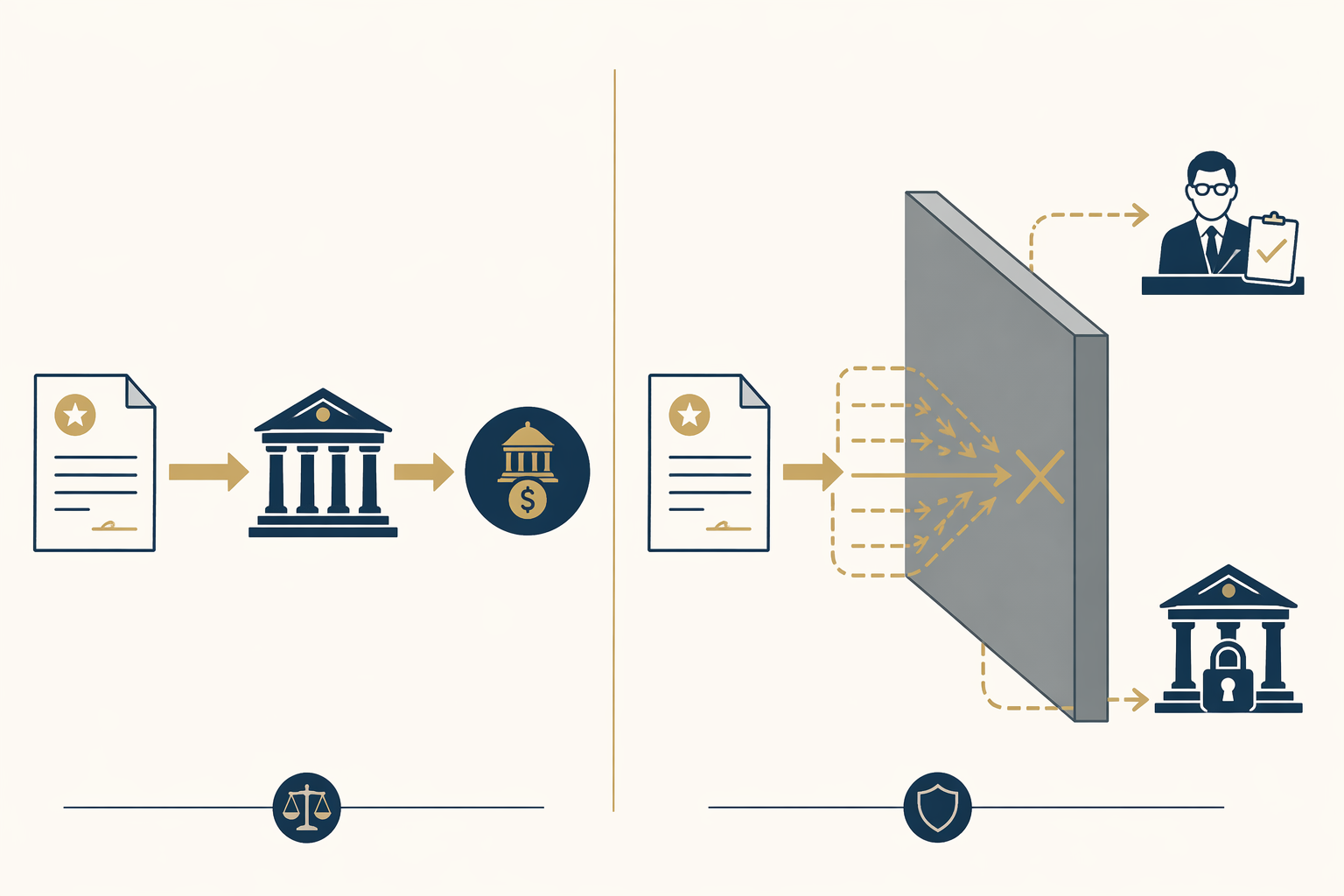
The trilogy complicates that sequence. Price reads the decisions as doing several things at once: redirecting some grant-termination disputes away from district courts and toward the Court of Federal Claims, suggesting that private APA suits may be unavailable in at least some impoundment contexts, and elevating the Comptroller General as the actor Congress designated to enforce the Impoundment Control Act’s procedures.[3] None of those moves is merely procedural housekeeping. Each one changes the bargaining value of appropriations language.
The Court of Federal Claims path matters because it is built for money claims against the United States, not for supervising ongoing agency compliance in the same way a district court injunction might. A plaintiff may be able to seek compensation or relief framed through a contract or money-mandating statute, but that is not the same as obtaining a quick district-court order requiring an agency to continue a program, restore a grant, or obligate funds before a fiscal deadline expires. For a grantee, timing may be the remedy.
Courthouse News Service’s litigation reporting captured the practical stakes: parties challenging alleged impoundments have looked to courts as the last place capable of forcing executive compliance before money disappears into the calendar.[5] That is exactly where forum rules become substantive. A case that can be heard only after the relevant funds lapse is not equivalent to a case that can preserve the funds while the merits are litigated.
The unresolved tension inside the Impoundment Control Act
The Impoundment Control Act was Congress’s post-Nixon answer to presidential refusals to spend. In broad terms, it limits the President’s ability to withhold budget authority by requiring rescission proposals to be sent to Congress and by allowing funds to be withheld only temporarily unless Congress approves the cancellation.[6] That statutory design assumes a Congress unwilling to let appropriations be converted into suggestions.
The difficulty is that the ICA also contains language preserving private litigation positions. The statute says that nothing in the Act should be construed to affect “the claims or defenses of any party to litigation.” That kind of savings language would normally make lawyers cautious before treating the Comptroller General’s enforcement role as exclusive. It reads like a refusal to wipe out other claims.
Yet the emergency decisions point in the other direction, at least in part. Price’s reading is that the Court has signaled a more exclusive enforcement model under which the Comptroller General becomes the practical gatekeeper for ICA enforcement, even though the statutory text is not an easy fit for that result.[3] His recommendation that lower courts construe the exclusivity holding narrowly — for example, limiting it to funds actually subject to rescission proposals — is an interpretive argument, not a guarantee of what lower courts or the Supreme Court will do next.[3]
That is the doctrinal engine under the July 2026 CR. If the executive later withholds funds tied to a CR concession, a private party may argue that the ICA did not displace its APA claim, that the agency acted unlawfully under the appropriations statute, or that the dispute belongs in district court because it is not merely a money claim. The administration may answer that Congress supplied a specific ICA pathway, that the Comptroller General is the proper enforcer, or that the plaintiff’s claim belongs somewhere else. The emergency decisions do not remove all arguments from either side. They do make the challenger’s first month of litigation harder.
The Comptroller General solution is practical, but not simple
A legal system can look orderly on paper while leaving the person with the live injury stranded. The Comptroller General may investigate, issue legal conclusions, and press Congress’s institutional position. That role can be powerful, especially where the dispute concerns the executive’s compliance with budget statutes rather than a single grantee’s payment dispute. But it is not the same thing as letting every affected party walk into district court for emergency relief.
There is also the Bowsher problem lurking in the background. Bowsher v. Synar held that Congress could not retain removal control over an officer exercising executive power. That precedent is why confident claims about a Comptroller-General-centered enforcement regime should be treated carefully. If the Comptroller General is merely reporting, auditing, and suing in a manner consistent with statutory design, the model may be defended. If the office becomes the decisive mechanism for compelling execution of appropriations, separation-of-powers objections are not imaginary.
This is not a reason to say that the Court has definitively invalidated the ICA, or that the executive now has an open license to impound whatever it dislikes. The materials do not support that. The more precise reading is more unsettling: the Court’s emergency posture has made private, fast, district-court enforcement less certain, while channeling more of the burden toward an institutional actor whose own constitutional footing can become contestable at the edge.
Why that changes the value of a CR concession
The July 2026 bill therefore has two lives. In the first, it is a House GOP stopgap funding bill with reported riders, timing choices, and the usual pressure surrounding a shutdown deadline.[1] In the second, it is a test document for a changed appropriations enforcement regime. The first life is what floor managers and campaign committees will argue about. The second is what agency counsel, grantee lawyers, and appropriations staff will have to live with after signature.
Suppose a spending concession is written into a CR in exchange for votes. The old political shorthand would say that the concession has been “won.” Under the new enforcement environment, the more complete statement is that the concession has been enacted and may still require a viable enforcement path if the executive declines to obligate the funds, terminates awards, delays apportionment, or asserts rescission authority. Those are different propositions.
Alan B. Morrison’s analysis in the Yale Journal on Regulation is useful here because it connects impoundment doctrine to shutdown dynamics rather than treating them as separate constitutional curiosities. His point, applied to the current setting, is that impoundment pressure can compound funding crises by making negotiated appropriations less reliable.[7] If one side believes that the executive can later withhold or slow-walk disfavored spending with limited immediate judicial consequence, then the written compromise no longer performs the same settlement function.
That does not mean appropriations riders are meaningless. Congress can still draft conditions, reporting requirements, deadlines, and program-specific instructions. It can still use oversight and subsequent legislation. It can still create political costs. But those tools do not always help the grantee whose award has been terminated this week, the program officer who needs legal clearance before obligating funds, or the negotiator who must decide whether a promised appropriation is durable enough to justify a vote.
Vox’s account of the shutdown stakes put the issue in more accessible terms: if courts cannot or will not quickly force spending, then the executive gains leverage in a funding confrontation even without winning new statutory language.[8] That formulation is blunt, but the underlying point is sound if kept within bounds. The leverage comes not from a formal declaration that the President may ignore appropriations at will, but from remedial friction — delay, forum disputes, standing fights, APA preclusion arguments, and uncertainty over who may invoke the ICA.
The real deadline is not only the date in the bill
Stopgap bills invite attention to dates. How long does the CR run? Does it push the next confrontation past a politically inconvenient moment? Does it create another shutdown threat before agencies can plan? Those questions are legitimate, and the July 2026 House bill should be read with them in mind. But the legal deadline that now deserves equal attention is the deadline for enforceability.
If funds expire before a court can act, if the plaintiff is redirected to a forum that cannot give timely programmatic relief, or if the only recognized enforcement path runs through the Comptroller General, then the spending line may fail in practice even while remaining respectable in statutory form. For legal professionals, that is not a rhetorical distinction. It determines pleadings, forum selection, client advice, compliance risk, and the real-world value of a negotiated term.
The July 2026 CR should therefore be read less as another entry in shutdown theater and more as the first major appropriations bargain negotiated under a narrowed, uncertain enforcement system. The final bill may fund agencies for a defined period. It may contain concessions that look meaningful on the page. The harder question will begin after enactment: who can force the executive to spend, in what forum, and fast enough for the appropriation to matter?
References
- House GOP leaders unveil stopgap funding bill ahead of expected vote, The Hill.
- What Is a Continuing Resolution?, Peter G. Peterson Foundation.
- Making Sense of the Emergency Appropriations Decisions, Harvard Law Review Blog, November 2025.
- Supreme Court allows Trump administration to withhold billions in foreign-aid funding, SCOTUSblog, September 2025.
- Courts could be last hope to thwart Trump impoundment, Courthouse News Service.
- FAQs on Impoundment: Presidential Actions Are Constrained by Long-Standing Law, Center on Budget and Policy Priorities.
- Impoundments Are Compounding the Federal Shutdown Problem, Yale Journal on Regulation.
- The Supreme Court just made it nearly impossible to end the shutdown, Vox.
Comments
Join the discussion with an anonymous comment.