
The legal implications of Cuba's alliances with China, Iran, and Russia do not turn on whether Havana is using warmer rhetoric toward Washington's adversaries. The more consequential question is whether those relationships are taking forms that lawyers, compliance teams, and governments can actually invoke: ratified agreements, immunity clauses, credit structures, participation in economic frameworks, and common doctrines against unilateral sanctions and extraterritorial jurisdiction.
By that measure, the three tracks are moving at different speeds and through different legal instruments. Russia and Cuba signed a military cooperation agreement in March 2025 that was ratified by Russian lawmakers in October 2025; reporting on the agreement describes cooperation on joint operations, intelligence sharing, arms supplies, and immunity from Cuban jurisdiction for Russian personnel.[1][2] Iran and Cuba are pursuing a decade-long strategic partnership after four decades of relations, with reported annual credit lines between $200 million and $500 million.[3] China’s role is less a military analogue than an economic and doctrinal one: Cuba joined the Belt and Road Initiative in 2018, and Beijing provided an $80 million financial aid package and a 60,000-ton rice shipment in early 2026.[4] In May 2025, China and Russia also issued a joint declaration on international law opposing unilateral sanctions and long-arm jurisdiction, language that matters well beyond the bilateral China-Russia relationship.[5][6]
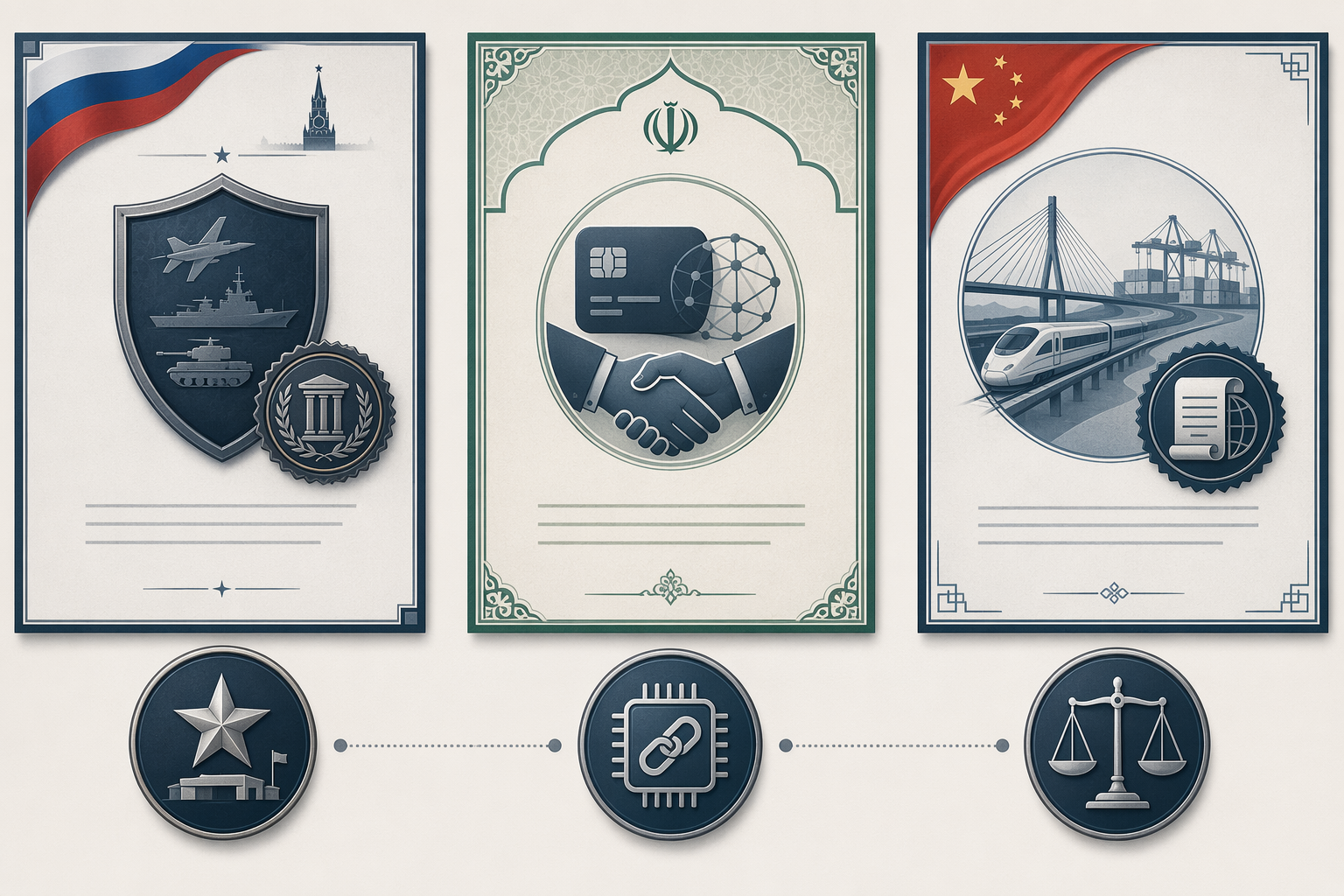
Those instruments should not be collapsed into one loose category of anti-US alignment. A military cooperation agreement does not do the same legal work as a credit line. Belt and Road participation does not create the same operational consequences as immunity for foreign military personnel. A doctrinal declaration against long-arm jurisdiction does not itself block a US subpoena, but it gives states a shared vocabulary for rejecting the legitimacy of such enforcement.
| Track | Instrument | Legal Function |
|---|---|---|
| Russia-Cuba | Military cooperation agreement signed March 2025 and ratified October 2025 | Creates a formal basis for defense cooperation, reported joint operations, intelligence sharing, arms supplies, and immunity provisions |
| Iran-Cuba | Decade-long strategic partnership effort with annual credit lines | Supports financing and strategic cooperation; reported drone-related claims require attribution and caution |
| China-Cuba | Belt and Road participation with emergency assistance | Stabilizes Cuba economically and embeds assistance in a broader Chinese development framework |
| China-Russia | May 2025 joint declaration on international law | Supplies a shared doctrinal position against unilateral sanctions and long-arm jurisdiction |
The Russia Agreement Is the Clearest Legal Instrument
The Russia-Cuba military cooperation agreement carries the most immediate legal weight because it is formal, ratified, and operationally specific. It is not merely a communique announcing friendship. Russian legislative action in October 2025 gave the March 2025 agreement a documentary status that compliance and national-security lawyers cannot treat as atmospheric politics.[1]
The reported content of the agreement is also unusually practical. It provides a legal basis for cooperation in joint operations, intelligence sharing, and arms supplies, and it grants Russian personnel immunity from Cuban jurisdiction.[2] Those features matter because they address permissions and consequences. Who may be present? What may they exchange? What forms of military cooperation are authorized? Which courts may assert jurisdiction if something goes wrong?
The immunity point deserves particular attention. Immunity provisions do not automatically transform a cooperation agreement into a war-fighting alliance, but they do change the legal environment in which foreign personnel operate. They can reduce local criminal or civil exposure for Russian personnel in Cuba and make enforcement depend less on Cuban courts than on the terms of the agreement and the sending state's own processes.
That is a meaningful shift without being a mutual defense treaty. The available reporting supports a conclusion that the agreement creates a formal legal basis for military cooperation and personnel protections. It does not support treating the agreement as an automatic commitment by either state to enter a war on the other's behalf. For sanctions and export-control analysis, that distinction is not cosmetic. A cooperation agreement may increase red flags around defense contacts, dual-use transfers, financial facilitation, shipping, insurance, and services, while still falling short of a collective-defense obligation.
The agreement also gives Cuba and Russia a document around which to organize conduct. If military equipment, technical support, or intelligence-related services are later questioned by another state, the parties are not left relying only on political speeches. They can point to a ratified framework. Whether that framework defeats foreign enforcement is a separate question. But it gives the relationship a legal object that prosecutors, sanctions authorities, banks, insurers, counterparties, and foreign ministries would all have to read.
Iran Adds Strategic Depth, but the Drone Claims Need Quarantine
The Iran-Cuba track is legally significant in a different way. The relationship is described as spanning 40 years, and the current effort is to craft a decade-long strategic partnership backed by annual credit lines reportedly between $200 million and $500 million.[3] That is not the same as the Russia-Cuba military agreement. It is broader, more financial, and less clearly reducible to a single ratified defense instrument in the available material.
Credit lines matter because sanctions risk often appears first in payment architecture. A strategic partnership that includes recurring financing can affect how goods are procured, which banks or intermediaries are approached, how sovereign or state-linked entities allocate risk, and whether transactions are structured to avoid US-controlled channels. The legal issue is not simply whether money is available. It is whether financing channels create repeatable pathways that sit outside the assumptions of US enforcement.
The drone reporting is more sensitive. Diálogo Américas reported drone acquisitions of more than 300 units since 2023 and Iranian advisers on the ground, while NBC Miami reported warnings by US officials that Iranian drones in Cuba could threaten South Florida.[3][7] The figure and the characterization rest on US intelligence assessments cited by officials, including Jeb Bush and Rep. Carlos Gimenez, and Cuban authorities have denied the claims.[7] That makes the reports relevant to risk assessment, but not a settled evidentiary foundation for a legal conclusion.
For a sanctions lawyer, the cautious version is still important. If unmanned systems, advisers, components, training, or financing are present, the relevant issues could include defense-sector sanctions, export controls, end-use restrictions, technical services, procurement networks, and secondary-sanctions exposure. But the public record described in the available sources supports a conditional analysis, not a definitive finding that a verified drone deployment of a precise size has occurred.
China's Role Is Economic Stabilization and Legal Doctrine
China's Cuba track should not be forced into the same frame as Russia's. The available material points first to economic support through Cuba's Belt and Road participation, signed in 2018, and to Beijing's early-2026 emergency assistance: an $80 million financial aid package and a 60,000-ton rice shipment.[4] Those facts do not establish a military trigger comparable to the Russia-Cuba agreement. They show a support channel that can reduce Cuba's economic isolation and give Beijing a structured basis for assistance.
Economic stabilization has legal consequences even when it does not look like a defense pact. Assistance routed through a state-to-state development framework can affect procurement, shipping, sovereign financing, commodity supply, and the role of state-owned or state-linked entities. It can also complicate pressure campaigns that depend on isolating a sanctioned economy from large-scale external support.
The Belt and Road dimension matters because it supplies a ready-made institutional language: development cooperation, infrastructure, sovereign choice, and resistance to externally imposed economic pressure. None of that immunizes a transaction from US sanctions by itself. A bank with US exposure still has to evaluate US jurisdiction, dollar clearing, beneficial ownership, restricted parties, and sectoral prohibitions. But it changes the diplomatic and legal environment in which enforcement pressure is received.
The China-Russia Declaration Turns Bilateral Deals Into a Wider Legal Position
The most important connective tissue is not a Cuba-specific agreement. It is the May 2025 China-Russia joint declaration on international law, which state media and subsequent legal analysis described as opposing unilateral sanctions and long-arm jurisdiction.[5][6] That language speaks directly to the legal theory behind much of US sanctions enforcement: the claim that domestic legal authority can reach foreign conduct when jurisdictional hooks such as US persons, US-origin goods, dollar clearing, correspondent banking, or other regulated touchpoints are present.
The declaration does not repeal US law, bind US courts, or give private parties a defense merely because China and Russia object to extraterritorial enforcement. Its significance is different. It supplies a shared doctrinal position that states can use when refusing cooperation, criticizing enforcement actions, designing countermeasures, or framing sanctions as unlawful coercion rather than legitimate regulation.
That doctrinal layer helps explain why the Cuba-China, Cuba-Russia, and Cuba-Iran tracks should be read together without pretending they are identical. Russia supplies the most formal military instrument. Iran supplies strategic partnership and financing, with contested security reporting at the edge. China supplies economic support through Belt and Road participation. The China-Russia declaration supplies the vocabulary for contesting the legal reach of the sanctions system surrounding all of them.
This is where the compliance problem becomes harder than screening a counterparty list. A transaction connected to Cuba may now sit inside several overlapping legal narratives. US authorities may see sanctions evasion, military support, prohibited facilitation, or restricted-party exposure. Cuba and its partners may characterize the same conduct as sovereign cooperation, development assistance, lawful defense cooperation, or resistance to unlawful unilateral measures. The legal risk does not disappear because one side rejects the other's jurisdiction. It becomes a jurisdictional contest with documents on both sides.
What This Changes for Sanctions and Cross-Border Risk
The immediate implication is not that Cuba has joined a single integrated bloc with China, Iran, and Russia. The available instruments do not show one mutual defense architecture or one unified sanctions-avoidance mechanism. They show a set of distinct arrangements that can reinforce one another.
That distinction matters in practical legal review. A defense-related contact involving Russian personnel in Cuba raises different questions from a Chinese rice shipment, an Iranian credit facility, or a bank transfer connected to a Belt and Road project. The answer cannot be supplied by the word “alliance.” Counsel would need to ask which instrument is being invoked, which entities are involved, which jurisdictional hooks are present, and whether the transaction touches military cooperation, financing, commodities, technical assistance, or state-linked procurement.
- For Russia-linked activity, the key questions are whether the conduct falls within the military cooperation framework, whether Russian personnel protections are relevant, and whether arms, intelligence, or technical services are involved.
- For Iran-linked activity, the key questions are whether a strategic partnership or credit line is financing the transaction, whether defense or drone-related goods or services are implicated, and whether the public evidence supports the level of risk being assigned.
- For China-linked activity, the key questions are whether Belt and Road channels, state entities, commodity support, or emergency assistance structures are involved, and whether US jurisdictional hooks remain present.
- Across all three tracks, the key question is whether the parties are merely trading with Cuba or deliberately placing the transaction inside a legal and diplomatic posture that contests unilateral sanctions.
The harder issue is enforceability. A Chinese-Russian declaration against long-arm jurisdiction can support diplomatic resistance, blocking measures, or non-cooperation. It does not prevent a US regulator from acting where US law supplies jurisdiction. A Russian-Cuban immunity provision may protect Russian personnel from Cuban jurisdiction. It does not necessarily protect them from measures imposed by third states. Iranian credit lines may create financing capacity. They do not answer whether a correspondent bank, insurer, shipper, or supplier with US exposure can lawfully participate.
There is also a proof problem. Some instruments are clear enough to analyze as legal architecture: the Russia-Cuba agreement, Cuba's Belt and Road participation, China's reported assistance, and the China-Russia declaration. Other claims, especially the precise scale of Iranian drone activity, remain contested and should be treated as allegations or intelligence-based assessments unless independently verified. Mixing those categories weakens the legal analysis rather than strengthening it.
A Counter-Legal Framework, Not a Mutual Defense Bloc
The strongest conclusion is narrower than the usual geopolitical formulation and more useful for legal purposes. Cuba's alliances with China, Iran, and Russia do not yet amount to one integrated mutual defense bloc. The Russia agreement is the closest to a formal military instrument, but the available material still places it below an automatic defense commitment. Iran's track is strategic and credit-backed, with security claims that require careful attribution. China's track is principally economic and doctrinal in the materials available, not a direct military equivalent.
Together, however, the tracks create a coordinated legal framework that can contest the reach of US sanctions enforcement. One part authorizes military cooperation and protects foreign personnel. Another supports strategic financing and potentially security-related cooperation. Another provides emergency assistance through a development framework. The China-Russia declaration gives the broader legal argument: unilateral sanctions and long-arm jurisdiction are to be resisted as a matter of international legal principle.
For cross-border counsel, that is the relevant shift. Cuba has long had political partners. What is changing is that those relationships are acquiring legal forms designed to allocate permissions, financing, immunity, assistance, and doctrinal resistance. The sanctions question is no longer only whether a particular transaction appears on a prohibited list. It is also which state claims authority over the transaction, which state rejects that authority, and which document each side will cite when the dispute becomes operational.
References
- Russian lawmakers ratify military cooperation agreement with Cuba, TASS.
- An agreement on Russian military cooperation with Cuba, International Affairs.
- Iran and Cuba: An Expanding Strategic Alliance, Diálogo Américas.
- China and Russia reaffirm commitment to Cuba, People's Dispatch, January 23, 2026.
- China, Russia vow to strengthen cooperation in international law matters, state media says, Reuters, May 8, 2025.
- China, Russia, and International Law, Lawfare.
- Iranian drones in Cuba could threaten South Florida, officials warn, NBC Miami.
Comments
Join the discussion with an anonymous comment.