
The legal implications of a delayed Powerball claim usually begin in a narrower place than the headline suggests. A claimant has a ticket, a confirmation screen, a filing receipt, or a public draw result. The lottery authority answers that payment will not be made yet, or will not be made at all. From that point forward, the case is no longer about jackpot size. It is about the reason for the interruption.
That reason matters because “delayed claim” is not one legal category. A mistaken number display raises different questions from a courier investigation. A budget impoundment raises different questions from a winner who waits for tax, anonymity, or estate-planning reasons. The same claimant may feel the same practical injury — no money, no timetable, and no clean answer — but the legal posture changes with the source of the delay.

The First Question Is Why the Lottery Has Not Paid
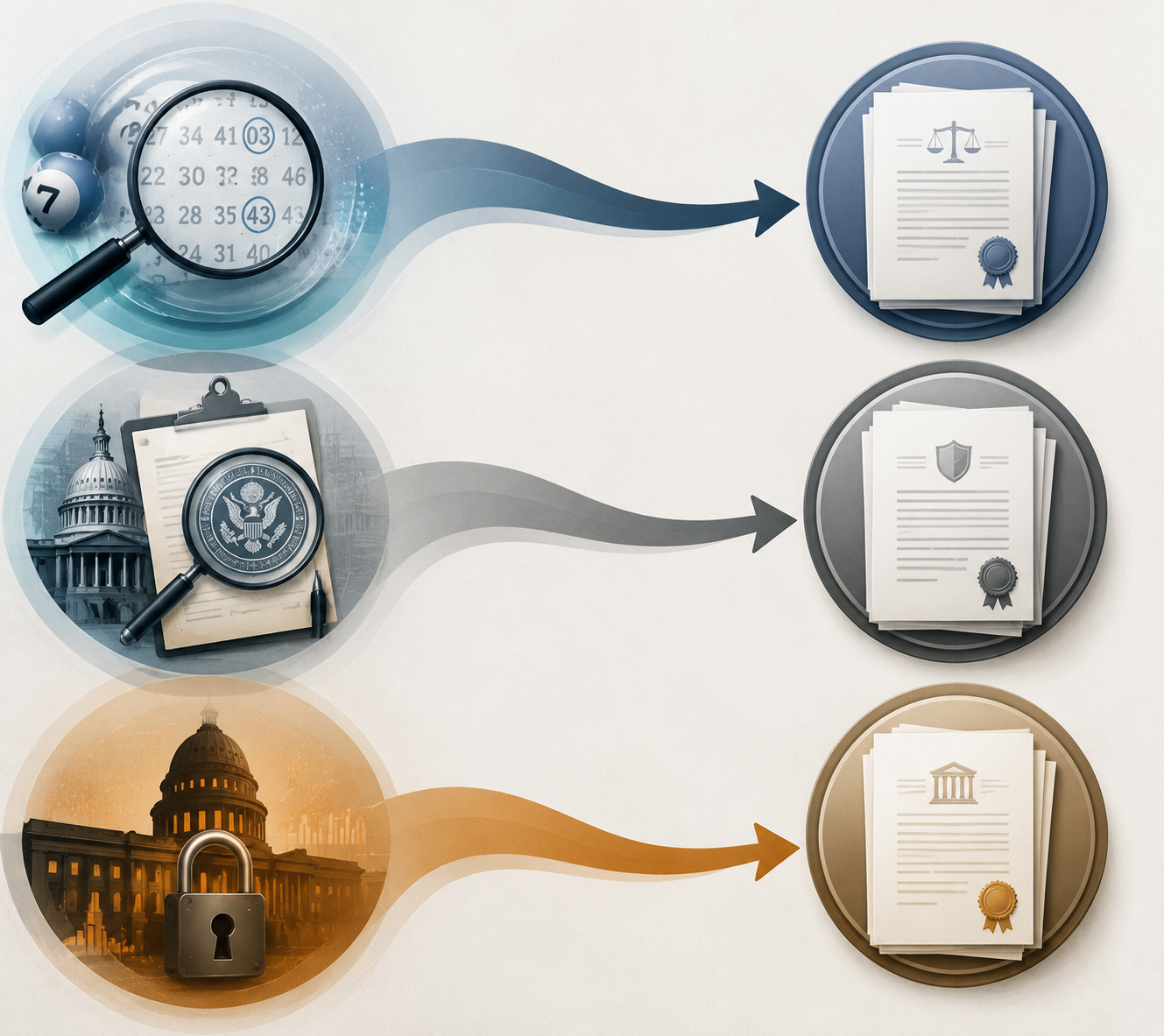
A lawyer looking at a delayed Powerball payment has to separate at least three authority-side situations, plus one separate winner-side scenario, before choosing a theory of liability.
| Delay category | What is being disputed | Likely legal posture |
|---|---|---|
| Lottery authority error | Whether the lottery’s own publication, system, or representation created an obligation to pay | Breach of contract, negligence, fraud in narrower cases, and sometimes emotional distress as a secondary theory |
| Regulatory or legislative investigation | Whether the authority may withhold payment while reviewing how the ticket was bought, claimed, or processed | Claims focused on statutory authority, administrative delay, due process-style objections, and settlement leverage |
| State budget impoundment | Whether the claimant’s entitlement is blocked by government funding or appropriation limits rather than ticket validity | Contract, statutory-payment, class-action, and state-law remedies shaped by sovereign immunity and budget law |
| Winner-side strategic delay | Whether the claimant waited before filing or completing a claim | Usually deadline, documentation, tax, anonymity, or estate-planning advice rather than a refusal-to-pay lawsuit |
The last category deserves only a brief place here. A winner who has not yet submitted a claim faces a different set of problems from a claimant who has submitted one and is being held up by the lottery authority. Deadline frameworks and emergency filing triage belong in resources such as State-by-State Rules for Lottery Prize Expiration Deadlines and Legal Tips for Last-Minute Lottery Prize Claims. They help identify whether a claim exists in the first place. They do not answer what happens when the state accepts the claimant into the process and then refuses or delays payment.
What Claimants Usually Plead
Breach of contract is the cleanest theory when the claimant says the lottery made an enforceable promise. In a standard winning-ticket case, the asserted contract may be built from the ticket, the published rules, draw procedures, and prize-payment regulations. In an error-display case, the claimant’s harder job is showing that a website, posting, or representation was more than information — that it created a payment obligation despite lottery rules that may reserve final authority to certified draw results.
Negligence fits a different part of the story. It asks whether the lottery or its contractor owed a duty in operating the system, whether it breached that duty, and whether the breach caused legally recoverable harm. Administrative sloppiness alone is not enough. The claimant still has to connect the error to a recognized injury, and public lotteries often have statutory defenses, claims-notice rules, or immunity arguments that private defendants do not.
Fraud is more demanding. A claimant generally has to allege a false representation, knowledge or recklessness as to falsity, intent to induce reliance, actual reliance, and damages. A mistaken posting can be humiliating or costly without being fraudulent. The theory becomes more plausible only if the claimant can point to conduct that looks knowing, reckless, or intentionally misleading rather than merely wrong.
Emotional distress claims sit further out. Delayed wealth can disrupt a claimant’s life in obvious ways, but frustration, embarrassment, and financial uncertainty do not automatically satisfy the standards for negligent or intentional infliction of emotional distress. Those claims tend to need conduct and harm beyond ordinary payment delay.
Cheeks Shows the Appeal and the Instability of an Error-Display Case
John Cheeks’ lawsuit against Powerball and the D.C. Lottery is the fact pattern that makes delayed-payment disputes feel simple at first glance. Public reports in early 2024 described his claim that numbers appearing on the lottery website matched the numbers on his ticket for a Powerball drawing, and that he later sued after being told he was not the jackpot winner. The reported amount at issue was $340 million, and the claims reported included breach of contract and fraud theories.[1][2][3]
As a human story, it is vivid: a person checks an official-looking source, believes the transaction has resolved in his favor, and then learns that the institution will not honor what he saw. As precedent, it is not yet the thing many headlines want it to be. The cited public reports described a lawsuit, not a final merits ruling or a confirmed settlement.[1][2][3]
That distinction controls the legal weight of the case. A filed complaint can identify viable theories, preserve evidence, and pressure defendants to explain how the error occurred. It does not establish that a website display overrides certified draw procedures, that reliance was legally reasonable, or that a lottery authority committed fraud. Those questions depend on the governing D.C. lottery rules, the exact website language, the role of any contractor, and the court’s view of whether an erroneous publication can become an enforceable promise.
The Cheeks pleadings also reportedly invoked an Iowa erroneous-winner example, but that kind of citation has to be handled carefully. A case from another jurisdiction may help frame an argument. It does not bind a D.C. court. Lottery statutes are state-specific, and the authority to correct errors is often written directly into the rules that players are deemed to accept.
Moriarty Is the Practical Center, But Not a Merits Ruling
Kristen Moriarty’s Texas dispute is more concrete because it produced payment pressure and a reported full cash-value settlement. Public reporting and law-firm commentary described an $83.5 million settlement in August 2025 after a delayed prize payment connected to scrutiny of a courier-purchased lottery ticket and broader review of Texas Lottery practices.[4][5]
The posture matters. This was not a court announcing that every courier-related delay is unlawful. It was a settlement. Settlements can reflect litigation risk, political pressure, agency exposure, evidentiary problems, public scrutiny, and the cost of continued nonpayment. They can also reflect a claimant’s strong factual position. They do not, by themselves, decide what the law requires in the next case.
Moriarty is still important because it shows where leverage may exist. If the claimant has a facially valid winning ticket, if the delay is caused by institutional uncertainty rather than a defect in the ticket itself, and if the authority’s investigation stretches beyond what its rules clearly authorize, the claimant’s lawyer has more to work with than outrage. The case can be framed around the agency’s power to suspend payment, the procedures used to investigate, the timeline of communications, and the harm caused by keeping prize money out of the claimant’s hands.
Courier involvement complicates that analysis. A lottery authority has a legitimate interest in confirming that tickets were lawfully purchased, that no prohibited actor participated, and that the claim complies with state rules. Regulatory review is not automatically wrongful just because it delays payment. The claimant’s best argument is not that investigation is forbidden; it is that the authority used investigation as an open-ended hold after the conditions for payment had been satisfied.
That is why Moriarty should be treated as persuasive evidence of settlement leverage, not as controlling law. It tells future claimants that a delayed-payment dispute can become expensive and politically difficult for a lottery authority when the agency cannot identify a clean rule-based reason for nonpayment. It does not tell a court in another state how to read that state’s Powerball rules, courier statutes, sovereign-immunity provisions, or administrative remedies.
Budget Impoundment Is a Different Kind of Delay
The Illinois budget impoundment episode belongs in the same conversation only if its limits are kept visible. In 2015, Illinois Lottery winners were reportedly issued IOUs or faced delayed payments because of the state budget impasse, and a class action followed over unpaid prizes.[6]
That is not an erroneous-number case. It is not primarily a courier-investigation case. The bottleneck was the state’s payment machinery. For claimants, that distinction can be maddening because the result is the same — the state does not pay when expected. For lawyers, it changes the argument. The fight shifts from whether the claimant won to whether the government may delay disbursement because of appropriation, budget authority, or payment-processing constraints.
The Illinois example is useful because it shows that a valid prize claim can be obstructed by something outside the drawing process. It is less useful as a current prediction tool. The episode was tied to a particular state budget crisis in 2015, and budget law is unusually dependent on state constitutional structure, appropriations practice, and statutory waiver rules.[6]
How the Delay Category Changes the Likely Lawsuit
In a lottery-authority-error case, the claimant’s lawyer will usually press hardest on representations. What exactly did the official site say? Was the posting public-facing or internal? Did the claimant see it before any correction? Did the rules reserve final authority to certified results? Did the agency or contractor know the information was wrong before leaving it available? The answers decide whether the case sounds in contract, negligence, fraud, or only public-relations damage.
In an investigation-delay case, the timeline becomes central. The claimant has to show more than impatience. Useful facts include when the claim was submitted, what documents were requested, whether the claimant complied, what rule authorized the hold, whether the authority gave reasons, and whether similarly situated claimants were treated differently. A delay that is short, explained, and tied to verification looks very different from a delay that continues after the authority has the documents it says it needs.
In a budget-impoundment case, the claimant may have the least dispute over entitlement and the most difficulty getting a fast remedy. The lottery may not be denying that the claimant won. It may be saying that payment cannot move through the state system yet. That posture can support collective litigation or statutory-payment arguments, but it also invites defenses rooted in sovereign immunity, appropriations limits, and the mechanics of suing a state.
Winner-side delay should not be collapsed into any of those categories. If a claimant waits to come forward for privacy, tax, estate, or safety reasons, the central risk is usually expiration or failure to satisfy claim procedures. Once the deadline is missed, the claimant is not ordinarily arguing that the lottery delayed payment after a valid claim; the claimant is arguing about whether a valid claim was ever perfected.
The Procedural Defenses Are Not Technicalities
Lottery authorities are not ordinary counterparties. They operate under statutes and regulations that define how tickets are validated, how errors are corrected, who may claim, when prizes expire, and what records control. A claimant who treats the dispute as a simple broken promise can miss the agency-law defenses that may decide the case before a jury ever hears about unfairness.
- Validation rules: the authority may argue that only certified draw results and validated tickets create payment obligations.
- Error-correction provisions: many lottery systems reserve the ability to correct erroneous postings, displays, or communications.
- Claims-notice requirements: a claimant suing a public entity may need to satisfy state notice rules before filing.
- Sovereign immunity: damages claims against a state or lottery commission may be limited unless immunity has been waived.
- Administrative exhaustion: some disputes may have to move through agency procedures before reaching court.
Those defenses do not make delayed payment harmless. They do mean that the claimant’s best facts have to be matched to the right cause of action and the right forum. A strong public narrative can still fail if the governing rules say the publication was nonbinding, the claim was not perfected, or the agency had statutory authority to pause payment.
What Recent Cases Actually Predict
The recent cases point to a cautious prediction. A claimant has the most plausible lawsuit when agency conduct supplies a concrete obstruction: a public-facing error that induced reliance, an investigation that outlasted its stated justification, or a payment hold caused by government machinery rather than the claimant’s failure to comply.
Cheeks helps identify the claims a plaintiff may plead after an alleged lottery publication error, but its publicly reported status does not support treating it as an adjudicated win for claimants.[1][2][3] Moriarty supplies the strongest recent claimant-side outcome because it ended in a reported full cash-value settlement, but that strength is practical rather than precedential.[4][5] Illinois shows that even undisputed prize entitlement can be delayed by state payment capacity, though its 2015 budget setting limits how far it can be generalized.[6]
For lawyers advising claimants, the first task is not to announce that the lottery breached the law. It is to build the chronology: purchase, publication, claim submission, agency response, rule cited, documents requested, investigation milestones, and payment decision. The second task is to test that chronology against the lottery’s enabling statute and claim regulations. Only then does the label — contract, negligence, fraud, emotional distress, statutory payment, or administrative challenge — become more than pleading language.
Delayed-claim lawsuits are therefore most plausible where the claimant can point to specific agency conduct that caused the nonpayment. They remain fact- and jurisdiction-dependent. The strongest recent claimant success is evidence that a lottery authority may settle under pressure when its payment hold becomes difficult to defend; it is not a binding rule that delayed Powerball claimants are entitled to judgment.
References
- DC man sues Powerball, DC Lottery after apparent website error says he won $340M, NBC Washington, 2024.
- Powerball: Man sues lottery after website error shows $340m win, BBC, 2024.
- A D.C. man thought he won a $340 million Powerball jackpot. The lottery says otherwise, NPR, 2024.
- Texas Lottery settles $83.5 million jackpot lawsuit, The Texas Tribune, August 2025.
- Texas Lottery Commission Settles $83.5 Million Lottery Jackpot Lawsuit, Howry Breen & Herman, 2025.
- Illinois Lottery winners sue state over IOUs, Illinois Policy, 2015.
Comments
Join the discussion with an anonymous comment.