
The legal problem starts before anyone argues about prison architecture: swamp, wildlife, and heat are being treated as if they were ordinary security devices.
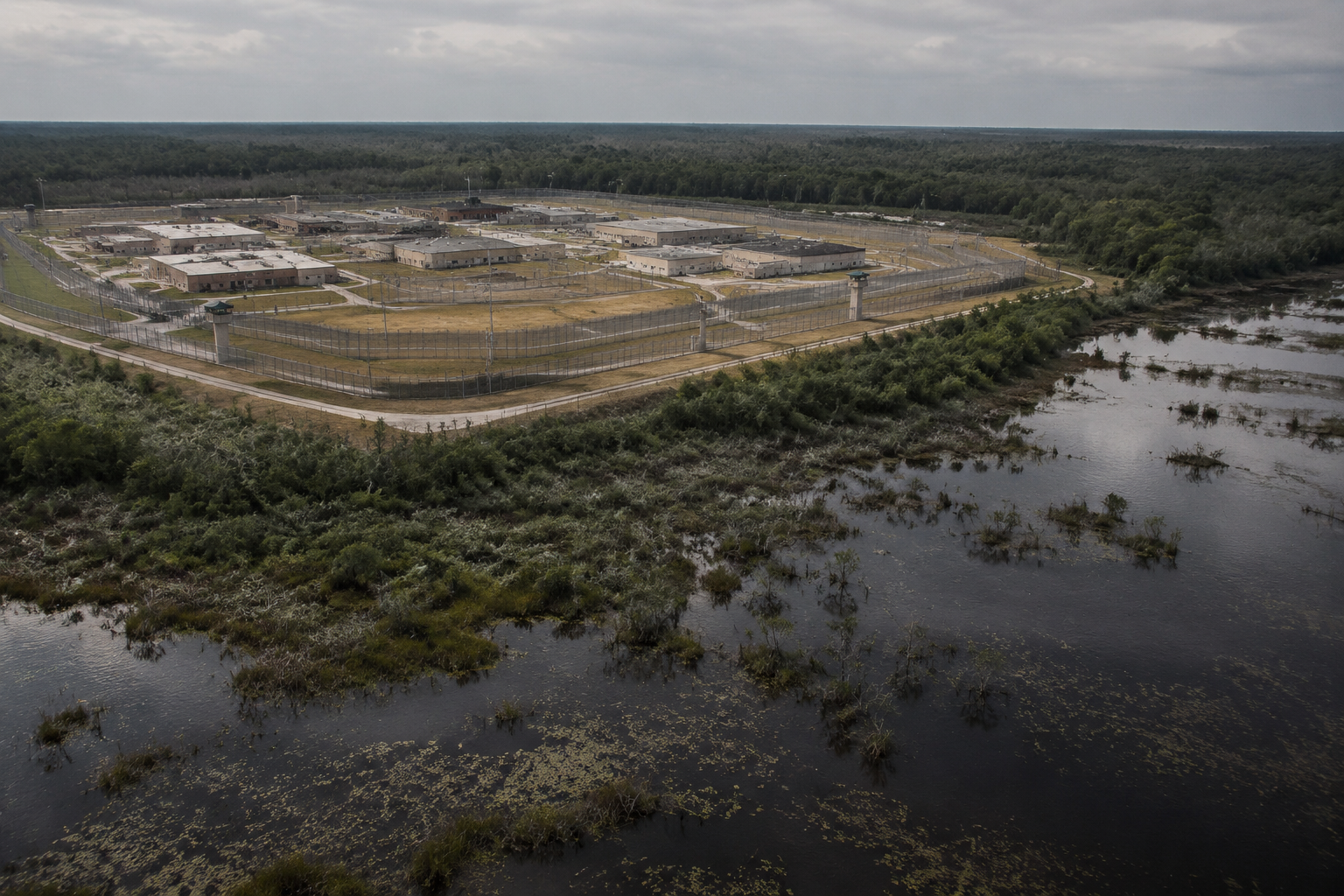
Florida had to answer the counsel question first
In H.C.R. v. Noem, a federal court granted preliminary injunctive relief in March 2026 requiring ICE to provide confidential legal calls and attorney access for people held at Alligator Alcatraz.[1] That is the point where the animal-security concept stops being a theatrical image and becomes a due process injury: if counsel cannot reach the client confidentially, the state has turned access to law into a facility-managed privilege.
Amnesty International's December 2025 report, Torture and Enforced Disappearances in the Sunshine State, described conditions including a 2-by-2-foot outdoor punishment 'box' and concluded that the conditions amounted to torture under the UN Convention Against Torture.[2] The report matters because it shifts the dispute away from the lurid animal branding and back to the actual mechanics of confinement: isolation, exposure, punishment space, and a detention design that makes harshness part of the infrastructure.
A January 24, 2026 law review article, Alcatraz in the Everglades: A Legal and Humanitarian Crisis, treated the facility as a convergence problem rather than a single-issue immigration dispute.[3] That reading fits the record. Once the legal system is asked to analyze the site, the questions multiply across access to counsel, conditions of confinement, administrative authority, and the basic legitimacy of using remoteness as a substitute for lawful detention design.
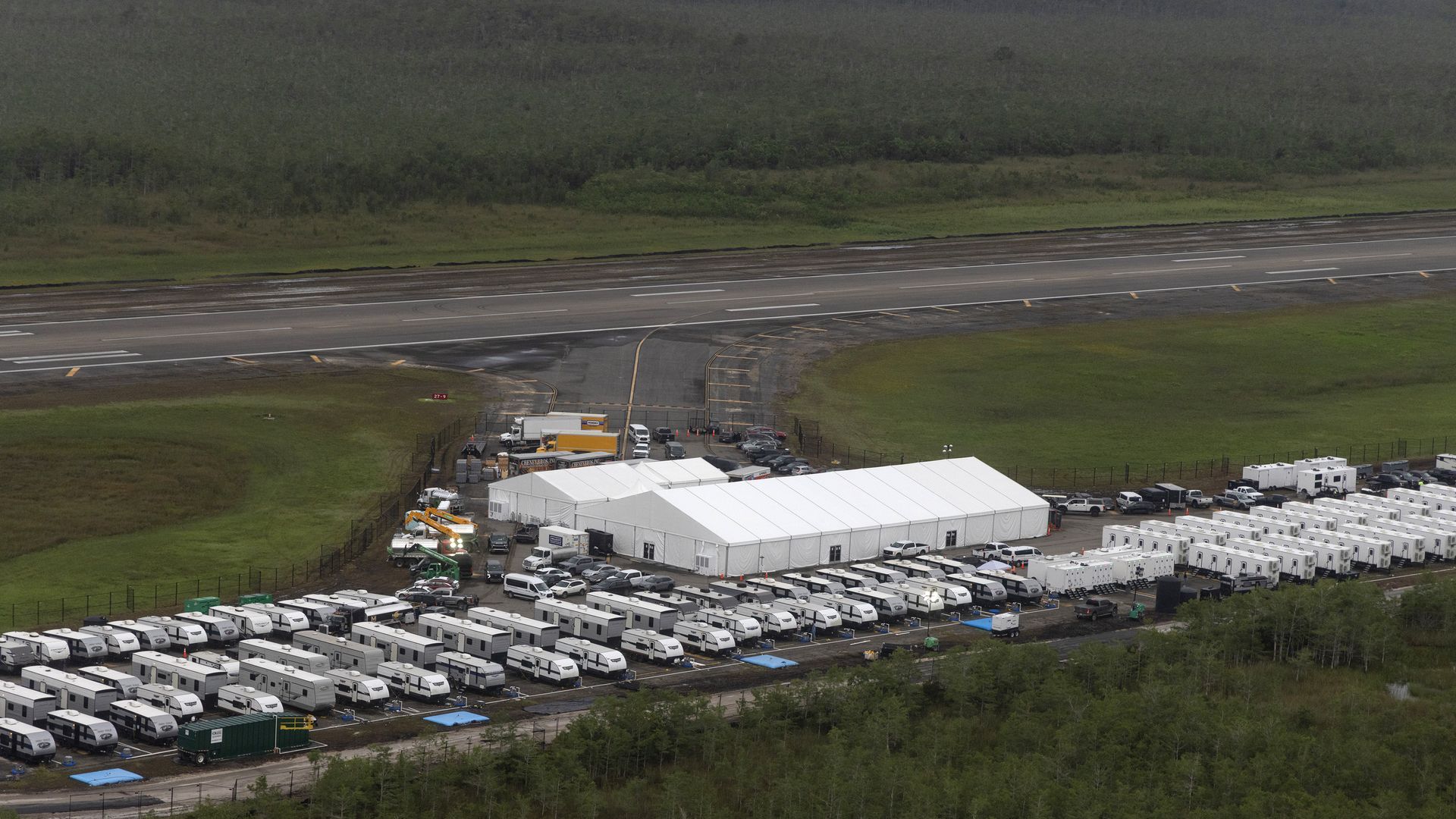
Environmental law did not disappear at the fence line
The environmental cases did not treat the site as exempt because it was framed as emergency security infrastructure. In Friends of the Everglades v. Noem, the Eleventh Circuit held NEPA did not apply because the facility was not 'federally controlled,' making the case the first circuit ruling to interpret the 2023 NEPA amendments.[4] The result was narrower than a full vindication of the project: control mattered, and the government's labels could not do all the work once the administrative record was tested.
A separate Clean Air Act suit, Center for Biological Diversity v. Florida, targeted unpermitted diesel generator emissions at the site and sought civil penalties of up to $124,426 per day.[5] That claim is useful precisely because it is unglamorous. Detention sites still emit, consume fuel, and generate regulated externalities even when officials describe them as temporary or exceptional.
Public reporting on the project also varied enough to deserve careful attribution. One reference summary put the total cost at $1.2 billion, while internal data cited in press reporting suggested that nearly 70% of detainees had not received final removal orders.[6] Those figures do not decide the legality of the site, but they do explain why the controversy moved beyond symbolism: the facility was expensive, and a large share of the people inside were not there after final deportation orders.
Israel showed the same defect before construction hardened
Israel's July 16, 2026 move to reclassify Nile crocodiles as 'managed wild animals' was meant to clear a legal path for a crocodile-moat prison proposal.[7] But the Ministry's legal adviser, Neta Drori, warned that there was 'insufficient scientific or legal evidence to justify implementing the plan' and that there was no modern precedent for it.[7] That warning matters because it came before any completed project could accumulate the usual defenses of built facts, sunk costs, or operational necessity.
The Nature and Parks Authority opposed the plan as well, pointing to Israel's earlier crocodile-farming experience, which ended after animals escaped into the wild and created public safety risks.[8] That objection is not a reaction to the image of crocodiles in the abstract. It is a conservative institutional judgment that the supposed perimeter device is neither stable nor obviously safe.
The substitution problem is the legal problem
The common defect is not that every animal-adjacent prison feature is automatically unlawful. It is that dangerous animals, hostile terrain, and improvised environmental conditions are being asked to do the work of detention infrastructure, and that substitution invites overlapping objections that do not disappear when the state changes the label. In Florida, the facility was operational, litigated, and forced to answer for access to counsel, humane treatment, environmental review, and regulated emissions. In Israel, the warning arrived earlier, but the logic was already the same: a crocodile moat is not a legal shortcut around lawful detention safeguards, humane-treatment norms, environmental law, administrative rationality, or the need for a real scientific basis.
References
- H.C.R. v. Noem — ACLU — March 27, 2026
- Torture and Enforced Disappearances in the Sunshine State — Amnesty International — December 2025
- Alcatraz in the Everglades: A Legal and Humanitarian Crisis — Immigration and Human Rights Law Review — January 24, 2026
- Friends of the Everglades v. Noem — Earthjustice — June 26, 2026
- Center for Biological Diversity v. Florida — Center for Biological Diversity — June 17, 2026
- Alligator Alcatraz — Wikipedia
- Israel reclassification of Nile crocodiles as managed wild animals — Middle East Monitor — July 17, 2026
- Israel Nature and Parks Authority opposition to crocodile prison proposal — Politis — July 19, 2026
Comments
Join the discussion with an anonymous comment.