
Kyle Bylin and Jeremy Morrison were born on the same day, January 26, 1988, at Unity Medical Center in North Dakota. Decades later, an AncestryDNA kit given as a Christmas present in December 2023 led to the allegation that the two men had been switched at birth. A lawsuit was filed on July 17, 2026, and the reporting on the complaint notes another complication familiar to anyone who has tried to reconstruct old hospital conduct: records from the period had been destroyed.[1]
That is enough to make an intake lawyer sit forward. It is not enough, by itself, to carry a case. A direct-to-consumer DNA result may explain why a family has just been thrown into crisis, but the legal work begins in the gap between a private genetic genealogy match and evidence a court can rely on.
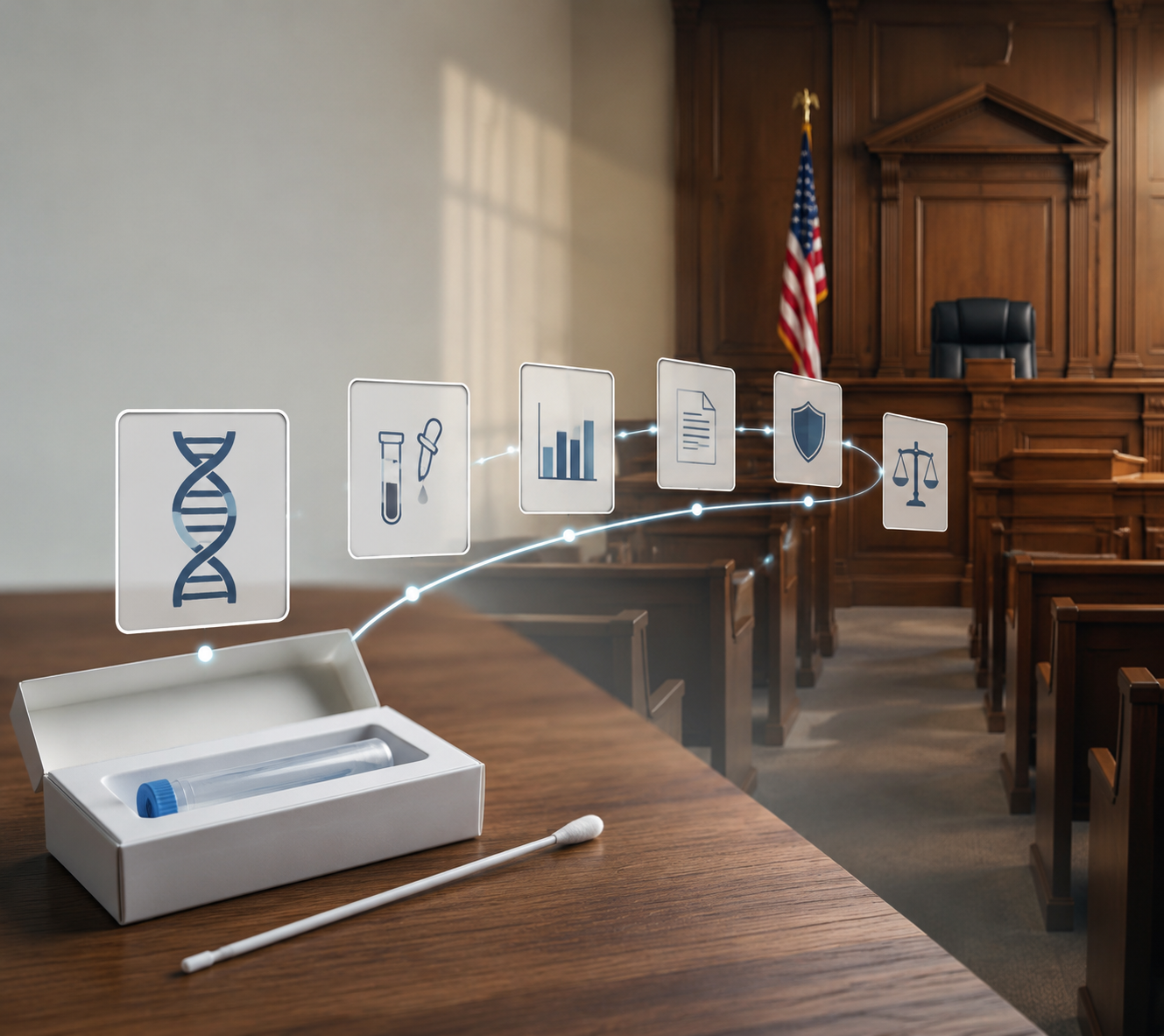
For counsel, the first question behind a switched-at-birth DNA discovery is not whether the story is astonishing. It is whether the client can build a clean evidentiary record, identify a legally cognizable injury, and survive the limitations fight that almost always follows when the alleged switch occurred decades earlier.
The Consumer Test Opens the Door, but It Is Not Courtroom Proof
Consumer genetic testing is often the first credible signal that the family record is wrong. In the North Dakota complaint-stage case, the AncestryDNA result is the plot point that makes the alleged switch discoverable to the families. But litigation cannot stop at the screenshot, match list, or family-tree inference.
The immediate assignment is to preserve what the client has without confusing it with forensic proof. Counsel should collect the client’s account of how the kit was purchased, who used it, what notices or matches appeared, and when each person learned of the possible switch. Those details matter for a later discovery-rule argument. They also help separate the client’s first suspicion from the date counsel obtained legally reliable confirmation.
The next step is a legal DNA test through an accredited process. The protocols described in legal-testing guidance emphasize an AABB-accredited laboratory, neutral witnessed sample collection, government-issued photo identification checks, sealed and signed chain-of-custody paperwork, and delivery of results directly to the court or requesting party rather than through the tested person as an informal intermediary.[2][3]
| Stage | Counsel's Practical Objective |
|---|---|
| Consumer DNA result | Preserve the discovery trail without overstating admissibility |
| Legal DNA testing | Create a witnessed, identity-verified, chain-of-custody record |
| Medical and birth record review | Identify the institution, staff practices, missing records, and possible concealment |
| Claim selection | Match the theory to duty, causation, damages, and available defendants |
| Limitations analysis | Build the discovery-rule, concealment, or independent-duty argument before filing |
The cost and timing are not usually the hardest part. Legal-testing guides place a typical test in the approximate $400 to $800 range, with results often available in 2 to 5 business days.[2] The harder part is sequencing. If the legal test is handled casually after everyone already believes they know the answer, the case may inherit unnecessary authentication and chain-of-custody disputes.
What a Clean Legal DNA Record Should Show
- The laboratory is AABB-accredited or otherwise accepted for the jurisdiction and purpose at issue.
- Each tested person is identified through government-issued photo identification or an appropriate equivalent for a minor or incapacitated person.
- Sample collection is witnessed by a neutral collector rather than performed privately at home.
- Specimens are sealed, signed, tracked, and accompanied by chain-of-custody forms.
- The final report is transmitted in a way that avoids any serious dispute over alteration, substitution, or selective disclosure.
That record does not prove negligence. It proves the biological relationship problem with enough discipline to let the legal questions begin.
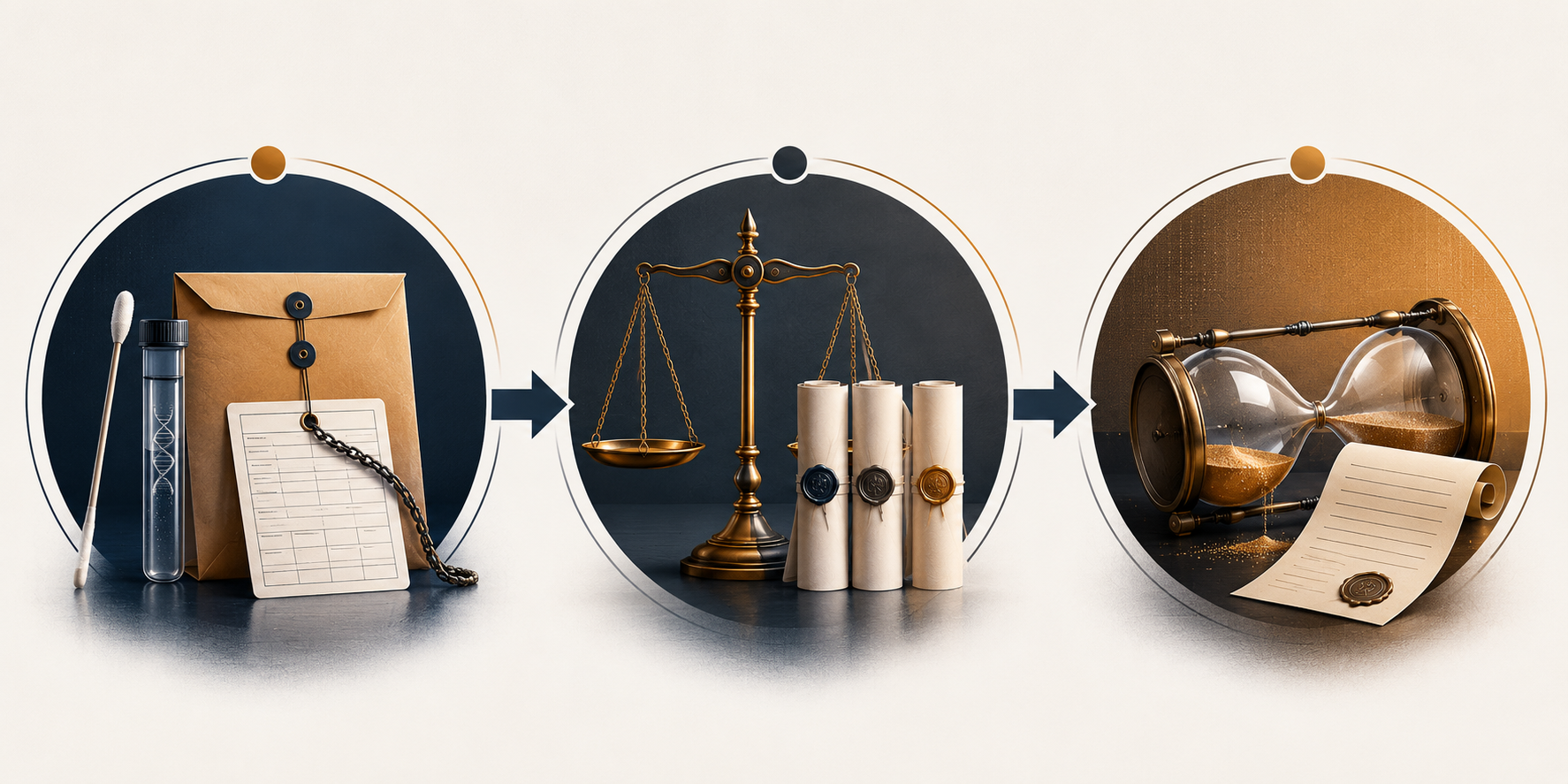
After the Test, the File Becomes a Hospital-Conduct Case
Once legal DNA testing confirms that the family relationships are not what the birth records say, counsel has to move away from the emotional force of the discovery and toward institutional conduct. Who had custody of the newborns? What identification protocols existed? Were bassinets, wristbands, nursery logs, feeding records, or discharge forms used? Which records still exist? Who controlled retention? If records are gone, were they destroyed under a routine policy, destroyed after notice of a possible problem, or simply unavailable because of time?
The North Dakota allegations make the records issue visible because reporting on the complaint says hospital records from the relevant period were destroyed.[1] That fact may become important, but its legal effect cannot be assumed from the outside. Missing records can matter differently depending on retention law, notice, spoliation doctrine, the age of the documents, and whether other circumstantial evidence can reconstruct what happened.
The intake file should also separate three timelines: the date of birth, the date the client first had reason to suspect a switch, and the date legally reliable testing confirmed the biological mismatch. Courts and defendants may not treat those dates the same way.
The Claim Theory Has to Fit the Injury, Not Just the Shock
A birth-switch lawsuit can sound in several theories, but they are not interchangeable labels. Negligence focuses on whether the hospital or other birth facility breached a duty of reasonable care in identifying, handling, and discharging newborns. Medical malpractice may apply when the jurisdiction treats the conduct as professional health-care negligence, with its own presuit, expert, damages, and limitations rules.
Fraudulent concealment asks a different question: whether a defendant knew or had reason to know of the switch and failed to disclose it in a way that should toll limitations or support a separate claim. Intentional infliction of emotional distress requires more than a disastrous mistake; it usually depends on conduct that a court is willing to treat as extreme or outrageous under the governing law.
| Theory | What Counsel Must Be Ready to Prove |
|---|---|
| Negligence | Duty, breach, causation, and damages tied to newborn identification and discharge practices |
| Medical malpractice | A health-care duty and breach under the jurisdiction's professional-negligence framework |
| Fraudulent concealment | Knowledge, nondisclosure or misleading conduct, reliance or delayed discovery, and tolling consequences |
| Intentional infliction of emotional distress | Conduct and harm severe enough to meet the jurisdiction's threshold |
The load-bearing U.S. authority in this area is Larsen v. Banner Health System, a Wyoming Supreme Court decision involving a switched-at-birth claim brought 43 years after the injury. The court allowed the claim to proceed and recognized that a hospital’s duty in this setting can encompass purely emotional harm.[4]
Larsen matters because many switched-at-birth plaintiffs are not claiming a conventional physical injury from the switch itself. The injury is the rupture of identity, kinship, upbringing, medical history, and family relationships. A court that refuses to recognize emotional harm as legally cognizable in this setting can end the case before the evidence about nursery practices receives much attention. Larsen gives plaintiffs a serious answer to that defense, though it remains a Wyoming appellate decision rather than a universal rule.[4]
The Limitations Fight Is Usually the Real Merits Fight
In an ordinary medical-negligence file, the date of injury and the date of filing are close enough that limitations analysis may be hard but familiar. In a switched-at-birth file, the alleged negligent act may have occurred 20, 40, or 60 years before the client learned anything was wrong. That makes timeliness the issue that can decide the case before a jury ever hears about the nursery.
Larsen again supplies the important legal pathway. The Wyoming Supreme Court applied the discovery rule in a birth-switch setting, allowing the claim despite the 43-year delay between the switch and the lawsuit.[4] The point is not that every old switch case is timely. The point is narrower and more useful: a court can treat discovery of the injury as the relevant trigger where the nature of the wrong made earlier discovery unrealistic.
Counsel should build that argument before filing, not after the motion to dismiss arrives. The complaint and supporting record need to explain when the plaintiff first learned facts inconsistent with the recorded family relationship, why earlier discovery was not reasonably possible, and what steps the plaintiff took after suspicion arose. The consumer DNA result may be central to that chronology even if it is not the final admissible test.
Discovery Rule, Concealment, and Independent Duty
The discovery-rule argument asks when the plaintiff knew or reasonably should have known of the injury and its possible cause. In a birth-switch case, that often means distinguishing vague family oddities from actionable notice. A lifetime of looking unlike one’s relatives is not the same thing as a verified genetic mismatch traceable to a birth facility.
Fraudulent concealment is more demanding and, when supported, more pointed. The 2024 Norway case illustrates why. Two women switched in 1965 alleged that Norwegian health authorities knew by 1985 but did not disclose the switch until 2021.[7] That kind of fact pattern is not just late discovery; it raises the possibility that the institution’s own nondisclosure prevented timely suit.
An independent-duty argument may also matter where the plaintiff alleges that the defendant had a continuing or separate obligation to disclose information once it learned of the switch. The strength of that argument depends heavily on jurisdiction, the defendant’s knowledge, statutory duties, and the relationship between the parties.
Practitioners should be careful with quick limitations charts. A Super Lawyers state-by-state reference on paternity challenges shows wide variation, from a 1-year limit in Oregon to no stated limit in Georgia, Rhode Island, and Washington.[5] That is useful as a warning about family-status variability, not as a substitute for researching medical-malpractice, negligence, fraud, and repose rules in the governing jurisdiction.
Prevalence Claims Should Stay Modest
The public imagination tends to treat switched-at-birth cases as either urban legend or hidden epidemic. The available material supports neither extreme. A DDC blog post reported 8 documented switched-at-birth incidents in the United States between 1995 and 2008, while also estimating that up to 500,000 babies per year were at potential risk of going home with the wrong parent.[6]
Those figures should not be merged. The 8 incidents are documented cases in a defined period. The 500,000 figure is a theoretical exposure estimate from a commercial DNA-testing company’s blog, not a documented incidence rate. For pleading and settlement purposes, counsel is better served by proving what happened in this hospital, to these families, under these identification procedures.
International Cases Reinforce the Discovery Pattern, Not a Single Rule
The fact pattern is not uniquely American. The Norway matter involving women switched in 1965 and disclosure decades later underscores the role of institutional knowledge and delayed discovery.[7] A Spanish case reported by the BBC involved court-ordered DNA testing when the person was 16.[8] These examples are useful because they show how the same human injury tends to surface through later testing, official records, or institutional disclosure.
They should not be used as shortcuts. Different legal systems answer duty, damages, and limitation questions differently. Their real value for a U.S. intake file is factual: switched-at-birth claims often become visible only after the people harmed have lived for years inside the wrong family history.
What Makes the Case Litigable
A viable switched-at-birth file usually has more than a stunning DNA result. It has a legally collected genetic test, a documented discovery chronology, a plausible institutional defendant, a theory that fits the injury, and a limitations argument that has been treated as part of the case from the first interview.
The North Dakota lawsuit is important because it is current, concrete, and painfully ordinary in its point of origin: a holiday DNA kit that exposed a life-altering allegation. It is still a complaint-stage case, not precedent.[1] Larsen carries more legal weight for now because it shows an appellate court allowing a decades-old switched-at-birth claim to proceed and recognizing emotional harm within the hospital’s duty.[4]
The practical sequence is unforgiving. Preserve the consumer-DNA discovery trail. Obtain legal DNA testing with witnessed collection and chain of custody. Investigate the birth facility’s records and practices. Select the claim theory with attention to damages and proof. Then plead timeliness as a central issue, grounded in discovery, concealment, or an independent duty where the jurisdiction allows it.
A switched-at-birth DNA discovery is not self-executing evidence, and it is not automatically a timely lawsuit. It can become a litigable case when counsel turns the discovery into admissible proof, chooses a theory that matches the harm, and gives the court a disciplined reason to hear a claim that could not realistically have been brought earlier.
References
- ABC News wire story and NBC Bay Area reporting on the Bylin/Morrison North Dakota switched-at-birth lawsuit, ABC News and NBC Bay Area, July 2026.
- Legal DNA testing guide, Fastest Labs.
- Genetic testing and parentage self-help guide, California Courts.
- Larsen v. Banner Health System, Wyoming Supreme Court, 2003, LSU Law Center biotech case archive.
- State-by-state paternity limitations table, Super Lawyers.
- DDC switched-at-birth incidents and potential-risk discussion, DDC, 2017.
- Norway switched-at-birth case reporting, 2024.
- Spanish switched-at-birth case involving court-ordered DNA testing, BBC, 2021.
Comments
Join the discussion with an anonymous comment.